-
-
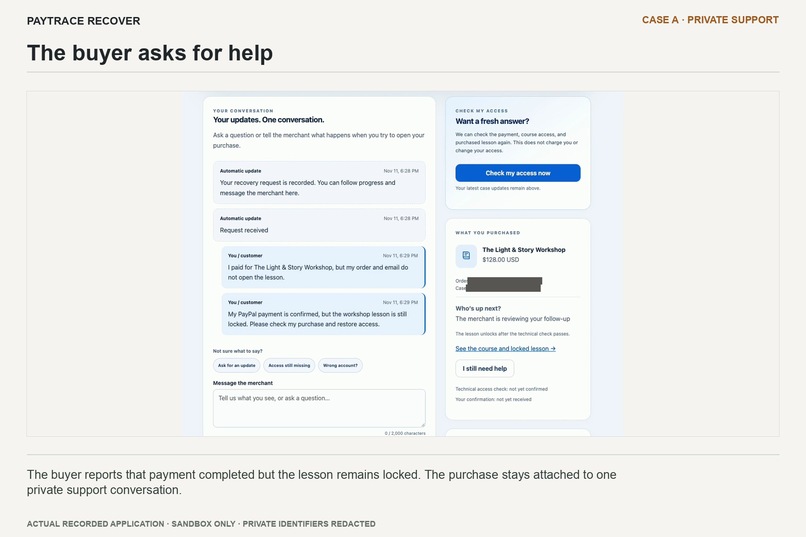
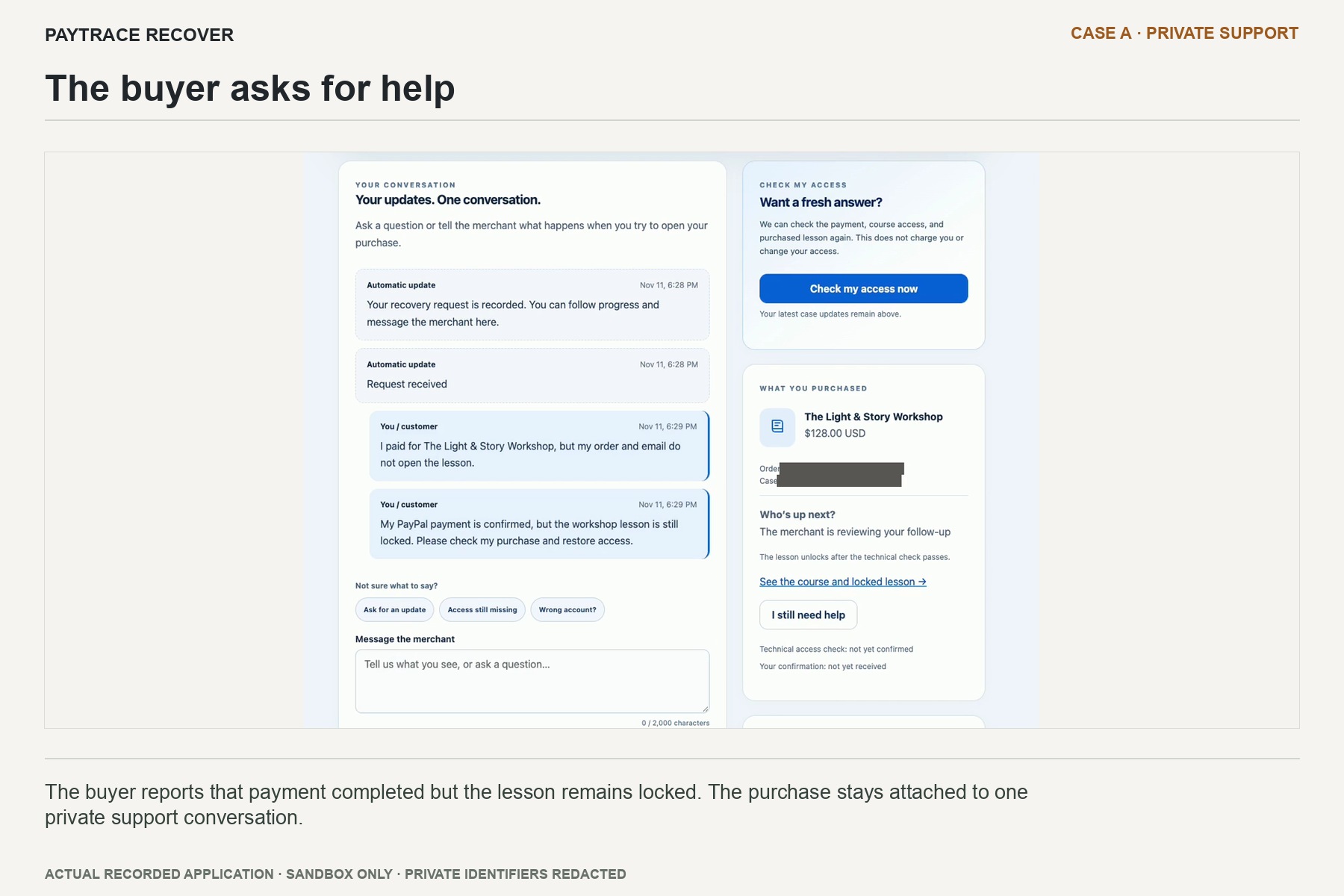
The learner reports a locked lesson through a private support conversation linked to the purchase.
-
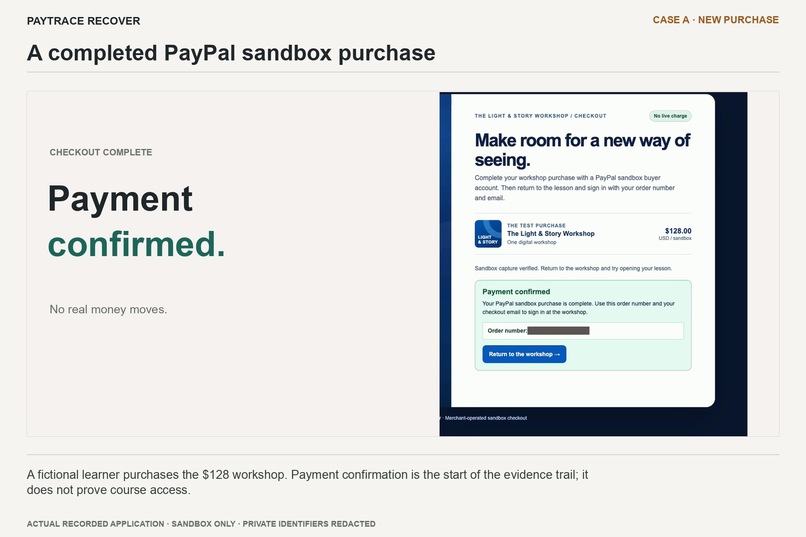
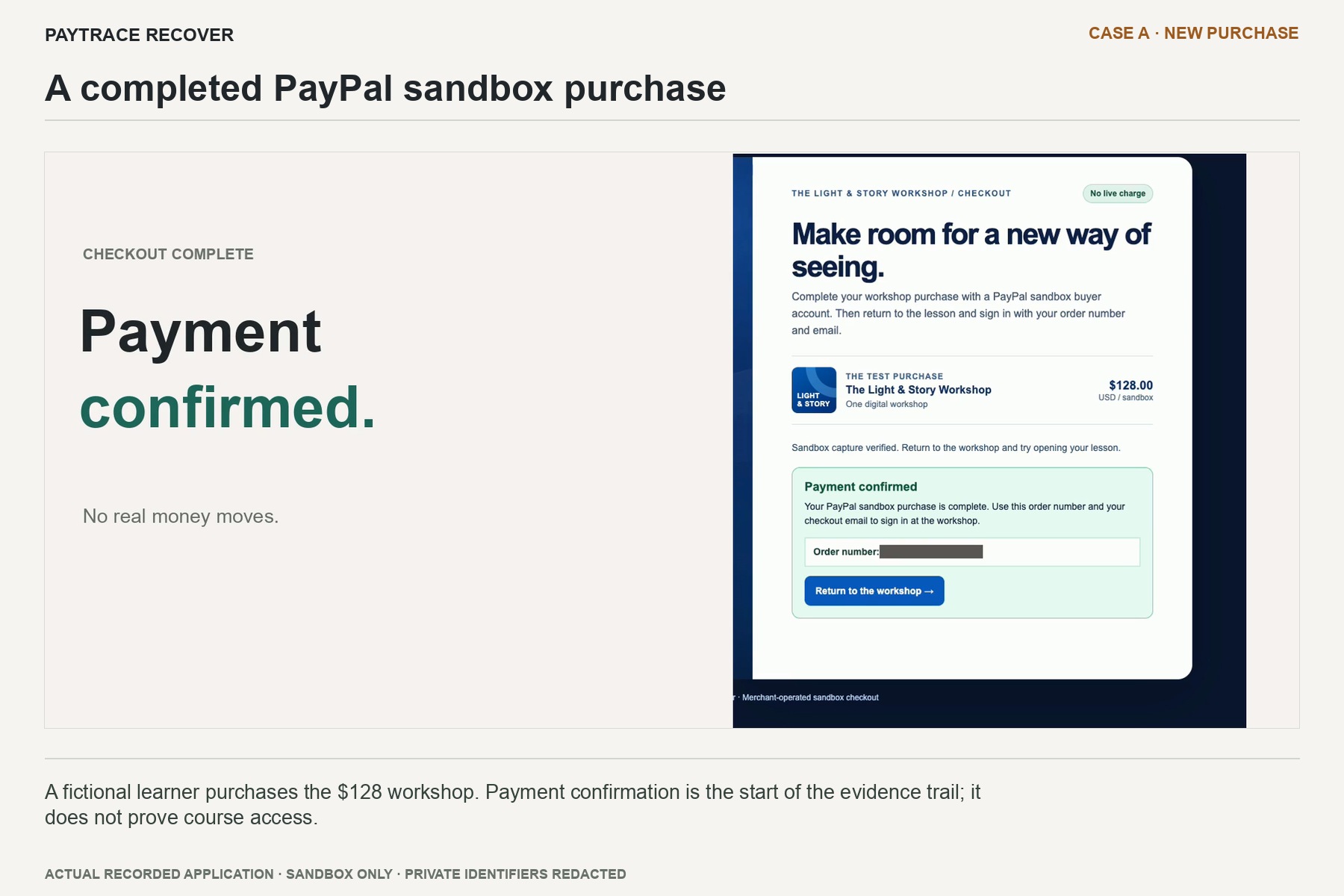
A completed $128 PayPal sandbox purchase starts the evidence trail. Payment confirmation does not prove course access.
-
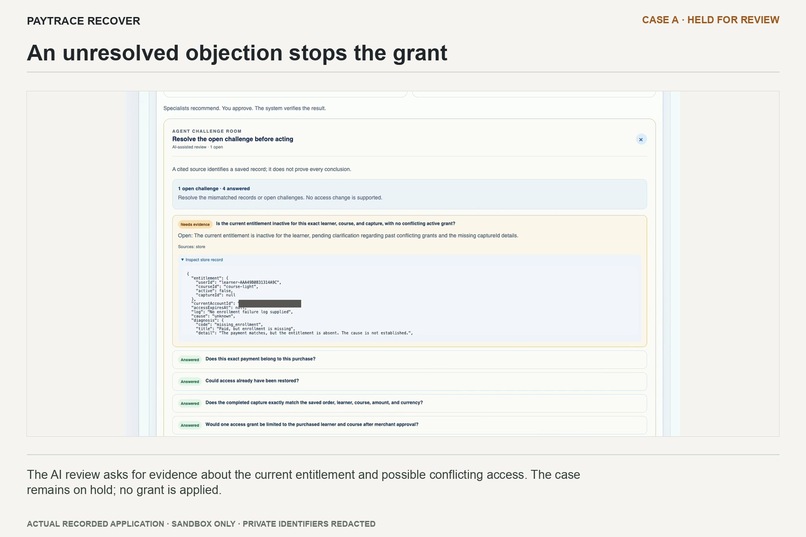
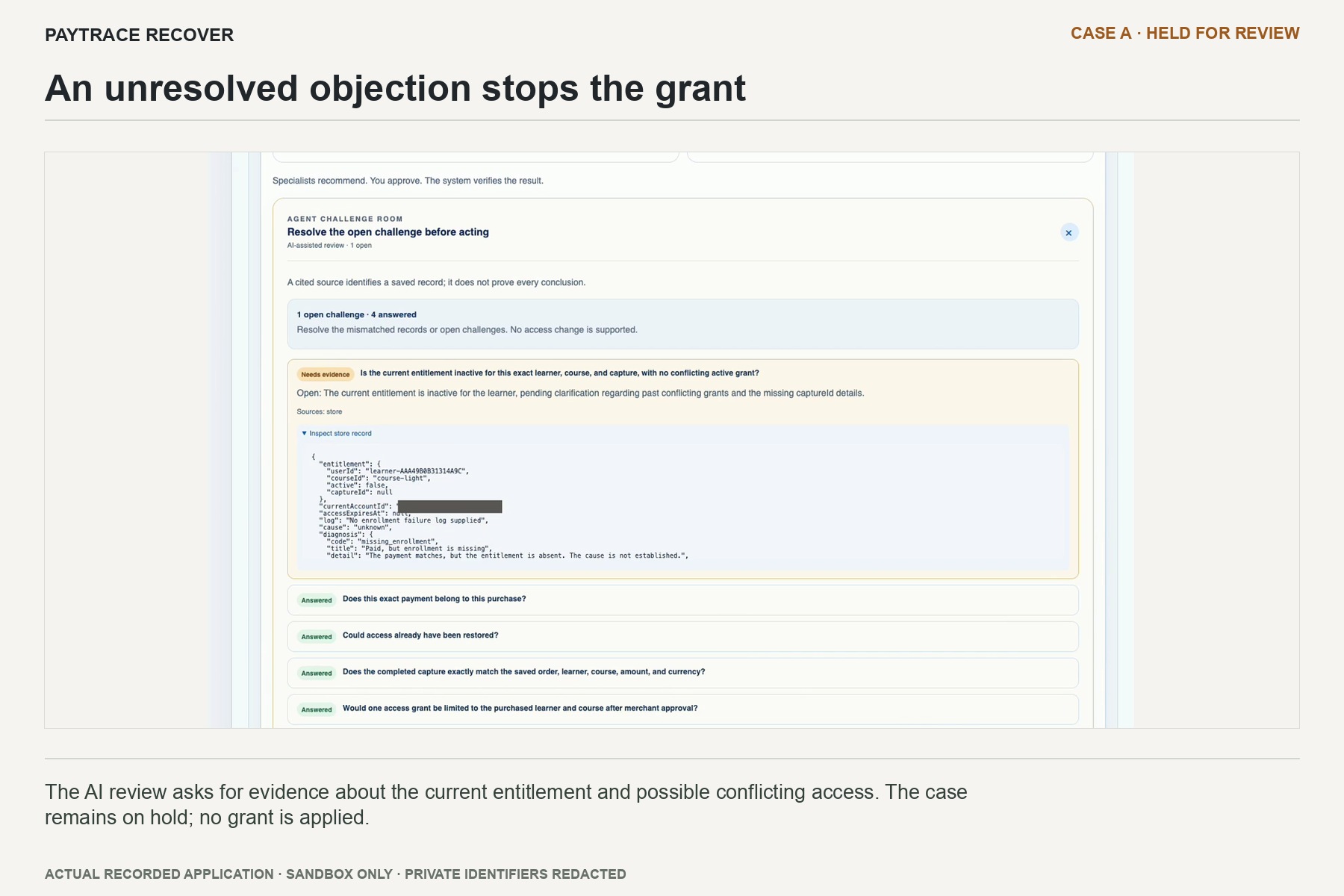
An unresolved access-history objection keeps the new case on hold. No grant is applied.
-
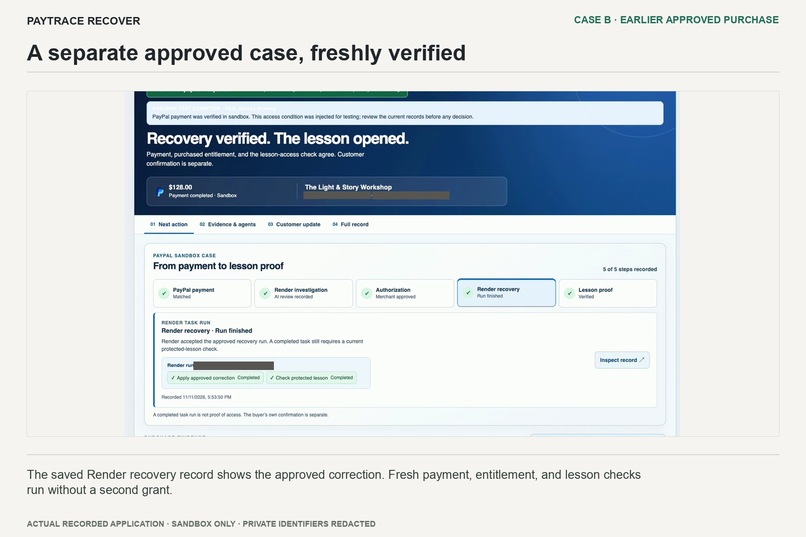
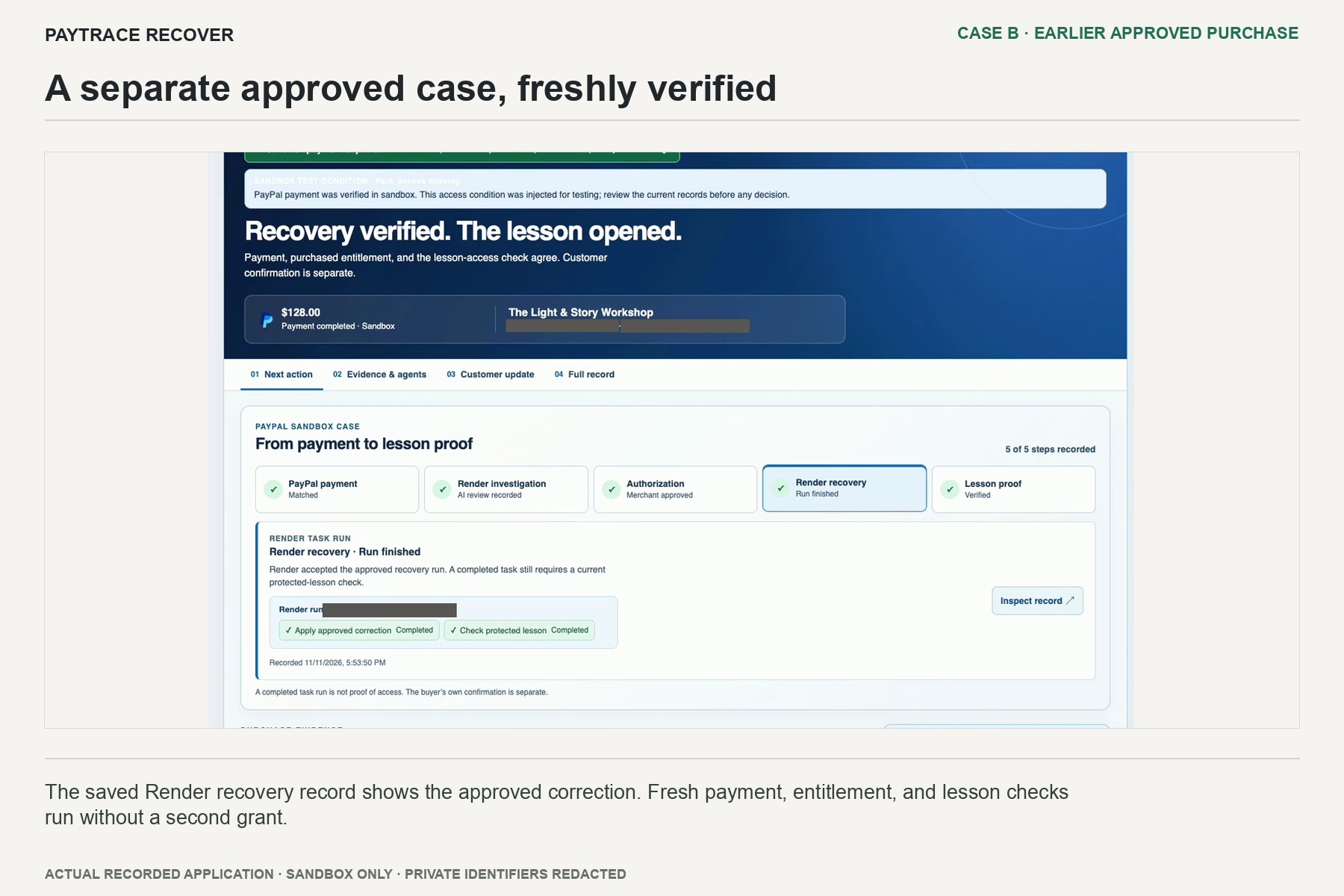
A separate, earlier-approved case shows its saved Render recovery record and fresh checks without a second grant.
-
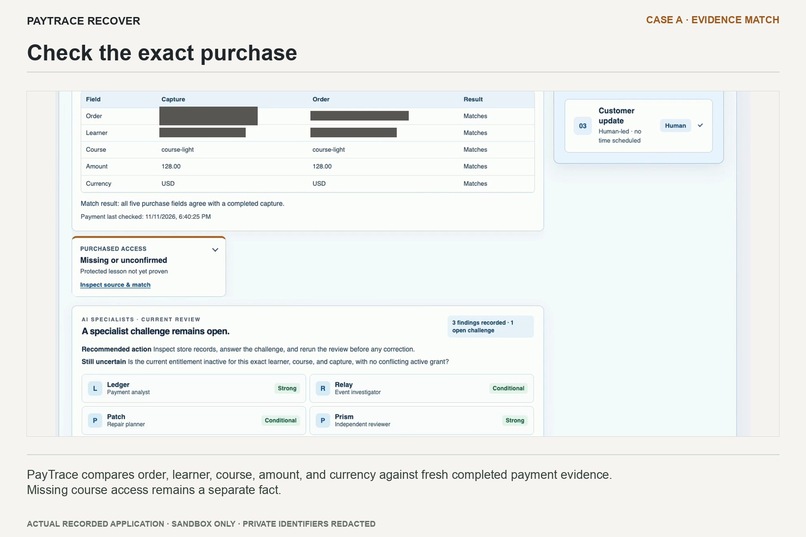
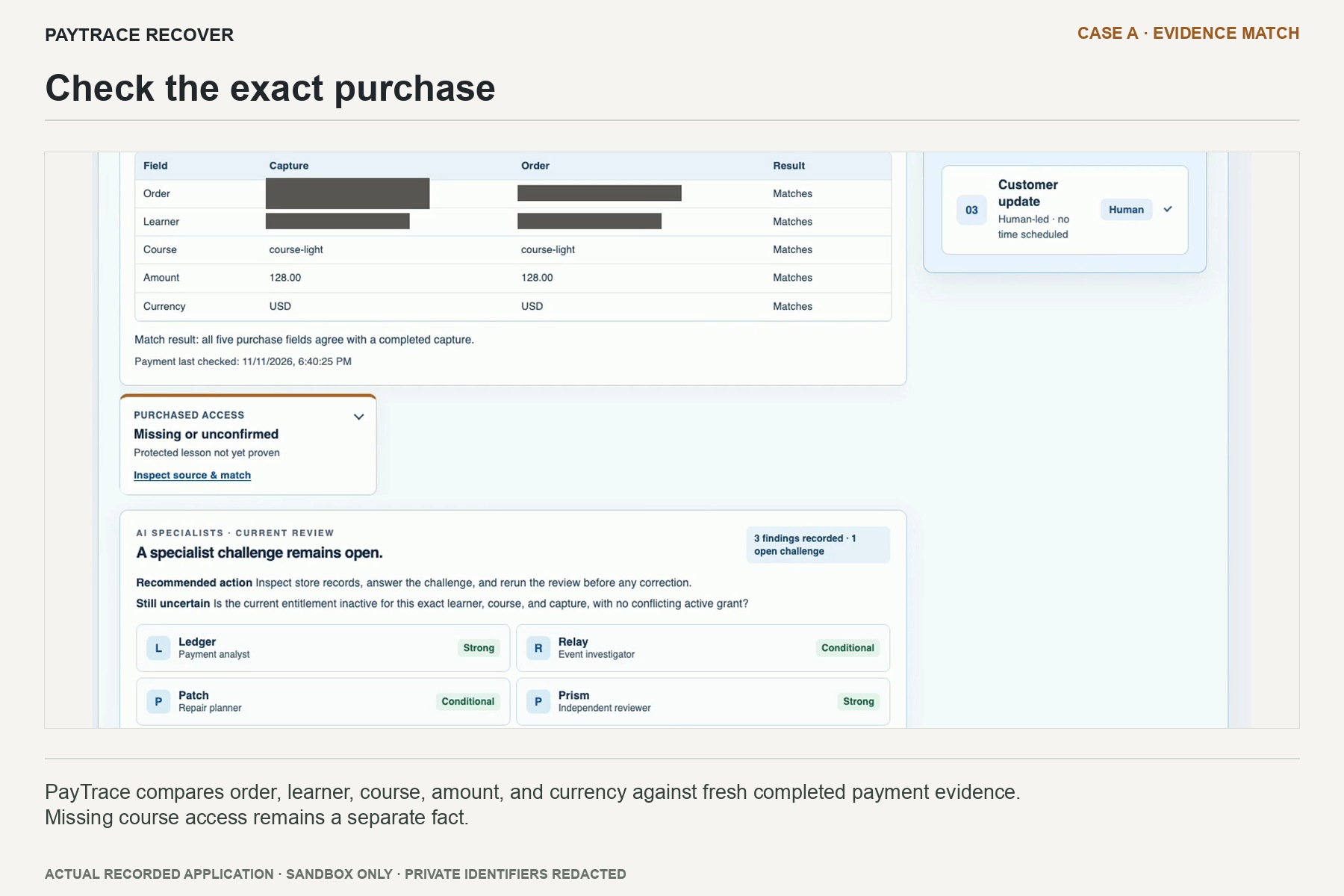
PayTrace checks the order, learner, course, amount, and currency against fresh completed-payment evidence.
-
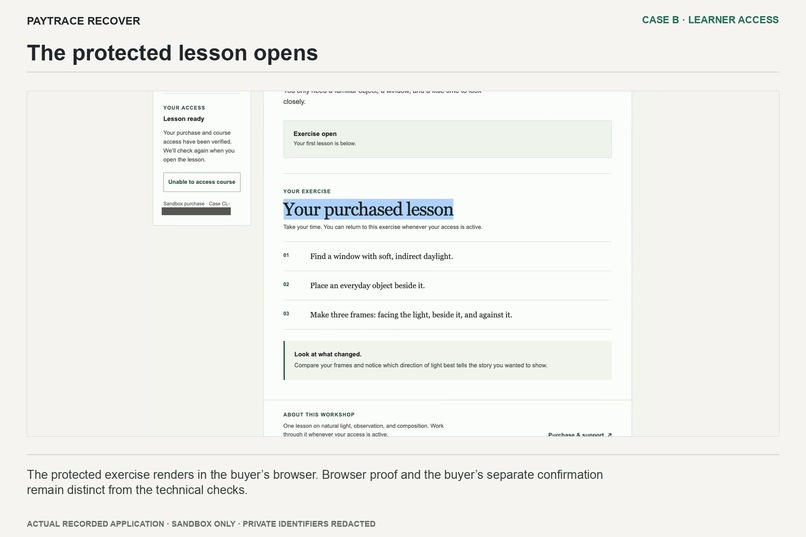
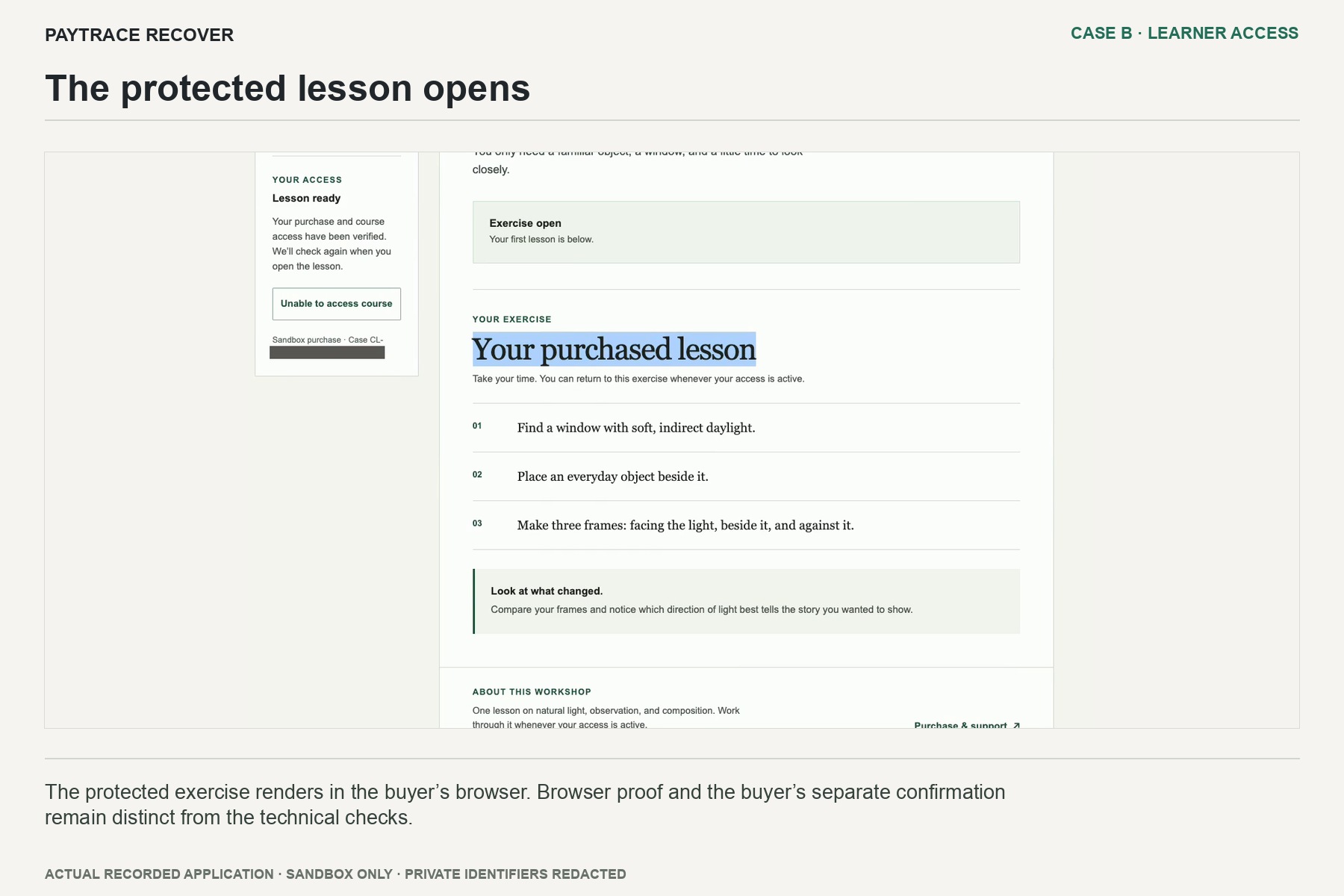
The protected lesson opens for the earlier-approved learner; buyer confirmation remains separate from technical verification.
Inspiration
Paying for digital access should be the easy part. But imagine buying a course, receiving a PayPal payment confirmation, and then finding the first lesson locked. The customer is left wondering when access will arrive. The merchant has to reconcile payment, order, enrollment, and support records that may live in different systems.
That gap inspired PayTrace Recover. We wanted a system that could investigate the mismatch, explain what the evidence supports, propose the smallest safe correction, keep the merchant in control, and check whether the customer can actually open the protected lesson.
The idea behind PayTrace is simple: “payment completed” should not be confused with “purchase delivered.”
What it does
PayTrace Recover turns a missing digital purchase into a case that both the merchant and customer can follow.
The merchant desk prioritizes cases that need attention. Opening a case shows the decision and next action first, alongside three essential facts: whether payment completed, whether it matches the purchase, and whether the purchased access exists. Merchants can inspect payment records, course records, specialist findings, workflow history, and the audit trail when they need more detail.
PayTrace uses fresh PayPal sandbox order and capture data to check the specific purchase. It compares that evidence with the saved order, learner, course, amount, and currency before considering an access correction. A separate reference course service checks the learner’s entitlement and whether protected lesson content opens.
Four AI specialist roles help explain the case:
- Ledger examines the payment and purchase match.
- Relay follows the handoff between payment and course access.
- Patch considers the smallest purchase-specific correction.
- Prism challenges assumptions, contradictions, and missing evidence.
The specialists provide findings tied to evidence and recommend a next step. Their recommendations cannot independently authorize an access grant. Deterministic checks govern whether the evidence is current and whether a proposed correction is eligible.
Before a merchant applies a correction, PayTrace previews exactly what would change and requires approval of that specific action. An optional sandbox policy, disabled by default, can authorize eligible cases for the single reference course within defined amount, daily, and evidence limits. A mismatched purchase, unavailable evidence, or unresolved objection keeps the case on hold.
After a correction, PayTrace rereads payment, entitlement, and protected-lesson evidence. A successful write alone does not mean recovery is verified. The Recovery Passport keeps payment, investigation, authorization, correction, technical lesson proof, and customer confirmation as separate stages.
The customer can follow a private progress timeline, reply to the merchant, ask for help, and separately confirm whether access works on their own device.
How we built it
PayTrace uses a Node.js backend, SQLite for sandbox case storage, and browser-based merchant and customer interfaces hosted on Azure App Service. A separate reference course service manages entitlements and protected lesson checks.
The payment integration uses PayPal’s free sandbox:
- PayPal JavaScript SDK presents checkout for the sandbox buyer.
- PayPal Orders API v2 creates orders, captures approved payments, and retrieves order evidence.
- PayPal Payments API v2 retrieves current capture details for subsequent payment checks.
Azure OpenAI powers the specialist consultation through its Responses API endpoint. The model receives a constrained case snapshot and returns findings tied to saved evidence. The interface distinguishes model-backed consultation from scripted specialists used in the public sample walkthrough.
Render Workflows provides staged investigation and recovery tasks. Gathering evidence and consulting specialists are separate from applying an authorized correction and verifying its outcome.
PayTrace saves case state, recovery intent, and audit history so interrupted operations can be reconciled. Purchase-scoped idempotency keys protect correction attempts from accidental repeats. Fresh payment and access reads prevent stale case information from being treated as current proof. Customer messages and private case links have their own access controls.
Codex assisted implementation, frontend and backend integration, deployment debugging, security review remediation, and regression tests. ElevenLabs supplied the demonstration narration; it is a presentation tool, while Azure OpenAI provides the application’s runtime AI functionality.
Challenges we ran into
The hardest design question was: What does “recovered” actually mean?
A completed PayPal payment does not prove course access. An entitlement record does not prove the protected lesson opens. A technical lesson check does not prove the buyer has tried it on their device. Treating these as separate facts shaped the case model, the Recovery Passport, and the interface language.
Reliability was another challenge. A provider can finish an operation even if its response never reaches the app. Repeating an access change without checking could duplicate a write or conceal an uncertain outcome. We designed recovery to reconcile saved intent with fresh reads and hold ambiguous changes for review.
We also had to balance automation with trust. AI can organize evidence and expose contradictions, but payment-linked access changes still need narrow eligibility rules, current authorization, and an audit trail. In the recorded demonstration, an unresolved access-history objection keeps a new purchase on hold rather than forcing a successful outcome.
Finally, the merchant interface had grown too dense. We moved the decision, next action, and strongest supporting facts to the front of the case. Detailed records and analysis remain available without blocking the primary task.
Accomplishments that we're proud of
PayTrace Recover is a working sandbox prototype with customer checkout, a merchant desk, private support conversations, PayPal payment checks, model-backed specialist reviews, an exact correction preview, recovery workflows, and protected-lesson verification.
We are especially proud of the distinction between an access write and a verified outcome. The app can report that a correction was applied while withholding a verified result until fresh payment, entitlement, and protected-lesson checks agree.
As of November 11, 2026, the automated suite passes 358 tests with zero failures, covering case behavior, payment and access boundaries, workflow retries, customer support, authorization, and failure handling.
The latest live demonstration shows two explicitly separate sandbox cases. A newly recorded $128 workshop purchase proceeds through checkout, support, and model-backed investigation, then remains on hold because an objection is unresolved. The video then switches to an earlier merchant-approved recovery, showing its saved Render recovery record, fresh verification without another grant, the protected lesson opening, and separate buyer confirmation.
These are two distinct purchases, not one uninterrupted successful recovery. All learners are fictional, all payments use the PayPal sandbox, and no real money moves. Scripted sample evidence remains labeled separately from connected evidence.
What we learned
AI is most useful here as an evidence interpreter and critical reviewer. A useful specialist points to purchase and access facts, identifies contradictions, states what remains unknown, and helps the merchant understand the safest next step.
We also learned that the customer experience cannot be an afterthought. When someone has paid and received nothing, silence makes the problem worse. A recovery tool should explain what is happening, when to expect an update, and how to ask for help.
Building PayTrace reinforced that trust depends on distinguishing a plan, an authorized action, a technical check, and a customer-confirmed result.
What's next for PayTrace Recover
Our next milestone is a repeatable, freshly recorded journey from sandbox checkout through investigation, merchant approval, recovery, and protected-lesson verification for the same purchase. We also want to simplify connected testing for judges and preserve a redacted acceptance report for each completed run.
Before a merchant pilot, we need verified merchant sign-in, managed transactional storage, broader operational validation, and integration with a commercial course platform. We also want to test the experience with merchants and customers who have encountered digital-delivery failures and measure whether it improves resolution time and customer communication.
The long-term goal is to make “paid but not delivered” cases easier to investigate, safer to resolve, and less frustrating for the person waiting for access.


