Katale AI: Your Business. One Conversation Away.
Inspiration: Bringing AI Commerce to Everyday Businesses
In Uganda and across many emerging markets, small businesses increasingly rely on WhatsApp to communicate with customers, advertise products, negotiate prices, and receive orders.
Imagine a small business owner in Kampala selling handmade baskets, clothing, or electronics. Customers send messages and voice notes asking about products, prices, and availability. The merchant manually checks inventory, calculates totals, follows up on payments, and keeps track of orders across dozens of conversations.
As the business grows, these seemingly simple activities become overwhelming.
Traditional e-commerce and business management platforms often require merchants to learn complicated interfaces, maintain separate applications, or change how they already interact with customers.
This inspired a simple question:
What if a merchant could run their entire business simply by having a conversation?
That question led to Katale AI, an intelligent commerce assistant that combines conversational AI, WhatsApp, PayPal payments, and business analytics into one accessible experience.
The name Katale comes from Luganda, a widely spoken language in Uganda, and means market. It reflects our vision of making intelligent digital commerce accessible to everyday merchants.
What Katale AI Does
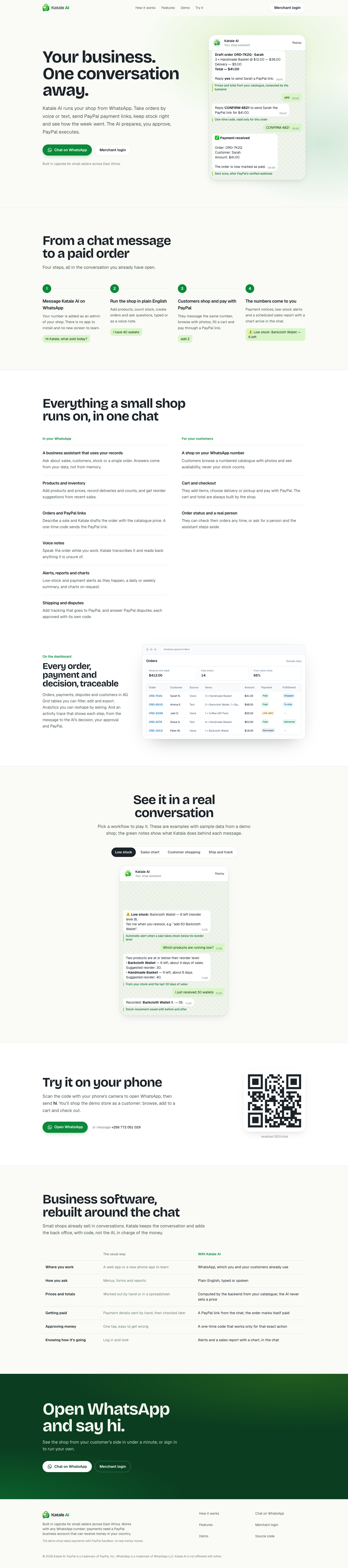
Katale AI transforms WhatsApp from a messaging application into an AI-powered business management and shopping platform.
For merchants, Katale AI acts as an intelligent business assistant. Through natural English conversations or voice notes, merchants can:
- Add products, update prices, and manage inventory.
- Create orders and generate PayPal checkout links.
- Monitor payments, shipments, and disputes.
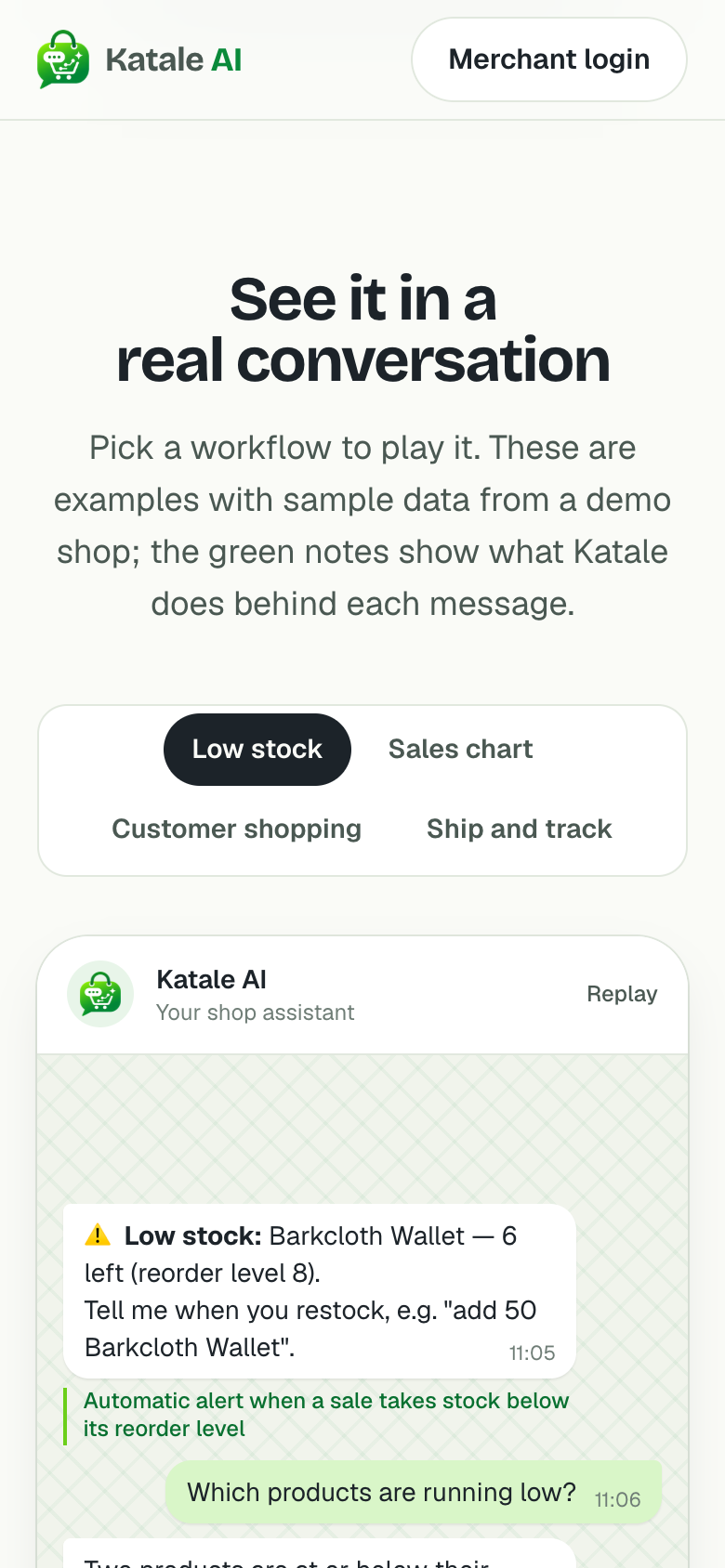
- Receive low-stock alerts, payment reminders, and business summaries.
- Ask questions about sales, revenue, customers, and inventory.
- Generate visual charts and actionable business insights.
For example, a merchant can say:
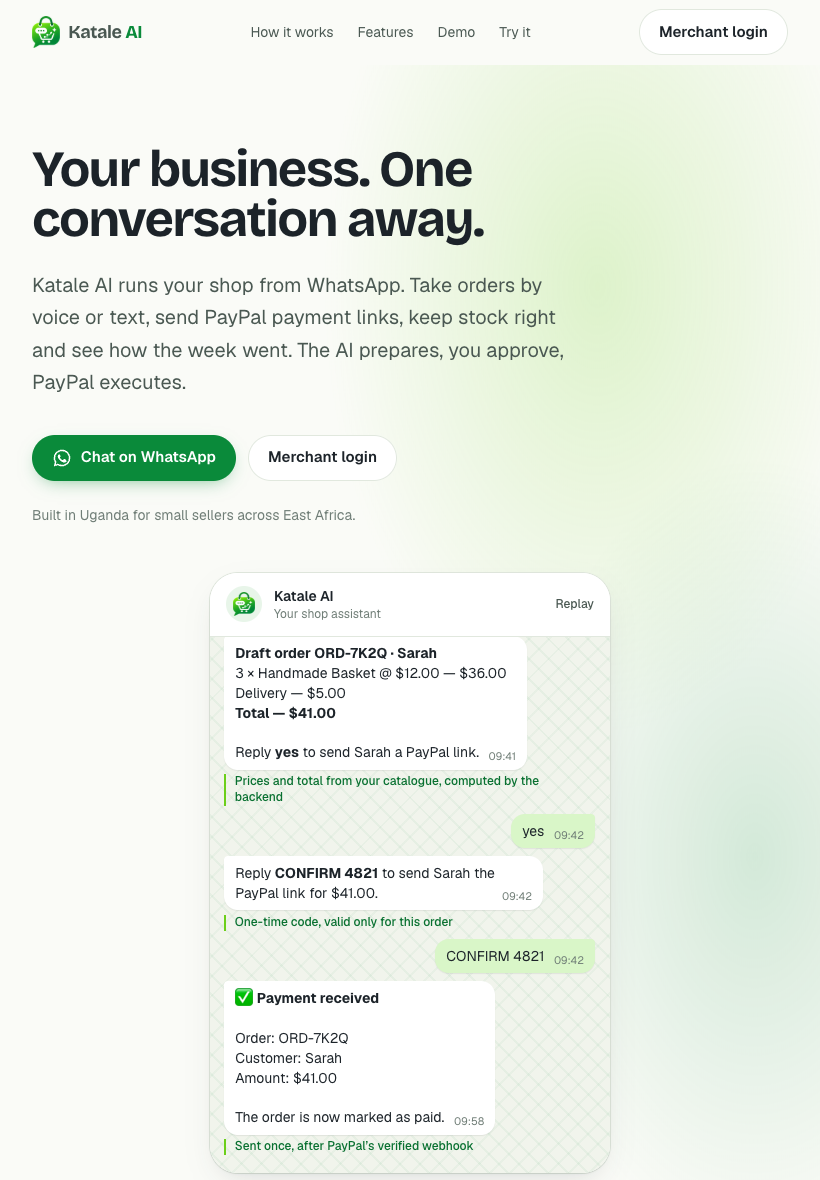
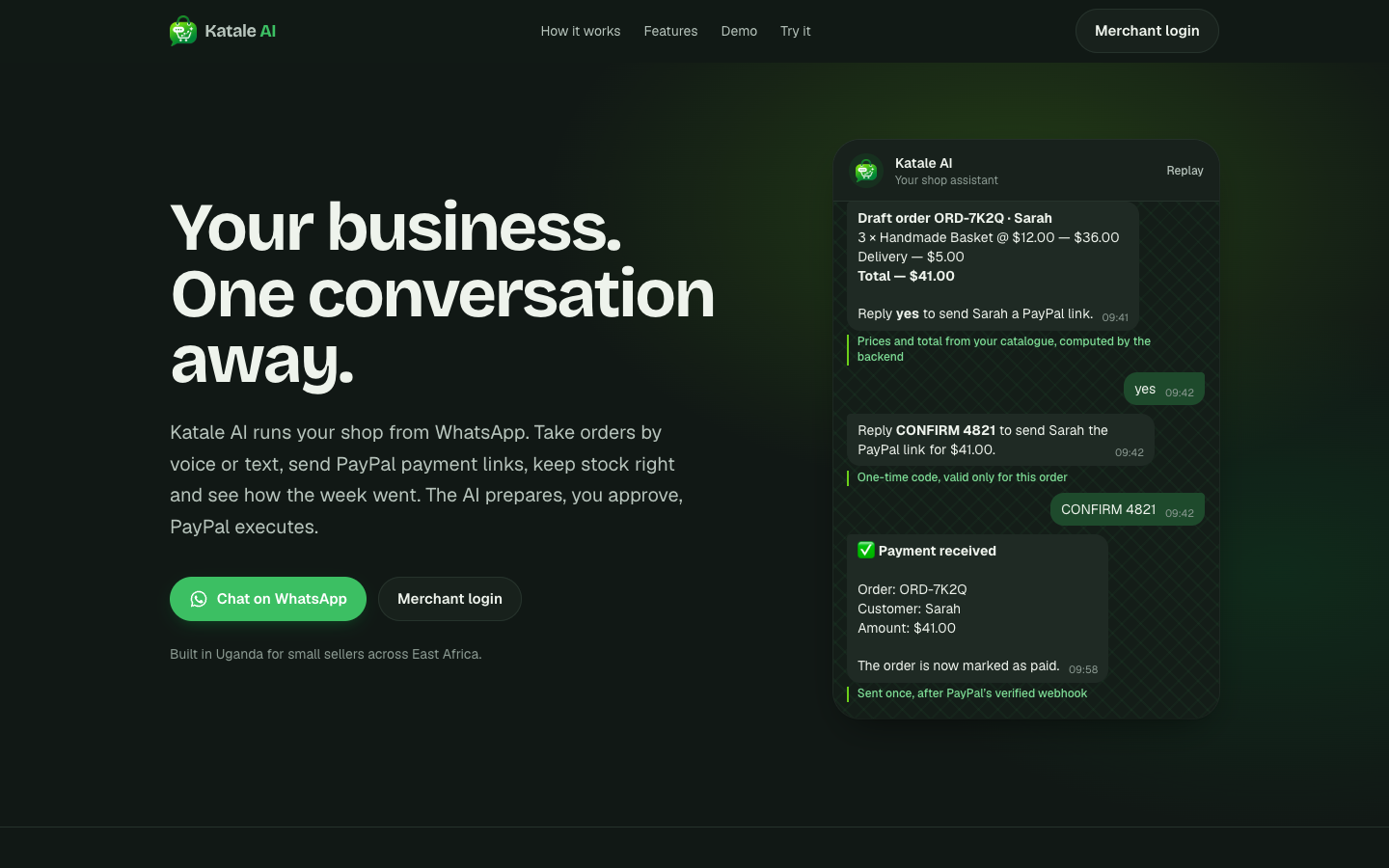
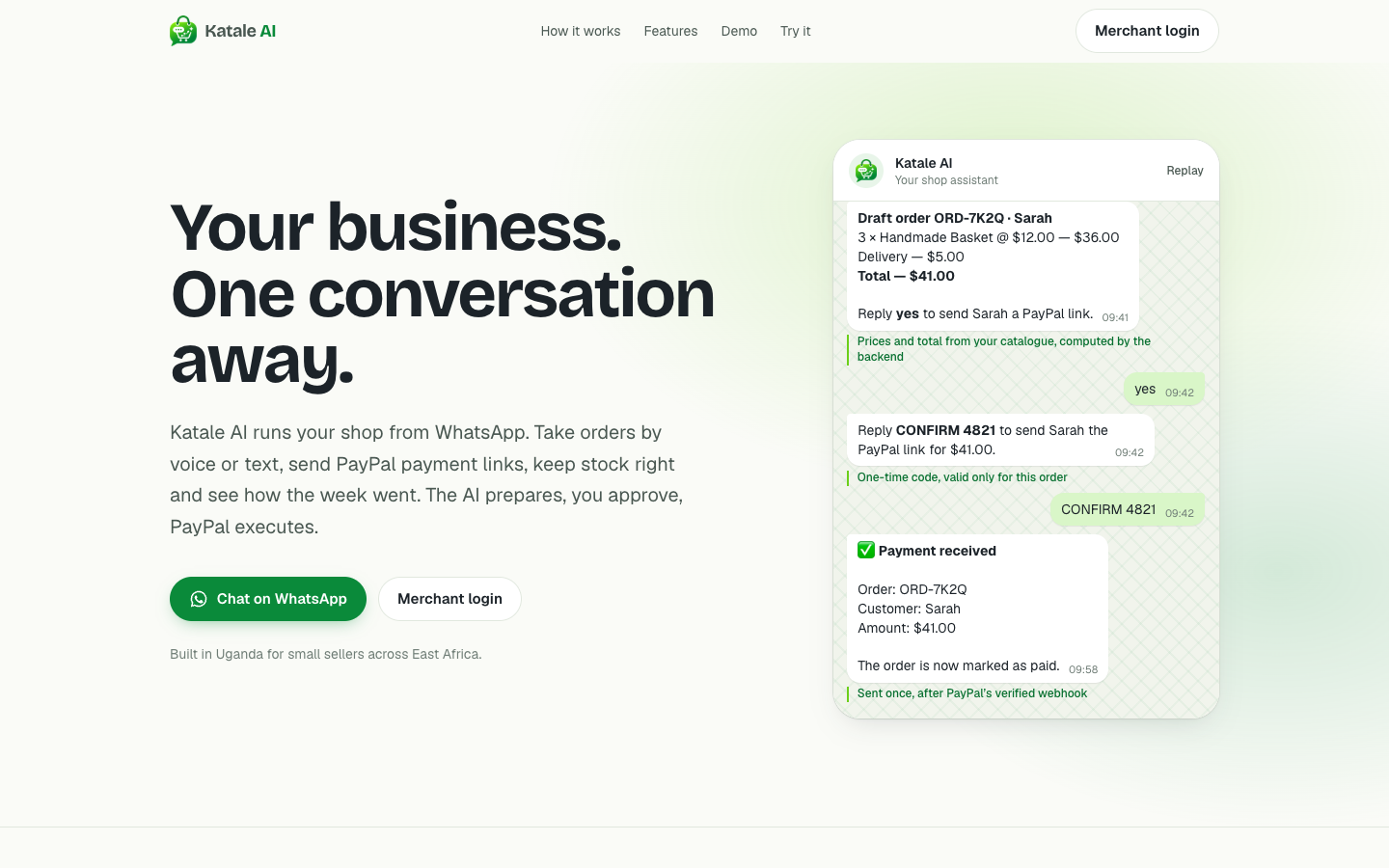
"Create an order for Sarah for three handmade baskets and add $5 for delivery."
Katale AI interprets the request, retrieves product prices, calculates the total through trusted backend services, and prepares the order. The merchant authorizes the payment request using a secure, single-use confirmation code.
PayPal then handles the checkout, while verified payment events update the order and inventory records.
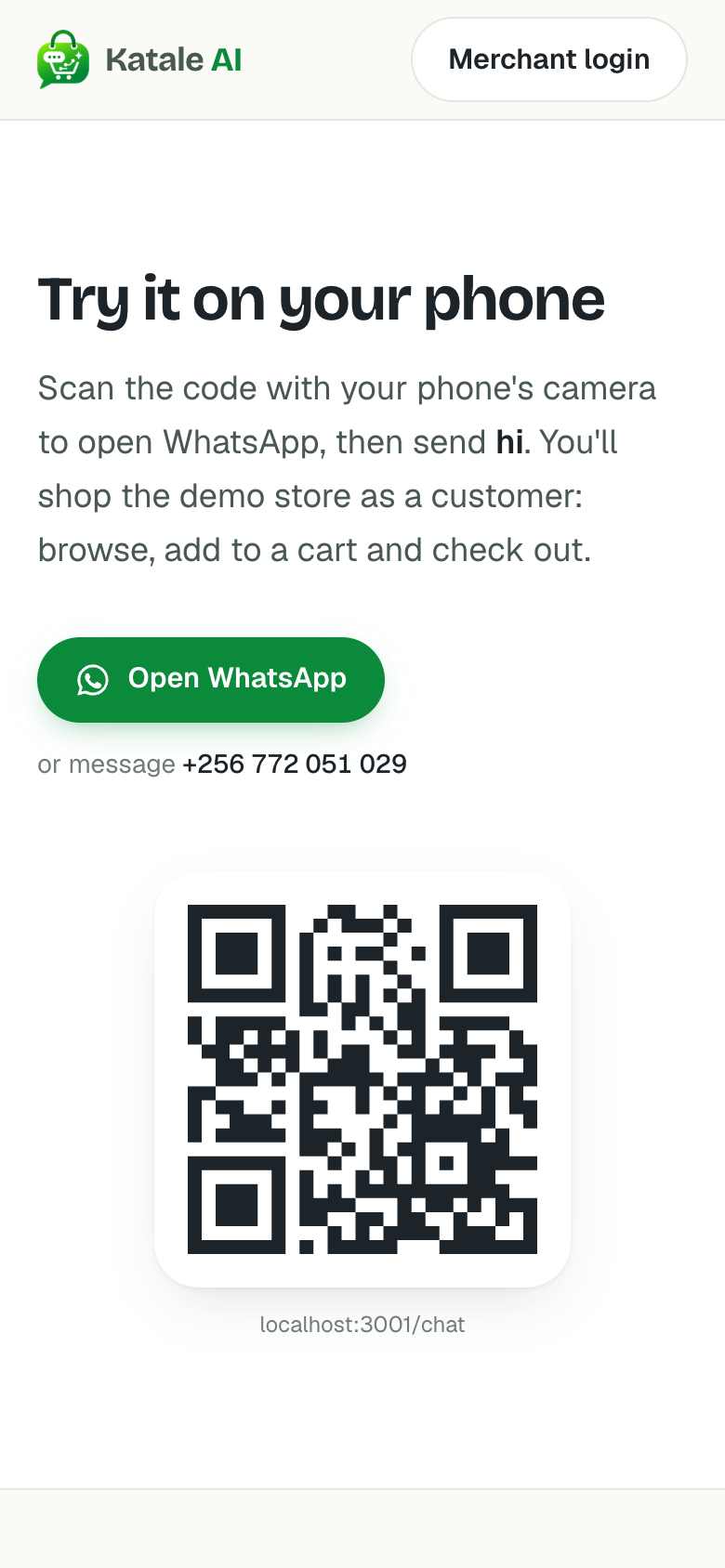
For customers, Katale AI offers conversational product discovery, shopping carts, order placement, PayPal checkout links, and order tracking through WhatsApp.
We also introduced merchant-controlled AI bargaining, allowing customers to negotiate prices within predefined limits without exposing the merchant's confidential minimum price.
The experience brings together product discovery, negotiation, payment, and after-sales support in a familiar conversational interface.
How We Built It
Katale AI uses a modular, full-stack architecture designed around reliability, security, and responsible AI.
AI and conversational intelligence
We integrated OpenAI's GPT-4.1-mini for natural-language understanding, reasoning, and structured tool calling. OpenAI Whisper processes English voice notes, allowing merchants to interact with their businesses through speech.
Our AI agents use separate, permission-controlled tools for merchant operations and customer shopping.
Payments and commerce
We integrated PayPal's Orders v2 API, webhooks, shipment tracking, and Disputes v1 API using the PayPal Sandbox environment.
A central design principle is that AI interprets and proposes, but trusted backend services validate and execute.
The AI cannot arbitrarily change transaction amounts or approve sensitive financial actions. Prices are validated against business records, and consequential merchant operations require explicit authorization.
Business intelligence
We integrated AG Grid for interactive operational tables and AG Studio for AI-assisted business analytics.
Merchants can explore orders, payments, customers, and product performance, and use natural-language instructions to create visualizations.
Technical architecture
Our technology stack includes Next.js, React, TypeScript, Fastify, PostgreSQL, Prisma, Docker, WhatsApp Web JS, and Cloudflare R2 for product image storage.
The application is deployed at https://kataleai.space, with source code publicly available on GitHub under the MIT license.
Challenges We Overcame
Building Katale AI involved several significant technical challenges.
1. Making AI safe for financial operations
Large language models can misunderstand requests or generate incorrect values. We addressed this by separating AI reasoning from financial execution, introducing backend-controlled pricing, structured tool validation, one-time confirmation codes, and transaction audit trails.
2. Handling asynchronous PayPal transactions
Payment confirmations, webhook retries, cancellations, refunds, and inventory changes can occur at different times. We implemented idempotent processing, payment reconciliation, explicit order states, and safeguards against duplicate transactions and inconsistent inventory.
3. Building reliable WhatsApp commerce
WhatsApp introduces unique challenges around message delivery, hidden contact identifiers, session reconnects, and distinguishing administrators from customers. We developed identity-aware routing, permission isolation, conversation management, and reconnection handling.
4. Creating a genuinely useful voice interface
Speech recognition alone is not enough. A transcribed request must be interpreted, linked to the correct business records, validated, and converted into an appropriate action. We built a pipeline connecting voice transcription to the same controlled commerce tools used for text interactions.
What We Learned
The most important lesson was that building a useful AI agent is not just about generating intelligent responses; it is about safely completing real-world tasks.
We learned how to combine LLM tool calling with deterministic business logic, integrate PayPal's commerce APIs, manage asynchronous financial events, and turn conversational interactions into auditable business operations.
We also learned that sophisticated technology creates the most value when it makes an existing experience simpler rather than more complicated.
What We're Proud Of
We're particularly proud that Katale AI demonstrates meaningful agentic commerce rather than a chatbot that merely recommends products.
Our assistant can interpret requests, interact with business systems, prepare transactions, and connect customers to real PayPal Sandbox checkout workflows.
We have also demonstrated customer purchases, verified payment events, inventory updates, and merchant notifications through the integrated system.
Most importantly, Katale AI is designed around the realities of small businesses that already depend on conversational commerce.
What's Next
Our longer-term vision is to make Katale AI a scalable commerce platform where businesses can connect their own WhatsApp accounts, manage their products and customers, and accept payments without needing extensive technical knowledge.
Future improvements include broader merchant onboarding, an official WhatsApp Business Platform integration, more intelligent product discovery, multilingual interactions, and expanded business automation.
Our vision is simple: make running a business as easy as sending a message.
Katale AI: Your Business. One Conversation Away.
Built With
- ag-grid
- cloudflare-r2
- docker
- fastify
- next.js
- node.js
- openai
- paypal
- postgresql
- prisma
- react
- typescript
- whatsapp-web.js
- whisper
