-
-
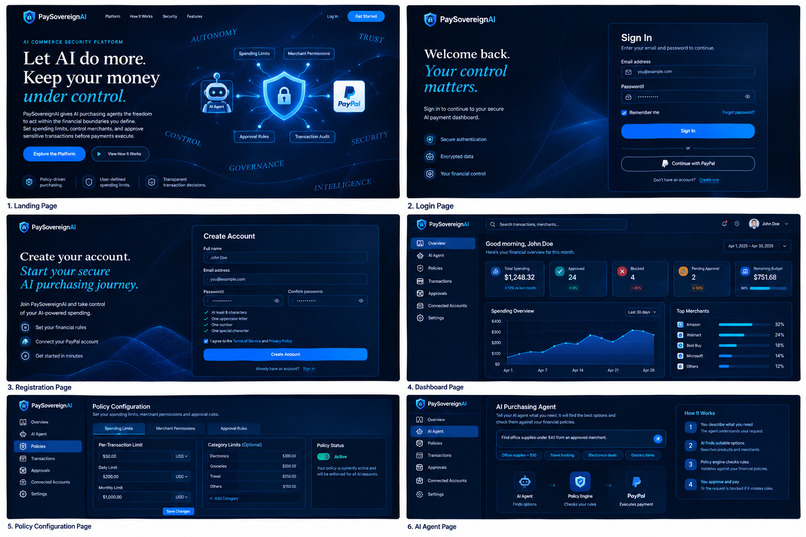
PaySovereignAI secures AI purchases with spending limits, merchant controls, policy checks, and user approvals.
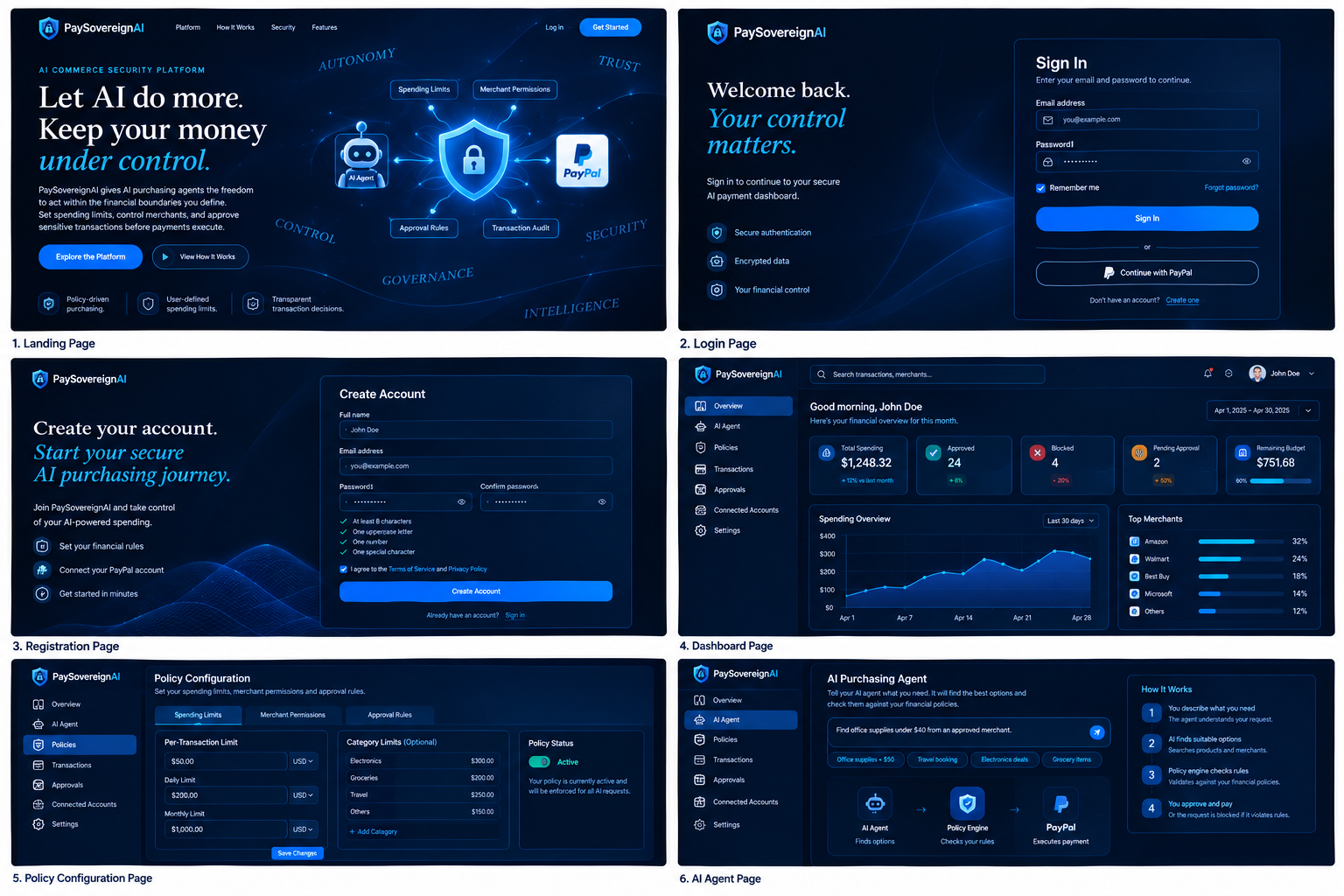
Inspiration
AI agents are becoming capable of doing more than answering questions. They can search for products, compare options, and potentially initiate purchases on behalf of users. However, giving an AI agent the ability to make payments introduces an important question: How can we give AI financial autonomy without giving it unrestricted control over our money?
A user might authorize an agent to purchase office supplies within a specific budget, but what happens if the agent selects an expensive product, chooses an unauthorized merchant, or follows a malicious instruction?
We created PaySovereign AI around one principle: AI agents should be able to act independently within clearly defined financial boundaries, while users remain in control of their money.
What it does
PaySovereign AI is a financial security layer designed to enforce spending policies before AI-powered purchases execute through PayPal.
Its core features include:
- Spending Limits: Define maximum transaction amounts and spending budgets.
- Merchant Permissions: Restrict purchases to approved merchants.
- User Approval Rules: Require explicit approval for transactions that meet configured conditions.
- Policy Enforcement: Evaluate payment requests against predefined rules before allowing them to proceed.
- Transaction Monitoring: Track payment attempts and display their outcomes.
- Audit Trail: Record policy decisions and explain why a transaction was permitted, rejected, or flagged for approval.
For example, if a user sets a maximum purchase amount of $50 and an AI agent attempts to buy an item costing $120, PaySovereign AI should reject the request before it reaches payment execution.
The goal is simple: give AI agents the freedom to help, without giving them unlimited financial authority.
How we built it
We designed PaySovereign AI around a policy-enforcement layer between the AI agent and the payment system.
The intended workflow is:
- The user provides a purchasing request and defines financial restrictions.
- The AI agent searches for suitable products and proposes a transaction.
- The backend policy engine evaluates the transaction against spending limits, merchant permissions, and approval requirements.
- Transactions that violate mandatory rules are rejected.
- Permitted transactions proceed through the appropriate PayPal payment flow, including any required user approval.
- The application records the outcome and presents the decision in a transaction dashboard.
Our technical approach focuses on separating AI decision-making from payment authorization. The AI can recommend a purchase, but it cannot independently override the policies enforced by the backend.
The project is designed to integrate PayPal APIs for payment processing, with a dashboard for monitoring transactions and reviewing policy decisions.
The final implementation details, technologies, and integrations should reflect the components actually completed in our submitted application.
Challenges we ran into
One of our main challenges was designing a system in which the AI agent could remain useful without being trusted to enforce its own financial restrictions.
An AI model can interpret a user's request and recommend a transaction, but relying only on instructions in a prompt would not provide a reliable security boundary. Financial policies therefore need to be checked independently by the backend.
Another challenge was designing clear rules for spending limits, merchant permissions, and user approvals while keeping the purchasing experience straightforward.
Integrating the policy engine with a real payment flow also introduces practical considerations, including transaction status verification, duplicate requests, error handling, and protecting sensitive credentials.
These challenges shaped our approach: security decisions should be explicit, independently enforced, and auditable.
Accomplishments that we're proud of
We are proud of developing a concept that connects AI-agent autonomy with practical financial controls.
Our key design decisions include:
- Treating financial policy enforcement as a separate layer rather than relying on AI prompts.
- Making spending limits and merchant permissions central to the purchasing workflow.
- Designing transaction decisions to be understandable and auditable.
- Connecting the concept directly to PayPal payment infrastructure.
- Prioritizing a demonstrable security workflow over unnecessary complexity.
Our most important goal is to demonstrate that an AI purchasing agent can remain helpful while operating within boundaries defined by its user.
What we learned
This project strengthened our understanding of the challenges involved in combining AI agents with financial systems.
We learned that giving an AI agent the ability to initiate actions requires more than connecting a language model to an API. The surrounding system must enforce permissions, validate requests, handle failures, and preserve a reliable record of important decisions.
We also recognized the importance of designing for security from the beginning rather than treating it as an additional feature.
Most importantly, we learned that useful AI autonomy is not about removing human control. It is about allowing automation to operate within clear, enforceable boundaries.
What's next for PaySovereign AI
Our next goal is to develop PaySovereign AI into a more complete and reliable policy-enforcement platform for AI-powered commerce.
Potential improvements include:
- More flexible spending policies, including daily and category-based budgets.
- Stronger protection against duplicate transactions and malicious instructions.
- Risk-based approval workflows for sensitive purchases.
- More detailed transaction analytics and audit logs.
- Expanded integration with supported PayPal capabilities.
- Testing across a wider range of transaction scenarios and failure conditions.
In the longer term, we envision PaySovereign AI supporting businesses that want to delegate purchasing tasks to AI agents without sacrificing financial oversight.
Our vision is a future where AI can handle more of the work, while people retain control over how their money is spent.
Built With
- agents
- ai
- api
- artificial
- cybersecurity
- development
- fintech
- intelligence
- javascript
- node.js
- payment
- paypal
- processing
- react
- rest
- typescript
- web


Log in or sign up for Devpost to join the conversation.