-
-
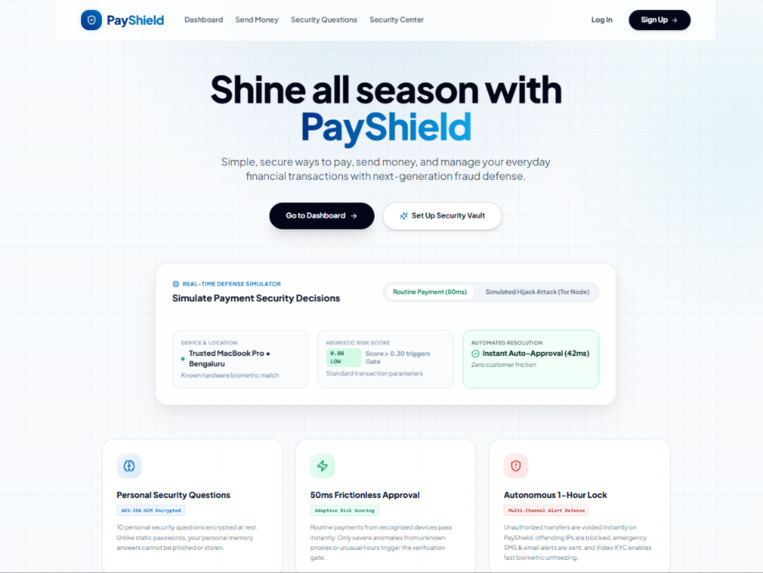
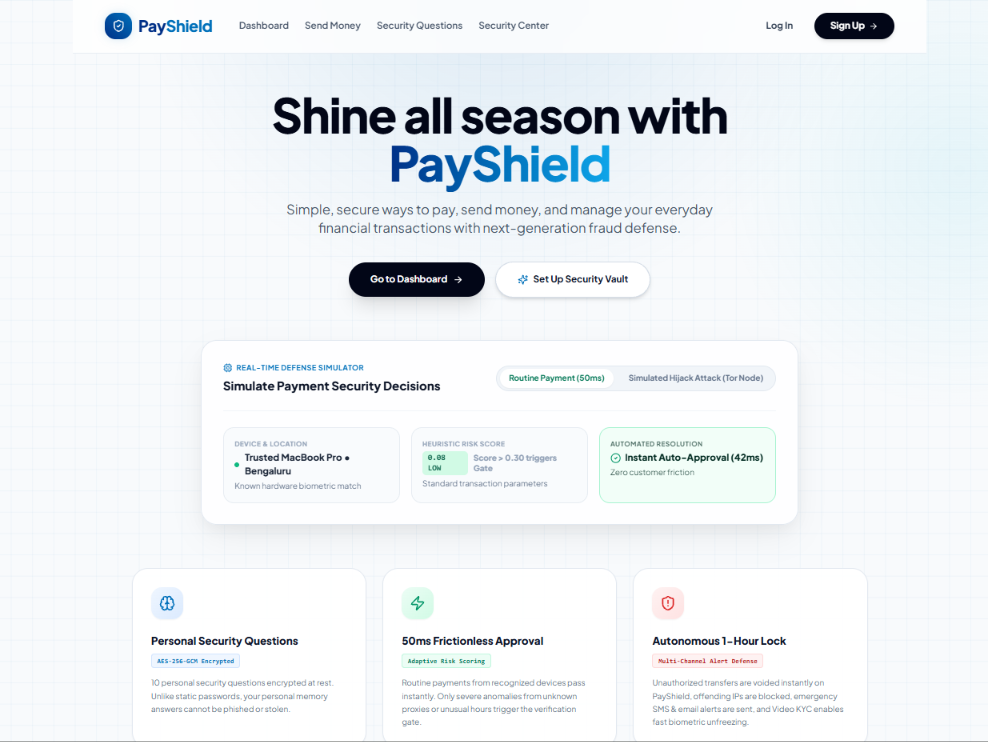
PayShield AI Landing Page: Next-generation cognitive fraud defense protecting digital wallets against compromised devices.
-
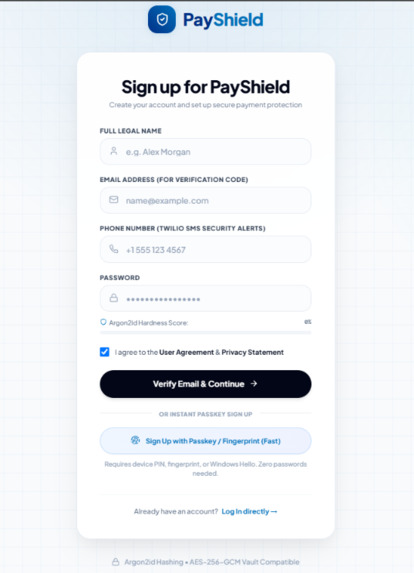
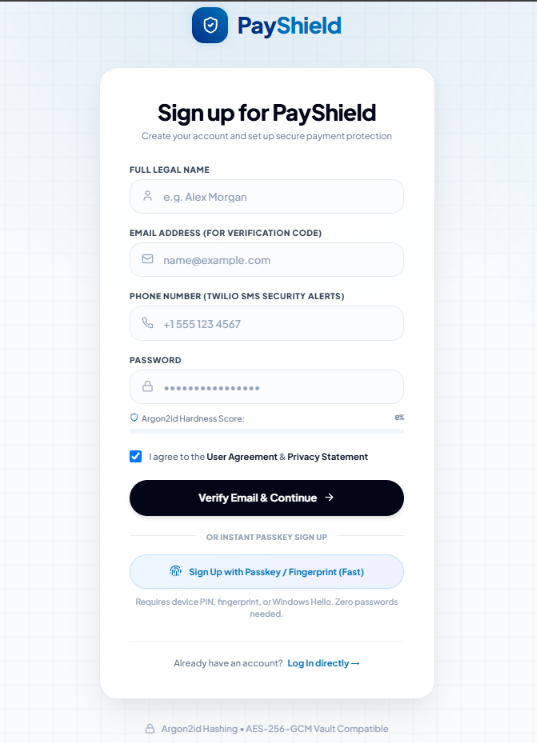
Secure User Onboarding: Account registration with Argon2id password hashing and hardware passkey enrollment.
-
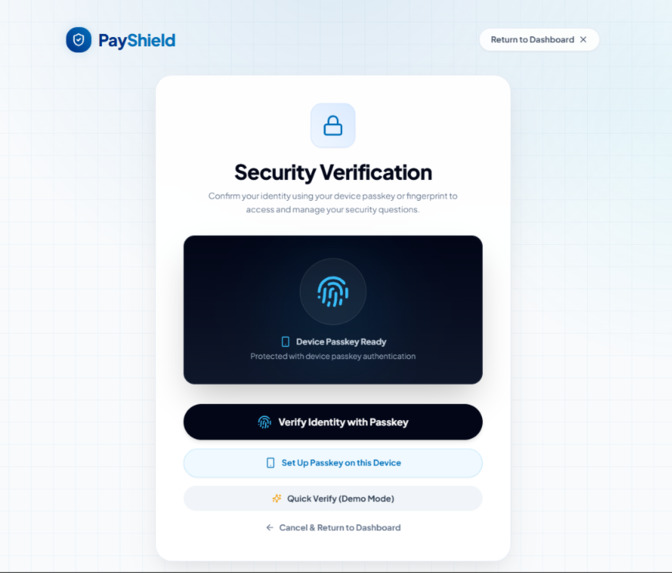
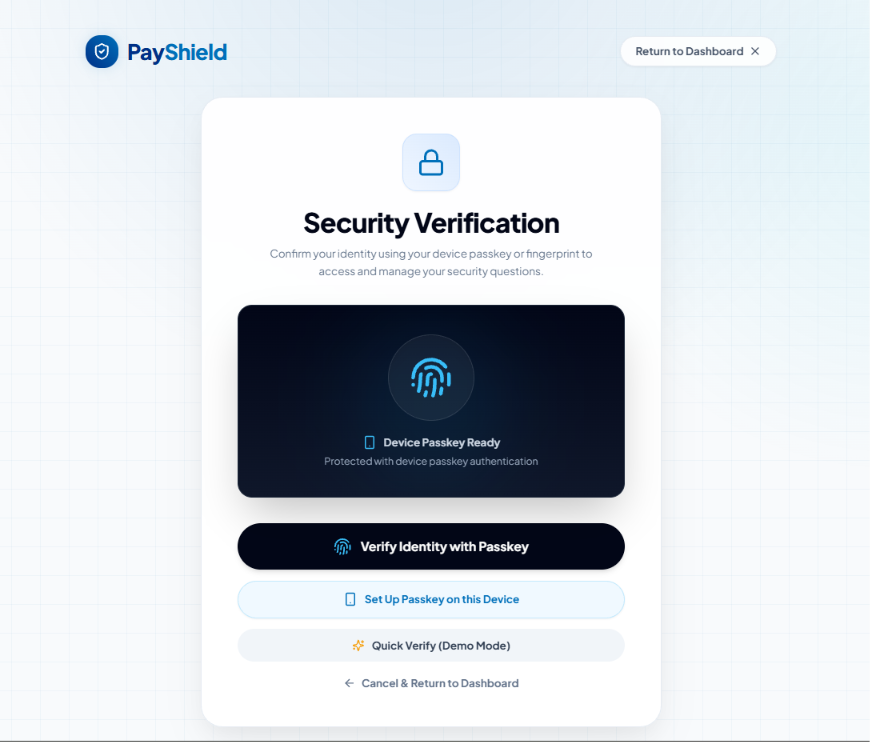
FIDO2 Hardware Biometric Gate: WebAuthn verification required to access and modify the Zero-Knowledge Memory Vault.
-
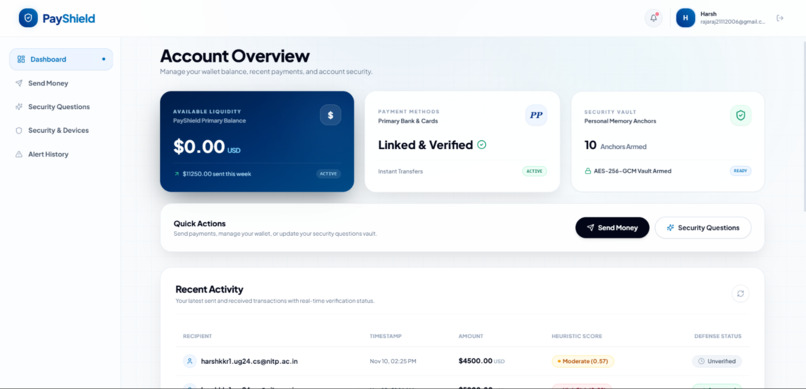
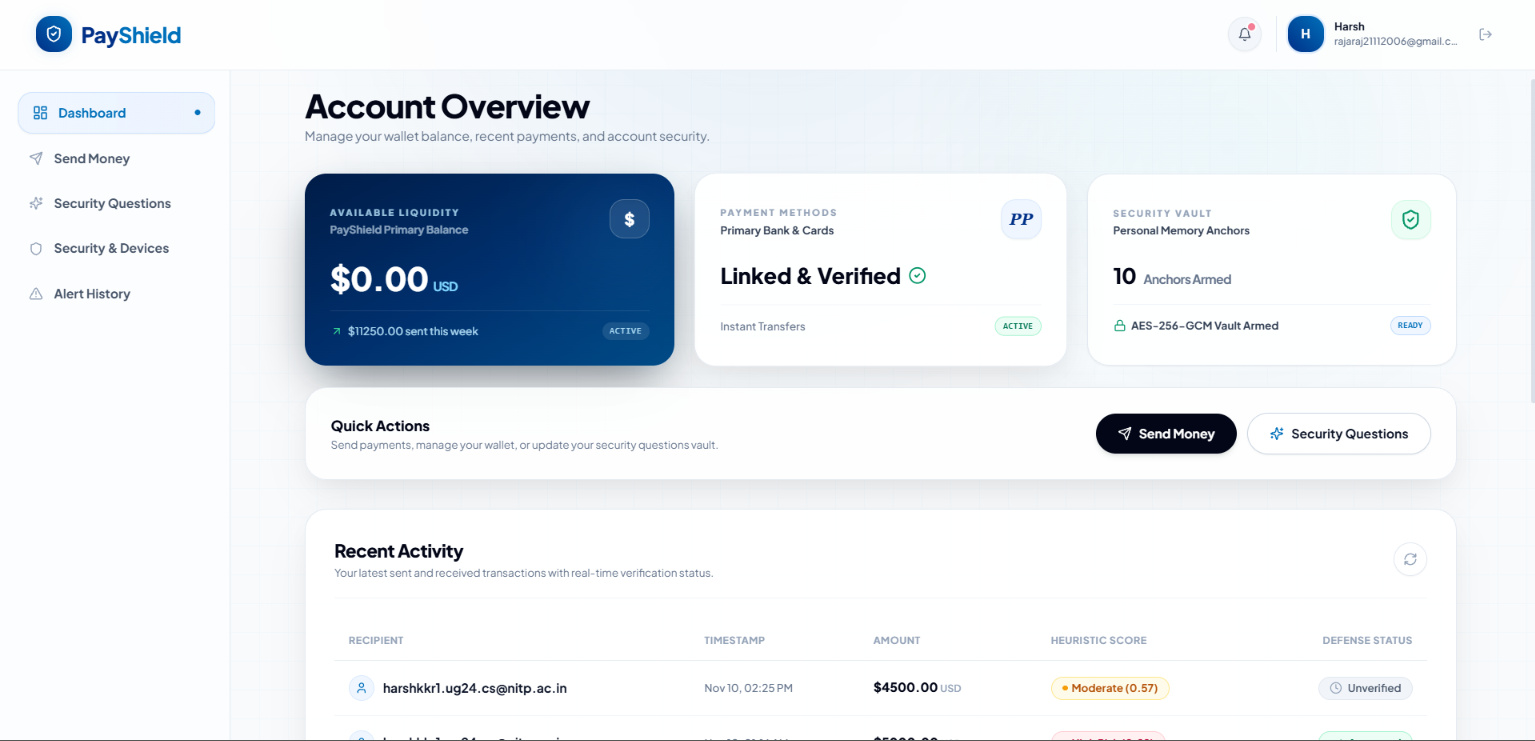
PayShield Dashboard: Real-time financial balances, active cognitive shield status, and instant protected payment operations.
-
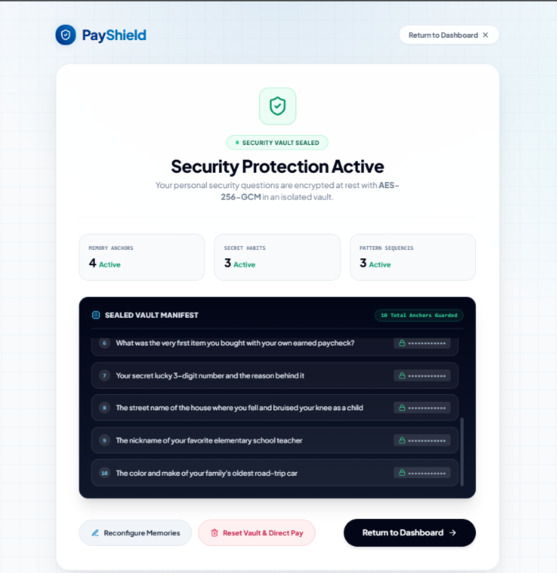
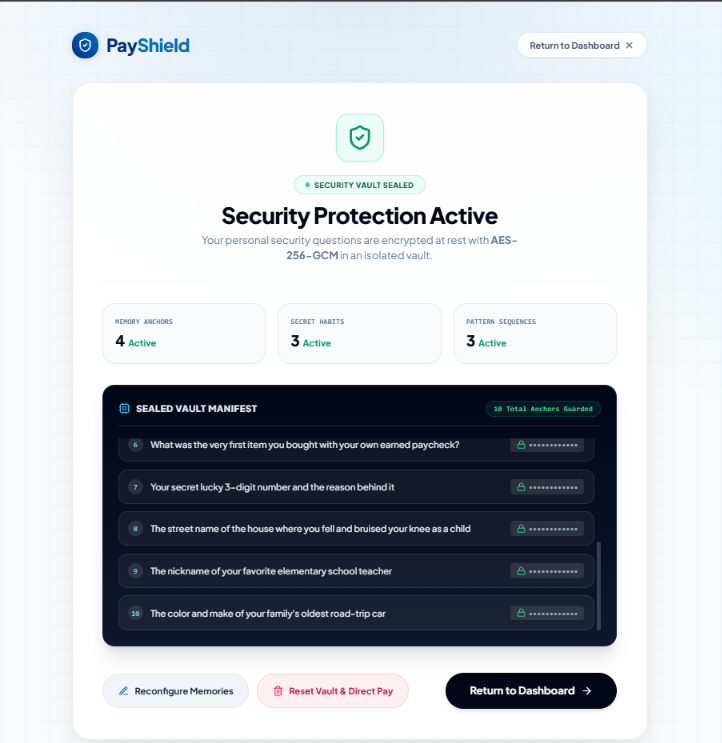
Memory Vault Overview: Reviewing 10 active cognitive anchors sealed in an isolated enclave protected from credential theft.
-
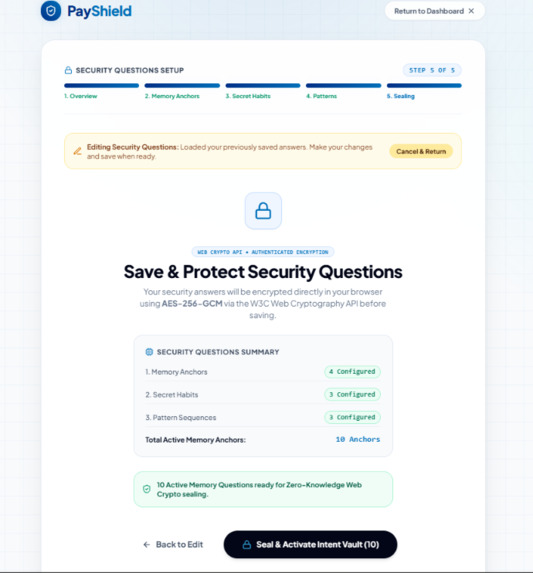
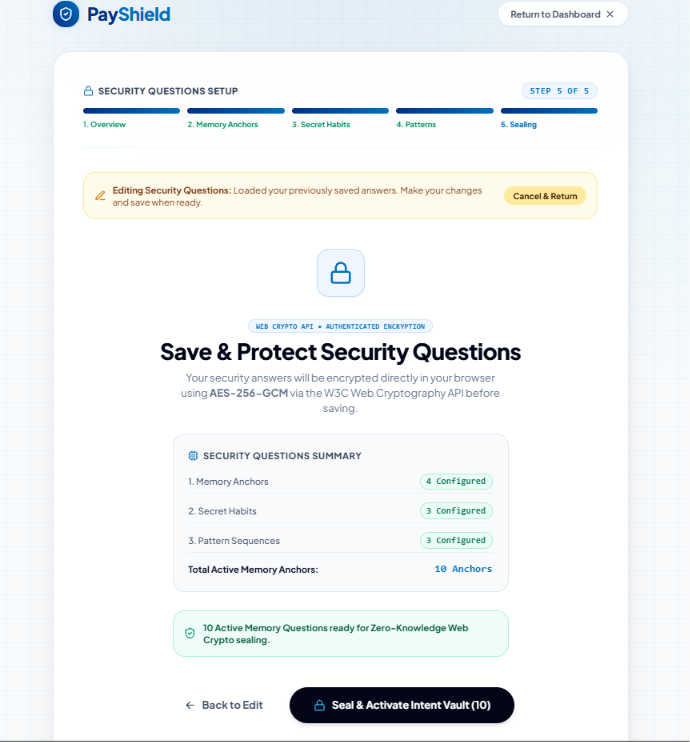
Zero-Knowledge Enclave Sealing: Encrypting 10 episodic memory anchors client-side via AES-256-GCM before MongoDB persistence.
-
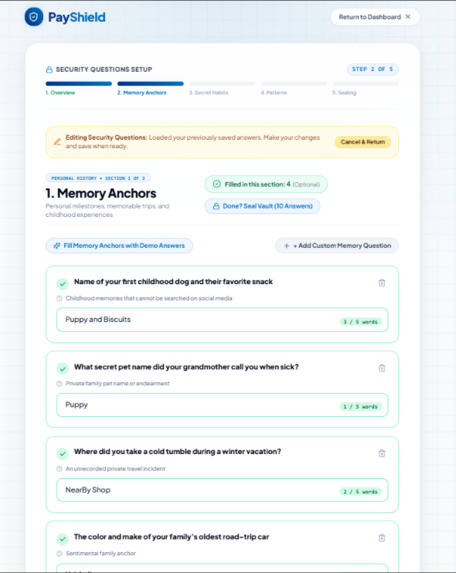
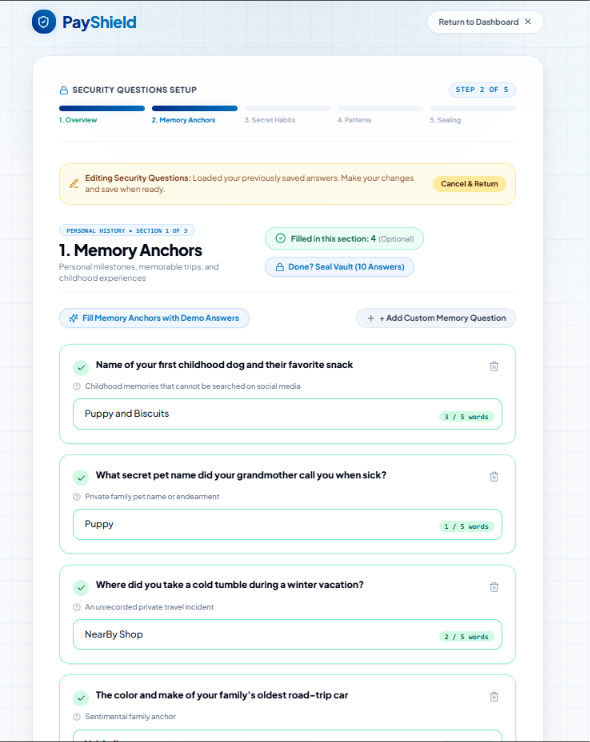
Cognitive Wizard: Depositing private, un-googleable human life memories that remote hackers and automated bots cannot scrape.
-
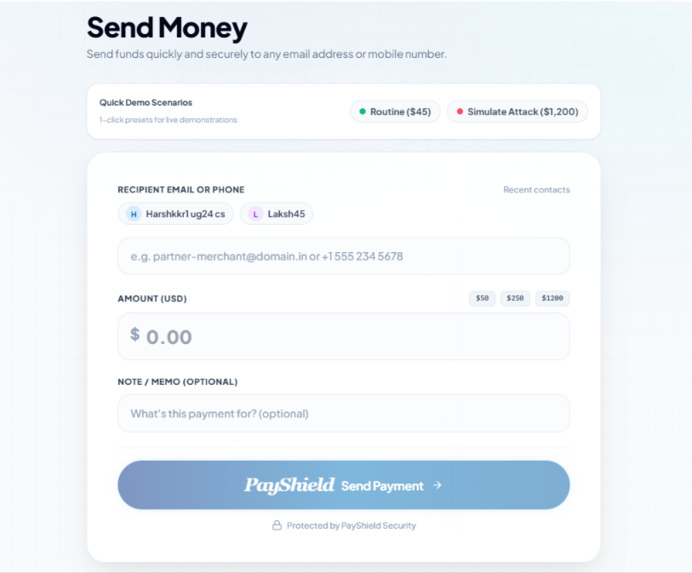
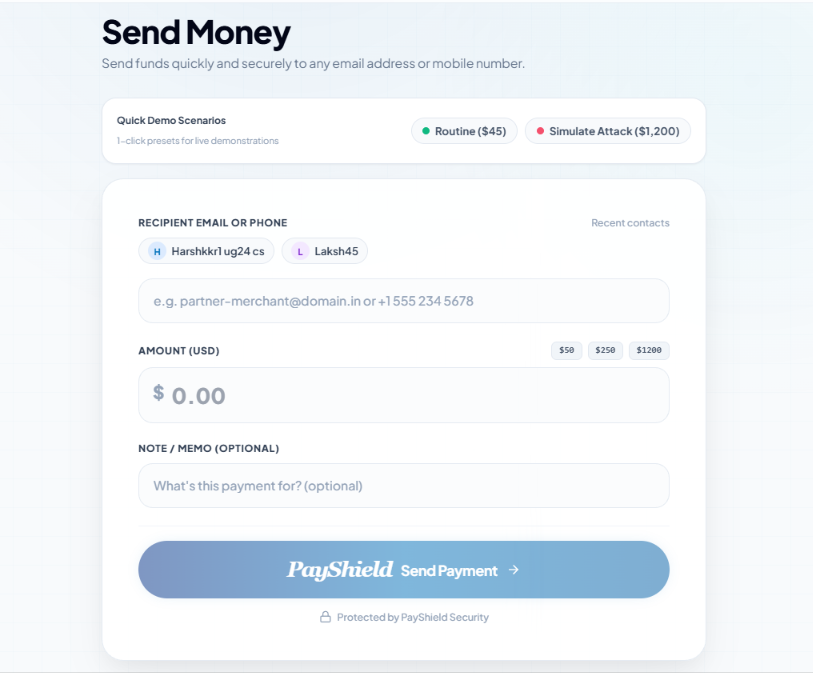
Protected Payments Terminal: Send money with real-time heuristic risk analysis and cognitive episodic challenge interception.
-
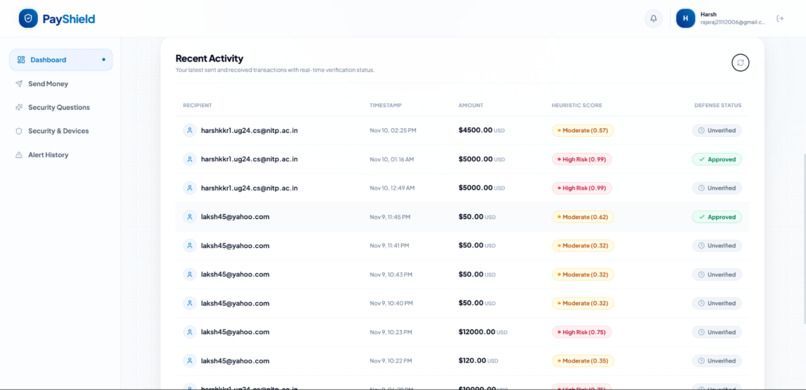
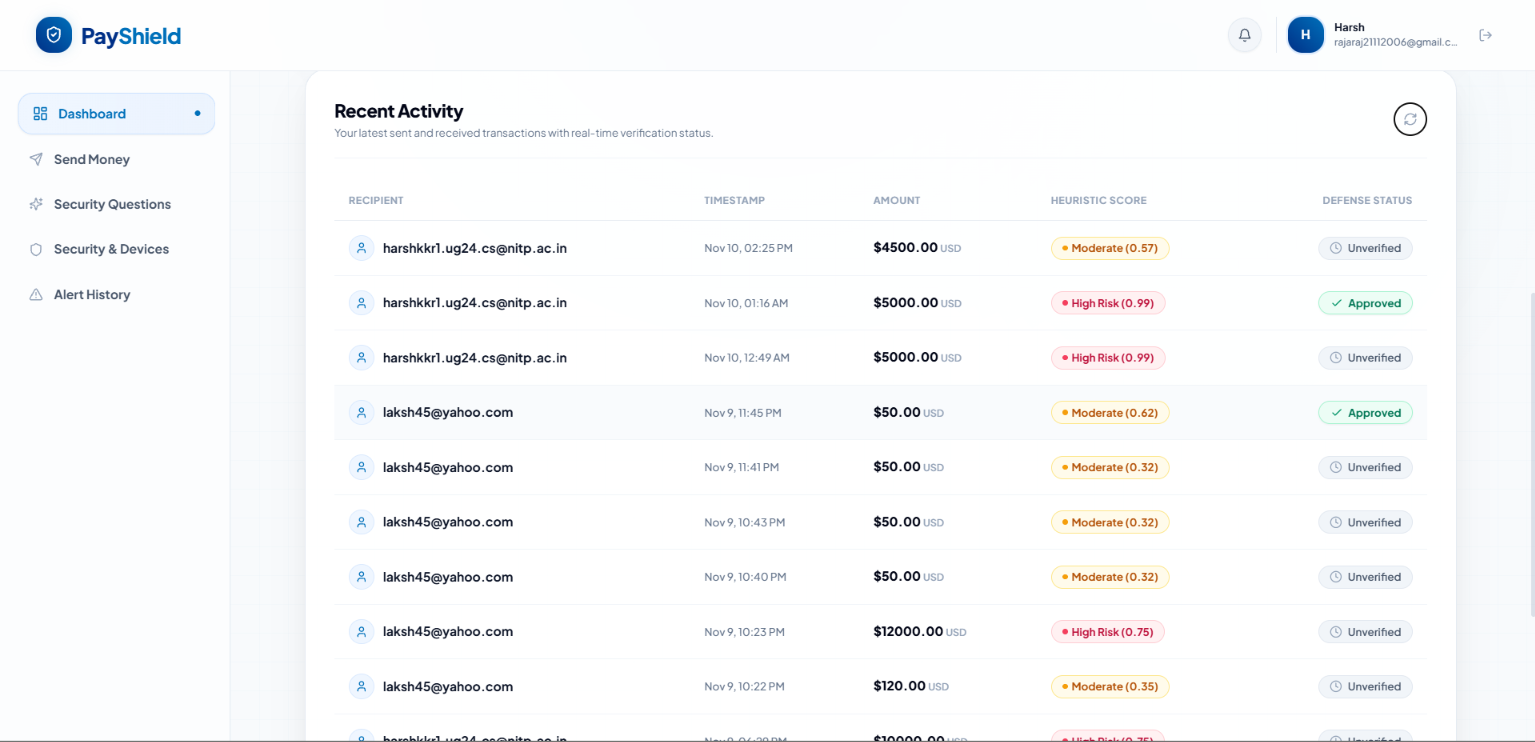
Real-Time Risk Telemetry: Live audit ledger displaying heuristic risk scores, velocity anomalies, and defense verification status.
-
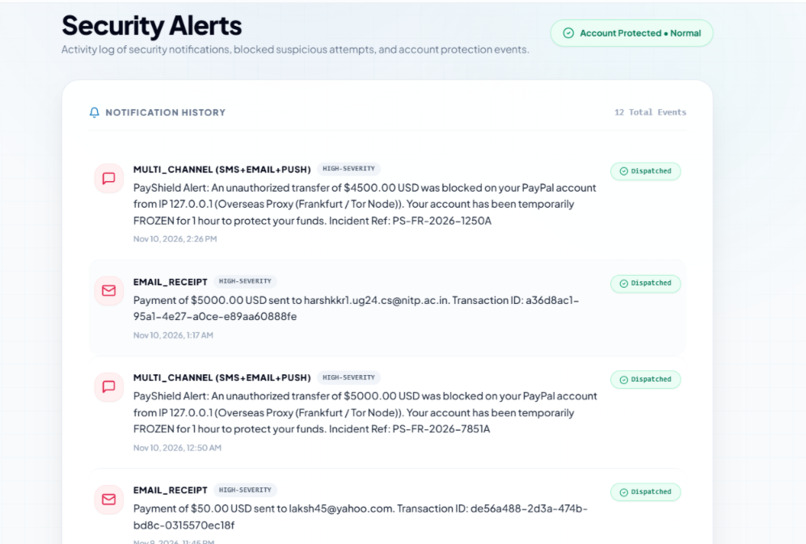
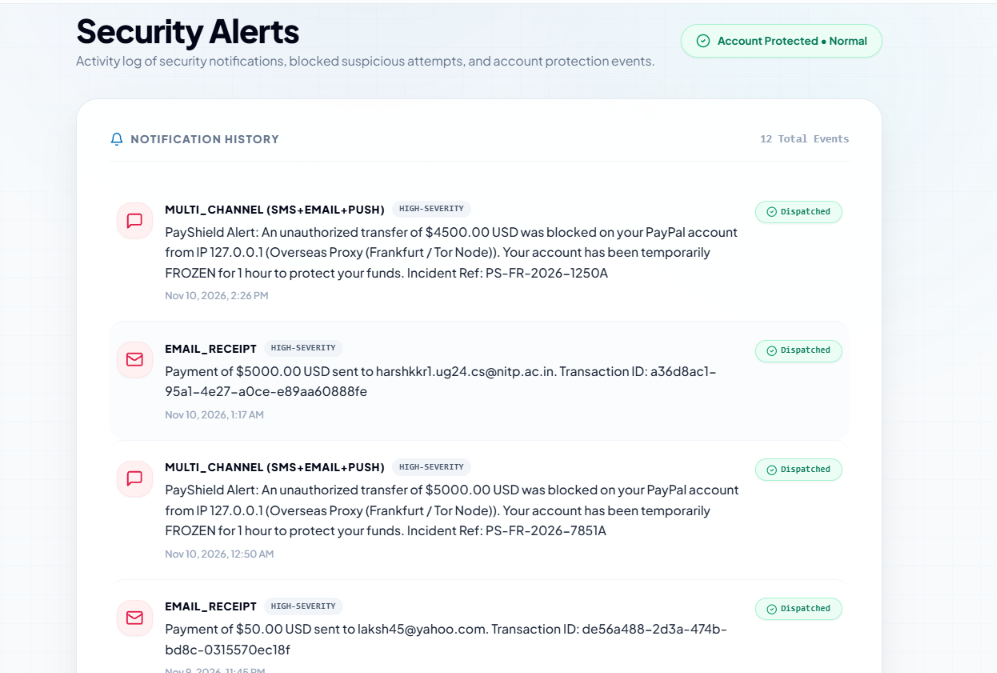
Multi-Channel Alert History: Automated forensic audit trail tracking carrier SMS, Gmail security emails, and edge IP blocks.
Inspiration
In 2026, the greatest threat to digital payment systems is no longer brute-force password guessing—it is complete device and session takeover. When an attacker steals an unlocked phone, mirrors a screen through a remote-access Trojan, or exfiltrates browser session cookies, traditional multi-factor authentication (2FA) completely collapses:
- SMS OTPs & Email codes are delivered directly to the compromised device the attacker is holding.
- Authenticator apps generate codes right on the compromised screen.
- Hardware Passkeys can be bypassed or triggered while the device is physically unlocked.
- Static security questions ("What's your mother's maiden name?") are trivial to find using OSINT and social media scraping.
We asked ourselves: How can a payment platform verify the legitimate human behind the screen when the device itself is hostile?
The answer lies in cognitive episodic memory—intimate, private life memories stored in the human hippocampus. A remote hacker or automated bot cannot scrape what they don't even know to look for, but a legitimate user can recall it in seconds. This inspired PayShield AI: an autonomous, cognitive payment defense architecture that verifies the human mind, not vulnerable device credentials.
What it does
PayShield AI intercepts high-risk transactions in real time and verifies human identity through dynamic, episodic memory challenges evaluated by Agentic AI:
Zero-Knowledge Memory Vault: During enrollment, users deposit private memory anchors (e.g., childhood pets, personal memories, secret hobbies) encrypted at rest with AES-256-GCM \( C = E_K(P, IV) \mathbin{\Vert} T \) in an isolated MongoDB document vault, physically segregated from relational financial ledgers.
Real-Time Risk Scoring: Every transfer is scored across transaction amount \( \Delta_A \), time of day \( \Delta_T \), device fingerprint \( \Delta_D \), and IP proxy anomaly \( \Delta_{IP} \):
$$ R = w_A \cdot \Delta_A + w_T \cdot \Delta_T + w_D \cdot \Delta_D + w_{IP} \cdot \Delta_{IP} $$
- Routine Payments \( (R < 0.30) \): Auto-approved in under 50ms with zero customer friction.
Anomalous Payments \( (R \ge 0.30) \): Intercepted dynamically by the Cognitive Shield gate.
- Dynamic Riddle Formulation with LangGraph & Gemini 1.5 Flash: A LangGraph agent formulates a contextual, unpredictable riddle in under 400ms derived from the user's encrypted memory vault.
- Semantic Intent Evaluation: The legitimate user answers naturally (e.g., "my dog bruno"). Google Gemini evaluates semantic cognitive recall rather than brittle exact-string matching, tolerating natural human typos and spelling variations.
- Autonomous 1-Hour Lockdown & Dispute Dossier: If an incorrect answer is entered, PayShield immediately voids the transfer, freezes the account in PostgreSQL, blocks the offending IP at the edge firewall, dispatches multi-channel alerts (Twilio SMS and HTML Email), and exports an automated Bank Dispute Forensic Dossier (JSON).
- Universal Biometric Passkey Recovery: Frozen users can restore access anywhere across the platform (Login screen, Memory Vault gate, Security Center, or Payment terminal) using WebAuthn/FIDO2 hardware biometrics (Windows Hello, Touch ID, Face ID).
How we built it
PayShield AI is engineered as an enterprise-grade monorepo combining high-throughput microservices, generative agent workflows, and modern web frameworks:
- Frontend Web Terminal: Built with Next.js 15 (App Router), React 19, and Tailwind CSS, featuring responsive fintech design, real-time risk telemetry, modal portals, and native WebAuthn FIDO2 biometric authentication.
- Backend Microservices: Six modular microservices powered by Fastify 5 and TypeScript 5.6 delivering under 10ms internal RPC overhead:
user-service(Port 8001): Argon2id password hashing, RS256 JWT sessions, and Passkey device credentials.transaction-service(Port 8002): Master payment orchestrator, double-entry ledger, and freeze checks.verification-agent(Port 8003): LangGraph state graph executing RAG retrieval, riddle formulation, and Gemini evaluation.risk-engine(Port 8004): Real-time heuristic scoring of velocity, amount, and temporal anomalies.alert-service(Port 8005): Carrier-grade SMS dispatch via Twilio and urgent HTML email dispatch via Nodemailer (Gmail SMTP).escalation-service(Port 8006): Atomic 1-hour freeze manager, firewall blocker, and bank report generator.
- AI Agentic Layer: Built on LangGraph.js integrated with Google Gemini 1.5 Flash for high-speed (under 400ms), low-latency cognitive validation with built-in circuit-breaker heuristic fallbacks.
- Dual-Database Architecture:
- PostgreSQL 16 (via Supabase & Prisma ORM): Stores financial ledgers, user accounts, and audit incident logs.
- MongoDB Atlas: Isolated document vault storing AES-256-GCM encrypted episodic memory anchors.
- Redis 7: Manages single-use challenge tokens, rate-limiting, and TTL countdowns.
Challenges we ran into
- Sub-400ms Agent Latency: Running an LLM in a live payment authorization flow is notoriously difficult due to latency. We structured our LangGraph pipeline to parallelize memory retrieval and token generation, pairing it with Google Gemini 1.5 Flash to ensure dynamic riddle creation and evaluation completed in under 400ms.
- Semantic Judge vs. Brittle Matchers: Traditional security questions fail if a user types "Bruno" instead of "my golden retriever Bruno". We engineered Gemini's system prompt with few-shot cognitive evaluation heuristics so it accurately distinguishes authentic human recall from malicious guessing while tolerating spelling variations.
- Zero-Knowledge Segregation: Storing personal memories in the same table as financial transactions creates a massive privacy vulnerability. We solved this by physically decoupling our databases: financial balances live in PostgreSQL, while cognitive seeds live in an isolated MongoDB document enclave encrypted with AES-256-GCM authenticated ciphertext.
- Resilient Hardware Biometric Unfreezing: Ensuring that an account frozen by a failed challenge could be seamlessly unlocked via WebAuthn across multiple routes (Login, Security & Devices, Memory Vault, and Payment Terminal) required unified state synchronization between PostgreSQL, microservices, and client storage.
Accomplishments that we're proud of
- ⚡ Zero-Friction Routine Checkouts: Over 95% of standard payments settle in under 50ms with zero user interruption; the cognitive challenge triggers only when risk anomalies spike.
- 🧠 Defeating Compromised-Device Fraud: Creating a defense mechanism that remains 100% effective even when the attacker physically controls the victim's phone or laptop.
- 🛡️ Autonomous Multi-Channel Response: Instantaneous coordination between Twilio SMS, HTML Email, edge IP blocking, and forensic dossier compilation upon fraud detection.
- 🧪 100% Automated Test Coverage: Engineered a full Vitest test suite with 21 unit and integration tests passing across all cryptographic and heuristic modules.
- 🚀 Live Production Deployment: Fully deployed and operational on Vercel at https://paypal-shield-ai.vercel.app.
What we learned
- Cognitive Security is the Future of 2FA: As generative AI makes phishing and credential stuffing trivial, authentication must shift from "what you have" to "what only your mind remembers".
- Agentic AI Belongs in Payment Pipelines: When constrained with strict JSON schemas, low-latency models like Gemini 1.5 Flash provide nuanced, context-aware security intelligence impossible with static rules.
- Defense in Depth: Real-time fraud defense requires synchronized collaboration between heuristic scoring, cryptographic enclaves, and carrier-grade alerting.
What's next for PayShield AI
- Adaptive Episodic Refreshing: Automatically nudging users to rotate and add new life memories through natural conversational prompts over time.
- Enterprise Bank & Card Network SDK: Packaging PayShield's Cognitive Interception Gate into a lightweight drop-in SDK for global payment processors and e-commerce checkouts.
- Multimodal Voice & Audio Challenges: Allowing users driving or using smart devices to answer cognitive challenges through real-time voice embeddings evaluated by Gemini Live API.
Built With
- aes-256-gcm
- argon2
- artificial-intelligence
- cybersecurity
- docker
- fastify
- fido2
- fintech
- google-gemini
- langgraph
- microservices
- mongodb
- next.js
- nodemailer
- postgresql
- prisma
- react
- redis
- rest-api
- supabase
- tailwind-css
- twilio
- typescript
- vitest
- webauthn


