-
-
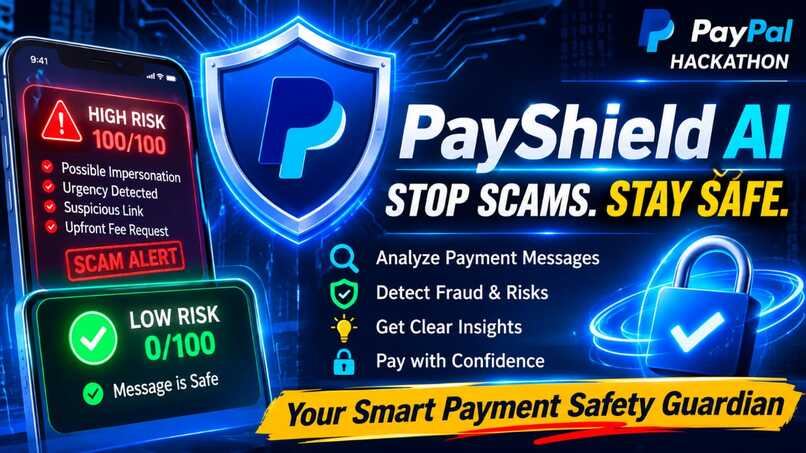
PayShield AI homepage
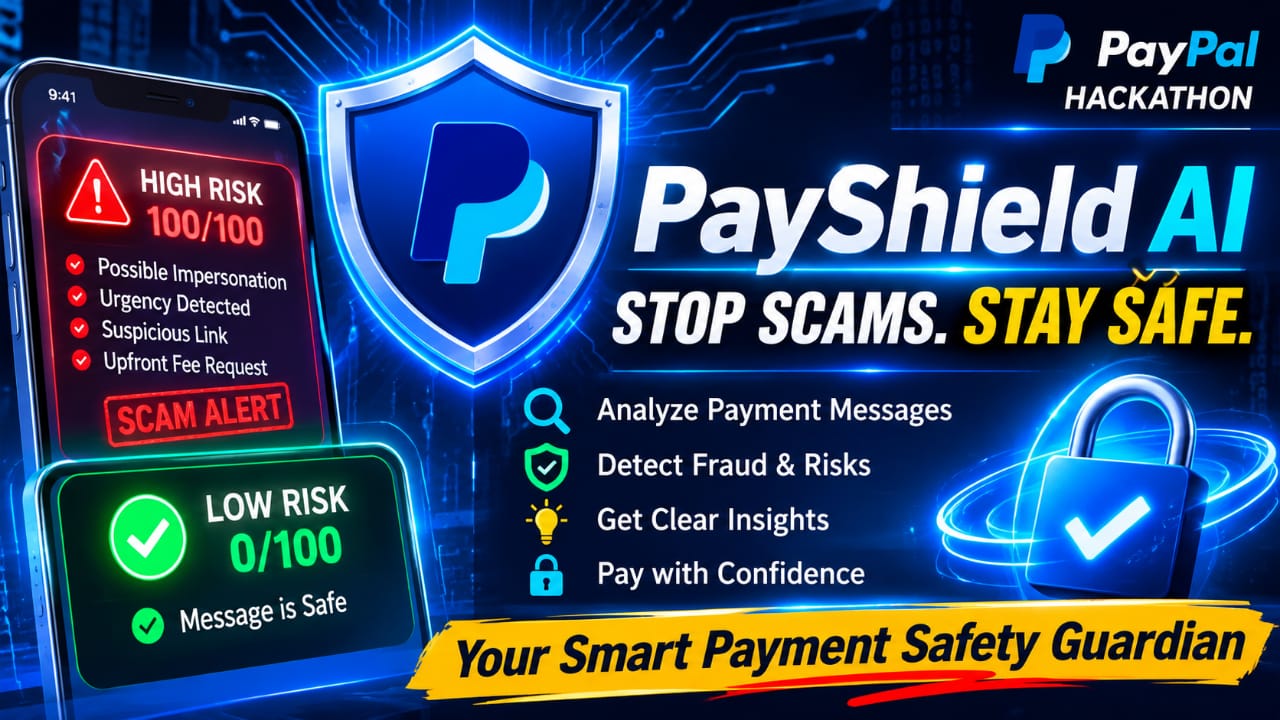
PayShield AI — Protect Before You Pay
Inspiration
Online payments have made shopping and sending money easier, but they have also created opportunities for phishing, fake payment messages, fraudulent links, and impersonation scams.
A message that looks like it came from PayPal can convince someone to click a suspicious link or share sensitive information. I wanted to build a project that helps people pause, identify warning signs, and make safer decisions before making a payment.
That idea inspired PayShield AI — a payment safety platform built around one simple principle: protect people before they pay.
What it does
PayShield AI helps users assess suspicious payment-related messages and links.
Its key features include:
- Message Risk Analyzer: Examines payment-related messages for suspicious language, urgency, credential requests, and possible phishing indicators.
- Smart URL Inspector: Checks links for suspicious domains, PayPal impersonation patterns, and insecure HTTP connections.
- Risk Assessment: Displays a risk score, risk category, and explanations of detected warning signs.
- Security Analytics Dashboard: Tracks analysis results and displays high-, medium-, and low-risk counts.
- Multilingual Support: Provides interface and warning translations in English, Hindi, Tamil, Telugu, and Kannada.
- PDF Reports: Allows users to generate downloadable security assessment reports.
- PayPal Sandbox Checkout: Demonstrates a separate test checkout flow through a backend connected to PayPal Sandbox.
How I built it
I developed PayShield AI as a web-based prototype using HTML, CSS, and JavaScript.
The frontend is hosted on GitHub Pages, while the backend is built with Node.js and Express and deployed on Render.
I implemented heuristic-based risk detection to identify suspicious patterns in messages and URLs. The results include risk scores and explanations so users can understand why a message or link may be suspicious.
I also integrated a PayPal Sandbox checkout flow. The backend securely handles order creation and payment capture, keeping PayPal credentials on the server rather than exposing them in the frontend.
The project also includes a security analytics dashboard, multilingual warnings, and PDF report generation.
Challenges I faced
Building this project involved several challenges:
False positives: Some harmless messages contain words such as password or payment details. I refined the detection logic to distinguish warnings from messages that explicitly say sensitive information is not being requested.
Backend deployment: Connecting the frontend to a Node.js backend required debugging deployment issues, environment variables, and API communication.
PayPal integration: Configuring Sandbox credentials and resolving authentication errors took careful testing. I eventually got the demo checkout working.
User experience: I wanted the risk results to be understandable, so I added clear explanations, analytics, translations, and downloadable reports.
Responsible security messaging: A risk score cannot guarantee that a payment or website is safe. I made sure the application communicates that its results are assessments, not guarantees.
What I learned
This project helped me understand how frontend and backend systems work together, how to deploy a web application, how to integrate payment APIs, and how to approach basic cybersecurity detection.
I also learned that building a security tool is not just about detecting suspicious activity. It is equally important to explain the findings clearly and avoid giving users a false sense of security.
What's next
I would like to improve PayShield AI with more advanced AI-powered threat analysis, stronger URL reputation checks, improved detection accuracy, and additional language support.
The current version is a working prototype. Its heuristic assessments are not a substitute for independent verification, and its PayPal integration is configured for Sandbox testing rather than real payments.
PayShield AI — Trust before you pay. Protect before you pay.
Built With
- css
- cybersecurity
- express.js
- html
- javascript
- node.js
- paypal
- phishing
- render
- sandbox
