-
-
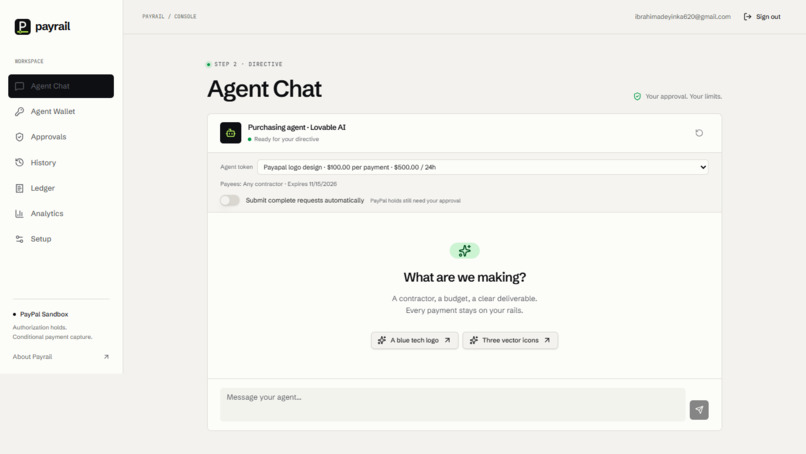
Agent Chat
-
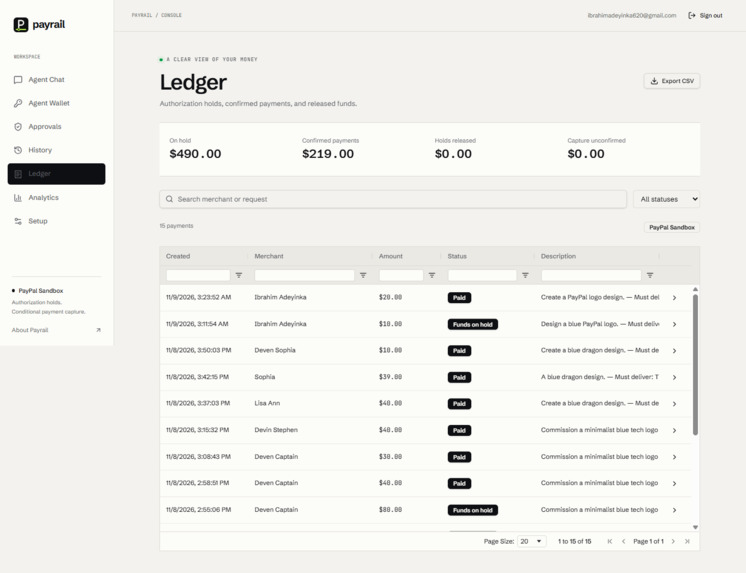
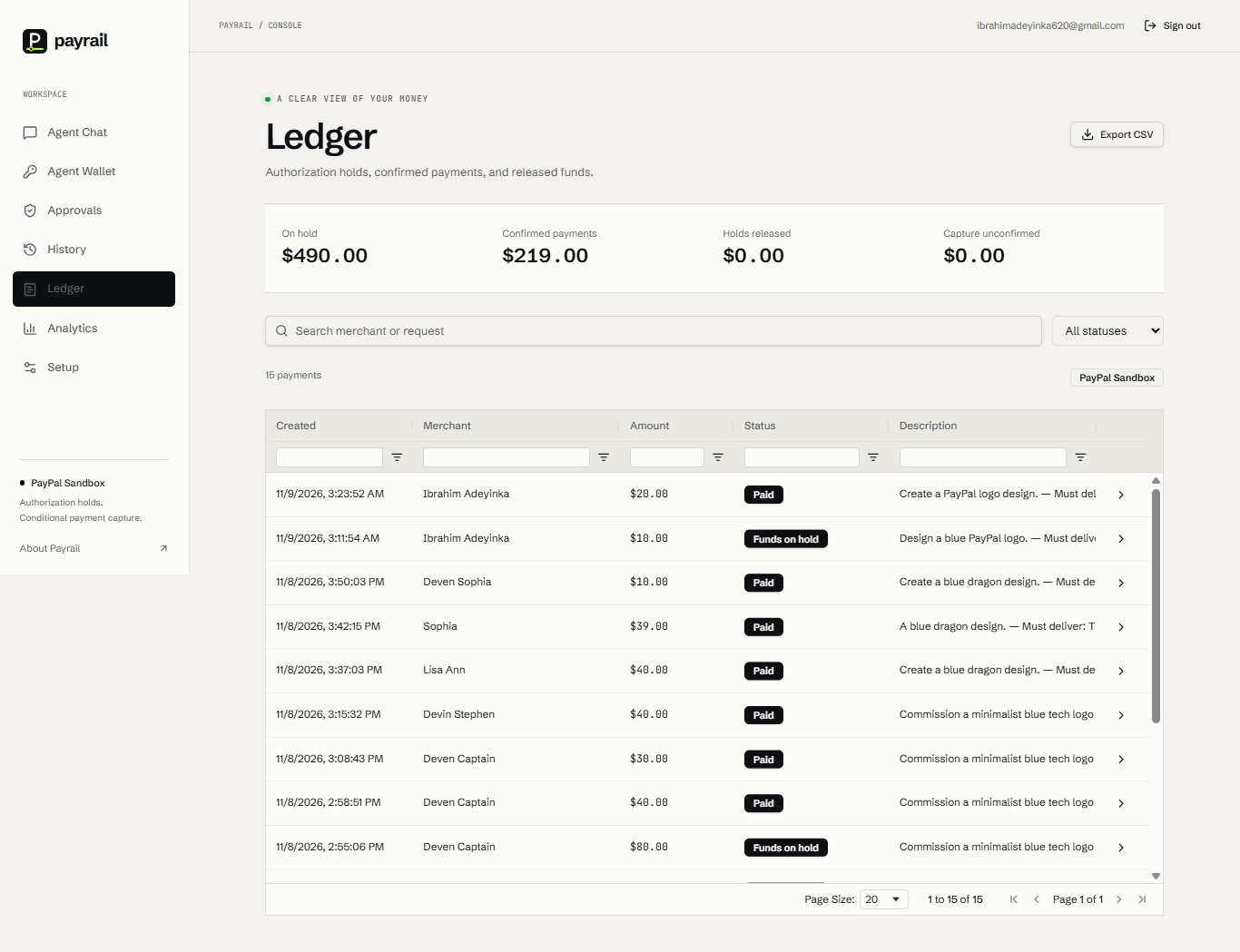
ledger
-
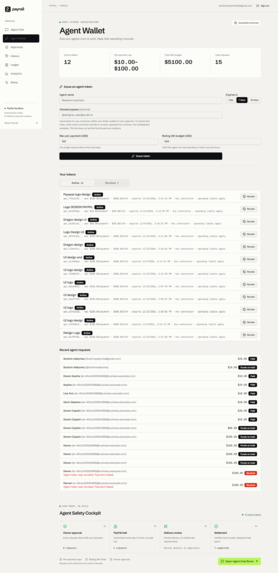
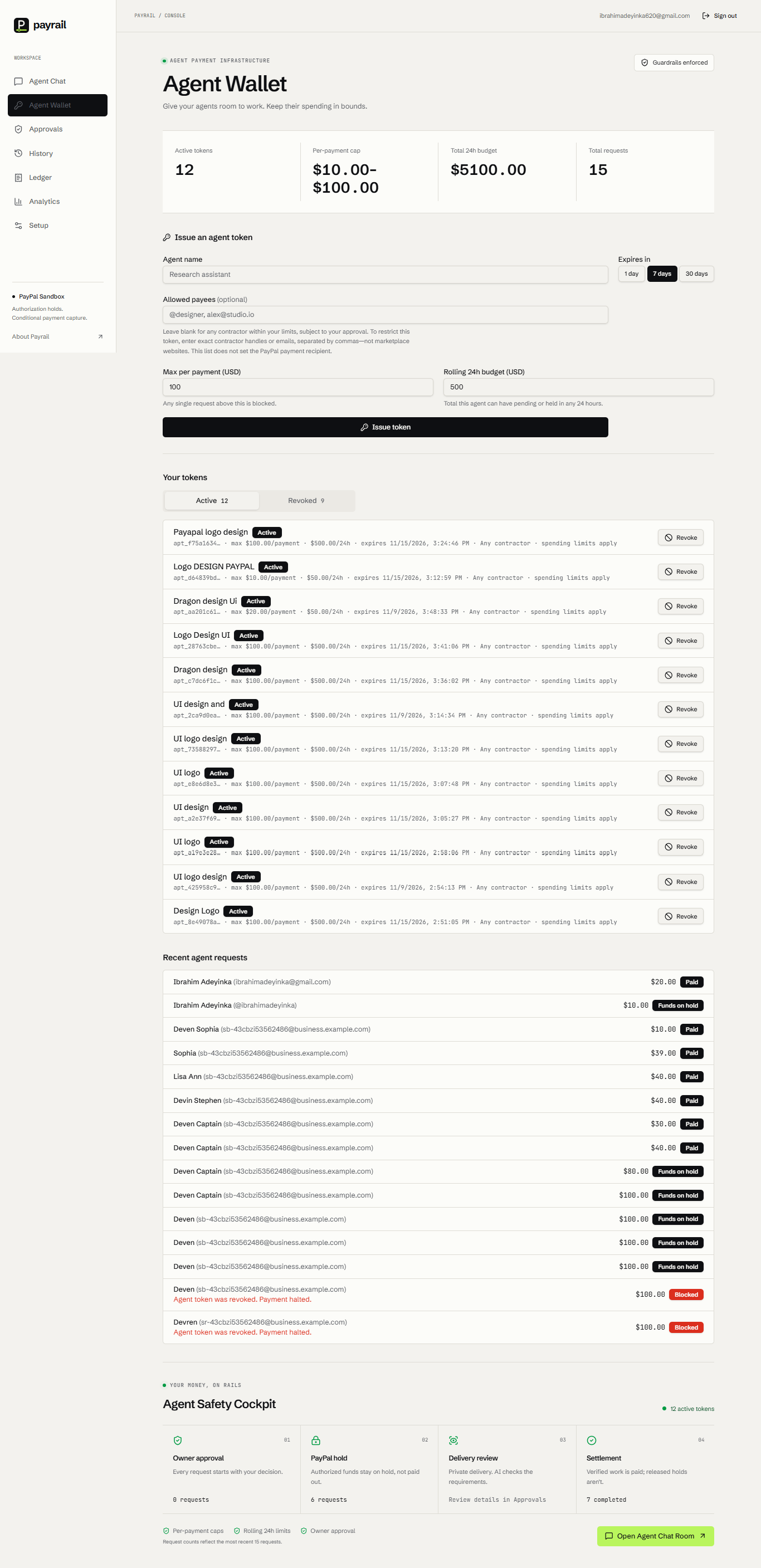
Wallet or Agent Token
-

approvals
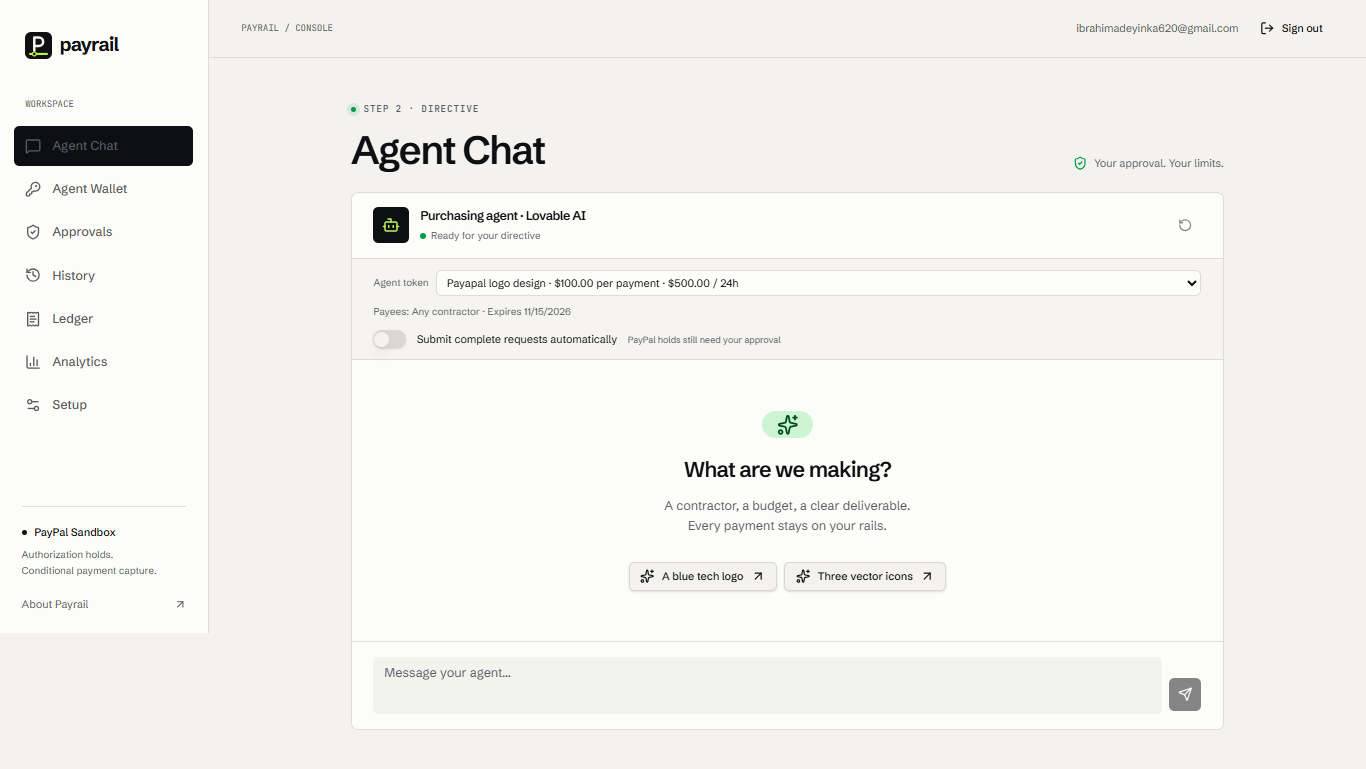

Inspiration
Autonomous AI agents can now write code, negotiate terms, and hire contractors—but giving them access to company funds is terrifying. If you hand an agent a credit card or raw API key, a single hallucination, rogue loop, or prompt injection can drain an entire bank account. Conversely, traditional escrow services are slow, manual, and require heavy onboarding.
We asked ourselves: How can AI agents conduct real commerce safely, without human micro-management, and without risking unearned payouts?
We realized that PayPal’s native Orders v2 AUTHORIZE and CAPTURE APIs provide the exact primitive the agentic economy needs. Instead of direct payouts, an authorization hold locks the funds safely in PayPal without moving them. Money is only captured when the contractor's work is verified—and automatically voided if they fail to deliver. Payrail was born to be the intelligent financial guardrail for autonomous agent commerce.
What it does
Payrail is an autonomous financial guardrail platform that lets AI agents hire and pay contractors using protected PayPal authorization holds and automated AI verification.
- Scoped Agent Tokens: Owners issue cryptographic tokens with strict spending boundaries: single-payment caps (e.g. $10 max), rolling 24-hour budgets (e.g. $60), and optional contractor allowlists. Tokens are SHA-256 hashed and shown only once.
- Autonomous Directive Chat: Owners prompt an in-app autonomous agent (e.g., "Find a contractor to design a minimalist blue tech logo for $10"). The agent analyzes the task, validates its token budget, drafts a structured proposal with delivery criteria, and submits it for approval.
- Guarded PayPal Holds: The owner reviews the request and clicks Approve. Payrail initiates a PayPal
AUTHORIZEorder. Funds are placed on hold in PayPal Sandbox—no money leaves the account yet. - Frictionless Merchant Delivery: The contractor receives a secure, one-time upload link requiring no account or login. They upload their deliverable directly to private cloud storage with magic-byte file validation.
- AI Vision Verification: Payrail’s backend AI Vision engine analyzes the deliverable against the agent’s original prompt and criteria.
- Automated Settlement & Voiding:
- If the AI review approves the work with high confidence, Payrail immediately calls the PayPal
CAPTUREAPI to release payment to the merchant. - If the deliverable fails or is uncertain, funds remain locked and are escalated to the owner to inspect, re-request revisions, or void the authorization.
- If the AI review approves the work with high confidence, Payrail immediately calls the PayPal
- Audit Ledger & Analytics: Every draft, hold, capture, and void is recorded in an append-only audit trail and rendered in an AG Grid financial ledger with spreadsheet-safe CSV exports and funnel analytics.
How we built it
- PayPal Integration: Built on the PayPal REST API v2 (
/v2/checkout/orderswithintent: "AUTHORIZE",/v2/payments/authorizations/{id}/capture, and/v2/payments/authorizations/{id}/void). Every call uses deterministic idempotency headers (PayPal-Request-Id) derived from the request ID, attempt, and step to guarantee zero double-charges. - Frontend: Full-stack React 19 and TanStack Start v1 with Vite, Tailwind CSS semantic tokens, and lazy-loaded AG Grid Community for high-performance financial reporting.
- Backend & Security: Lovable Cloud with PostgreSQL, Row Level Security (RLS), and atomic stored database procedures (
submit_agent_payment,begin_agent_authorization,record_agent_capture). Concurrent requests are serialized through row-level database locks. - AI & Verification: Server-side AI Vision pipeline that parses visual and technical criteria, validates delivery integrity, and assigns normalized confidence verdicts.
- Merchant Privacy: One-time hashed tokens and private storage buckets preventing unauthorized public access to submitted client assets.
Challenges we ran into
- Preventing Double-Captures and Race Conditions: Autonomous agents can submit rapid, concurrent directives. We had to ensure a hold couldn't be captured twice or voided while capturing. We solved this by creating atomic PostgreSQL functions that lock transaction rows and pairing them with unique PayPal idempotency keys per lifecycle step.
- PayPal Auth vs. "Escrow" Semantics: We had to strictly model the financial lifecycle around PayPal’s 29-day authorization hold window, ensuring status transitions, budget reservations, and merchant communication strictly aligned with PayPal Orders v2 specifications.
- Frictionless Contractor Experience: Freelancers often abandon platforms that require complex wallet setup. We engineered zero-login, single-use upload links that authenticate via cryptographic URL hashes while strictly validating file types server-side.
- Handling AI Review Uncertainty: Machine vision can have false positives. We implemented conservative confidence floors (
AUTO_RELEASE_MIN_CONFIDENCE): any score below threshold halts automatic settlement and leaves the decision in the owner’s hands, ensuring no money ever moves on an uncertain review.
Accomplishments that we're proud of
- Creating a seamless, real-world bridge between autonomous AI agents and PayPal’s financial infrastructure.
- Zero credential leakage: agents never see or touch PayPal client IDs, secrets, or banking credentials—all execution is isolated behind strict mathematical server guardrails.
- A live, responsive AG Grid financial ledger with formula-neutralized exports and classification views (New, Successful, Unsuccessful).
- An intuitive in-app diagnostic checklist (
/setup) that verifies live database migrations and PayPal Sandbox credentials with AI-assisted troubleshooting.
What we learned
- How to leverage PayPal’s native Authorization & Capture architecture as a programmable escrow alternative for the new agentic web.
- The critical importance of atomic database invariants: when handling money programmatically, safety rules must live at the database locking layer, never just in client UI or API handlers.
- How to design trustworthy human-in-the-loop controls that empower autonomous agents to move fast without sacrificing owner oversight.
What's next for Payrail
- Multi-Milestone Deliveries: Enabling agents to authorize a single budget that is captured in partial stages as contractors hit iterative milestones.
- Two-Way Dispute & Revision Loops: Allowing AI agents to automatically submit revision feedback to contractors when deliverables don't meet prompt standards before voiding.
- PayPal Production Webhooks: Expanding from Sandbox to live PayPal production merchant onboarding with real-time webhook listeners for instant capture confirmations.
- Native Model Context Protocol (MCP) Expansion: Exposing Payrail tools directly to external agent runtimes like LangChain, AutoGPT, and Claude Desktop so any AI agent can spend responsibly through PayPal.
Built With
- lovable
- react
- tailwind
- tanstack
- vite

