-
-
UI/UX
Inspiration Every day, millions of online merchants leave revenue on the table. Traditional payment dashboards are strictly retrospective: they tell store owners what happened last week or last month, but leave the hardest decisions—adjusting product prices, clearing stale inventory, and protecting profit margins—to manual guesswork and tedious CSV exports. We wanted to shift merchants from reactive reporting to autonomous execution. Inspired by the emergence of AI agentic workflows and the rich financial ecosystem of the PayPal Developer Platform, we set out to build a tool that doesn't just display merchant data, but actively thinks, recommends, and executes profit-maximizing store actions.
What it does PayPulse AI is an intelligent merchant financial and dynamic pricing engine that bridges real-time PayPal transactional data with AI reasoning:
Live PayPal Analytics: Ingests revenue, transaction velocity, refund rates, and active catalog products directly via PayPal Sandbox REST APIs.
AI Dynamic Pricing Engine: Calculates price elasticity and stock velocity to suggest optimal, margin-maximizing item price adjustments.
One-Click Catalog Execution: Enables merchants to push AI-suggested price changes straight back to their live PayPal catalog in a single click.
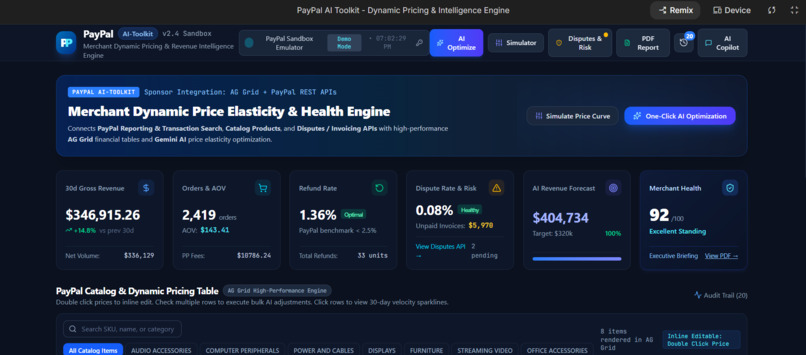
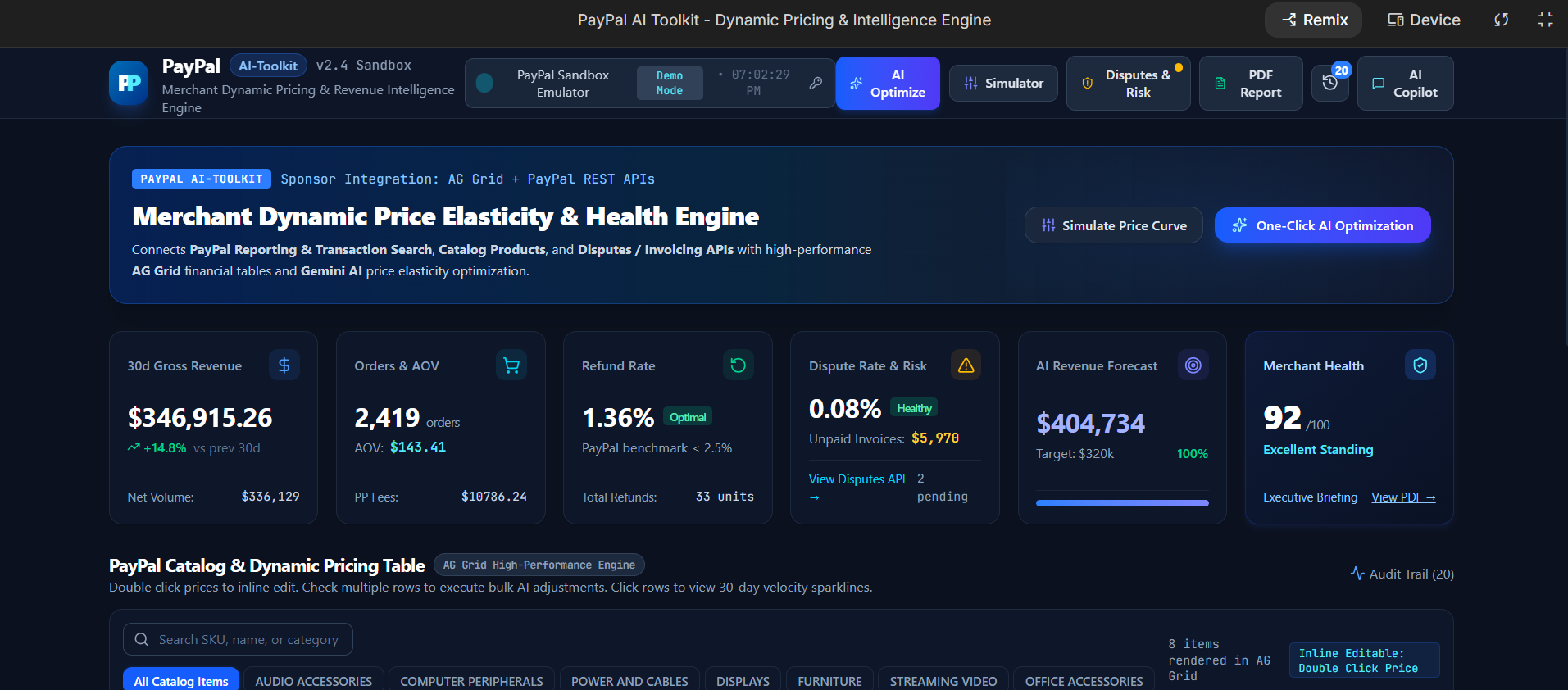
Interactive AG Grid Interface: Displays store health in a high-performance matrix featuring inline editing, conditional formatting, bulk price approvals, and mini trend charts.
Chat-with-Your-Store Assistant: A natural language interface allowing merchants to ask complex financial questions (e.g., "Which items have high refund rates?") and receive instant data-backed answers.
How we built it Backend: Built with Python (FastAPI) to process financial logic, manage API orchestration, and handle asynchronous tasks.
PayPal Integration: Connected directly to the PayPal Developer Sandbox REST APIs—specifically the Transaction Search API, Catalog Products API, Orders API, and Disputes API.
AI Architecture: Implemented an LLM agent layer using Function Calling (Tools) to parse raw transactional metrics, run price elasticity calculations, and execute catalog updates.
Frontend UI: Developed with React / Next.js and integrated AG Grid Enterprise to deliver smooth, high-performance tabular data rendering with row expansion and inline cell controls.
Challenges we ran into API Payload Reconciliation: Mapping real-time PayPal Sandbox transactional outputs into consistent structured formats for both the AI model and AG Grid required careful schema normalization.
Safe AI Function Calling: Ensuring the AI agent makes reliable, bounded pricing recommendations without introducing extreme price swings or unauthorized catalog changes required strict system guardrails and approval thresholds.
Latency Optimization: Balancing multi-endpoint PayPal API calls with LLM inference while maintaining an instantaneous, responsive dashboard UI.
Accomplishments that we're proud of Successfully completing the full loop: fetching live PayPal Sandbox data, passing it through an AI reasoning engine, and updating the catalog back on PayPal seamlessly in a single click.
Building a high-density, real-time financial interface powered by AG Grid that feels like an institutional-grade financial terminal.
Creating a practical, merchant-first AI application that addresses actual bottom-line profitability rather than serving as a decorative chatbot.
What we learned How to leverage PayPal's extensive developer ecosystem (Reporting, Catalog, and Disputes APIs) to extract actionable business intelligence.
Best practices for designing agentic AI systems that perform structured actions against external production REST APIs securely.
How to combine high-volume grid rendering (AG Grid) with conversational AI interfaces to build intuitive user workflows.
What's next for PayPulse AI Automated Competitor Scraping: Integrating live web-scraping agents to benchmark merchant pricing against real-time market competitor data.
Multi-Store Aggregation: Expanding the backend architecture to support merchants managing multiple PayPal seller accounts across different currencies.
Predictive Inventory Reordering: Extending the AI elasticity engine to forecast inventory stockouts and automatically trigger vendor reorders before stock runs dry.

