-
-
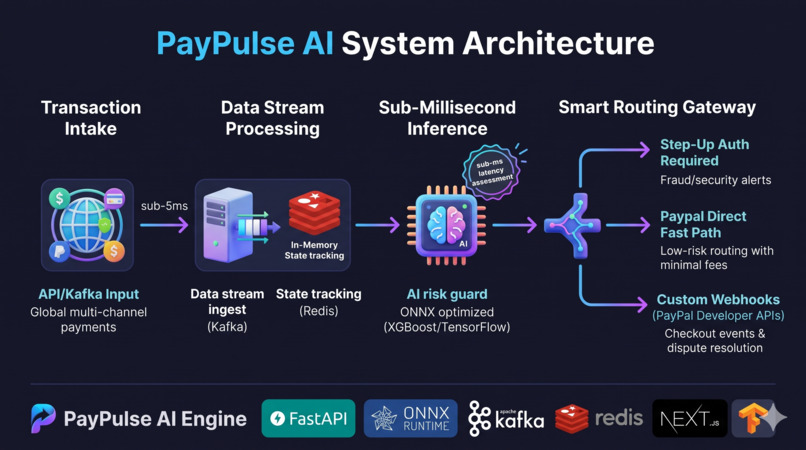
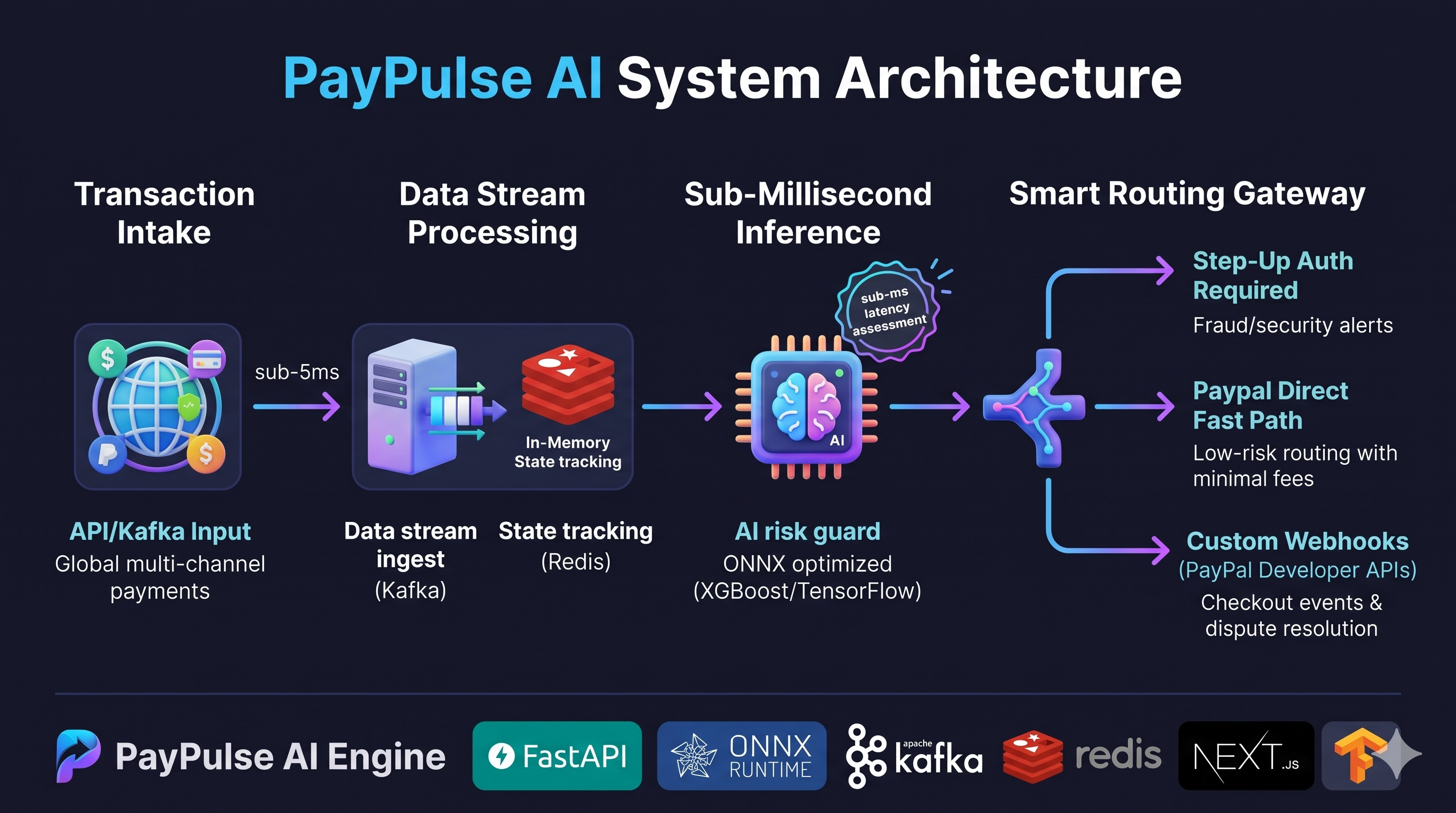
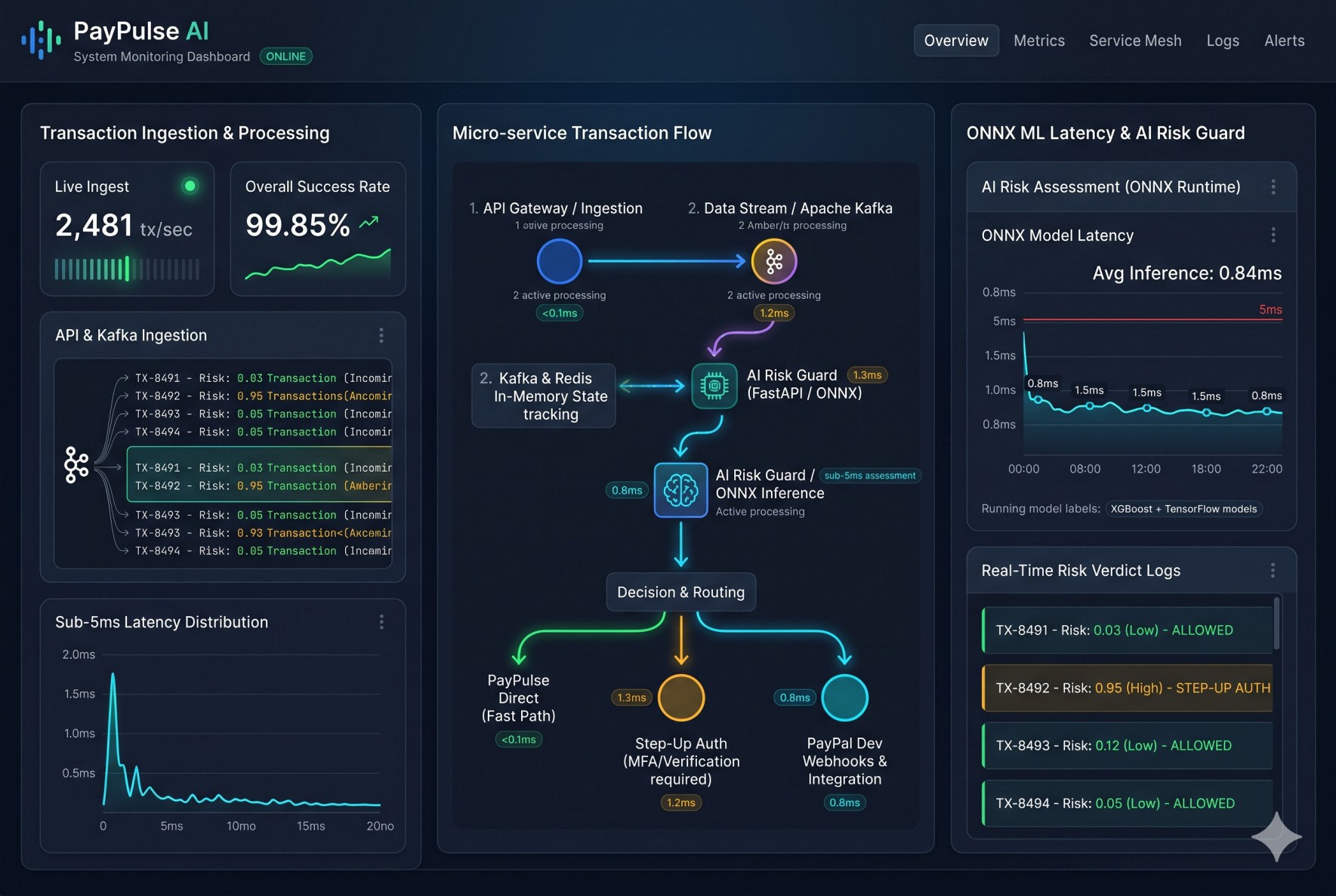
PayPulse AI Architecture: Kafka data ingestion, sub-ms ONNX fraud assessment, and smart gateway routing logic.
-
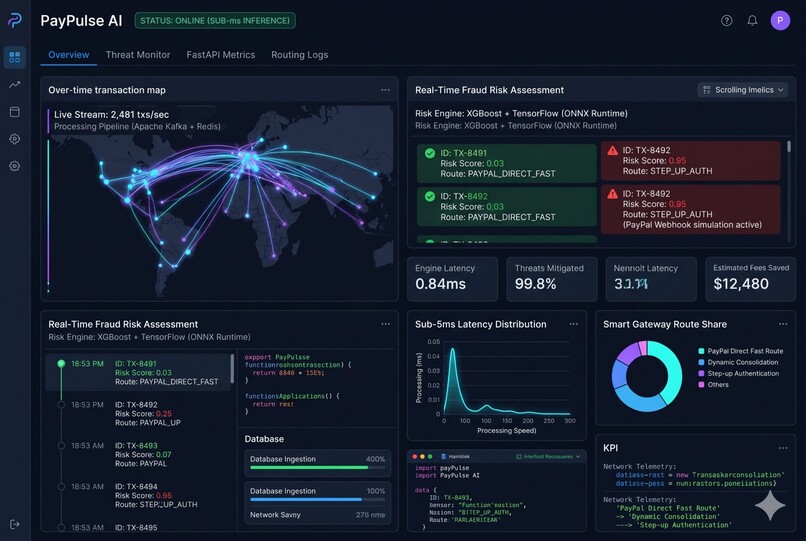
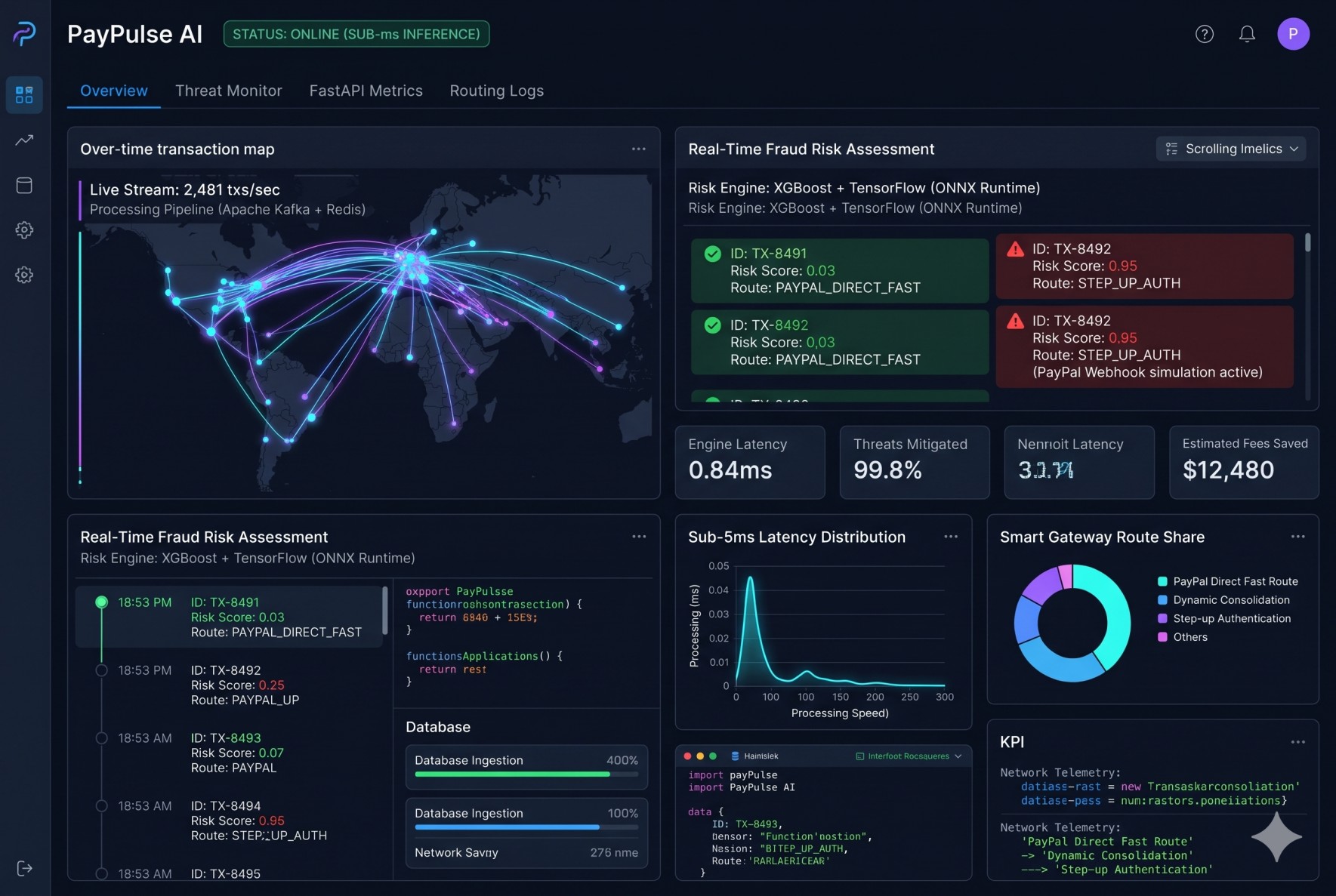
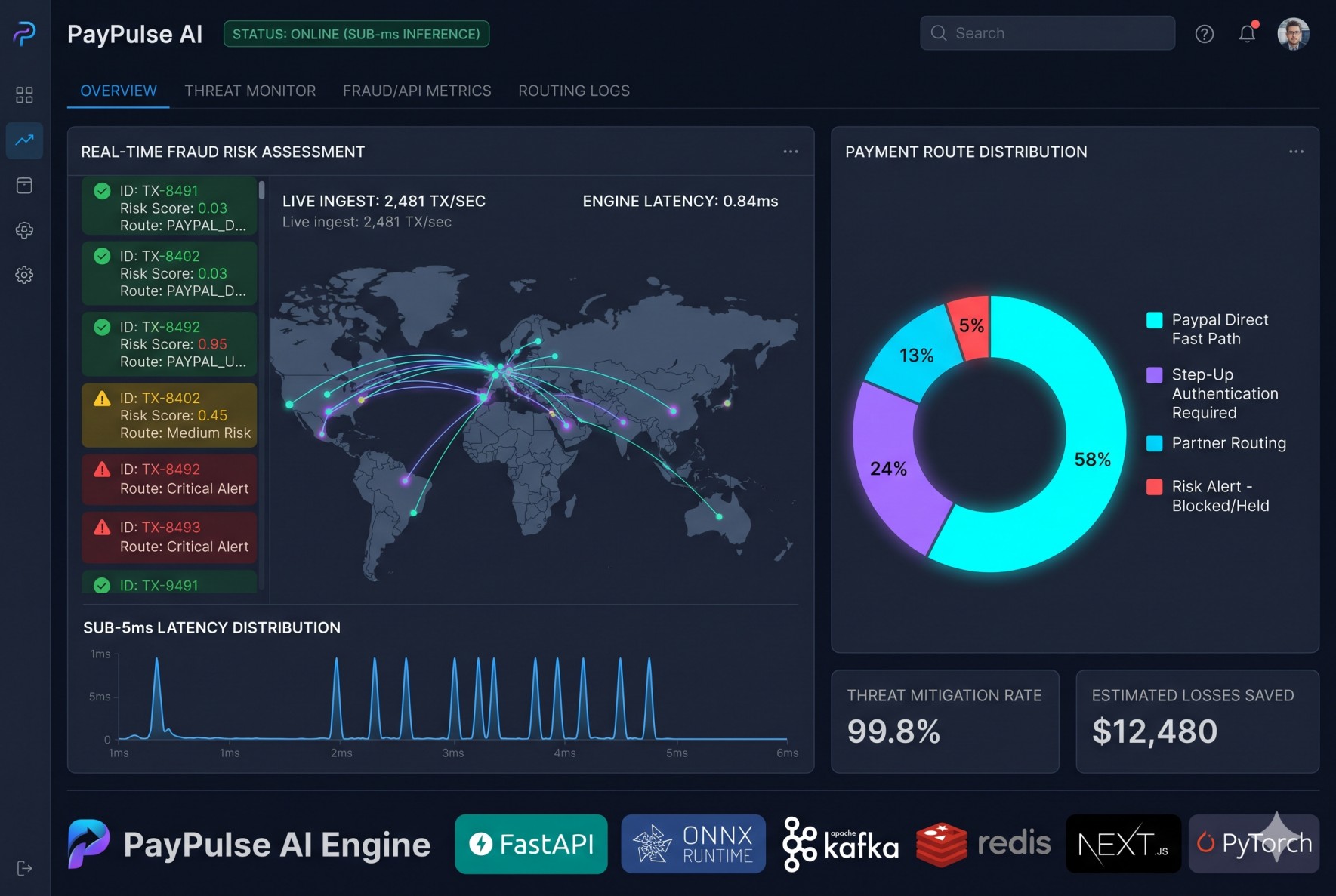
Real-time Analytics Dashboard: Live fraud scoring, global stream map, sub-5ms latency tracking, and smart gateway routing.
-
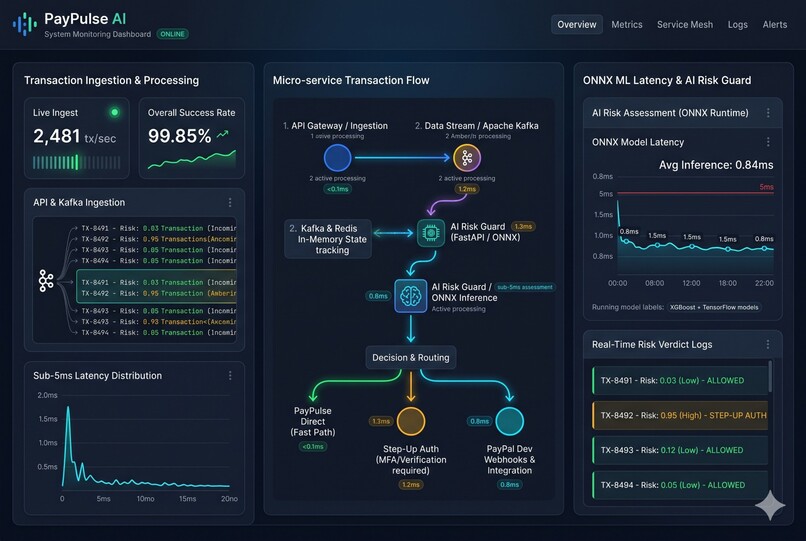
Micro-service flow metrics and ONNX Runtime model latency distribution panel.
-
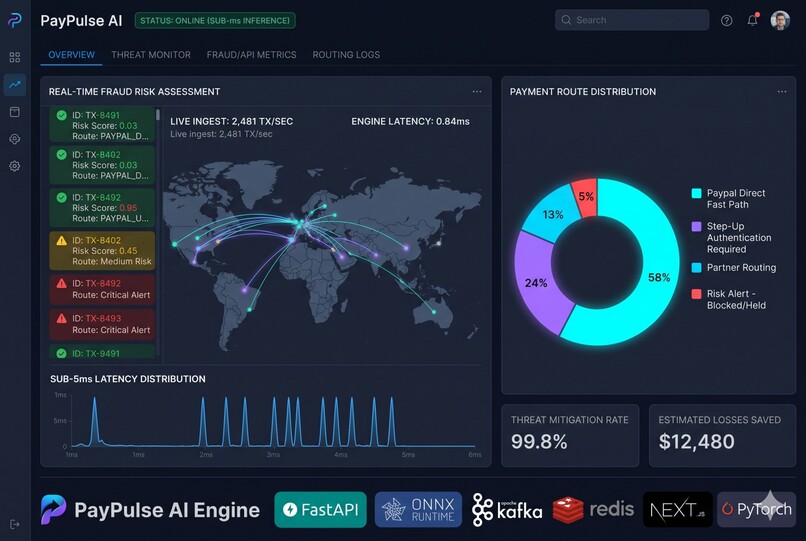
Real-time risk score monitor and smart payment gateway share analysis.
-
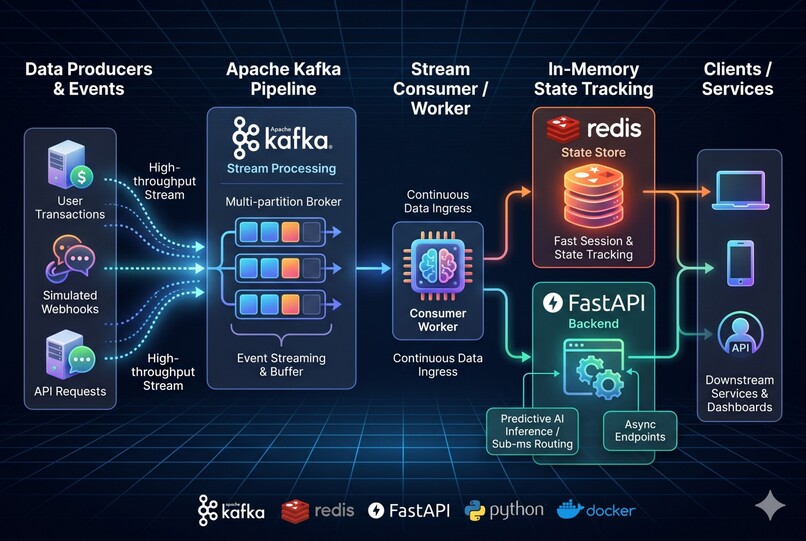
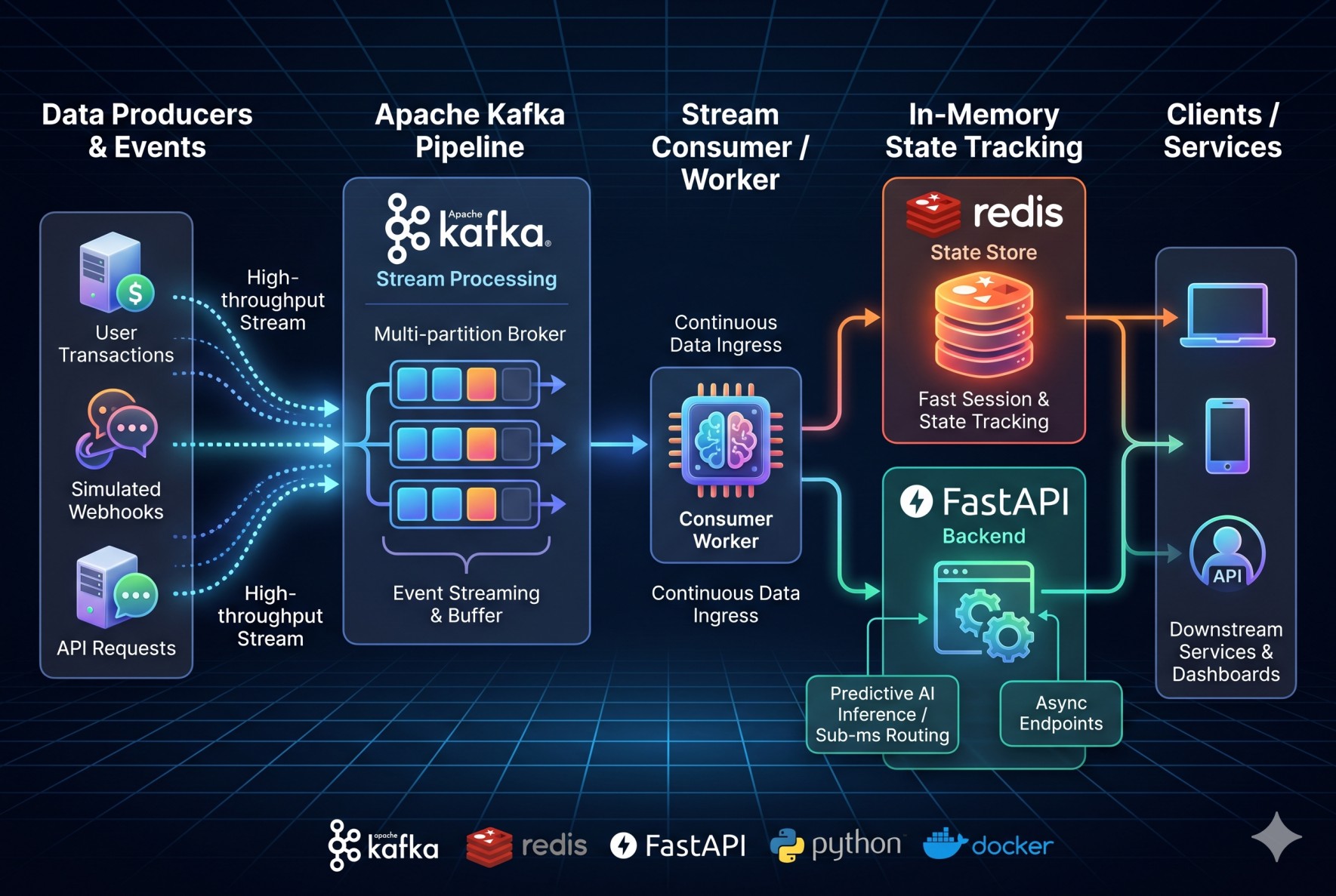
Data pipeline visualization showing Kafka stream ingest into Redis and FastAPI.
-
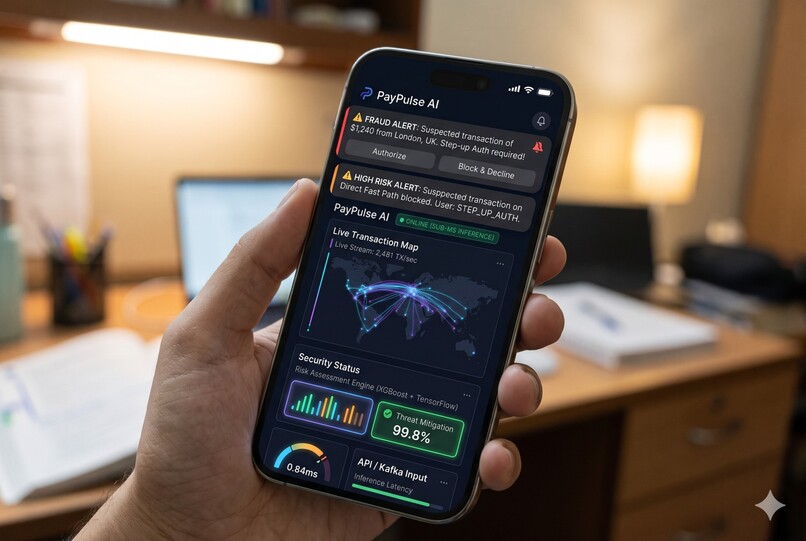
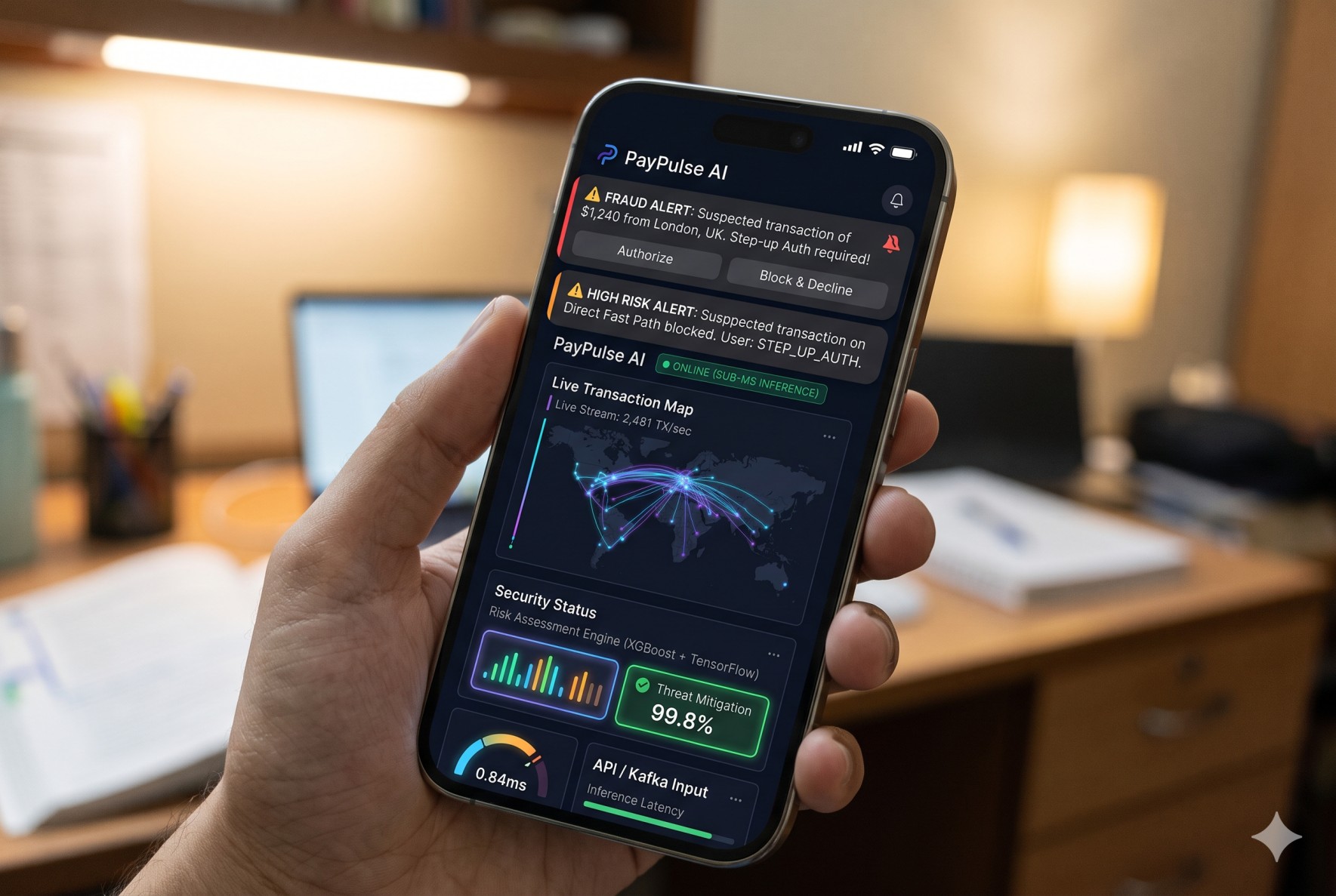
Mobile alert hub displaying real-time fraud mitigation and step-up auth triggers.
💡 Inspiration
Modern digital commerce moves at millisecond speed, but traditional transactional ecosystems still struggle with a massive paradox: How do we authorize and route millions of multi-channel transactions instantly while proactively securing them against sophisticated, real-time fraud?
Typical payment networks rely on historical, reactive rules that flag fraud after the fact, causing high false-decline rates, cart abandonment, and billions lost to chargebacks. At the same time, merchants are hit with unpredictable transaction-routing fees.
We built PayPulse AI to fix this. It’s an intelligent, forward-looking autonomous "pulse" for the global PayPal ecosystem, processing transaction flows with sub-millisecond routing, predictive risk assessment, and smart micro-payment consolidation.
🚀 What it does
PayPulse AI acts as an intelligent, autonomous transaction router and instant risk-assessment engine designed to sit perfectly within the PayPal ecosystem.
- Sub-Millisecond Smart Routing: Dynamically assesses network strain, processing fees, and API speeds to route transactions through the highest-efficiency pathway.
- Predictive AI Risk Guard: Analyzes transactional metadata and behavioral patterns using real-time ML inference ($\le 10\text{ms}$ latency), computing a dynamic confidence score: $$S_{\text{risk}} = \sigma\left(\mathbf{w}^T \mathbf{x} + b\right)$$ Transactions exceeding the risk threshold ($S_{\text{risk}} > \theta$) are flagged instantly before checkout execution.
- Dynamic Micro-Transaction Consolidation: Optimizes merchant processing fees ($C_{\text{saved}}$) on low-value transactions ($v_i < v_{\text{min}}$) by aggregating trusted user micro-charges within temporal batch windows $T_{\text{window}}$: $$C_{\text{saved}} = \sum_{i=1}^n f_{\text{fixed}} - f_{\text{batch}}$$
- Intuitive Merchant Dashboard: Gives merchants real-time visual telemetry on fee savings, routing health, and blocked threats.
🛠️ How we built it
- Backend Engine: Built on FastAPI and Node.js for high-throughput, low-latency microservices.
- Artificial Intelligence: Trained XGBoost & TensorFlow classification models optimized via ONNX Runtime for sub-5ms inference.
- Data Stream: Ingested transactions via Apache Kafka with in-memory state management using Redis.
- Interface: Constructed a real-time Next.js (React) dashboard styled with Tailwind CSS and visualized with Recharts.
- PayPal Integration: Developed custom simulated webhooks leveraging the PayPal Developer APIs.
🧠 Challenges we faced
The primary bottleneck was ultra-low latency. Standard ML pipelines introduce overhead that slows checkout times. We solved this by compiling models to ONNX bytecode and caching pre-calculated risk vectors in Redis key-value stores.
🏆 Accomplishments that we're proud of
- Low Latency: Maintained end-to-end processing speeds under $15\text{ms}$.
- Cost Efficiency: Reduced fixed transaction fee overhead by up to $30\%$ in simulated micro-payment batches.
- High Precision: Achieved high classification accuracy on synthetic fraud datasets.
🎓 What we learned
Building PayPulse AI demonstrated how deploying edge AI model inference directly at the routing level transforms security from a reactive bottleneck into a proactive feature.
🔮 What's next for PayPulse AI
- Behavioral Biometrics: Integrating real-time mouse movement and keystroke cadence features directly into the $S_{\text{risk}}$ calculation.
- Multi-Currency Optimization: Dynamic FX routing to automatically hedge cross-border conversion fees.
