
PayProof AI
Evidence-first AI payment verification for small online sellers
The problem
For a small online seller, receiving a payment notification is not the same as having reliable evidence that an order has been paid.
Customer orders often arrive through informal messages. Sellers must interpret product requests, confirm quantities and prices, match transactions to orders, and determine whether a payment is genuinely complete. This process can become confusing, especially when references are missing, amounts do not match, or payment information is incomplete.
AI can help interpret customer messages, but allowing an AI model to decide whether money has been received introduces a serious trust problem.
PayProof AI was built around a different principle: AI can assist with understanding information, but payment status must be established through verifiable payment evidence.
Our solution
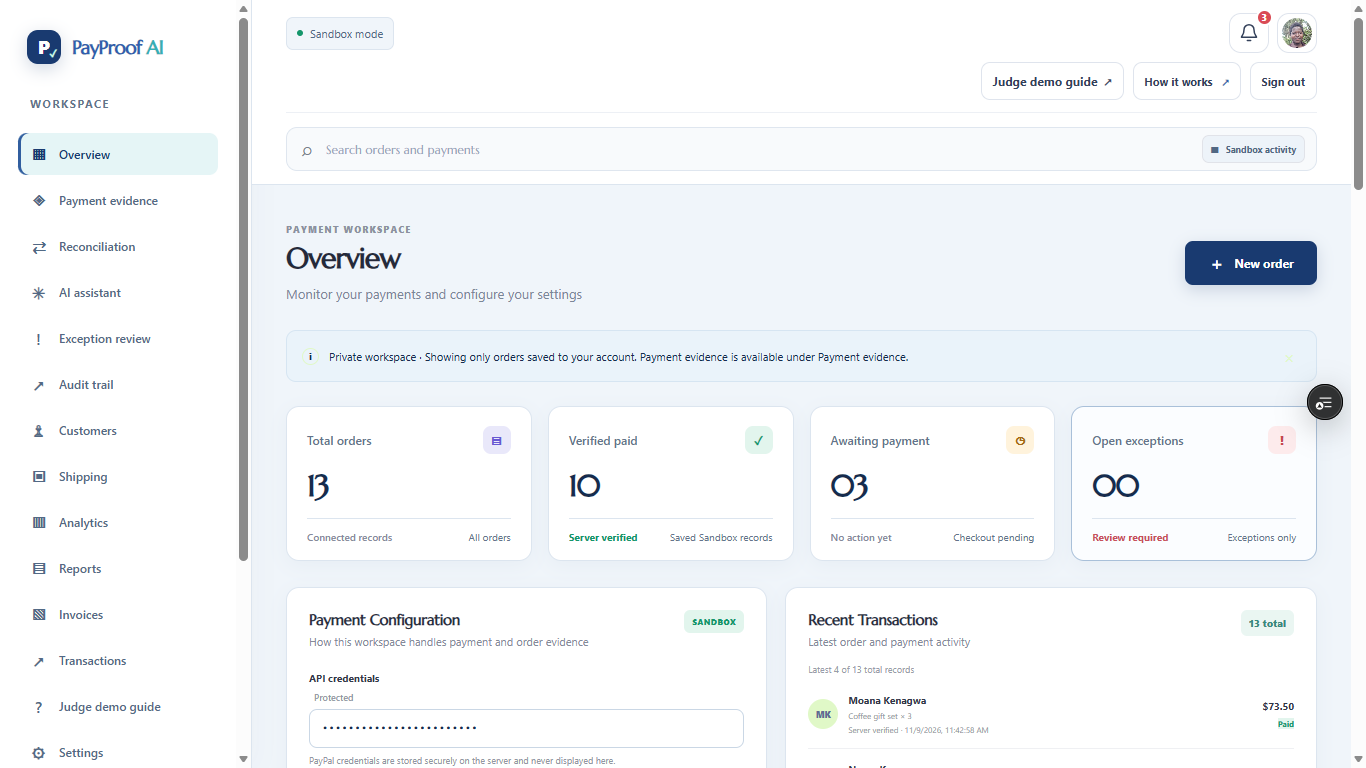
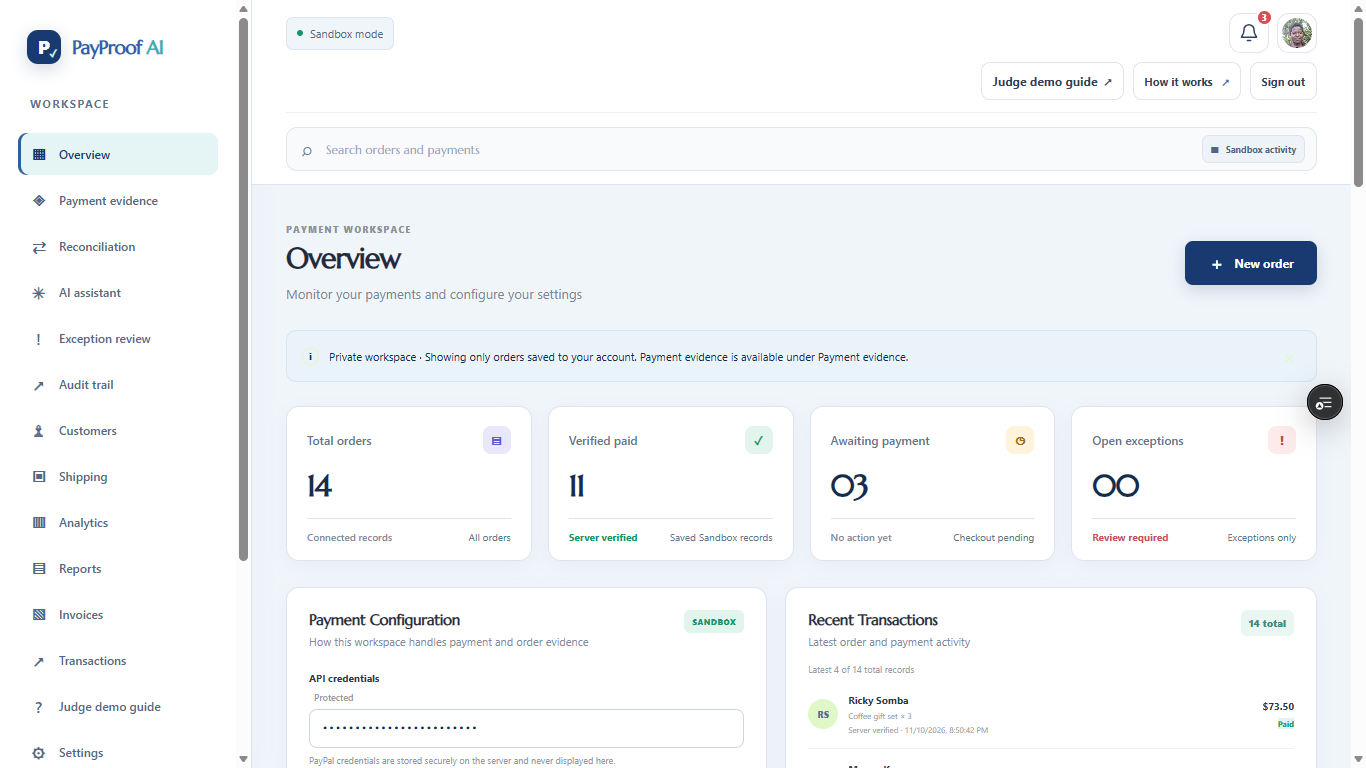
PayProof AI is an evidence-first AI payment verification prototype designed to help small online sellers move from customer messages to reviewable orders and verified PayPal Sandbox payment records.
It brings together AI-assisted order preparation, deterministic validation, PayPal checkout, server-side payment verification, and evidence-oriented review in one workflow.
The central design principle is:
Evidence first. AI explains the record. Verified payment data decides.
How it works
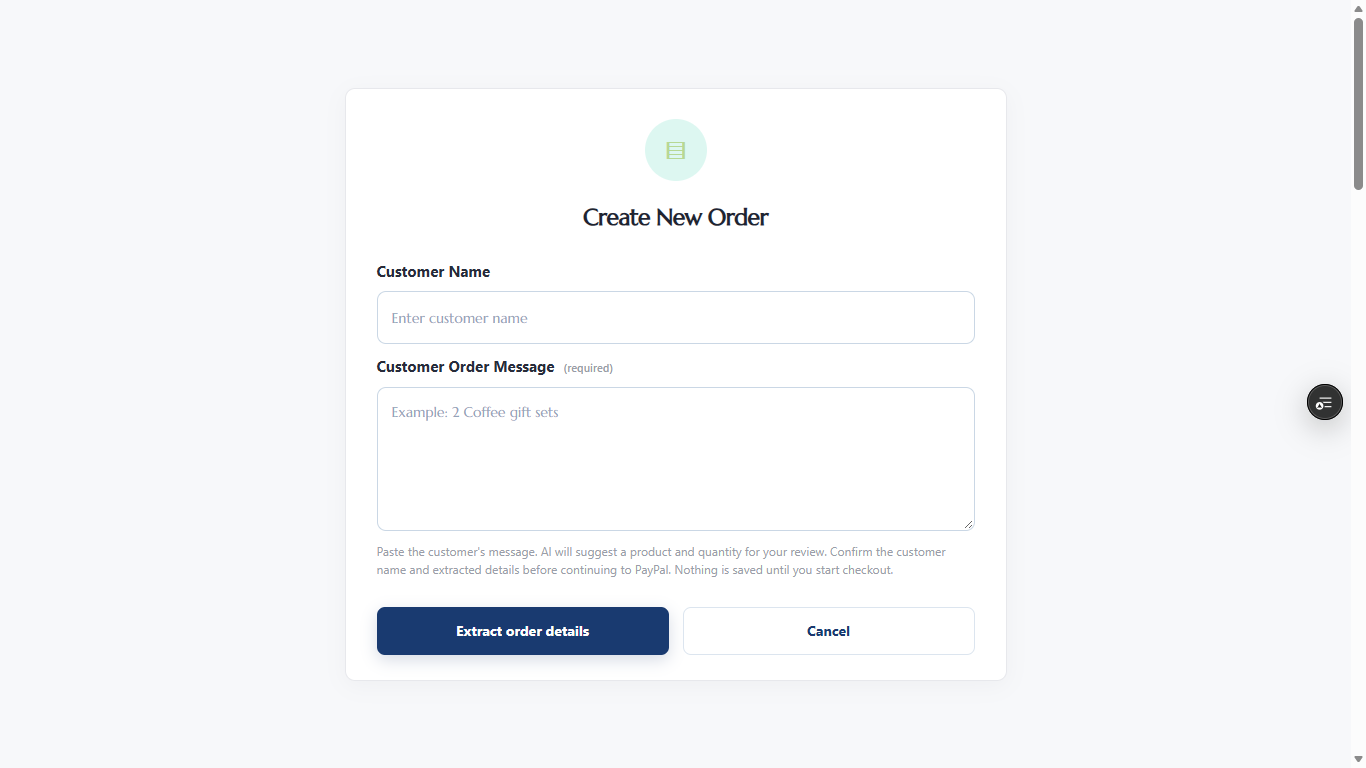
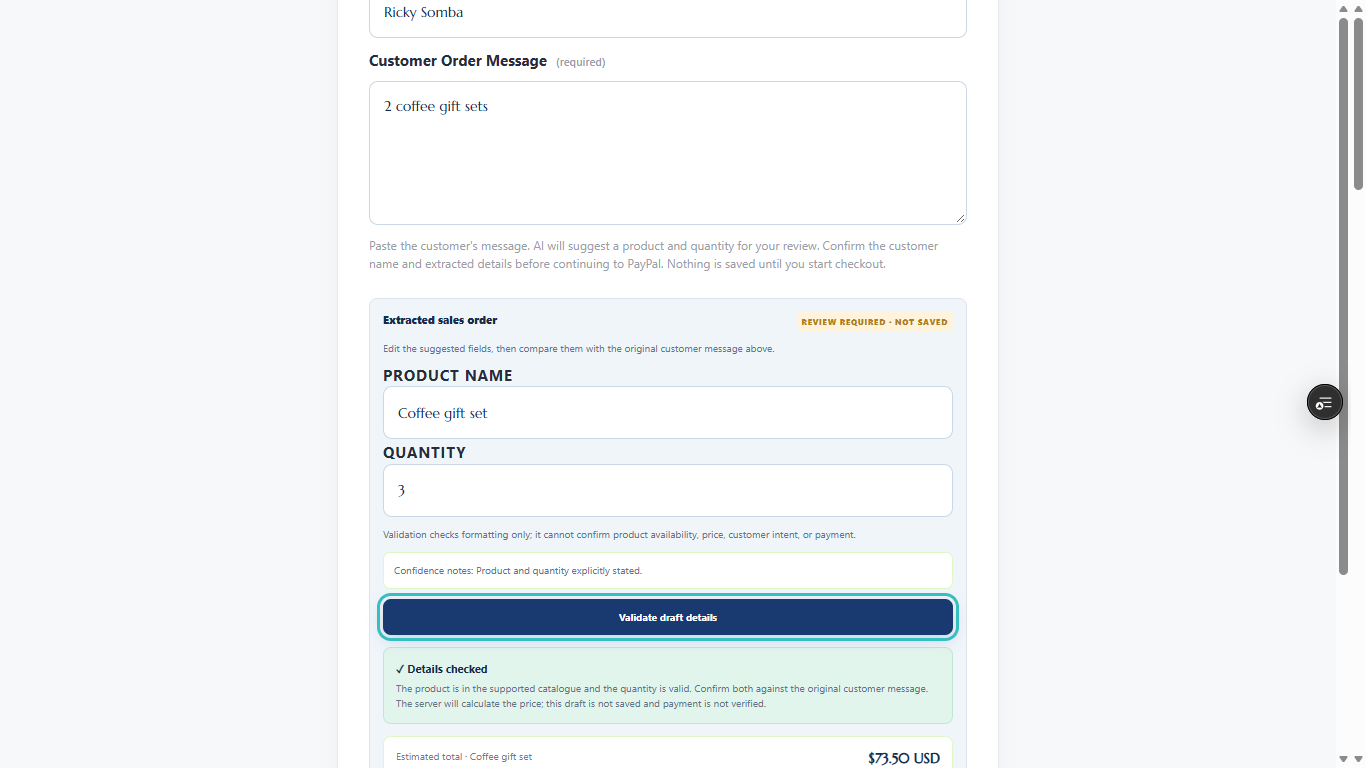
Turn messages into structured orders. A customer can provide order details in natural language. AI extracts proposed product and quantity information into a structured draft.
Keep the seller in control. The seller reviews the extracted information before proceeding. AI-generated details are treated as suggestions, not trusted payment instructions.
Validate the order deterministically. Application logic checks the selected catalogue items and calculates the expected order total. This keeps important commercial calculations outside the language model.
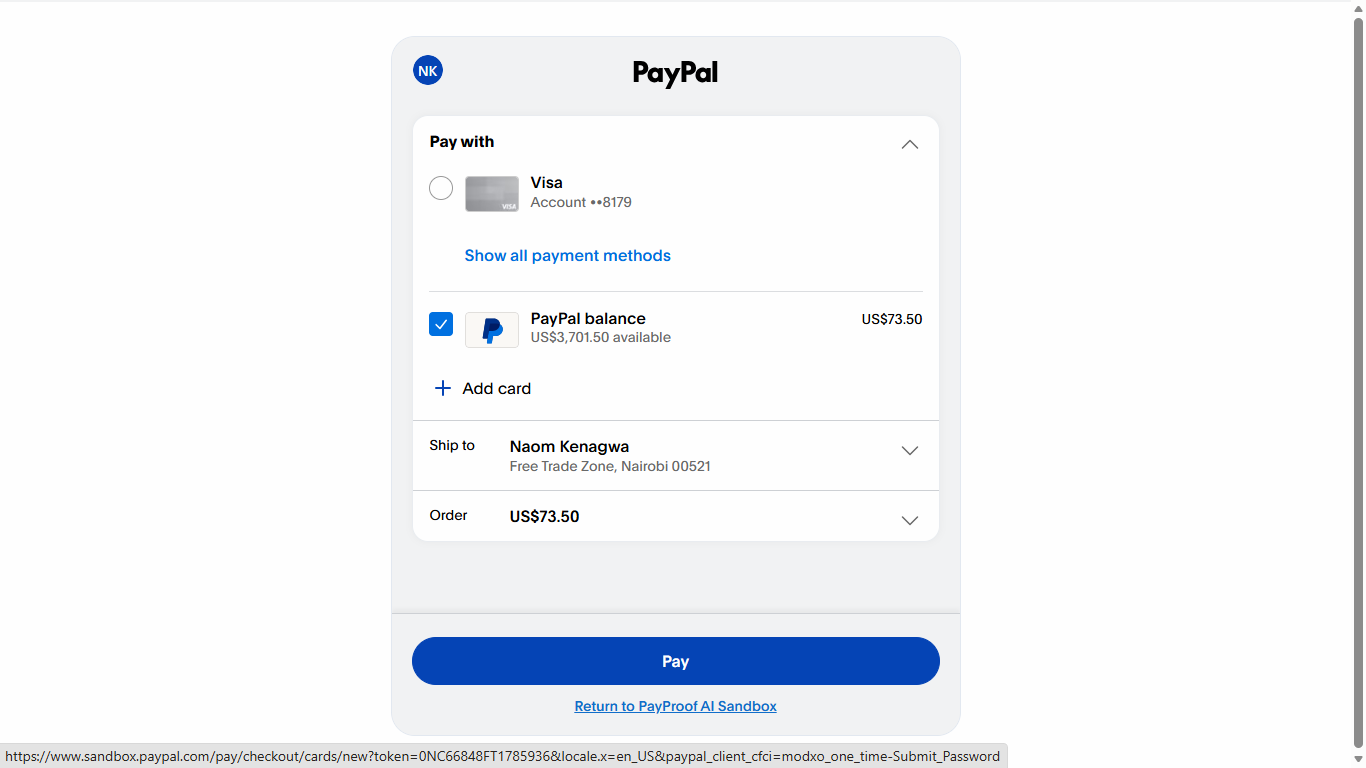
Complete PayPal Sandbox checkout. The customer proceeds through the PayPal Sandbox payment flow.
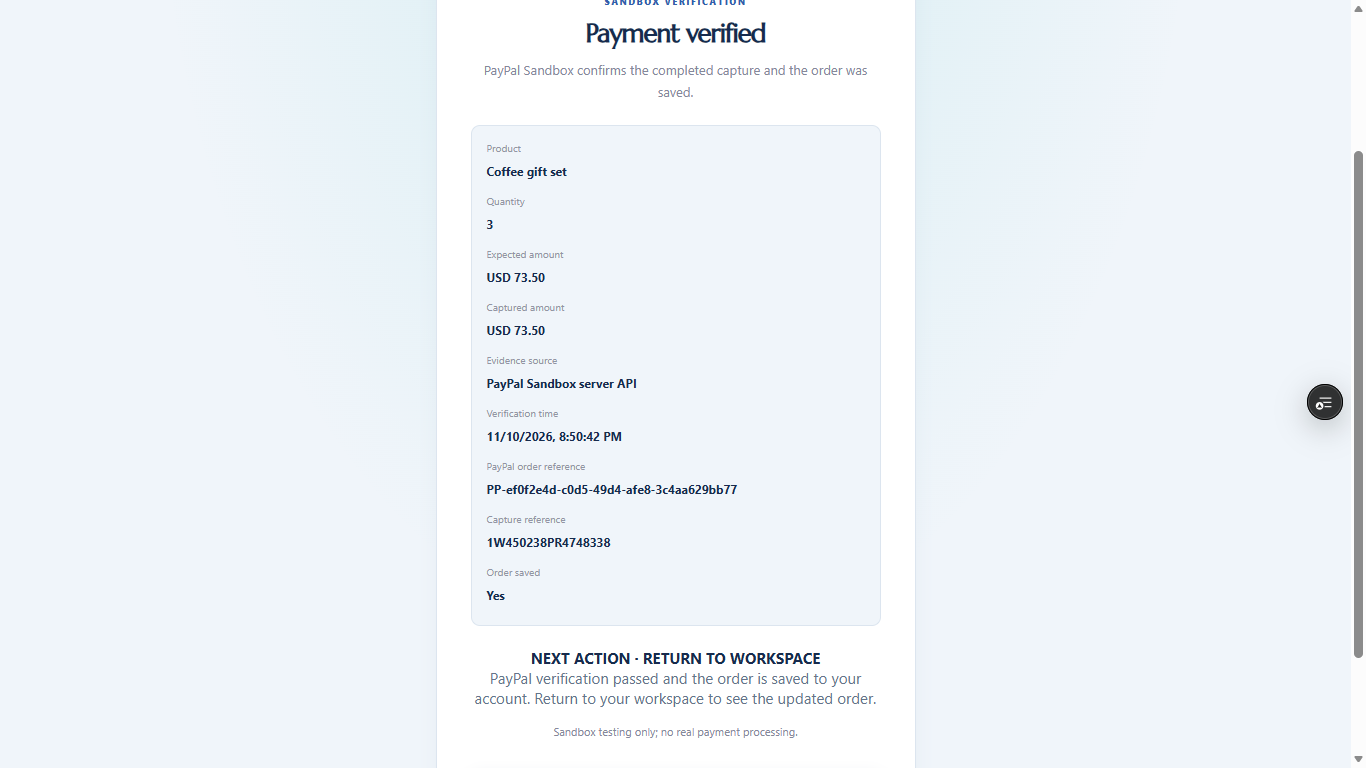
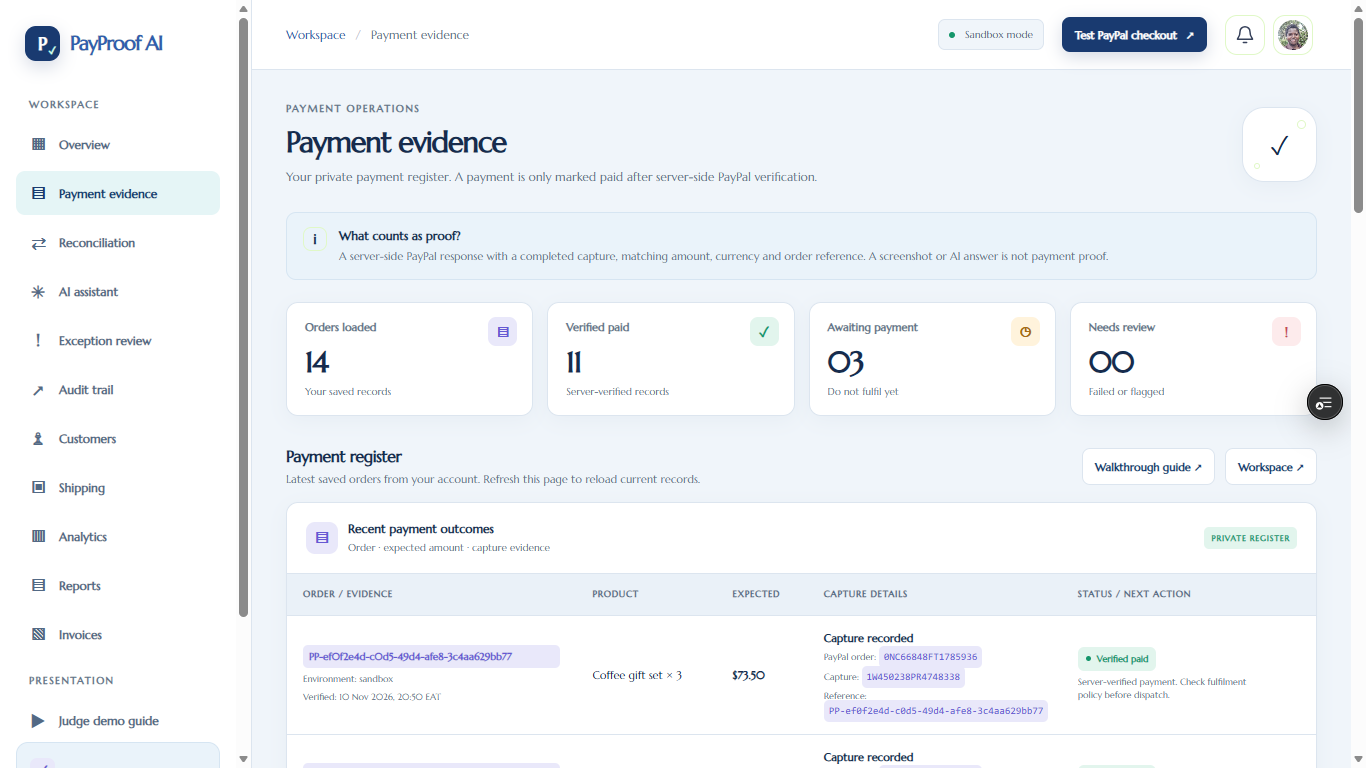
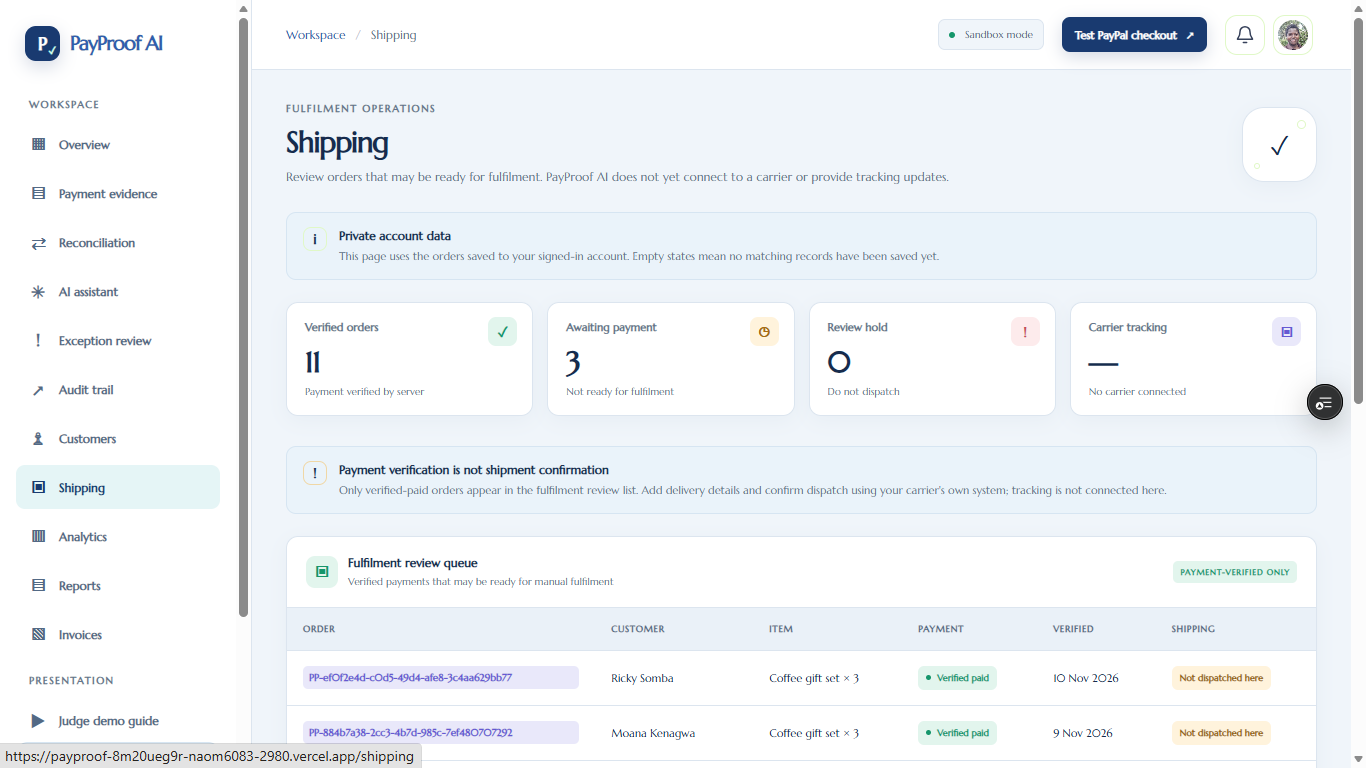
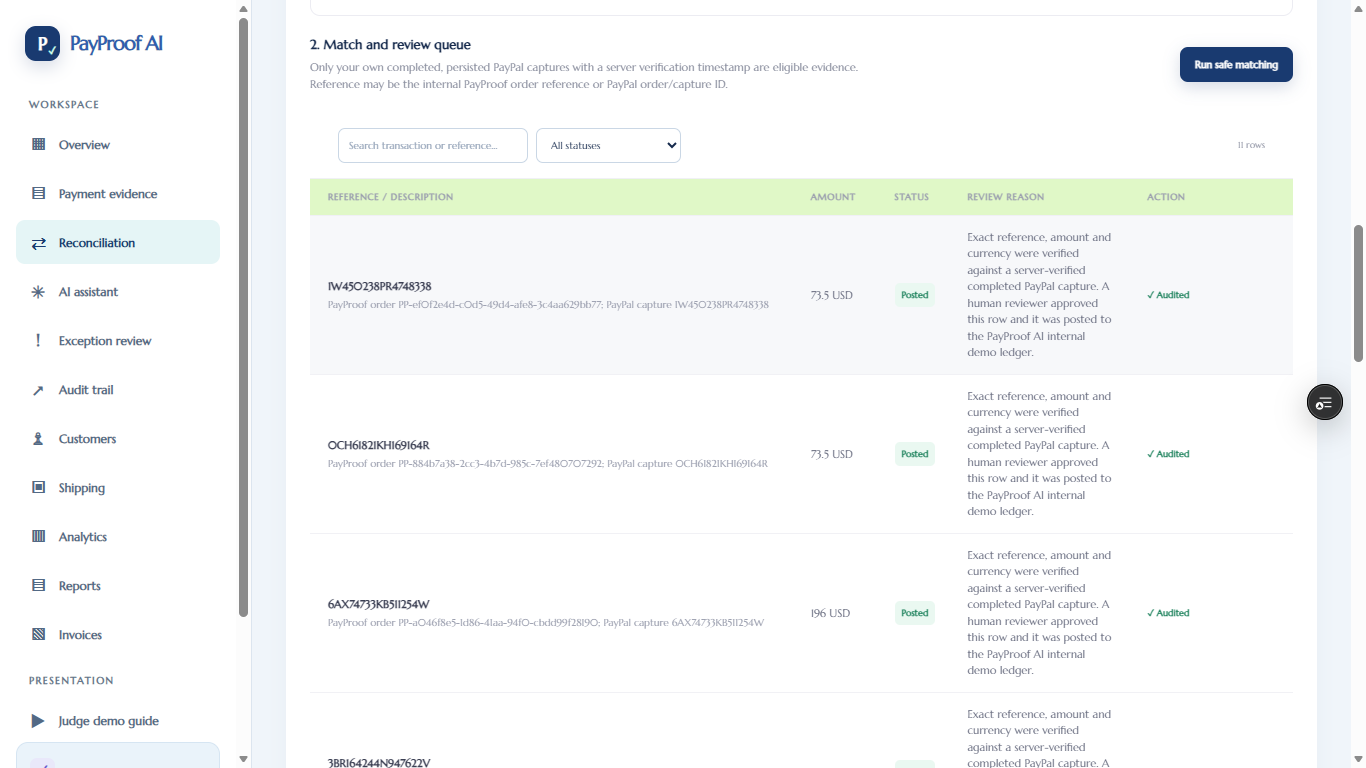
Verify payment on the server. The backend checks the PayPal payment result and compares it against the expected order information. The application does not rely on a customer's message, browser redirect, or AI response as proof of payment.
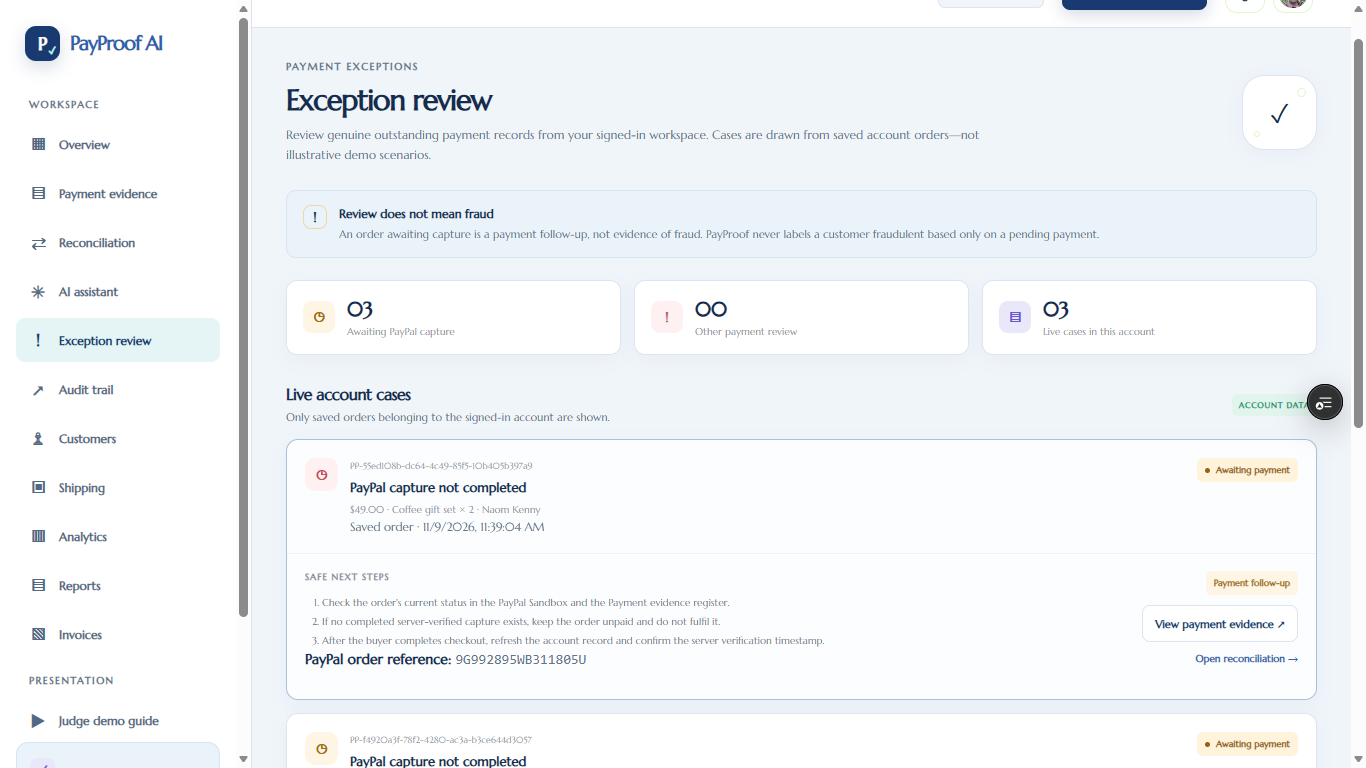
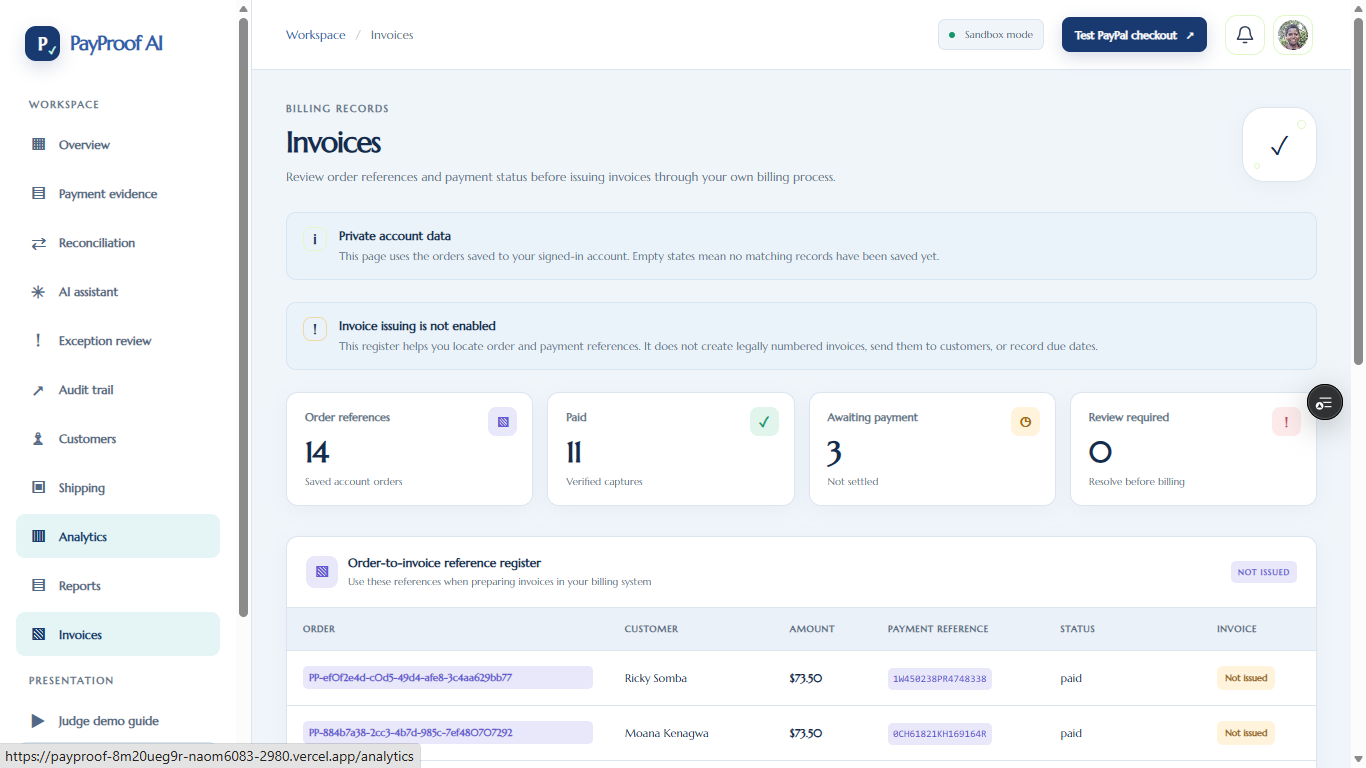
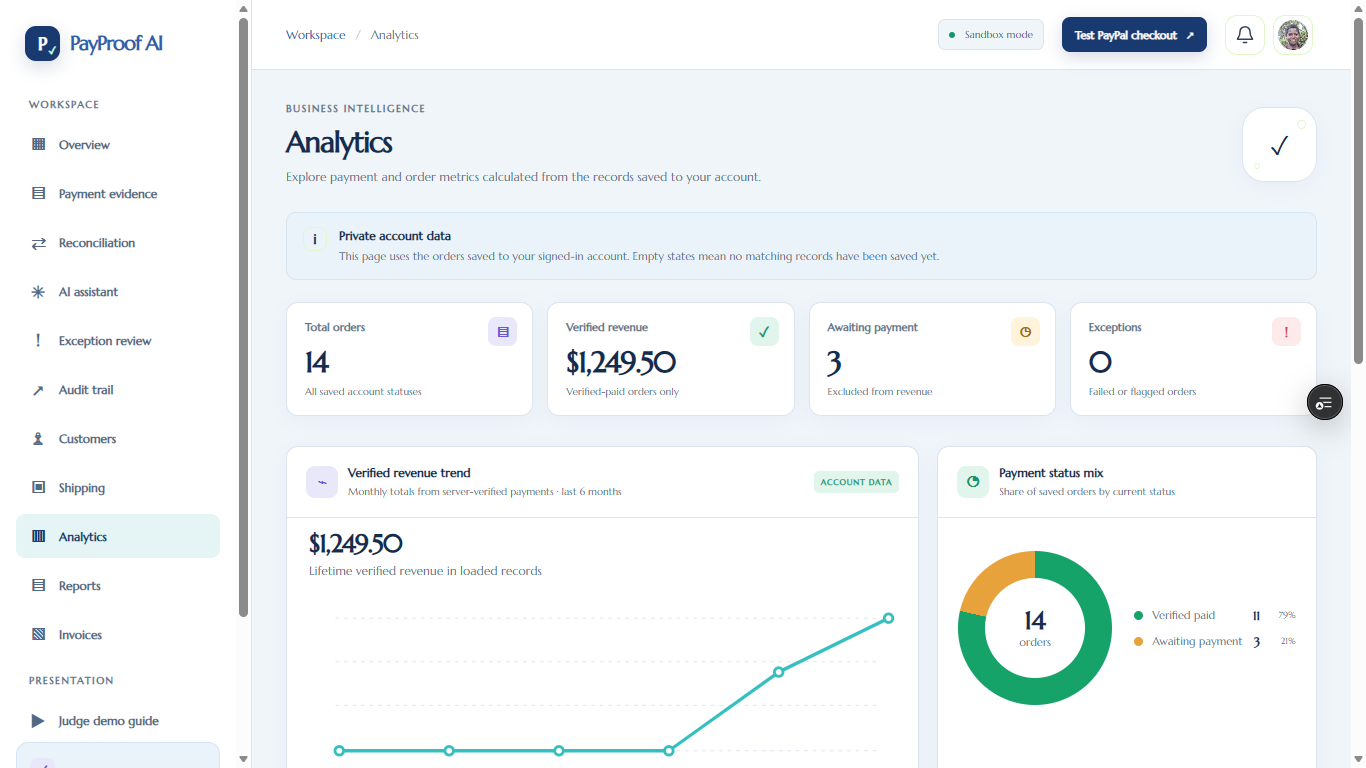
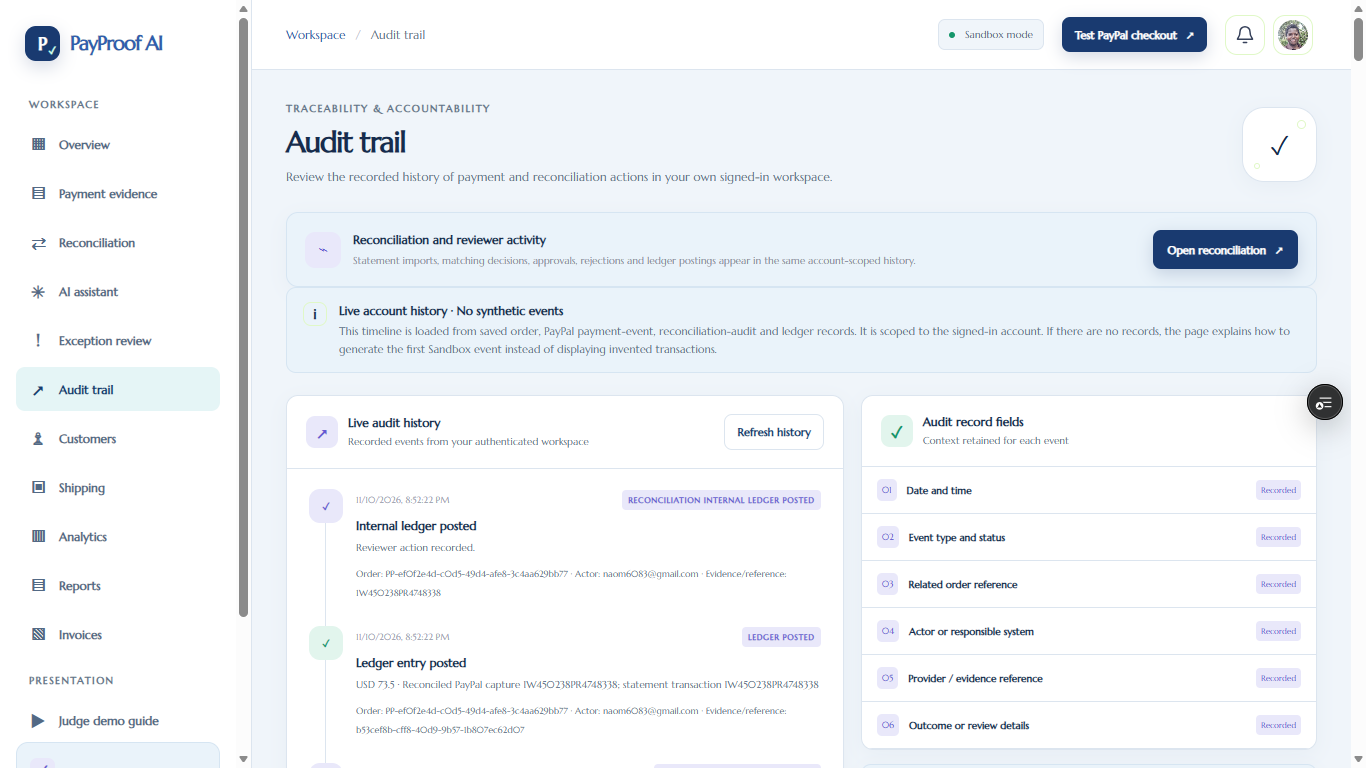
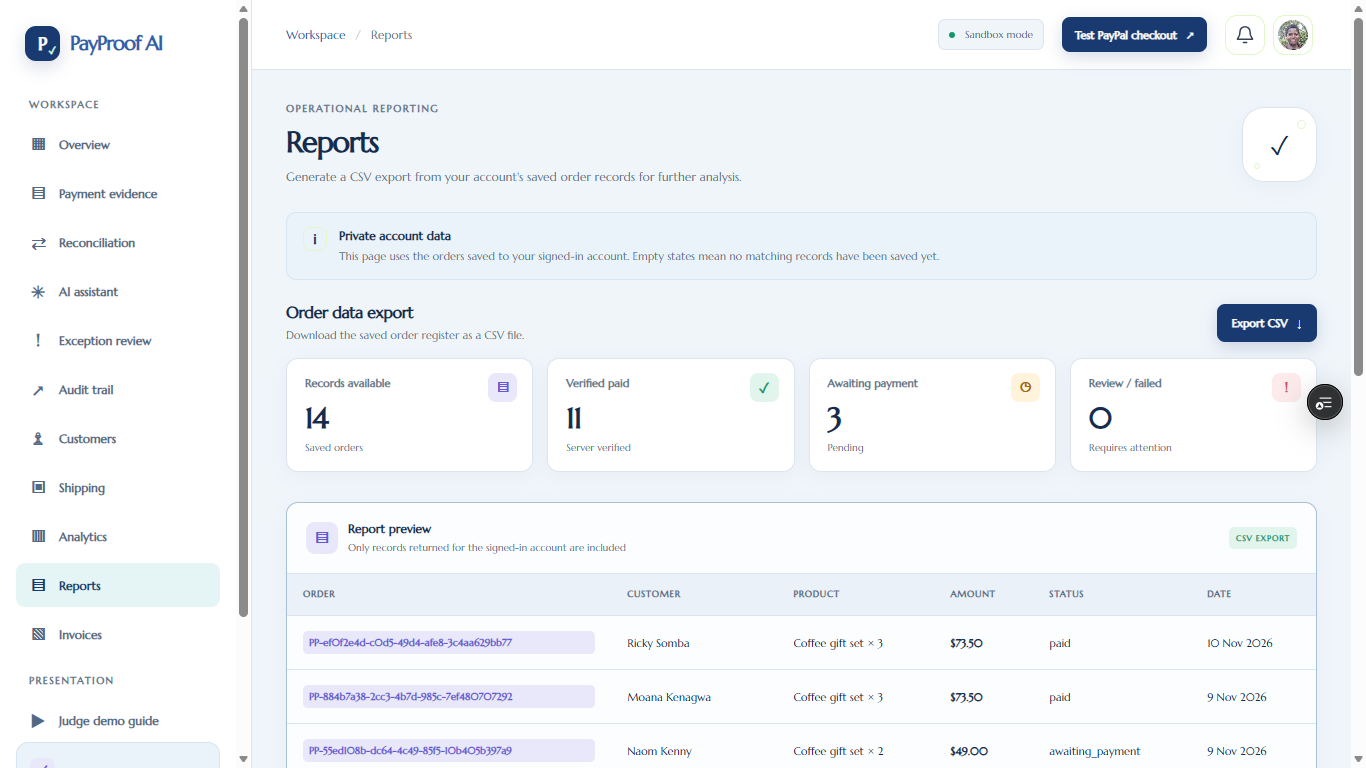
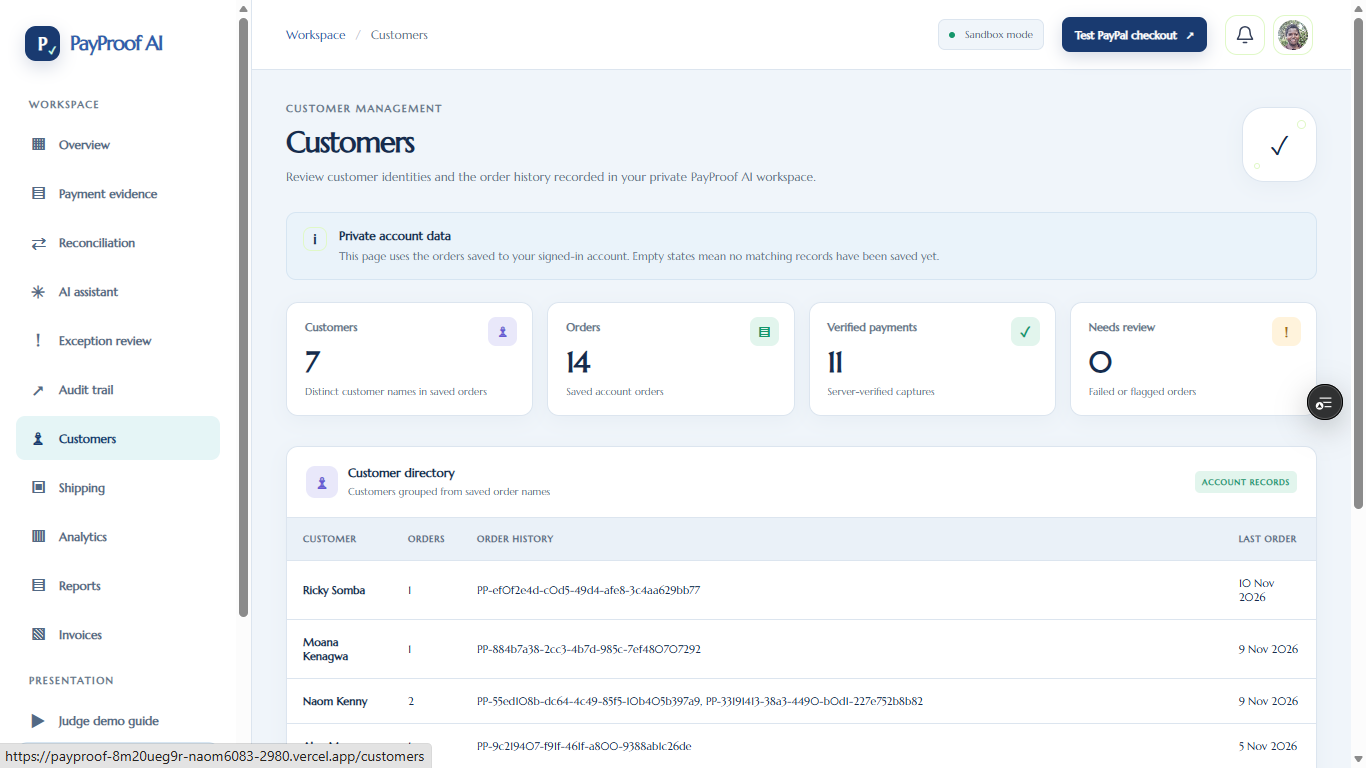
Review the evidence and exceptions. Payment records and order information can be examined to help identify incomplete or inconsistent cases. AI-assisted explanations support investigation while the underlying payment evidence remains authoritative.
What makes PayProof AI different?
Many AI-powered commerce concepts focus on automating tasks. PayProof AI focuses on the boundary between automation and financial trust.
- Evidence-based payment decisions: Payment status is grounded in server-side PayPal verification rather than an AI-generated answer.
- Human oversight: Sellers can review proposed order details before proceeding.
- Deterministic validation: Product selection and expected totals are handled by application logic.
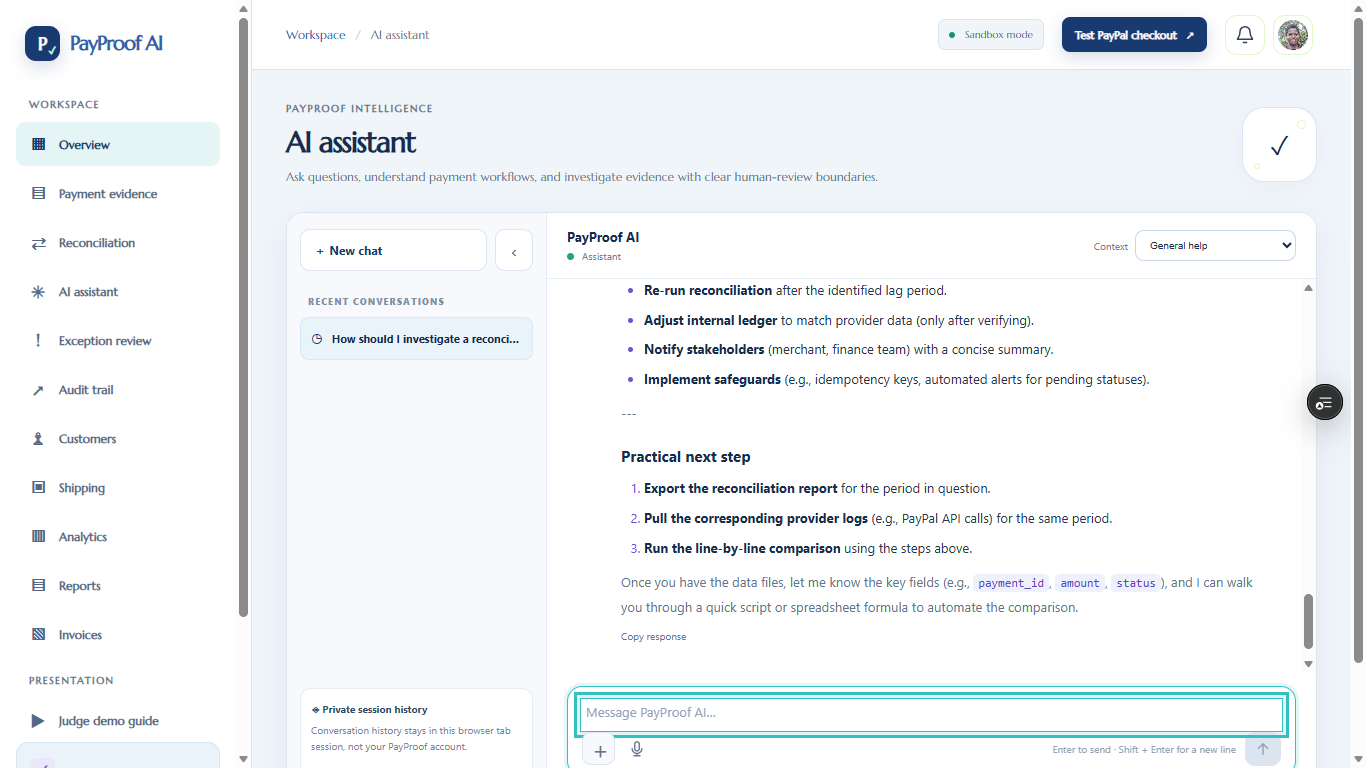
- AI with defined boundaries: AI helps interpret messages and explain records; it does not independently authorize payments or declare money received.
- Exception-oriented thinking: Incomplete or inconsistent information should be visible and reviewable rather than silently treated as success.
This separation of responsibilities is intentional. In a payment workflow, a confident-sounding answer is not a substitute for evidence.
How we built it
PayProof AI was developed as a full-stack web application using:
- Next.js and React for the application experience.
- TypeScript for structured, maintainable application logic.
- PayPal Developer Platform — Orders API Sandbox for the checkout and payment workflow.
- Supabase for authentication and application data services.
- Groq AI for AI-assisted interpretation of customer order messages and supporting explanations.
- Vercel for deployment and access to the hosted prototype.
The architecture separates AI-assisted interpretation from payment verification. The AI layer helps transform unstructured information into a proposed order, while deterministic application logic validates the order and the backend verifies the PayPal payment result.
Challenges and engineering decisions
One of the most important challenges was designing an AI-assisted workflow without allowing AI to become the source of truth for financial events.
We addressed this by separating the responsibilities of each component. AI extracts and explains information; application logic validates order details; PayPal provides the payment result; and the server performs verification before the application treats a payment as confirmed.
Another challenge was handling the transition between checkout and verification. A successful-looking browser redirect is not sufficient evidence that a payment has been completed. The application therefore needs to verify the payment result on the backend rather than trusting the browser alone.
We also had to think carefully about incomplete records, mismatched order information, and the difference between a verified PayPal capture and an internal application record. These distinctions shaped the evidence-first design.
What we learned
Building PayProof AI reinforced an important lesson about responsible AI in financial workflows: the best use of AI is not to replace every decision, but to make complex information easier to understand while preserving reliable sources of truth.
We learned to distinguish between extraction and validation, between a checkout redirect and server-side verification, and between a payment provider's verified result and an application's own internal records.
These principles influenced both the architecture and the user experience.
Current scope
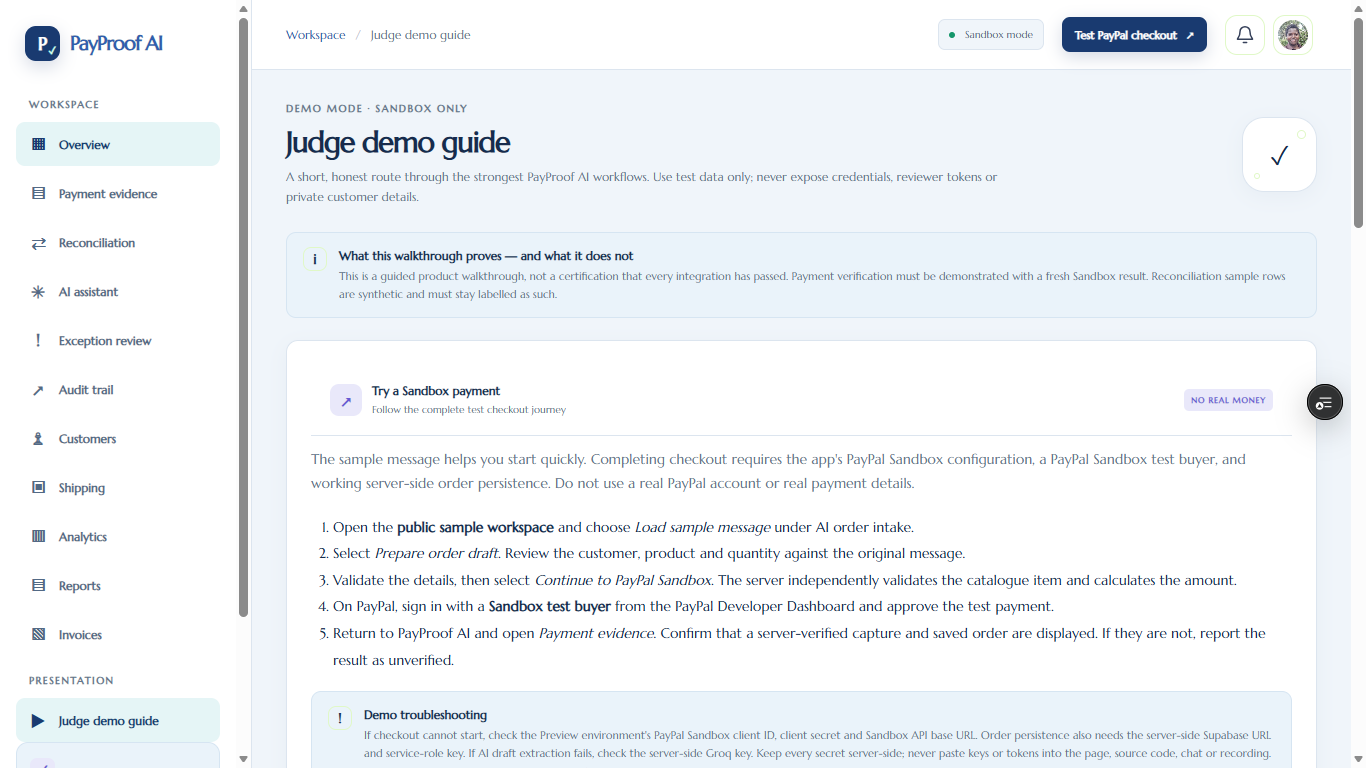
PayProof AI is a working prototype demonstrated with PayPal Sandbox. It showcases an end-to-end order preparation, checkout, and server-side payment verification workflow.
It is not presented as a live-money payment processor or as independent proof of bank settlement. Sandbox transactions and application records are used to demonstrate the design and verification process.
What's next?
Future development could extend the evidence model, strengthen reconciliation workflows, improve exception handling, and support additional payment evidence sources while preserving the same principle: financial decisions must be grounded in verifiable records.
Try PayProof AI
- Live prototype: https://payproof-8m20ueg9r-naom6083-2980.vercel.app/
- Source code: https://github.com/Moana-star/payproof-ai
- Demonstration video: https://youtu.be/k7vq-V0Pxgc
PayProof AI — Evidence first. AI explains the record. Verified payment data decides.
Built With
- artificial-intelligence
- fintech
- groq
- next.js
- paypal
- react
- supabase
- typescript
- vercel

