-
-
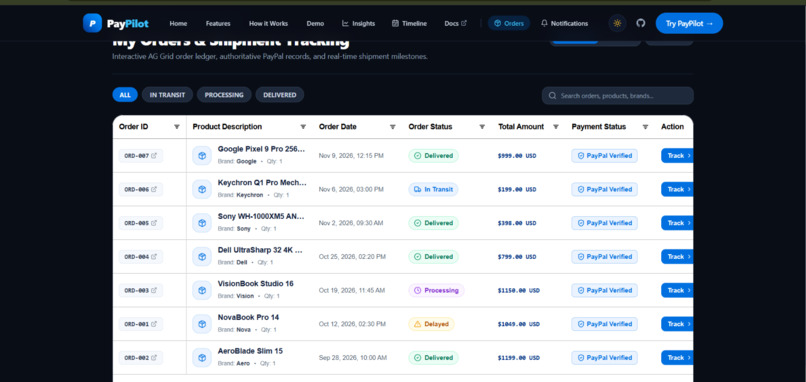
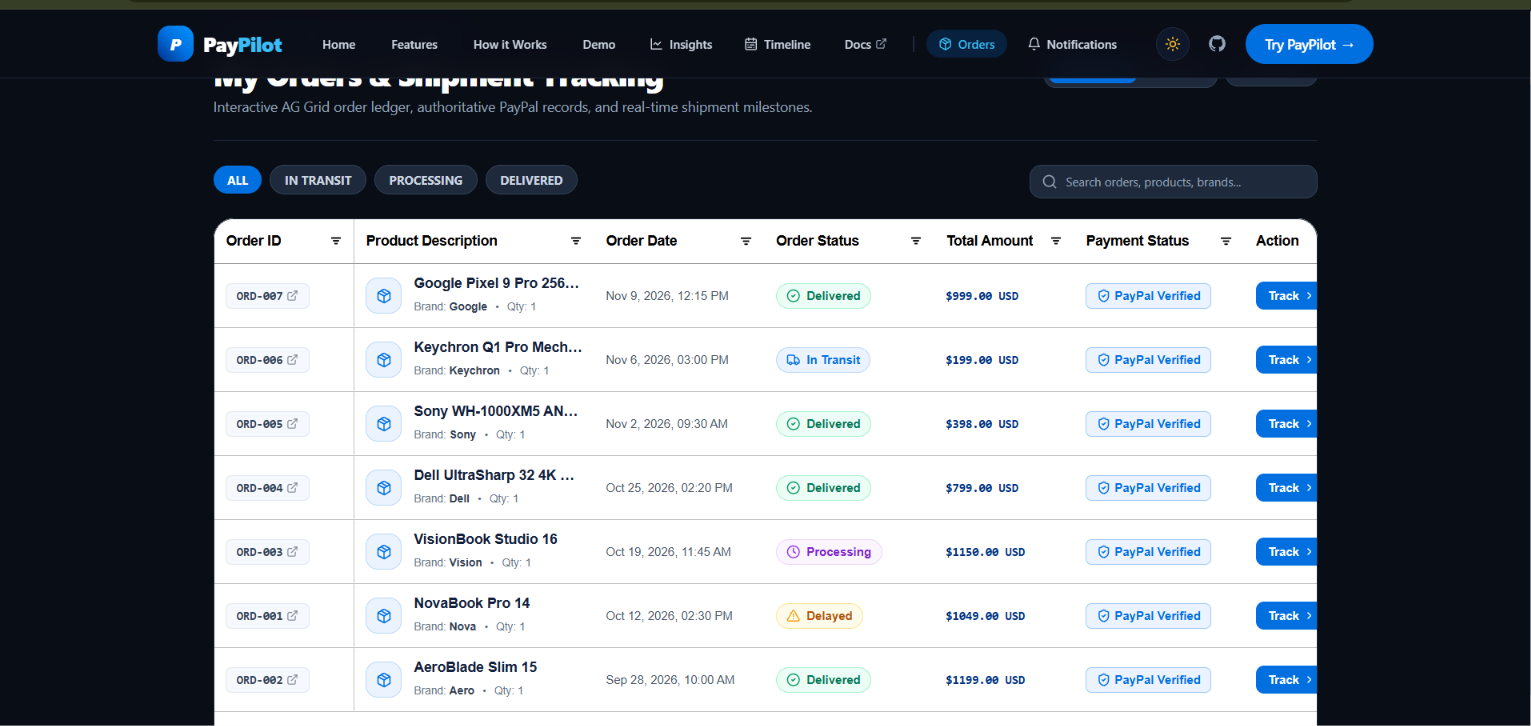
Interactive Dashboard: Centralized view of business metrics, analytics, and structured order management powered by AG Grid.
-
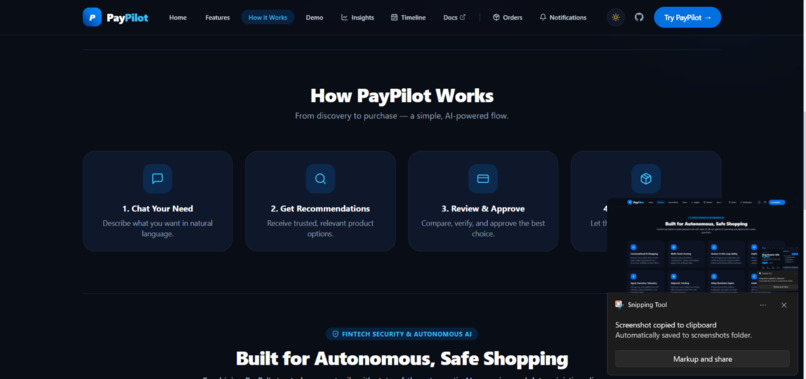
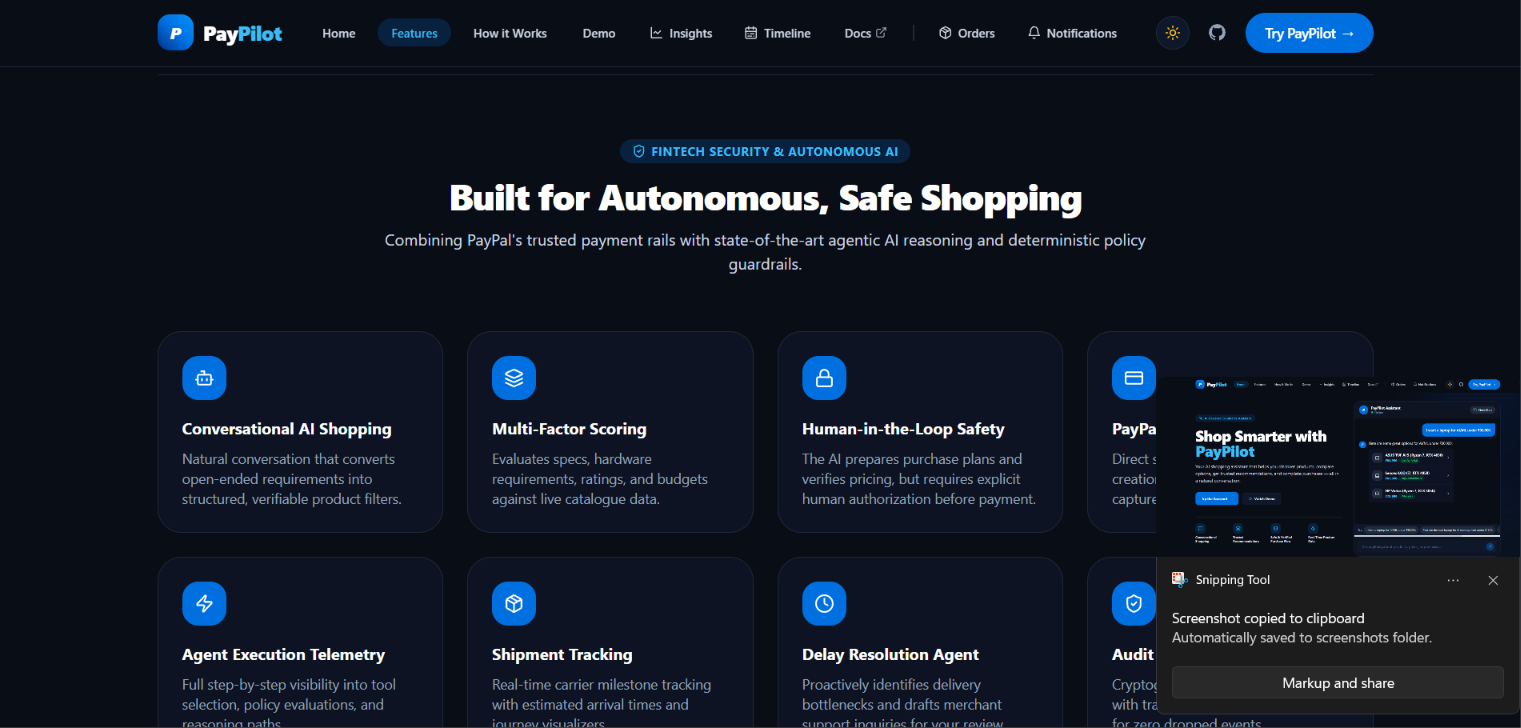
Workflow Interface: Natural language input enabling merchants to conversationalize and queue automated, AI-orchestrated workflows.
-
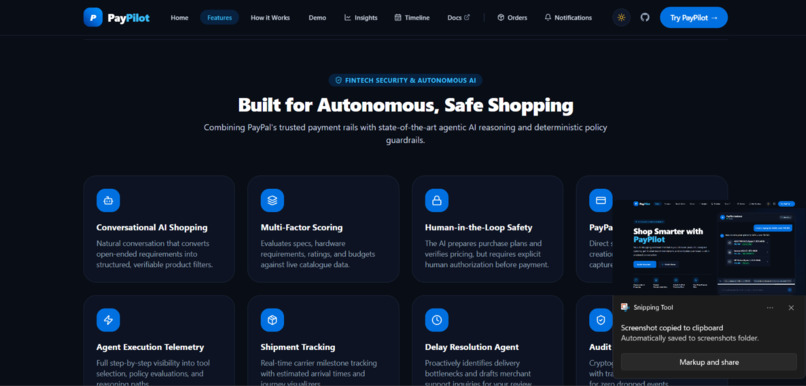
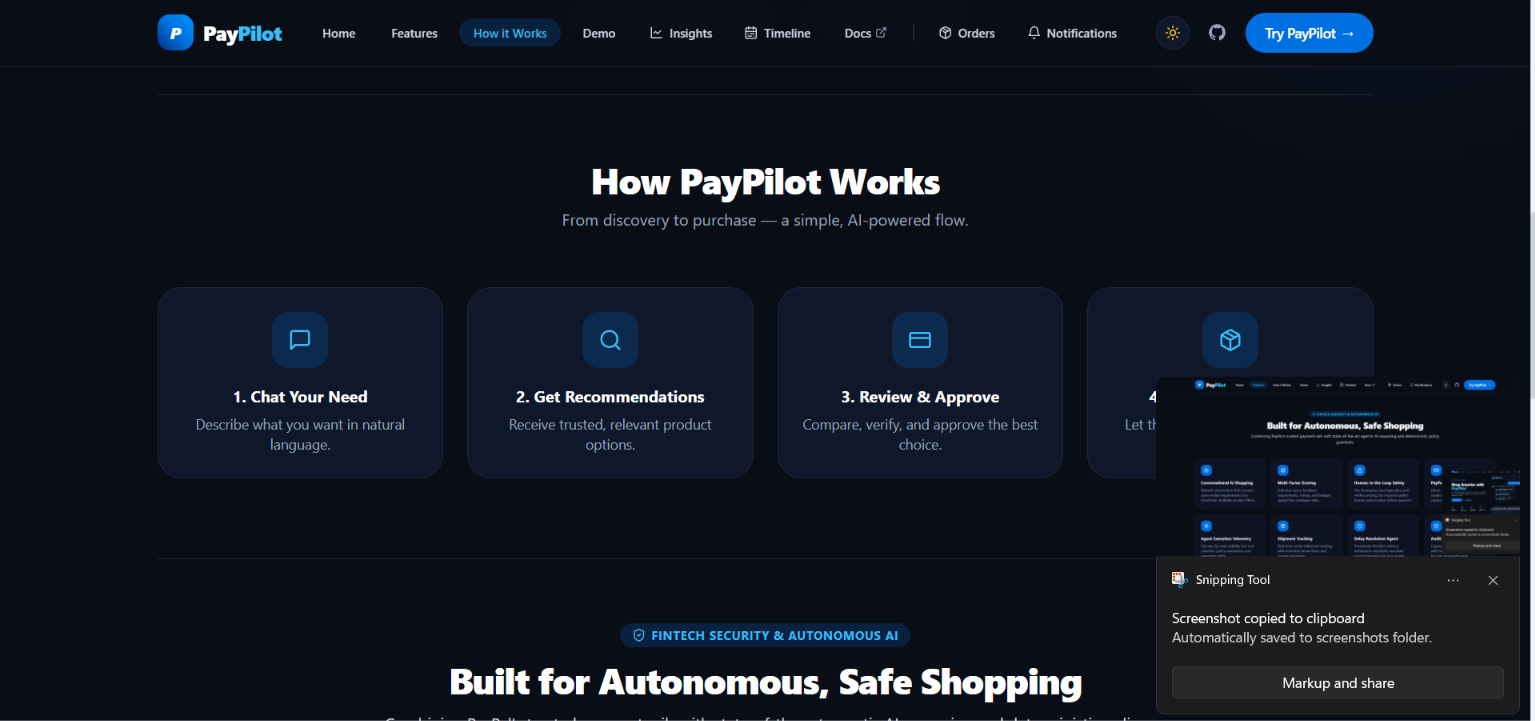
Human-In-The-Loop Approval: Built-in guardrails and approval gates ensuring safe execution for consequential financial operations.
-
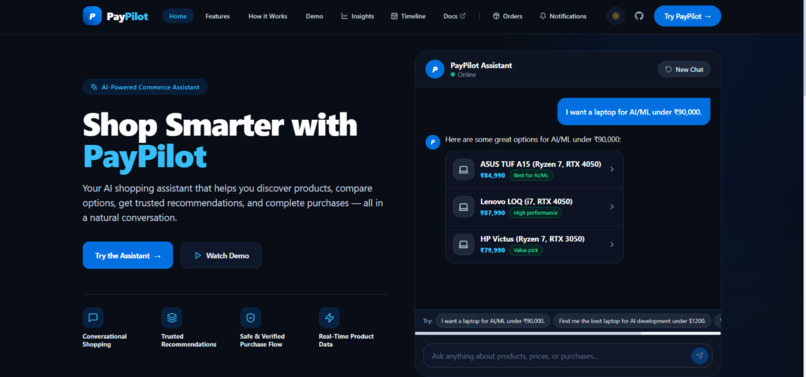
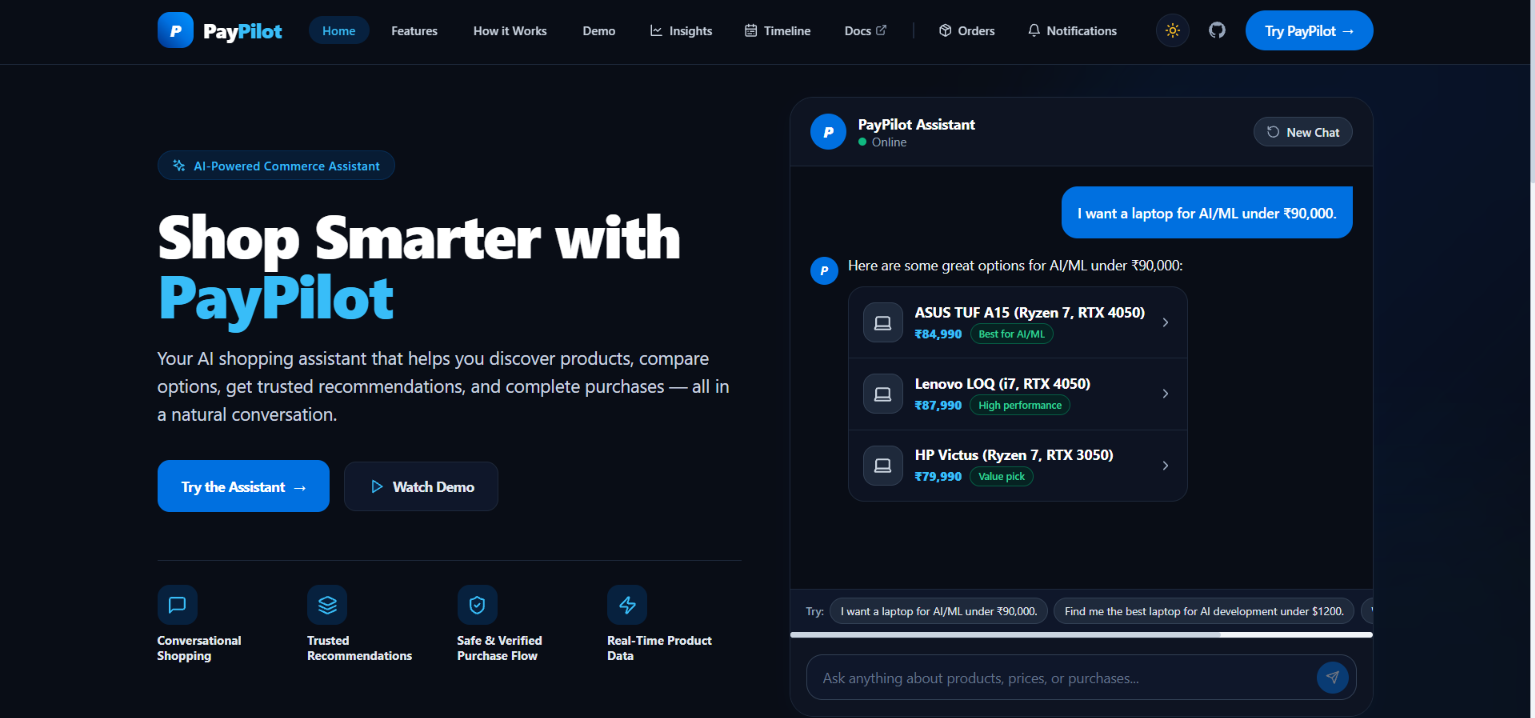
PayPilot Landing Page: Unified AI-powered merchant operations platform bringing inventory, finance, and orders together.
PayPilot — AI-Powered Merchant Operations Platform
Tagline: Smarter Business Operations. Powered by AI. Controlled by You.
Inspiration
Small and growing businesses often manage orders, finances, inventory, and purchasing through disconnected tools and manual processes. This makes it difficult for merchants to understand their operations and make timely decisions.
We were inspired to build PayPilot as an AI-powered merchant operations platform that brings these workflows together and makes business management more intelligent, accessible, and efficient.
What it Does
PayPilot helps merchants manage and understand their business operations through an integrated platform. It combines AI-powered business assistance with inventory insights, financial workflows, purchase planning, and order management.
Key capabilities include:
- AI Business Assistant: Conversational assistance for merchant operations and business queries.
- Inventory Intelligence: Specialized AI workflows for inventory analysis and insights.
- Financial Intelligence: Financial insights and assistance with business-related financial workflows.
- Business Briefings: AI-generated summaries to help merchants understand their business.
- Order Management: Structured order management and analytics powered by AG Grid.
- Payment Workflows: PayPal Orders v2 Sandbox integration for experimenting with payment operations.
- Human-in-the-Loop Controls: Approval mechanisms for consequential financial actions.
How We Built It
We built PayPilot using a modern full-stack architecture.
Technology Stack
| Layer | Technologies |
|---|---|
| Frontend | Next.js 14, React 18, TypeScript |
| Backend | FastAPI, Python |
| Database Layer | SQLAlchemy, Alembic |
| AI Integration | Groq, Large Language Models |
| AI Workflows | Inventory, Finance, Business Briefing Agents |
| Data Visualization | AG Grid Community |
| Payment Integration | PayPal Orders v2 Sandbox |
| API Tooling | APIMatic ContextMatic, MCP tooling metadata |
| Deployment | Vercel, Render |
| Testing | Backend integration tests, PostgreSQL CI checks |
AI Architecture
PayPilot combines LLM-powered conversational synthesis with deterministic intent extraction and fallback mechanisms.
Specialized workflows handle inventory analysis, financial insights, and business briefings through an orchestration layer.
For sensitive financial operations, the platform uses human approval gates instead of granting AI unrestricted execution authority.
Challenges We Ran Into
- Coordinating multiple specialized AI workflows while maintaining predictable behavior.
- Balancing natural-language AI responses with deterministic business logic.
- Designing secure financial workflows with appropriate human approval.
- Integrating different technologies and maintaining frontend-backend consistency.
- Testing APIs, database compatibility, and deployment configurations.
- Building reliable fallback mechanisms for AI-dependent functionality.
Accomplishments That We're Proud Of
- Built an integrated merchant operations platform combining AI assistance, inventory, finance, and order management.
- Developed specialized AI workflows for inventory, finance, and business briefings.
- Implemented human-in-the-loop approval gates for consequential financial operations.
- Integrated AG Grid Community for structured and interactive order management.
- Implemented PayPal Sandbox order workflows.
- Established backend integration testing and PostgreSQL compatibility checks through CI.
- Deployed the frontend and backend and brought multiple complex technologies together into one cohesive application.
What We Learned
We learned that building a useful AI-powered product requires much more than connecting an LLM to an application.
Reliable AI systems need deterministic logic, validation, structured data, clear API contracts, testing, and fallback mechanisms.
We also gained practical experience in full-stack development, AI workflow orchestration, payment integrations, database migrations, API testing, deployment, and collaborative engineering.
Most importantly, we learned that AI should support human decision-making, especially when financial operations and business-critical actions are involved.
What's Next for PayPilot
Our next goal is to make PayPilot more robust and production-ready.
Planned improvements include:
- Completing database-backed persistence and deployment configuration.
- Expanding inventory forecasting and financial analytics.
- Improving AI response accuracy and contextual business understanding.
- Integrating additional payment and merchant service providers.
- Developing deeper integrations with existing POS and business management systems.
- Introducing stronger authentication, monitoring, and audit capabilities.
- Improving scalability and multi-merchant support.
Our Vision
Our long-term vision is to make PayPilot a reliable AI-powered operating system for merchants, helping businesses move from fragmented manual workflows to intelligent, connected, and controlled operations.
Built With
- ag-grid
- agentic-ai
- ai-agents
- ai-orchestration
- alembic
- fastapi
- financial-analytics
- fintech
- full-stack-development
- groq
- human-in-the-loop-ai
- inventory-management
- llms
- merchant-management
- next.js
- paypal
- postgresql
- python
- react
- rest-api
- sqlalchemy
- typescript
- vercel
- web-development
