PayPilot — Your Business. Your Finances. One Intelligent Dashboard.
Inspiration
Running a business involves keeping track of countless moving parts: payments, invoices, customers, expenses, subscriptions, and financial reports. These tools are often scattered across different platforms, making it difficult to understand the bigger picture.
I wanted to build something that brings all of these pieces together.
That's where PayPilot came from: an AI-powered business management platform designed to give business owners one place to understand their finances, manage everyday operations, and make smarter decisions.
I was especially interested in combining financial technology with AI—not just creating another dashboard, but building an assistant that can actually help people work with their business data.
What It Does
PayPilot is designed to serve as an intelligent command center for businesses of all sizes.
Its features include:
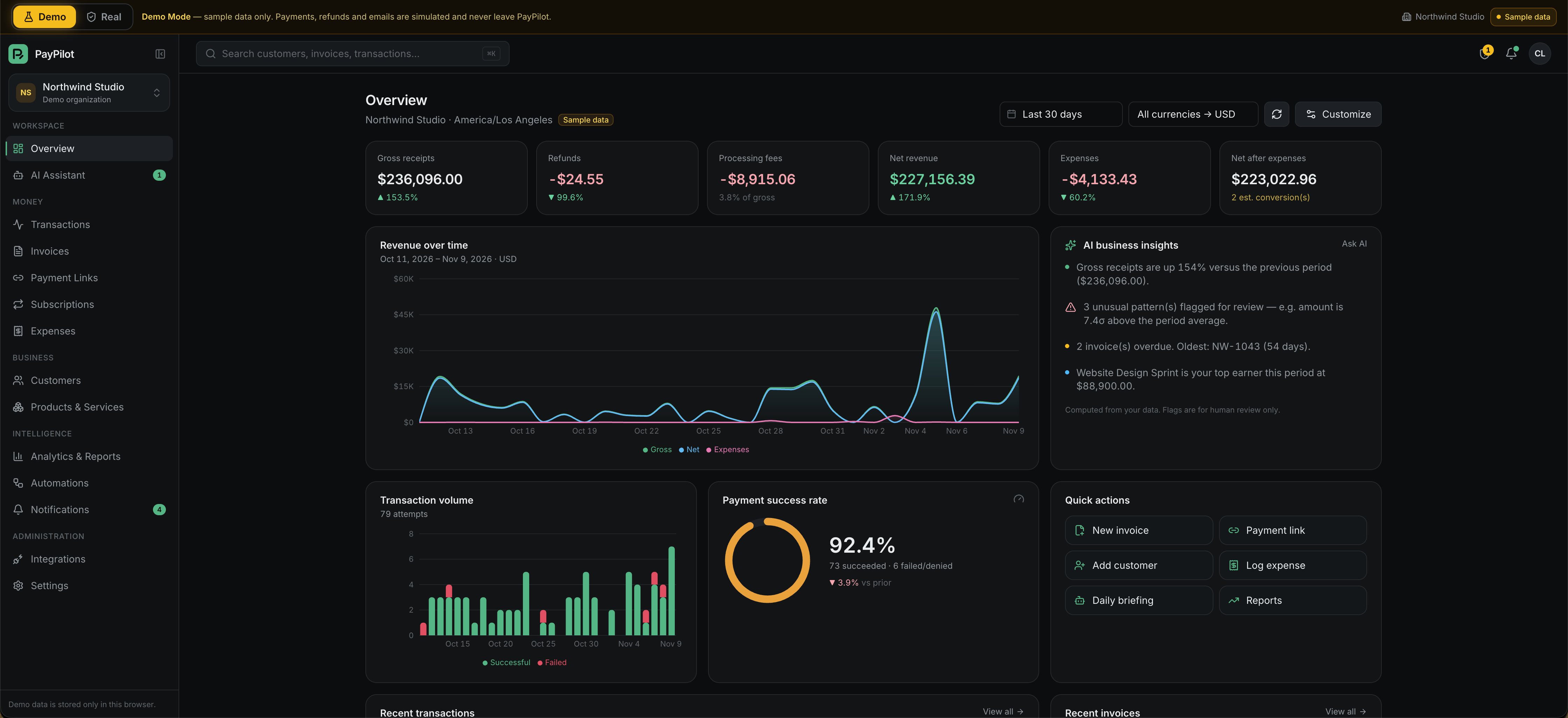
- Financial Dashboard: View revenue, transactions, outstanding payments, subscriptions, and business insights.
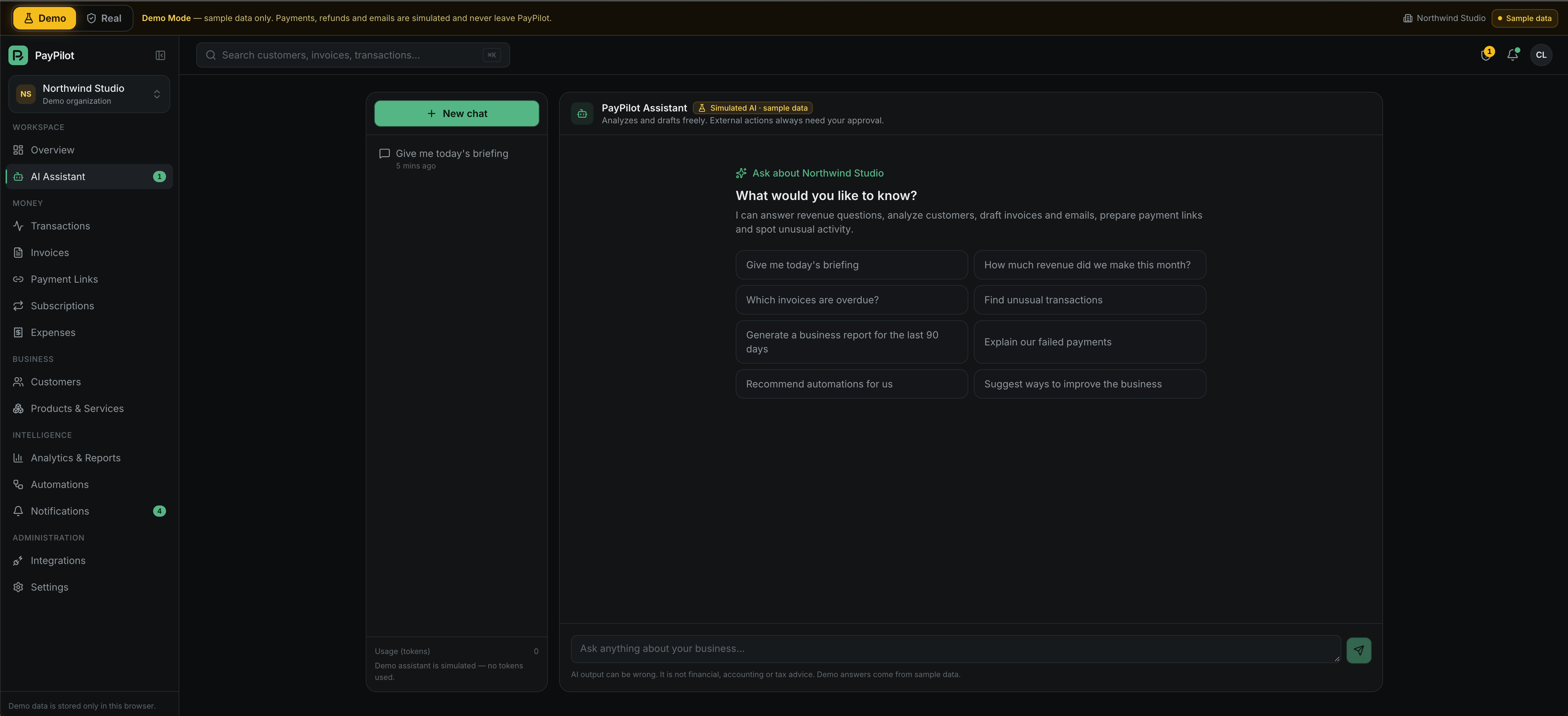
- AI Assistant: Ask questions about business finances, generate reports, analyze transactions, and receive useful recommendations.
- Transaction Management: View and organize payment activity through PayPal integration.
- Invoice Management: Create, manage, and track customer invoices.
- Customer Management: Keep customer information, payment history, and activity organized.
- Expense Tracking: Record business expenses and organize them into categories.
- Analytics & Reports: Understand revenue trends, payment activity, expenses, and business performance.
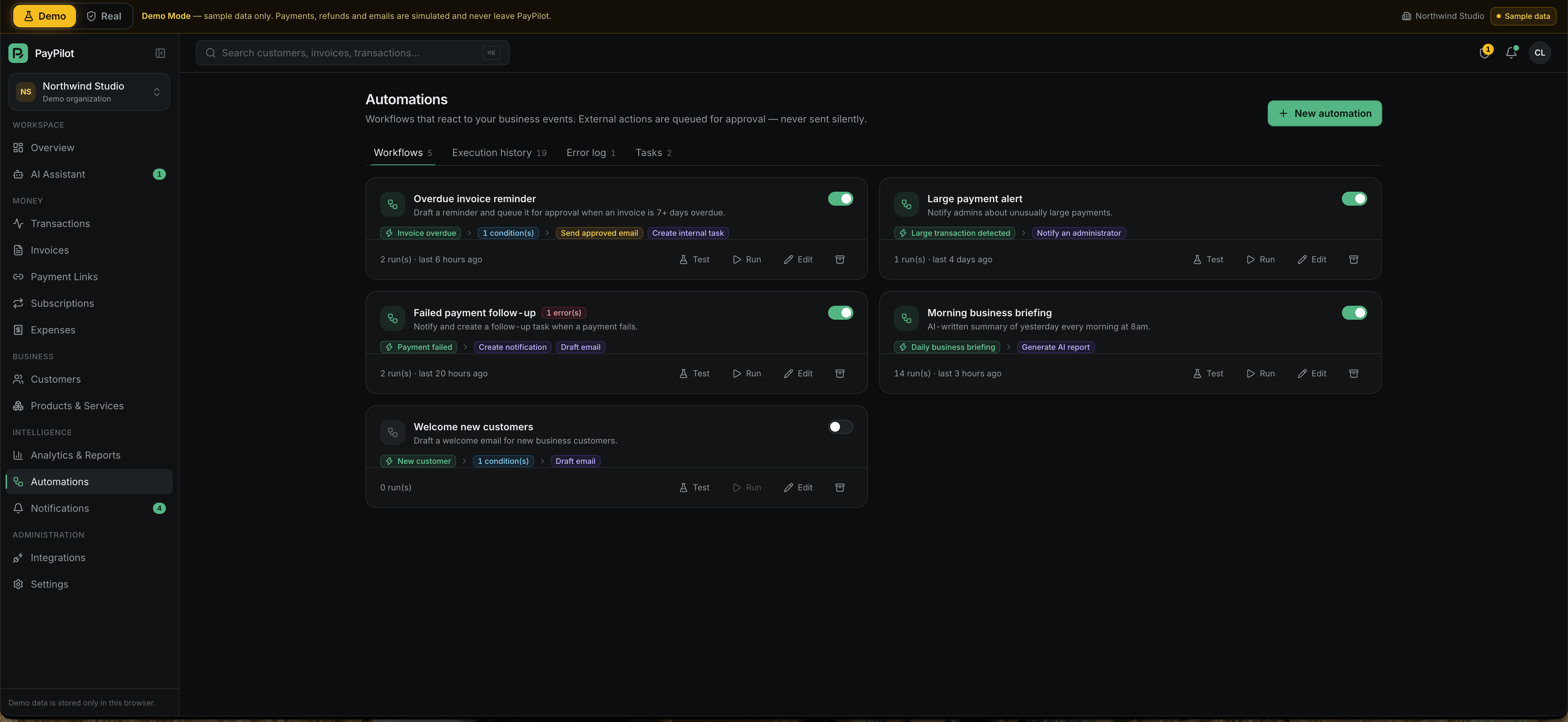
- Automations: Build workflows for recurring tasks, notifications, and payment-related events.
PayPilot also includes two application modes:
- Demo Mode: Explore a functional sample business environment without connecting real financial accounts.
- Real Mode: Work with actual business information and connected services, with safeguards and approval requirements for external actions.
How I Built It
I designed PayPilot around a modular architecture so that its features can work together while remaining independently maintainable.
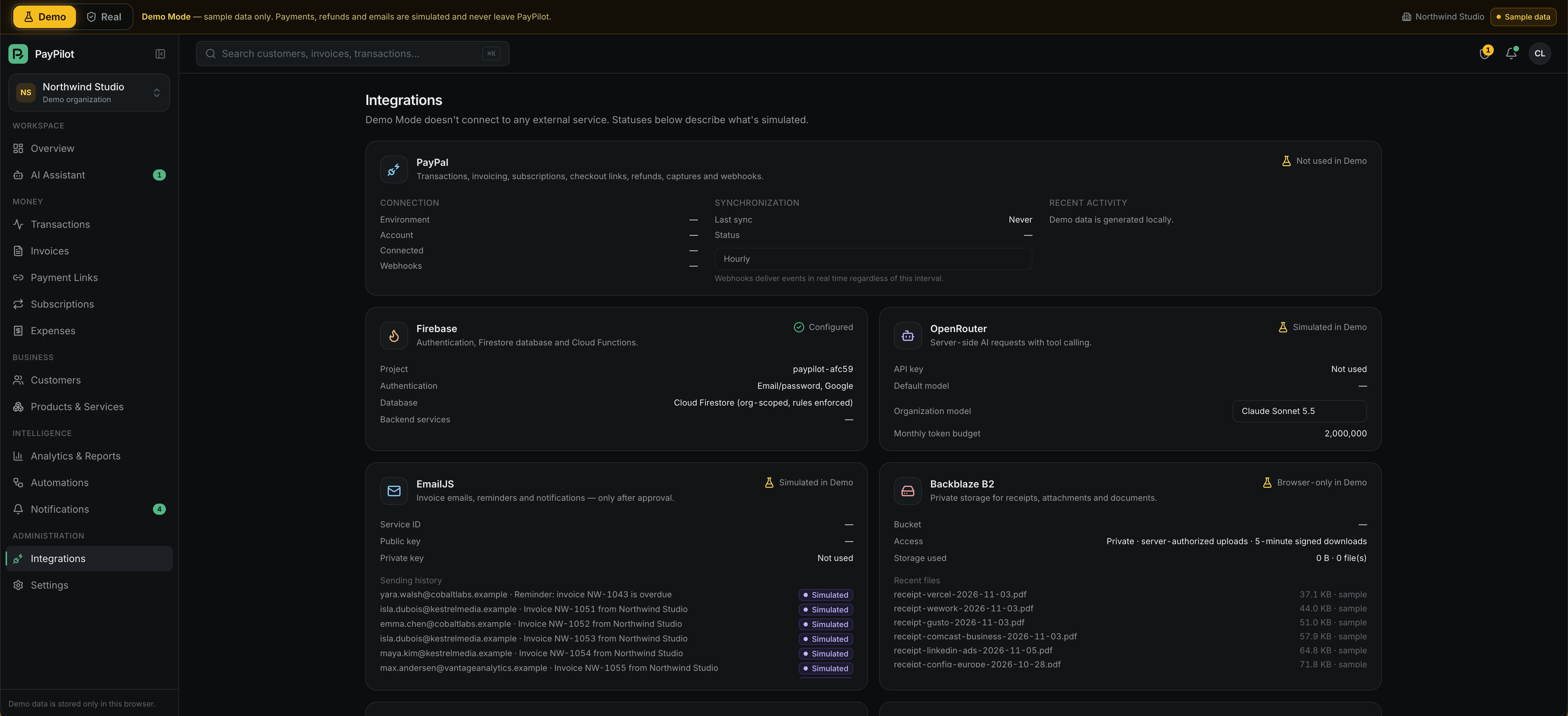
The frontend is built around React, TypeScript, and Vite, with Tailwind CSS providing the styling system. Firebase provides the foundation for authentication, database functionality, and backend services.
For AI capabilities, PayPilot uses OpenRouter to connect to language models. The goal is to allow users to interact with their business information through natural language rather than navigating through dozens of reports and menus.
PayPal REST APIs provide the planned payment integration, beginning with Sandbox testing. Backblaze B2 is used for private document and receipt storage, while EmailJS provides the email integration.
A major architectural decision was separating Demo Mode from Real Mode. This allows users to explore the platform safely while keeping sample data completely separate from actual business records.
What I Learned
This project pushed me to think beyond individual features and consider how an entire SaaS platform should work.
Some of the biggest things I explored included:
- Designing multi-tenant applications where different businesses have isolated data.
- Integrating AI with structured business data and tools.
- Understanding PayPal's REST APIs and OAuth authentication.
- Planning secure financial workflows with explicit approval requirements.
- Designing database structures that can scale as an application grows.
- Working with multiple services and APIs in one application.
- Building a consistent, responsive interface across an entire platform.
One particularly interesting lesson was that AI becomes much more useful when it can interact with real application data and tools, rather than simply generating text.
Challenges
One of the biggest challenges was bringing so many different systems together into one coherent application.
Payments, invoices, customers, expenses, and analytics all have different data structures and workflows. Making them work together while keeping information accurate requires careful planning.
Another challenge was designing a safe AI action system. An AI assistant might be able to prepare a refund, create a payment link, or draft an email, but those actions should never happen without the user's approval.
Multi-currency reporting also introduces complexity. Original transaction amounts need to remain intact while converted amounts are clearly identified as reporting values.
Finally, PayPal's multi-business integration has additional authorization and partner requirements, so the integration needs to be developed in stages rather than assuming every account can immediately connect to Live services.
What's Next?
PayPilot is designed to grow beyond its initial feature set.
Future possibilities include additional payment providers, accounting integrations, advanced financial forecasting, more AI agents, and eventually subscription plans for businesses using PayPilot itself.
The long-term goal is simple: make managing a business less complicated by bringing its finances, operations, and intelligence together in one place.
PayPilot — Your business. Your finances. One intelligent dashboard.
Built With
- apis
- authentication
- b2
- backblaze
- cloud
- css
- emailjs
- firebase
- firestore
- functions
- lucide
- openrouter
- paypal
- react
- rest
- tailwind
- typescript
- vite
