Inspiration
PayPilot AI – Hackathon Project
Inspiration
Freelancers and small business owners often spend valuable time managing invoices, calculating payment amounts, following up with customers, and tracking payments. These repetitive tasks can become frustrating and take time away from their actual work.
We were inspired by the idea of using Artificial Intelligence to simplify financial management. We wanted to build a platform where users could simply describe the work they completed and generate a professional invoice without manually filling in every detail.
This idea led to PayPilot AI – an intelligent invoicing and payment assistant for freelancers and small businesses.
What it does
PayPilot AI simplifies the invoicing and payment process through a single platform.
Its key features include:
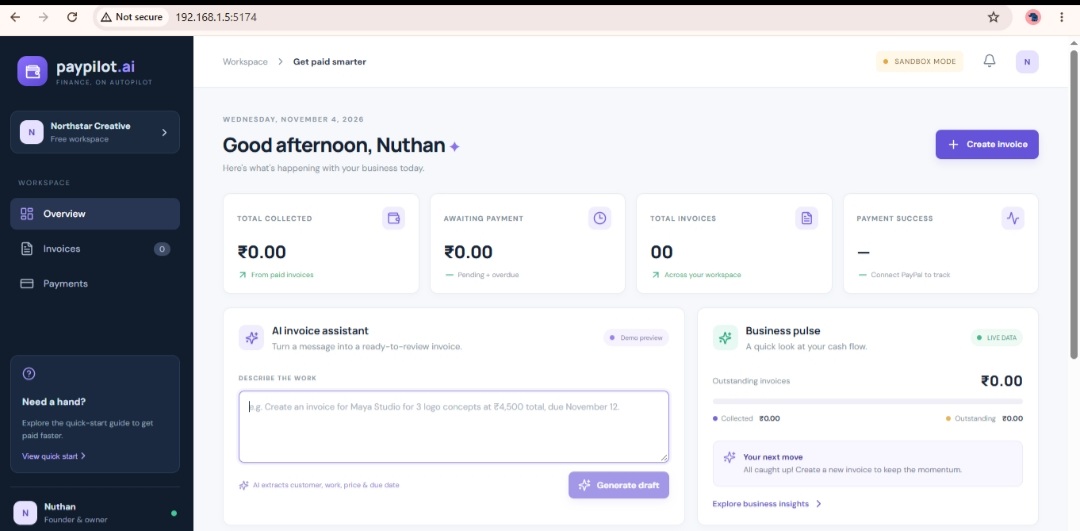
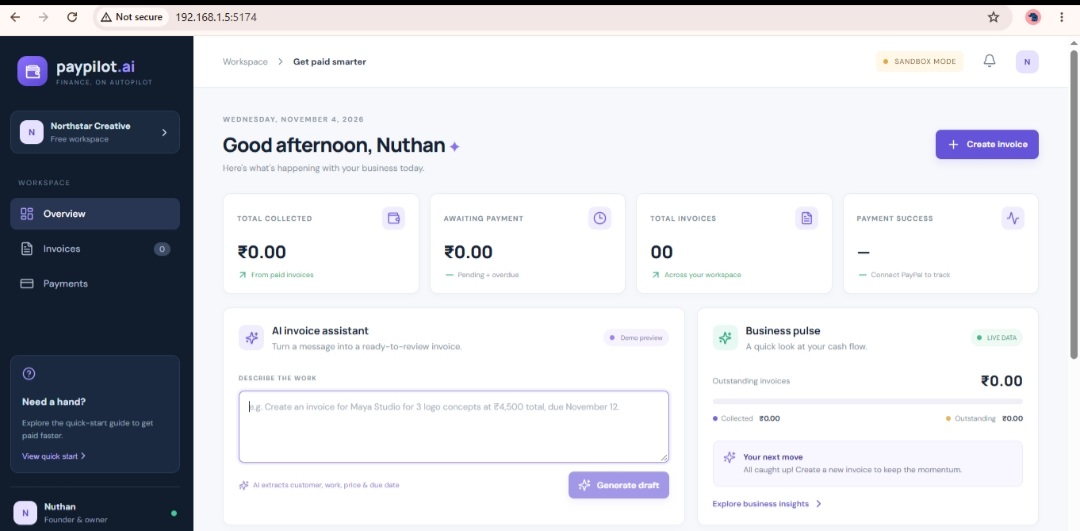
- AI Invoice Generation: Converts natural-language descriptions of work into structured invoice drafts.
- Editable Invoices: Allows users to review and modify customer details, descriptions, quantities, and prices before sending.
- PayPal Integration: Uses PayPal Checkout Sandbox to support payment order creation and server-side payment capture.
- Invoice Dashboard: Provides a central place to manage invoices and monitor their status.
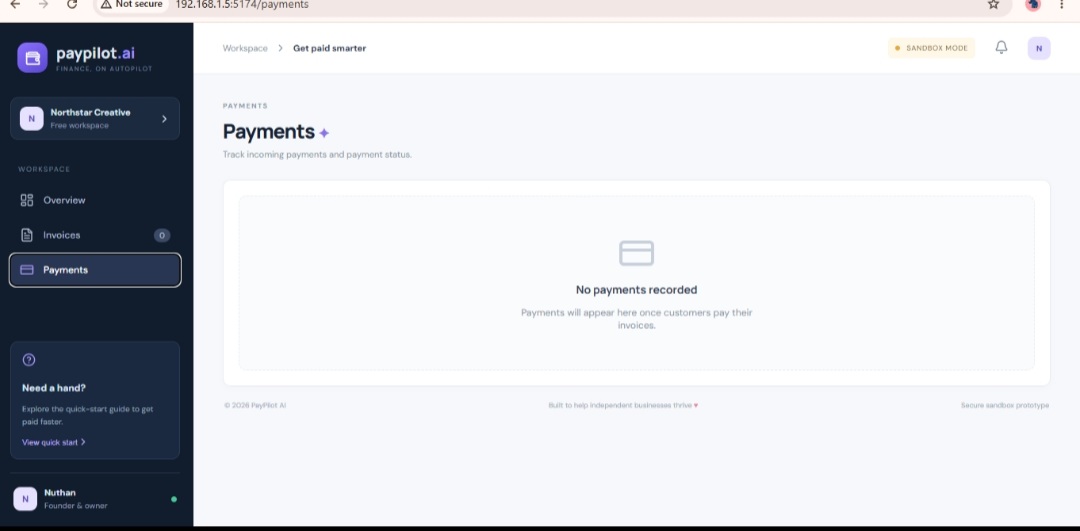
- Payment Tracking: Helps users track incoming payments and understand outstanding amounts.
- Business Insights: Displays collected amounts, pending payments, and other useful financial information.
Our main principle is that AI assists users, but the final decision remains in their hands.
How we built it
We used a modern technology stack to develop PayPilot AI.
- Frontend: React.js and Vite for building an interactive and responsive user interface.
- Backend: Node.js and Express.js for handling server-side operations and API requests.
- Database: SQLite for storing invoice and payment-related information.
- Artificial Intelligence: An AI integration layer designed to convert natural-language descriptions into structured invoice information.
- Payment Gateway: PayPal Checkout API and PayPal Sandbox for testing payment workflows.
The application follows a simple workflow:
- The freelancer describes the completed work.
- AI converts the description into an invoice draft.
- The user reviews and edits the invoice.
- The backend creates a PayPal payment order.
- The customer approves the payment.
- The backend captures and verifies the payment.
- The invoice status is updated based on the verified payment result.
Challenges we ran into
One of our biggest challenges was integrating multiple technologies into a single application.
- AI Accuracy: Converting natural-language descriptions into accurate invoice details requires proper validation. Missing information should not be automatically invented.
- Payment Integration: Connecting PayPal with the backend required understanding order creation, customer approval, and payment capture.
- Payment Verification: We needed to ensure that payment status changes only after the server verifies the PayPal response.
- Database Management: Maintaining consistent invoice details and payment statuses required careful backend design.
- User Experience: We wanted to make the application simple enough for freelancers who may not have technical or accounting knowledge.
These challenges helped us understand the importance of building reliable applications rather than focusing only on appearance.
Accomplishments that we're proud of
We are proud to have developed PayPilot AI as a practical solution to a real-world problem.
Our major accomplishments include:
- Building a modern and user-friendly financial dashboard.
- Designing an AI-assisted invoice generation workflow.
- Creating an editable invoice management interface.
- Integrating the PayPal Sandbox payment workflow.
- Designing a backend architecture that separates payment verification from frontend actions.
- Bringing invoice creation and payment management together in one platform.
Most importantly, we transformed an everyday business problem into an AI-powered product concept with practical real-world applications.
What we learned
What we learned
Building PayPilot AI helped us gain practical experience in full-stack development and AI integration.
We learned how to connect a React frontend with a Node.js backend, manage application data using SQLite, structure AI-generated information, and understand payment gateway workflows.
We also learned that AI-generated content must be validated before being used in important financial operations.
Another important lesson was that payment security, data accuracy, and user trust are essential when developing financial applications.
What's next for PayPilot AI
What's next for PayPilot AI
We aim to develop PayPilot AI into a complete AI-powered financial assistant for freelancers and small businesses.
Our future plans include:
- Completing and improving the end-to-end AI invoice generation workflow.
- Supporting multiple payment gateways and payment methods.
- Adding automatic payment reminders for overdue invoices.
- Introducing PDF invoice generation and downloading.
- Developing advanced cash-flow analytics and financial reports.
- Adding recurring invoices for regular customers.
- Improving AI accuracy and supporting multiple languages.
- Introducing real-time payment notifications and customer management.
Our long-term vision is to make financial management simpler, faster, and more accessible for independent businesses.
PayPilot AI – Describe the work. Generate the invoice. Get paid with PayPal.
Built With
- ai-agents
- artificial-intelligence
- css3
- express.js
- fintech
- full-stack-development
- generative-ai
- git
- html5
- invoice-automation
- javascript
- natural-language-processing
- node.js
- openai-api
- payment-integration
- paypal
- paypal-checkout
- paypal-sandbox
- react
- rest-api
- sqlite
- structured-outputs
- vite
- web-development
