💡 Inspiration
Managing money should be simple, but for freelancers and small business owners, it often becomes another full-time job. Tracking payments, following up with clients, and figuring out where the money is going can take time away from the work that actually grows a business.
That got us thinking: what if managing payments was as easy as having a conversation with an AI assistant?
That's how PayPilot AI started. We wanted to build something that goes beyond answering questions and actually helps people take action on their finances, with PayPal powering the payment experience.
🚀 What It Does
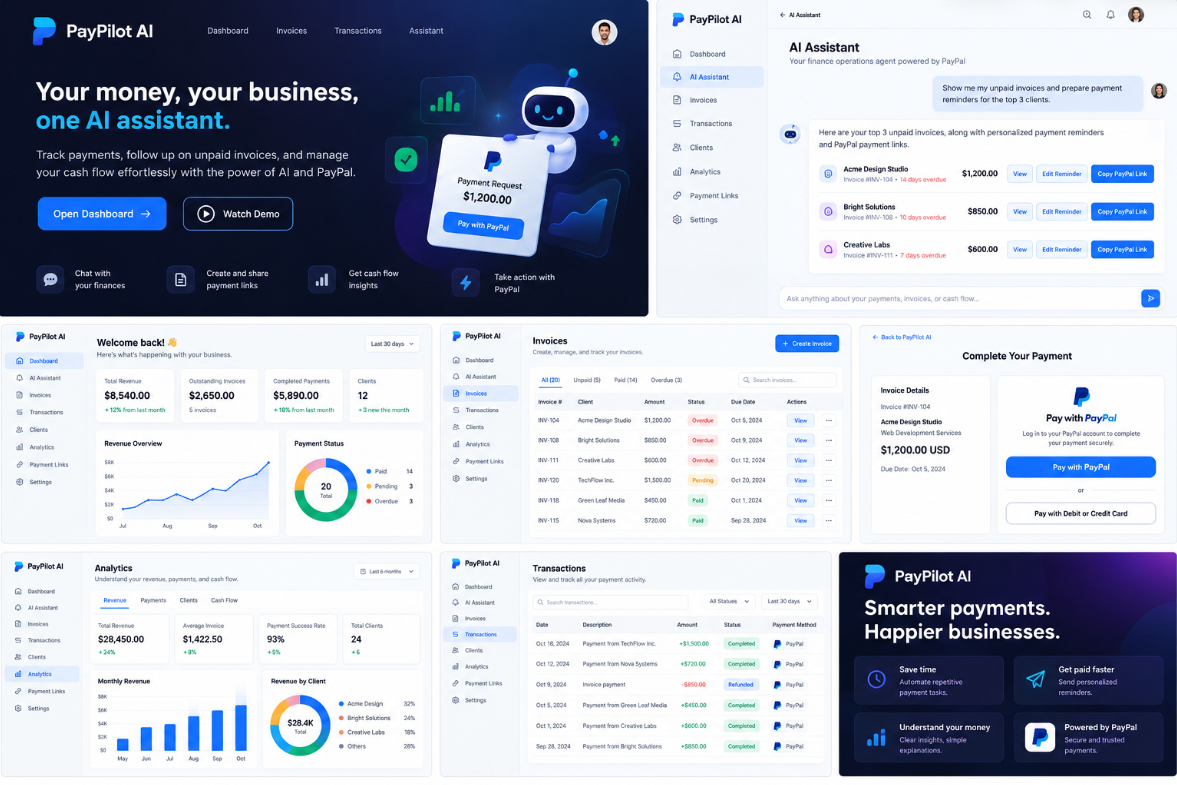
PayPilot AI is an AI-powered finance assistant designed to help freelancers and small businesses stay on top of their payments and cash flow.
With PayPilot AI, users can:
Track payments: Get a clearer picture of incoming payments and outstanding invoices.
Follow up smarter: Generate personalized payment reminders without writing every message from scratch.
Understand cash flow: Ask questions in plain English and get useful summaries of payment activity.
Simplify payments: Prepare PayPal-powered payment requests and guide users through the checkout process.
Make better decisions: Turn payment information into practical next steps instead of sorting through spreadsheets manually.
Our goal is simple: make financial tasks less stressful and give business owners more time to focus on their customers and their work.
🛠️ How We Built It
We designed PayPilot AI around two key technologies: AI and the PayPal Developer Platform.
The frontend provides a simple interface where users can view payment information and interact with the assistant. The backend handles application logic, connects the AI model to relevant tools, and communicates securely with PayPal's APIs.
The AI layer is designed to understand user requests, summarize available payment information, prioritize follow-ups, and prepare relevant actions. PayPal's sandbox environment allows us to demonstrate the payment workflow without processing real money.
We focused on making the experience practical rather than building another chatbot. The idea is to connect natural-language instructions with useful financial workflows, while keeping users in control of important payment decisions.
🧠 What We Learned
Building PayPilot AI helped us explore how AI can become more useful when it is connected to real tools and workflows.
We learned that a good AI-powered product is not just about generating convincing responses. It also needs reliable integrations, accurate data, clear feedback, and a smooth user experience.
We also explored the importance of payment security, server-side credential handling, transaction verification, and user confirmation before sensitive actions.
⚡ Challenges We Faced
One of the biggest challenges was connecting an AI-driven experience with payment operations that need to be reliable and secure.
AI can understand a request, but a payment application cannot simply trust a generated response as proof that a transaction succeeded. Payment status must be verified through trusted API responses.
Another challenge was balancing automation with user control. We wanted to reduce repetitive work without allowing an AI agent to make sensitive financial decisions without permission.
Designing a simple experience around several moving parts — AI, payment APIs, transaction data, and user confirmation — also required careful planning.
These challenges shaped our approach: automate the repetitive work, make important actions transparent, and keep the user in control.
🌍 What's Next
We see PayPilot AI becoming a helpful financial companion for independent professionals and small businesses — one that helps them understand their money, spend less time chasing payments, and make more confident decisions.
Our vision is not to replace financial judgment, but to make everyday financial management easier, smarter, and more accessible.
PayPilot AI — Your money, your business, one AI assistant.
Built With
- agentic
- ai-agents
- api-integration
- artificial-intelligence
- automation
- cash-flow
- fastapi
- financial-management
- fintech
- generative-ai
- large-language-models
- natural-language-processing
- payment-automation
- paypal
- paypal-checkout
- postgresql
- python
- react
- saas
- small-business

Log in or sign up for Devpost to join the conversation.