About PayPilot AI
Inspiration
Digital payments have become a part of everyday life, making it easier than ever to purchase products and services online. However, convenience does not always mean control. Users can exceed their budgets, make impulsive purchases, or approve transactions without fully understanding the potential risks.
We were inspired by a simple question:
What if your payment system could understand your purchase intentions, evaluate your spending decisions, and help protect you before money is spent?
This idea led us to build PayPilot AI — an intelligent payment authorization and risk management platform designed to make digital transactions smarter, safer, and more transparent.
What it does
PayPilot AI acts as an intelligent decision-making layer between a purchase request and payment execution.
Instead of simply processing a payment, it evaluates the transaction before it proceeds.
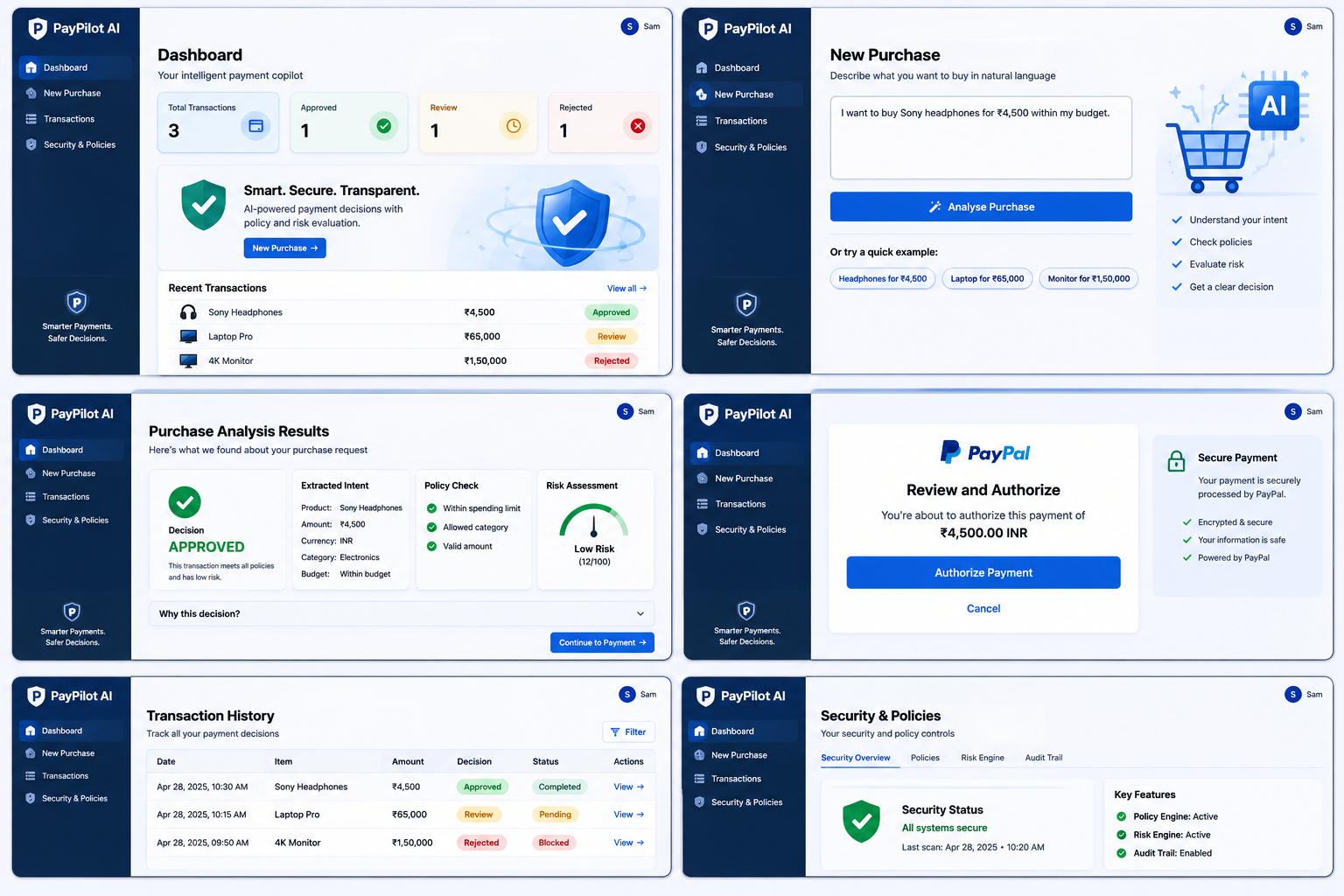
Users can describe their purchases in natural language, such as:
"I want to purchase Sony headphones for ₹4,500 within my budget."
PayPilot AI processes the request and evaluates it through three core components:
- Intent Understanding: Extracts structured purchase information, including product, amount, currency, category, and budget.
- Policy Engine: Validates spending limits and purchase rules to determine whether a transaction can proceed.
- Risk Engine: Evaluates transaction risk, assigns a risk score, and provides understandable reasons for its assessment.
Based on these evaluations, each transaction receives one of three decisions:
- APPROVED: The transaction satisfies the required policies and can proceed to user authorization.
- REVIEW: Additional verification or human approval is required.
- REJECTED: The transaction violates mandatory policies and cannot proceed.
For eligible transactions, PayPilot AI integrates with the PayPal payment workflow, allowing users to authorize and process payments through the PayPal Sandbox environment.
The platform also maintains transaction history and an audit trail, providing transparency into how each decision was reached.
How we built it
We developed PayPilot AI using a modular architecture that separates purchase understanding, financial policy validation, risk evaluation, and payment execution.
Backend:
- Python
- FastAPI
- SQLAlchemy
- SQLite
Frontend:
- React
- TypeScript
- Vite
- Tailwind CSS
Payment Integration:
- PayPal Orders API
- PayPal Sandbox
Testing and Security:
- Pytest
- Ruff
- Bandit
- pip-audit
The backend contains independent intent, policy, and risk engines. A transaction state machine controls the progression of each transaction and prevents unauthorized state changes.
We implemented persistent transaction storage and an append-only audit trail to maintain transaction history and accountability.
The frontend provides a dashboard, purchase analysis interface, transaction details, transaction history, and security and policy views.
An important architectural decision was to keep payment authorization separate from AI interpretation. The intent engine helps understand what the user wants, but final decisions are made through deterministic backend validation and policy checks. The user must explicitly authorize eligible transactions before payment execution.
Challenges we faced
One of our biggest challenges was designing a system where intelligent purchase understanding could coexist with strict financial security.
A natural-language request may be incomplete, ambiguous, or contain conflicting amounts and budgets. We had to ensure that the system validates the extracted information instead of blindly trusting it.
Another challenge was preventing unauthorized transaction approvals. We addressed this by implementing server-side policy evaluation, a controlled transaction state machine, and validation of payment information before capture.
Integrating payment workflows also required careful handling of order creation, user approval, payment capture, duplicate requests, and failed transactions.
We also faced the challenge of making the platform transparent. Rather than simply displaying an APPROVED or REJECTED result, PayPilot AI provides explanations of policy decisions and risk assessments.
What we learned
Building PayPilot AI helped us understand how multiple areas of software engineering come together in a real-world fintech application.
We gained practical experience in:
- Designing modular backend architectures.
- Developing REST APIs using FastAPI.
- Building responsive frontend applications using React and TypeScript.
- Implementing transaction state management and persistent databases.
- Designing deterministic policy and risk evaluation systems.
- Understanding payment authorization and capture workflows.
- Applying secure coding practices and automated testing.
- Handling errors, edge cases, and transaction integrity.
We also learned that in financial applications, intelligence alone is not enough. Reliability, transparency, user consent, and security must be fundamental parts of the design.
What's next?
Our vision is to evolve PayPilot AI into a more personalized intelligent payment assistant with advanced AI-based purchase understanding, adaptive spending insights, stronger fraud detection, customizable financial policies, and expanded payment integrations.
PayPilot AI is built around one principle: a payment should not just be easy to make; it should be a decision the user understands and controls.
Built With
- artificial-intelligence
- bandit
- css
- cybersecurity
- fastapi
- fintech
- fraud-detection
- full-stack
- html
- javascript
- natural-language-processing
- payment-security
- paypal
- paypal-sandbox
- policy-engine
- pytest
- python
- react
- rest-api
- risk-management
- ruff
- sqlalchemy
- sqlite
- typescript
- vite
