Inspiration
About PayPilot AI
Inspiration
Digital payments have become a normal part of our daily lives. However, most payment systems mainly focus on processing a transaction after the user decides to pay.
We wanted to explore a different idea:
What if AI could understand and analyze a payment before the user completes it?
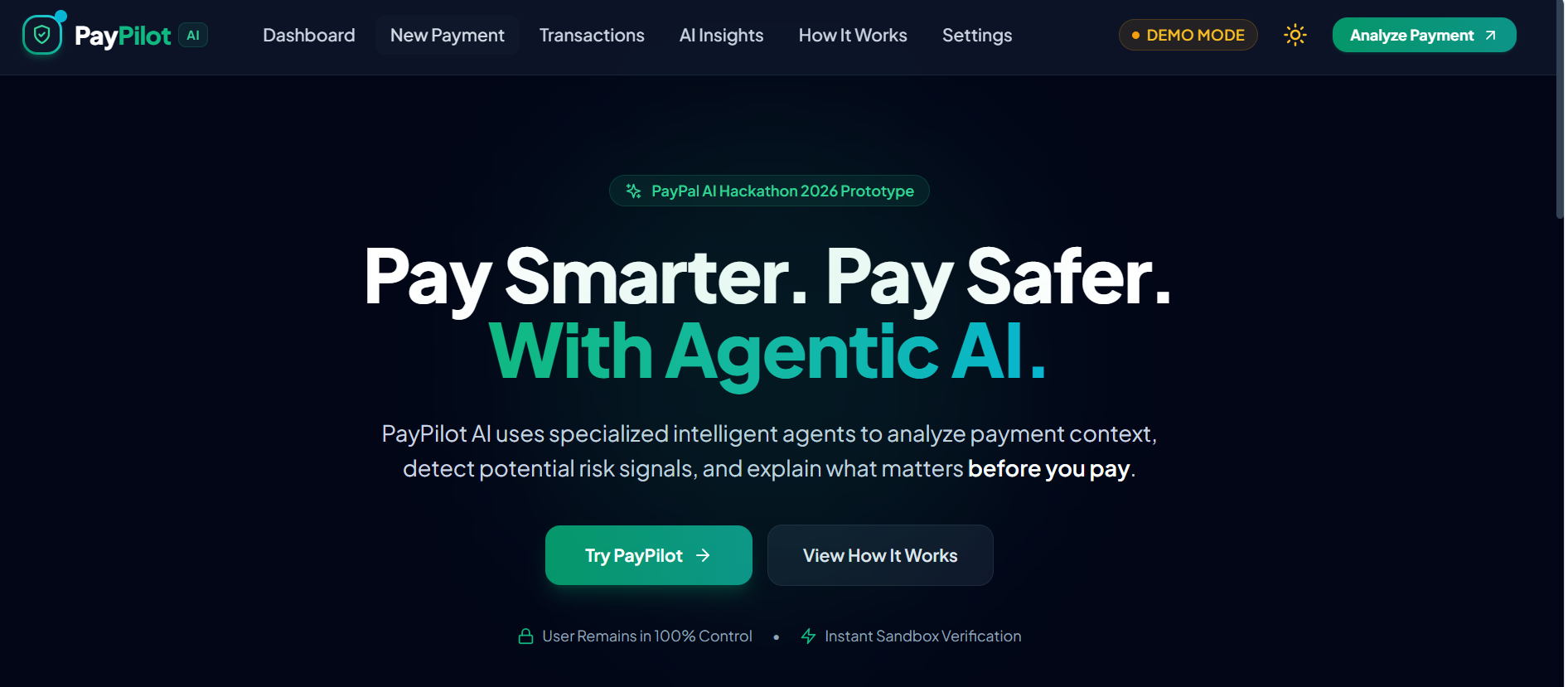
This idea inspired us to build PayPilot AI, an AI-powered payment safety and decision assistant. Instead of simply processing a payment, our system adds an intelligent analysis layer that helps users understand transaction risk, unusual patterns, spending behavior, and the reasons behind an AI recommendation.
What We Built
PayPilot AI uses an agentic AI architecture where multiple specialized AI agents work together.
The system includes:
- Transaction Understanding Agent – understands the payment context and purpose.
- Risk Analysis Agent – analyzes transaction-level risk signals.
- Fraud Signal Agent – identifies unusual or duplicate-like patterns.
- Spending Insight Agent – compares the transaction with historical spending behavior.
- Recommendation Agent – combines the analysis and provides a recommendation.
- Explainability Agent – converts technical findings into simple explanations for the user.
A central AI Orchestrator coordinates these agents and combines their outputs into a final assessment.
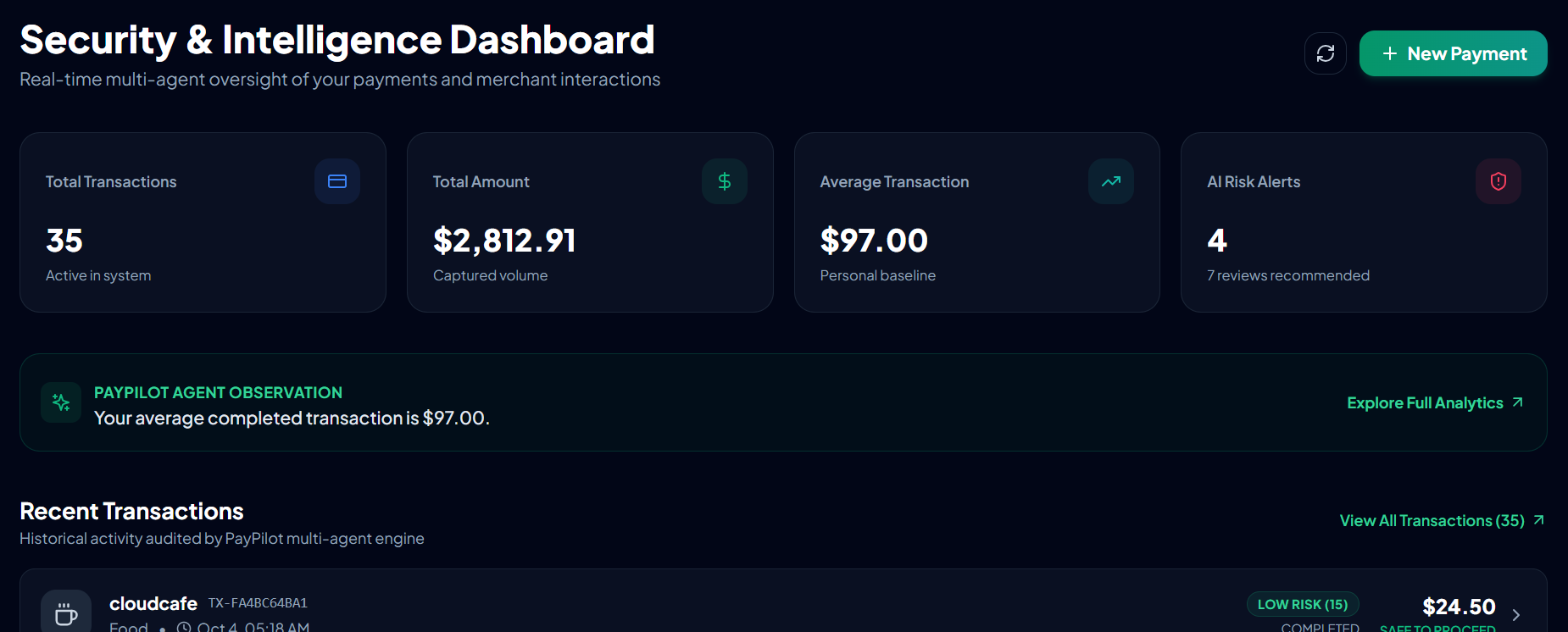
The user then sees the risk score, important signals, recommendation, and explanation before deciding whether to proceed.
An important design principle of our project is that the AI does not make the final payment decision. The user remains in control.
How We Built It
We built PayPilot AI using a modern frontend and backend architecture.
The frontend uses React, Vite, Tailwind CSS, Lucide Icons, and Recharts to provide a responsive fintech-style interface.
The backend uses Python, FastAPI, SQLAlchemy, and SQLite to manage APIs, transaction information, agent orchestration, and application data.
The AI layer consists of specialized agents coordinated through the AI Orchestrator. We designed the agents to produce structured outputs so that the backend can process their results consistently.
For payment testing, the project is designed around the PayPal Sandbox, allowing us to demonstrate the payment workflow without using real money.
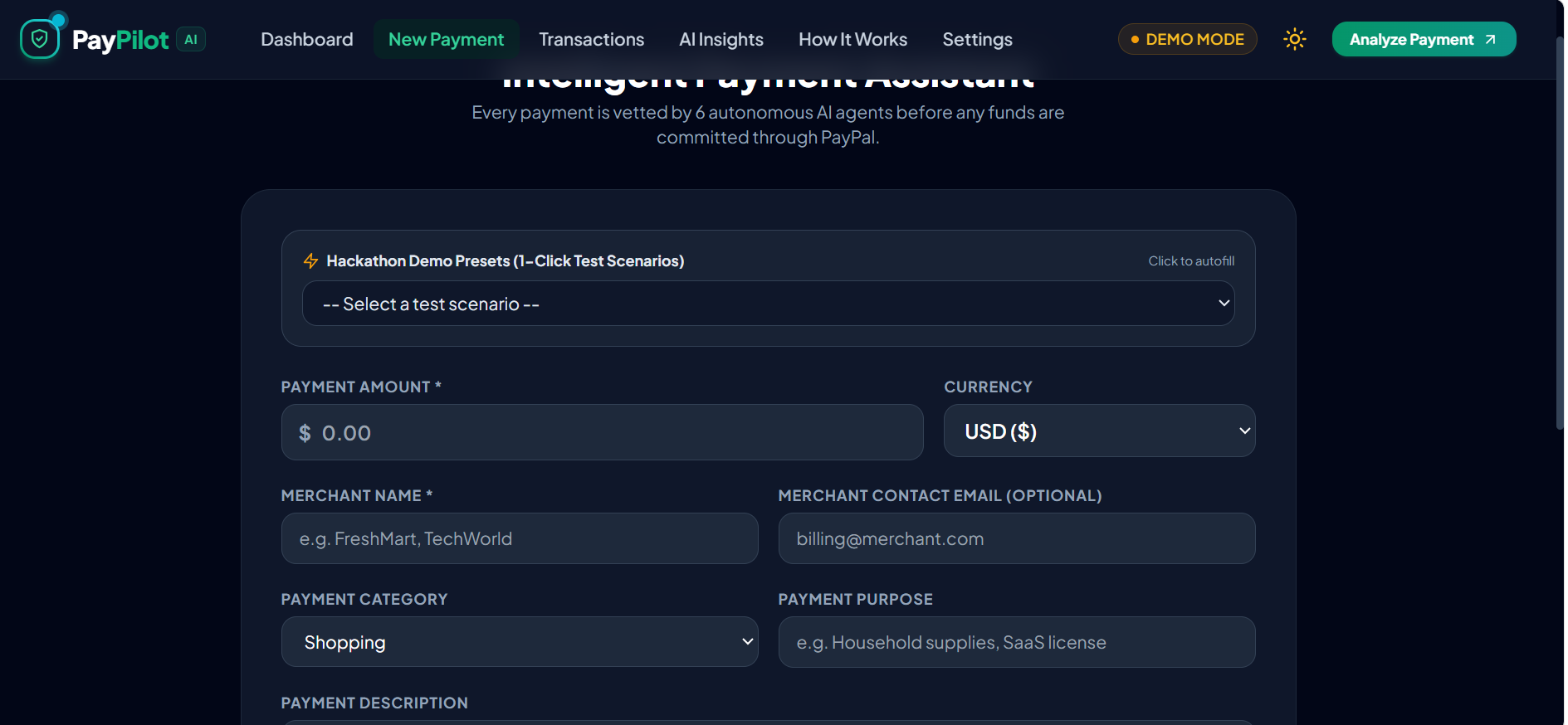
The application also supports a clearly labelled Demo Mode when payment credentials are not available during development.
What We Learned
Building this project helped us understand how AI can be integrated into a real-world application instead of being used only as a chatbot.
We learned about:
- Agentic AI and multi-agent architectures
- AI agent orchestration
- Structured AI outputs
- Explainable AI
- Risk analysis concepts
- Fraud signal detection
- REST API development
- FastAPI backend development
- React frontend development
- Database integration
- PayPal payment integration and sandbox testing
- Secure API credential handling
- Designing user-centered AI systems
One of our biggest learnings was that an AI system should not only provide a result. It should also help users understand why that result was produced.
Challenges We Faced
One of the main challenges was coordinating multiple AI agents. Each agent needed a clearly defined responsibility and a structured output so that the final result could be generated correctly.
Another challenge was making AI-generated results more reliable and understandable. We separated deterministic calculations from AI-generated explanations wherever possible and used structured outputs instead of relying only on free-form responses.
Fraud detection was another important challenge. We did not want the system to incorrectly tell a user that a transaction was definitely fraudulent. Instead, PayPilot AI presents risk signals and explanations so that users can review the transaction and make their own decision.
Payment integration was also challenging because transaction states, credentials, and API responses need to be handled carefully. Using the PayPal Sandbox helped us safely test the payment workflow.
Finally, we focused on making a technically complex multi-agent system easy for a normal user to understand. The Explainability Agent and visual dashboard were designed to present the AI findings in a simple and meaningful way.
Why PayPilot AI?
Our goal was not to build another payment interface or another chatbot.
We wanted to create an AI intelligence layer for payments.
The core idea behind PayPilot AI is:
Don't just process the payment. Understand the payment before the user makes it.
By combining Agentic AI, Explainable AI, Spending Intelligence, Risk Analysis, and PayPal integration, PayPilot AI demonstrates how AI can make digital payment experiences more transparent, informative, and user-centered.

Log in or sign up for Devpost to join the conversation.