Inspiration
Online shopping often involves multiple steps: discovering products, comparing prices, managing budgets, checking product suitability, and completing payments. Traditional shopping assistants mainly provide recommendations but rarely coordinate the entire purchasing journey.
We wanted to go beyond a conventional chatbot and build an intelligent commerce assistant that could understand customer intent, coordinate specialized AI agents, personalize recommendations, and simplify payments while keeping customers in control.
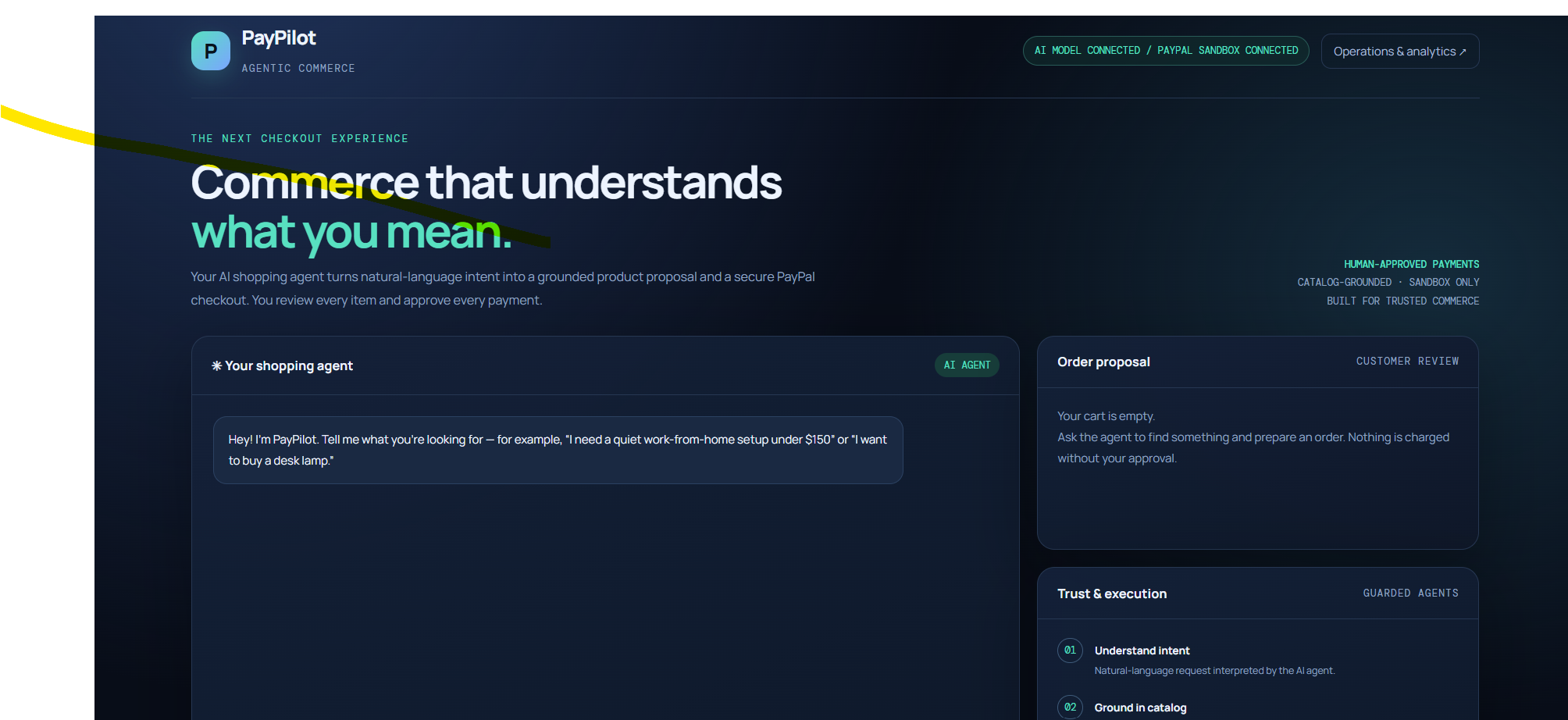
This inspired us to create PayPilot — Agentic Commerce with PayPal, an AI-powered shopping assistant that transforms natural-language shopping requests into personalized product recommendations and secure, customer-approved checkout experiences.
What it does
PayPilot is an Agentic AI-powered commerce platform that helps customers move from shopping intent to a reviewable purchase proposal.
Its key capabilities include:
- Natural-language shopping: Customers describe what they need using everyday language.
- Intelligent product discovery: Finds relevant products from connected product sources.
- Explainable recommendations: Explains why a product matches the customer's search.
- Budget optimization: Compares product prices against customer spending limits and identifies affordable options.
- Multi-agent orchestration: Coordinates specialized agents through a central PayPilot Supervisor.
- Personalized shopping: Uses preferred brands, categories, and budgets to influence product recommendations.
- Trust and checkout validation: Separates PayPilot checkout-eligible demo products from external marketplace listings.
- PayPal integration: Creates checkout proposals and supports customer-approved payments through the PayPal Orders API Sandbox.
- Operations dashboard: Provides visibility into orders, payments, and application activity.
Multi-Agent Architecture
PayPilot uses a hybrid multi-agent architecture consisting of:
- Shopping Agent: Reviews product discovery results.
- Budget Agent: Evaluates products against explicit spending limits.
- Trust Agent: Validates checkout eligibility and distinguishes external listings.
- Personalization Agent: Applies customer preferences to product ranking.
- PayPilot Supervisor: Coordinates specialist-agent results and produces a unified response.
How we built it
We built PayPilot using a combination of AI technologies, backend frameworks, payment APIs, and web technologies.
AI and Agentic Architecture
- OpenAI API for AI-powered natural-language shopping interactions.
- A supervisor-based hybrid multi-agent architecture.
- Deterministic specialist agents for budget validation, trust checks, and personalization.
Backend
- Python for application logic.
- FastAPI for REST API development.
- SQLAlchemy for database operations.
- SQLite for persistent order and payment records.
Frontend
- HTML, CSS, and JavaScript.
- Interactive product cards and shopping interface.
- Chart.js for analytics visualizations.
Product Discovery
- Curated PayPilot product catalog.
- DummyJSON sample product data.
- Optional eBay Browse API integration for external marketplace listings.
Payment Integration
- PayPal Orders API Sandbox for checkout creation, customer approval, and payment capture verification.
We designed the workflow so that customers can review their selected products and order proposal before proceeding to PayPal. Payment capture is handled through the backend after customer approval.
Challenges we ran into
One of our biggest challenges was integrating AI-powered product discovery with a reliable payment workflow.
We needed to ensure that recommendations were grounded in available product data and that external marketplace listings were never incorrectly presented as products eligible for PayPilot checkout.
Another challenge was designing an effective multi-agent architecture. Each specialist needed a clearly defined responsibility, while the supervisor had to coordinate their results without creating unnecessary complexity.
Integrating the PayPal Orders API also required careful handling of order creation, customer approval, payment capture, and cancellation states.
We additionally faced challenges in:
- Improving product search relevance.
- Implementing accurate budget comparisons.
- Maintaining preference data without storing unnecessary customer information.
- Preserving application stability while introducing new features.
- Building a professional interface that clearly communicates payment status and checkout eligibility.
We addressed these challenges through modular backend development, deterministic validation, clear product-source labeling, and repeated Sandbox testing.
Accomplishments that we're proud of
We are proud to have developed a working prototype that brings together Agentic AI, personalized commerce, and PayPal payment integration.
Some of our major accomplishments include:
- Building a functional natural-language AI shopping assistant.
- Implementing a supervisor-coordinated multi-agent workflow.
- Creating explainable product recommendation cards.
- Developing a budget-aware product comparison system.
- Implementing browser-local customer shopping preferences.
- Integrating PayPal Sandbox checkout with customer approval.
- Implementing payment capture verification and cancellation handling.
- Developing a persistent order management system.
- Creating an operations dashboard with analytics and activity tracking.
- Building an integrated frontend and backend experience.
Most importantly, we demonstrated how multiple specialized agents can coordinate different stages of a commerce workflow while preserving customer control over payments.
What we learned
Building PayPilot gave us practical experience in developing real-world AI-powered applications.
We learned how to:
- Integrate large language models into application workflows.
- Design supervisor-based multi-agent systems.
- Build REST APIs using FastAPI.
- Integrate third-party payment APIs.
- Handle payment approval and capture workflows.
- Implement product discovery and recommendation systems.
- Develop personalized shopping experiences.
- Manage persistent data using SQLite and SQLAlchemy.
- Build interactive web interfaces and analytics dashboards.
- Design AI systems with transparency, validation, and human oversight.
One of our biggest takeaways was that an effective Agentic AI system should not simply generate intelligent responses. It should coordinate meaningful actions, validate decisions, communicate limitations, and keep humans involved in important operations.
What's next for PayPilot — Agentic Commerce with PayPal
Our vision is to evolve PayPilot into a scalable and production-ready Agentic Commerce platform.
Future enhancements include:
- Verified real-time inventory: Integrate additional retailer APIs for accurate availability and pricing.
- Advanced personalization: Develop more sophisticated recommendation and preference-learning models.
- Intelligent price analysis: Introduce price-history analysis and product-value comparisons.
- Enhanced trust and security: Add advanced fraud detection, transaction risk analysis, and stronger validation.
- Expanded payment experiences: Explore additional PayPal payment capabilities and payment methods.
- Cloud deployment: Deploy a scalable production architecture with persistent cloud infrastructure.
- Advanced agent collaboration: Expand agent capabilities for more complex shopping and purchasing workflows.
Our long-term goal is to make commerce more intelligent, personalized, transparent, and secure.
PayPilot — Shop smarter. Spend wiser. Stay in control.
Prototype disclosure: PayPal transactions currently use the Sandbox environment and do not represent real-money purchases. DummyJSON provides sample product data rather than verified retailer inventory. External marketplace listings are view-only in the prototype.
Built With
- agentic
- ai
- api
- artificial
- css
- developer
- e-commerce
- fastapi
- generative
- html
- intelligence
- javascript
- language
- large
- models
- multi-agent
- openai
- payment
- paypal
- platform
- python
- rest
- sqlalchemy
- sqlite
- systems
