Inspiration
Freelancers and small sellers don't hate getting paid — they hate the admin around it: re-typing line items into clunky invoice forms, losing track of due dates, and dreading the awkward "just chasing this invoice…" email. Existing invoicing tools all start with a blank form. We asked: what if an invoice started with a sentence, and PayPal + AI handled everything after it?
What it does
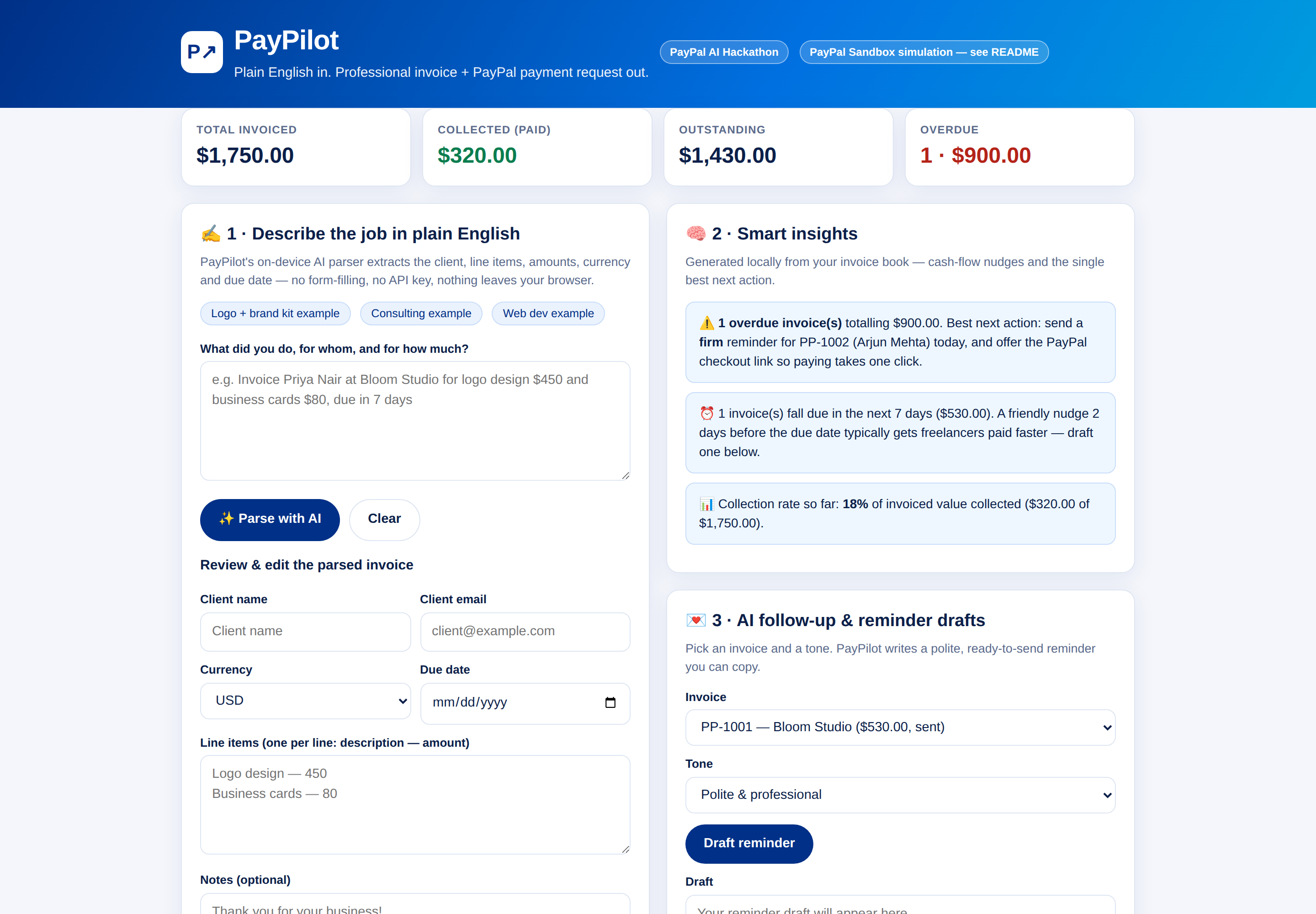
PayPilot is an AI invoicing assistant for freelancers, consultants and small sellers:
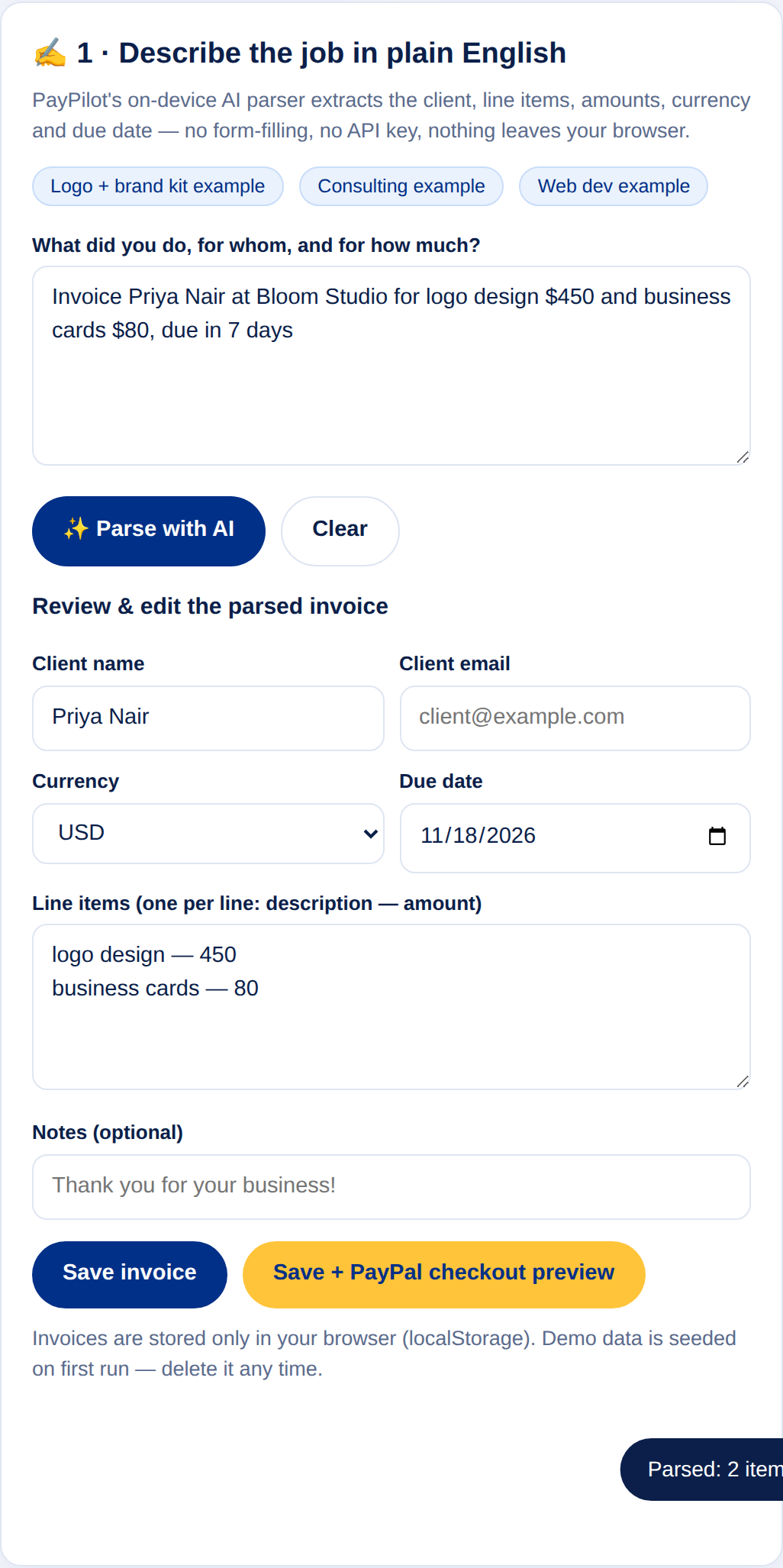
- Plain-English invoice creation — type "Invoice Priya Nair at Bloom Studio for logo design $450 and business cards $80, due in 7 days" and PayPilot extracts the client, email, line items, amounts, currency (USD, EUR, GBP, INR, AUD, CAD) and due date, including natural expressions like "net 14", "due 20 Nov" and hourly work ("8 hours consulting at $60 per hour").
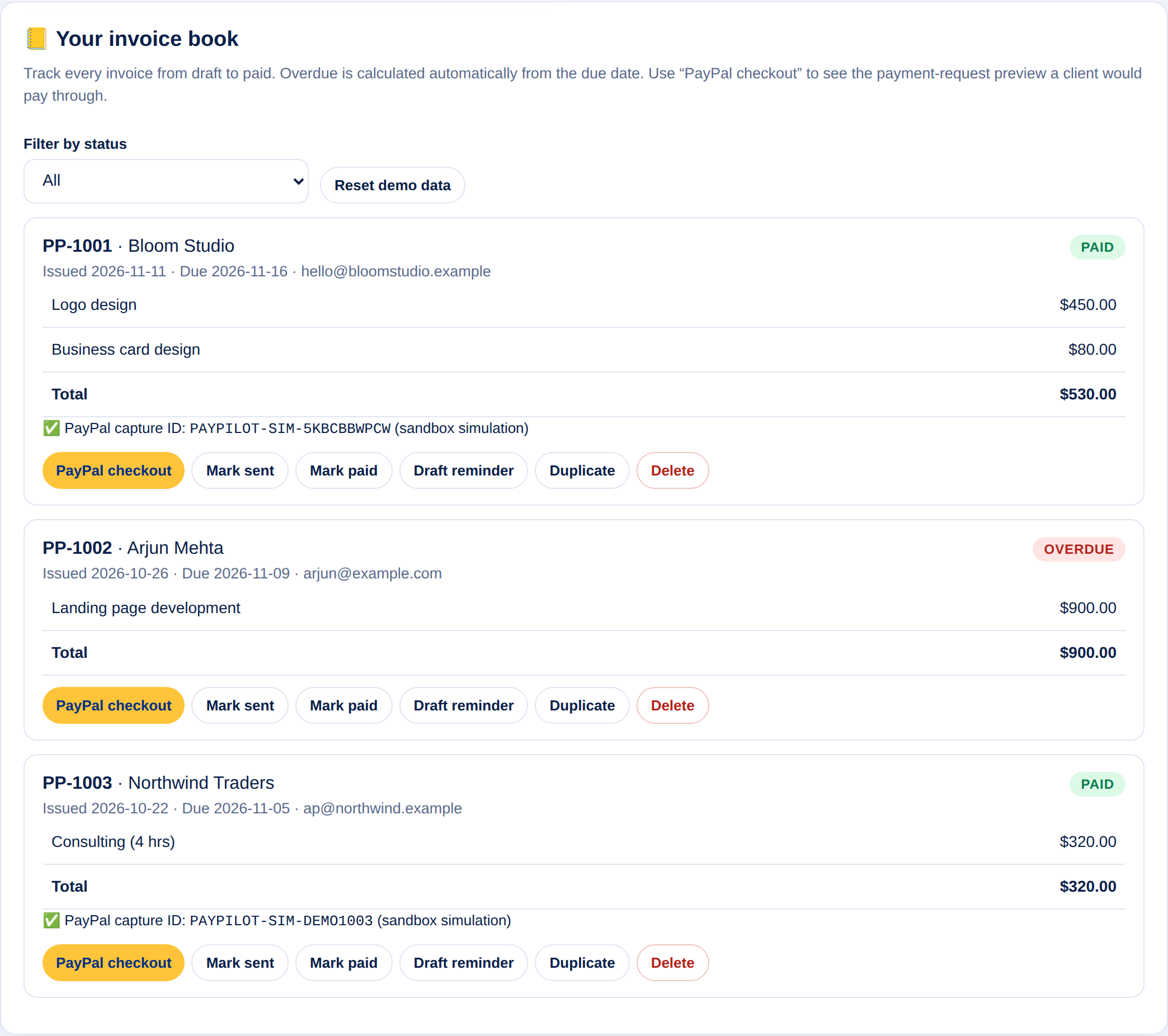
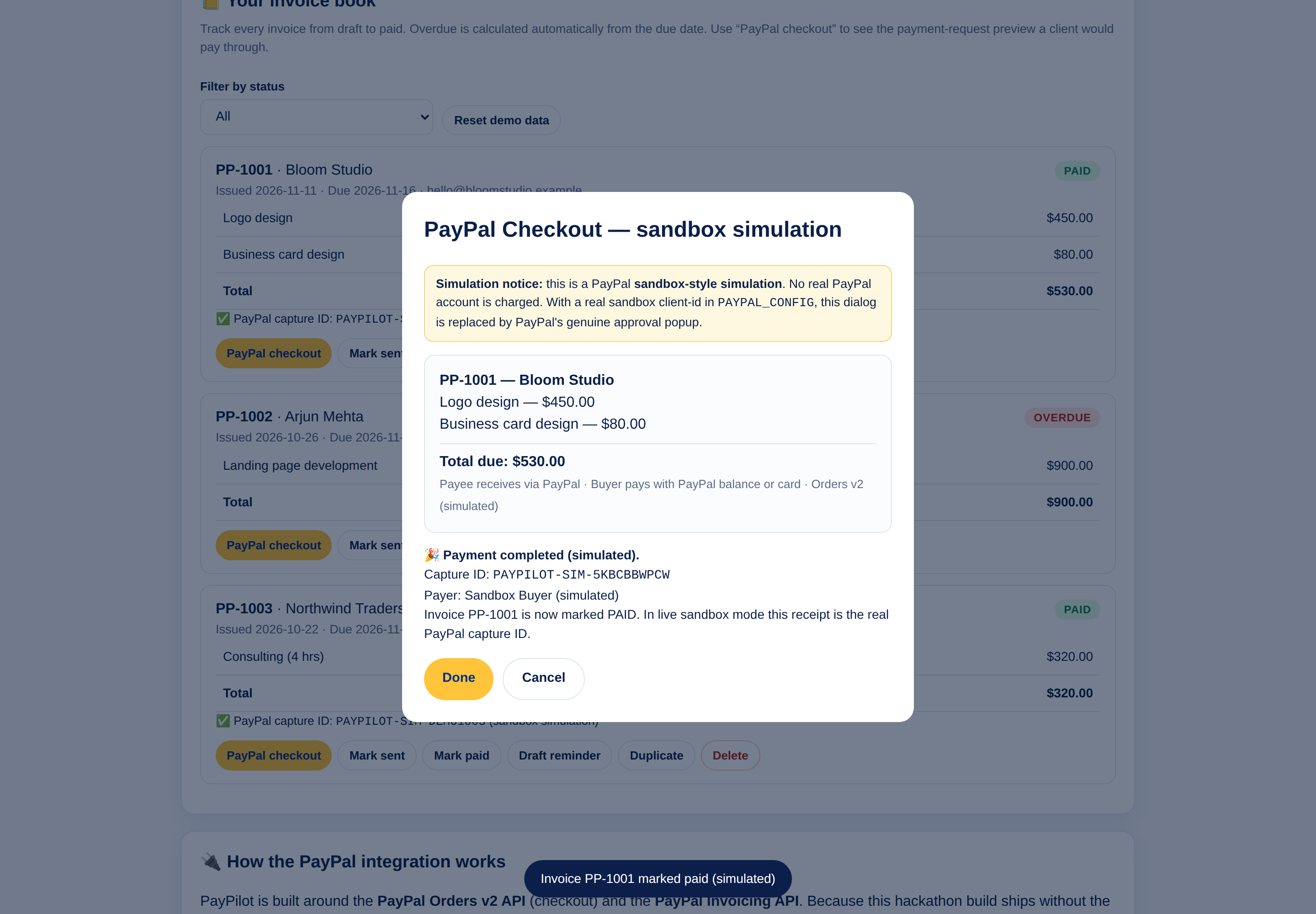
- PayPal payment request & checkout preview — each invoice generates a PayPal Checkout preview and runs the full create-order → buyer approval → capture flow, flipping the invoice to Paid with its capture/receipt ID.
- Invoice tracking — a live invoice book with Draft / Sent / Paid / Overdue statuses (overdue is detected automatically from due dates), plus totals for invoiced, collected, outstanding and overdue amounts. Everything persists in the browser via localStorage — no backend, no sign-up.
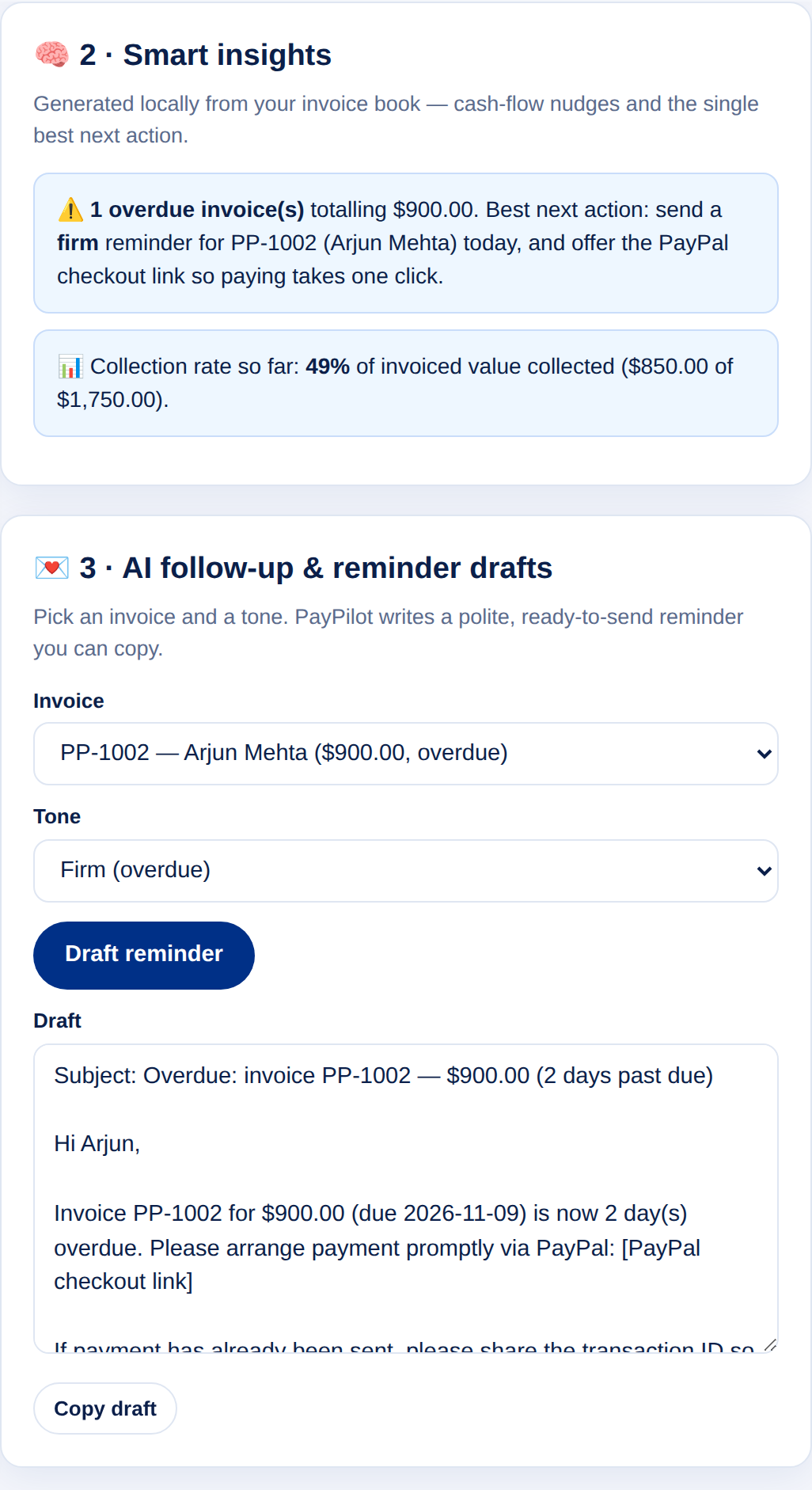
- Smart follow-ups — one click drafts a complete reminder email in a friendly, polite or firm tone, with the amount, items, due date and days overdue filled in, ready to copy and send.
- Smart insights — PayPilot reads your whole book and surfaces the single best next action for your cash flow: which overdue invoice to chase first, what's due this week, your collection rate, and which drafts are sitting unsent.
How we built it
PayPilot is a single self-contained index.html — HTML5, CSS3 and vanilla JavaScript, with no build step, no framework and no external network calls, so it runs from file:// or any static host (GitHub Pages). The AI layer runs entirely on-device: a grammar- and pattern-based natural-language parser for invoice extraction, a status-aware template composer for reminder drafts, and a rule-based insights engine over the invoice book. The parser is deliberately shaped as a drop-in seam — replace one function with an LLM API call returning the same JSON and the rest of the app is unchanged.
The payments layer is built around the PayPal Orders v2 API and PayPal Invoicing API. Because a hackathon build must never ship personal credentials, the checkout runs as a clearly-labelled PayPal sandbox simulation: every step (create order → approve → capture; or create invoice → send) maps 1-to-1 to the real sandbox call, and the integration is stubbed in a single documented PayPalAdapter + PAYPAL_CONFIG block. Paste a free sandbox Client ID from developer.paypal.com, flip one flag, load the PayPal JS SDK, and the identical flow calls the real PayPal sandbox — statuses and receipt IDs are consumed exactly the same way.
Challenges we ran into
- Natural-language amounts are messy: "2x logos — 300", "$60/hr", and "travel $120" all need different extraction rules, and client names must not swallow the word "for". We iterated the parser against a battery of realistic freelancer sentences.
- Keeping the whole product honest about payments: the simulation had to feel like the real PayPal flow (so judges can evaluate it end-to-end) while never pretending real money moved. Explicit labelling in the UI, README and video was the answer.
- Doing it all in one file with zero dependencies, so any judge can run it in ten seconds.
Accomplishments that we're proud of
- A complete, working invoicing loop — describe → invoice → PayPal request → paid → chased — in a single file with no setup.
- An on-device AI parser that handles currencies, hourly rates, quantities and natural due dates with no API key.
- Reminder drafts that freelancers can genuinely send as-is.
What we learned
Payments UX is mostly trust and clarity: showing the buyer a clean PayPal summary, and the seller an unambiguous status, matters as much as the API calls. We also learned how far deterministic, on-device AI can go for a well-scoped language task — and exactly where an LLM upgrade would add the most value (messier, free-form job descriptions).
What's next for PayPilot
- Wire the stubbed adapter to a live PayPal sandbox Client ID and add PayPal Invoicing API send + webhook-driven status updates (payment captured → invoice auto-marked paid).
- Swap the parser seam to an LLM for free-form, multi-job descriptions and multi-currency books.
- Recurring invoices, partial payments/deposits via PayPal, and one-tap reminder sending.
Built With
- css3
- github
- html5
- javascript
- localstorage
- natural-language-processing
- paypal
- paypal-checkout
- paypal-sandbox
- vanilla-js
