-
-
-

-
Landing page
-
Operator Overview
-
Task Live Run Demo
-
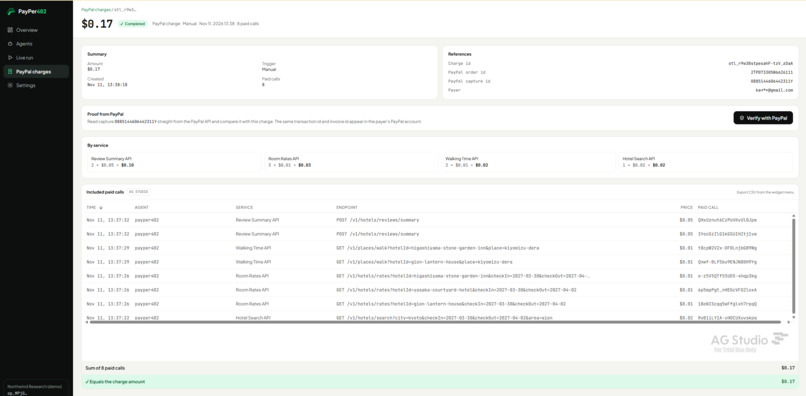
PayPal Charge
-
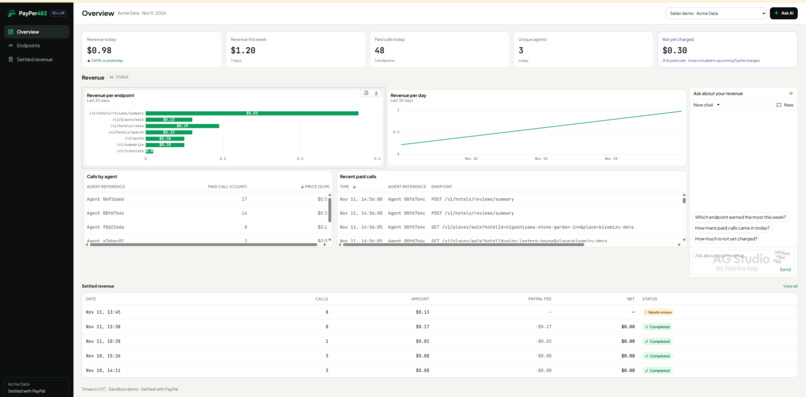
Seller Overview
-

Inspiration
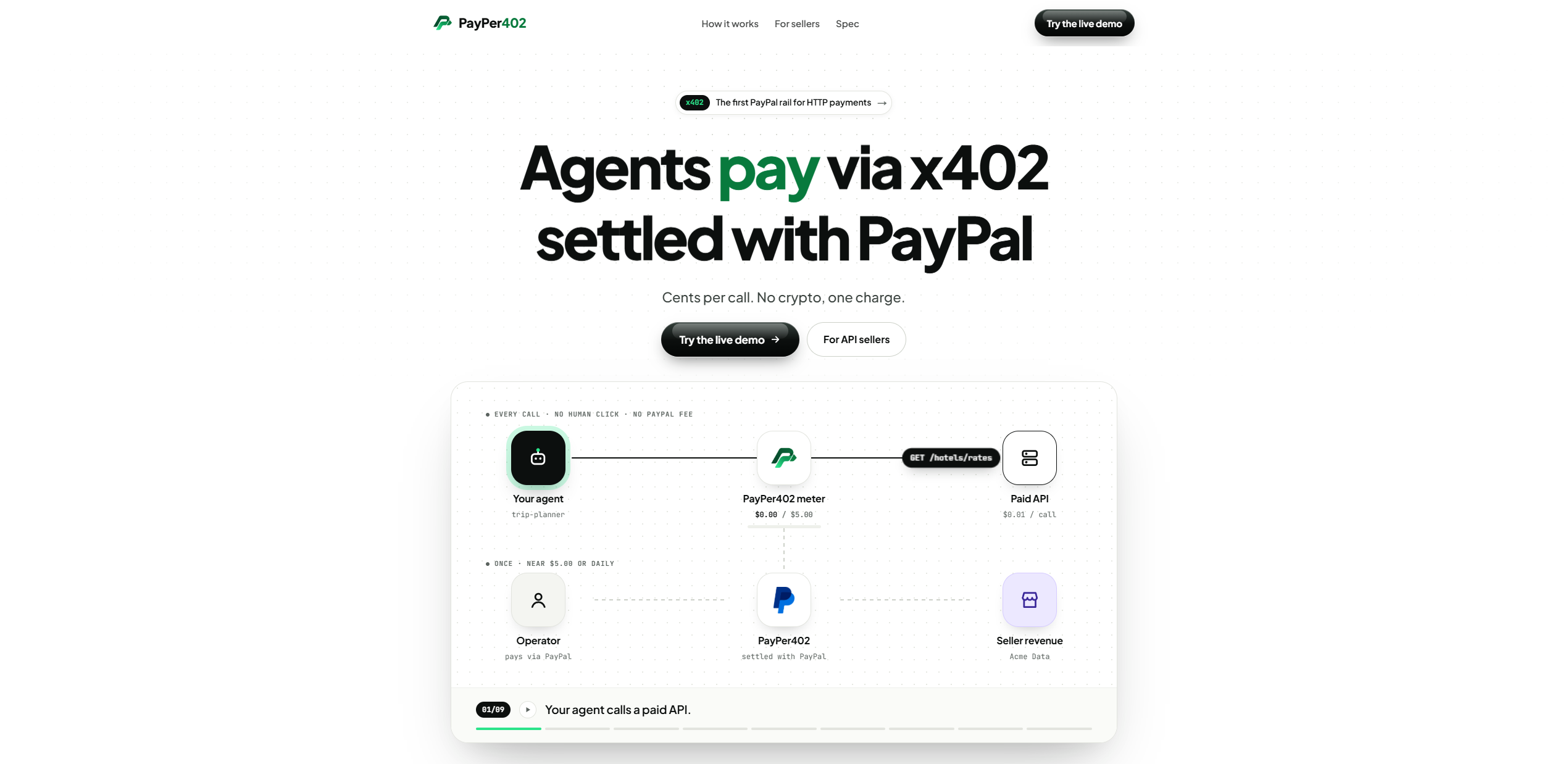
AI agents are starting to buy things on their own: a hotel rate, a review summary, a walking time. Each of those is worth a few cents. Yet today an agent cannot pay a few cents per call. API subscriptions need a human to sign up with every provider in advance, checkouts need a human for every purchase, and a fixed fee per transaction is bigger than the call itself.
The x402 protocol brings back HTTP 402 Payment Required so a machine can pay per request, but it settles on a blockchain. Most operators and API sellers don't want to hold stablecoins. They already have PayPal.
We wanted electronic toll collection for APIs: link once, drive through, get billed once.
What it does
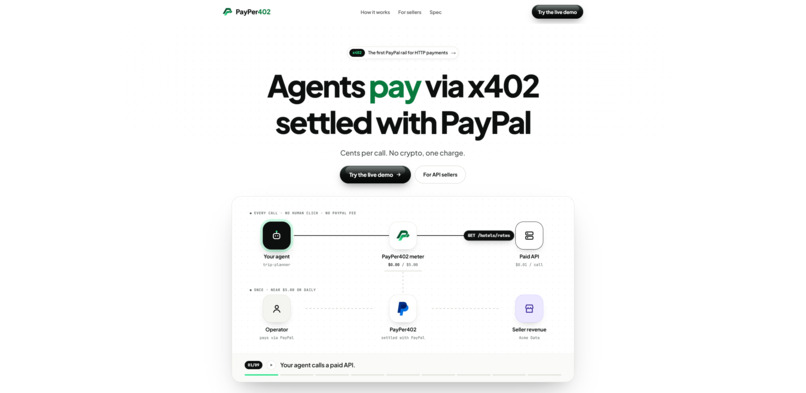
PayPer402 lets an AI agent pay for APIs one call at a time over x402, with the money settled through PayPal.
- Link once (human present). The operator links a PayPal account through the Vault v3 API and sets caps: per call, per day, total, and an unsettled cap.
- Pay per call (no human). A paid API answers
402with a price. The agent signs a payment commitment with its Ed25519 key and retries. The facilitator checks the signature, the caps and replay protection, records the commitment, and the API serves the response. - Settle in one charge (no human). Commitments are summed and charged to the saved PayPal account as one Orders v2 capture, when the unsettled cap is reached or once a day. A charge is never more than the sum of signed, unsettled commitments.
- Stop at any time. The payer clicks "Stop paying with PayPal" in their PayPal account, and the agent's next paid call is refused.
Why batch? A US PayPal checkout costs about 3.49% + $0.49. Charging a 2-cent call on its own:
$$0.49 + 0.0349 \times 0.02 \approx \$0.49 \approx 25\times \text{ the price of the call}$$
Batch 250 of those calls into one $5 charge and the fee drops to about a quarter of a cent per call.
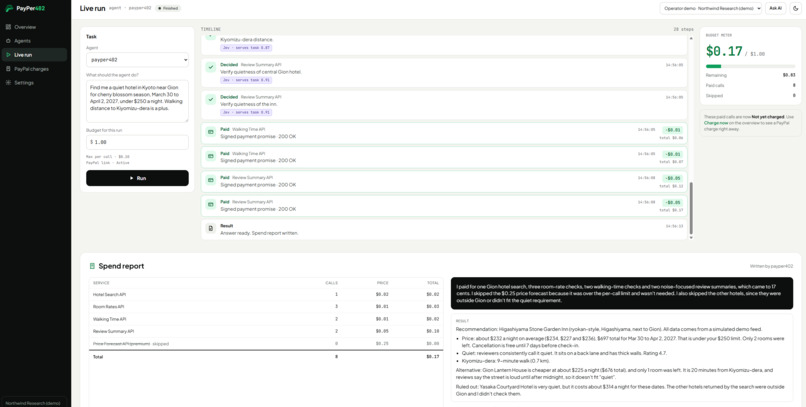
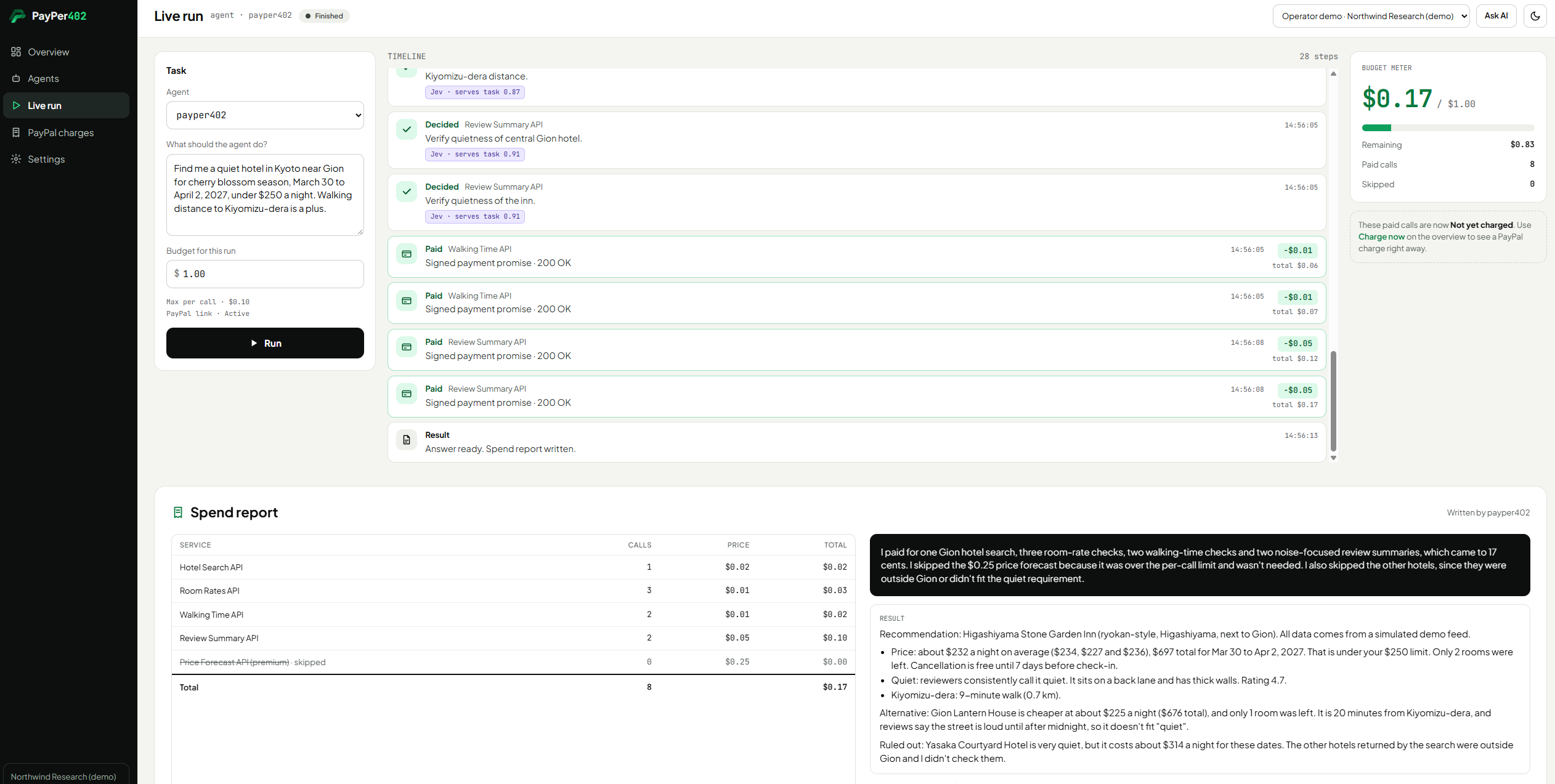
In the demo, a Claude agent plans a trip to Kyoto on a $0.50 budget. It reads the 402 prices of five paid travel APIs (1 to 25 cents), decides which ones are worth buying, pays, answers, and ends with a plain-English spend report. Before each payment, Jev (TypeSafe) gives a calibrated second opinion: does this call serve the task, and is the result already in hand? Code makes the final decision with fixed thresholds.
The web app covers three people:
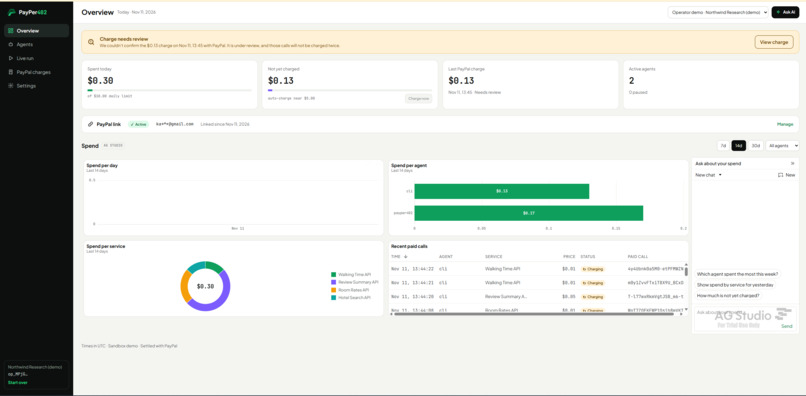
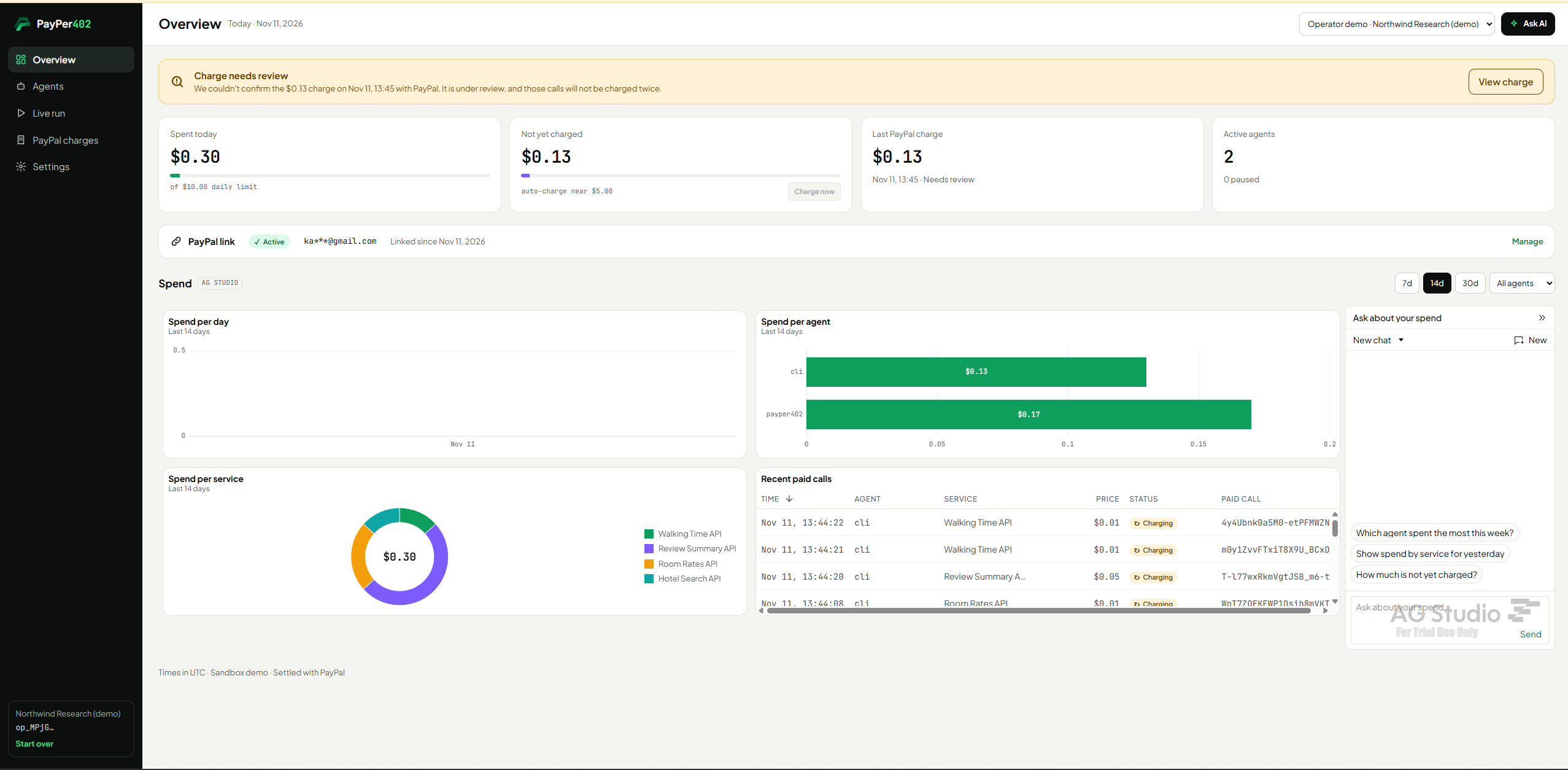
- Operators: link PayPal, set caps, manage agents, watch a live run, and charge.
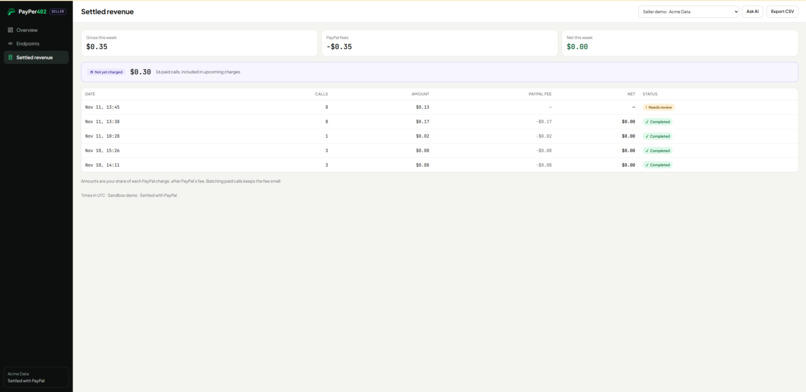
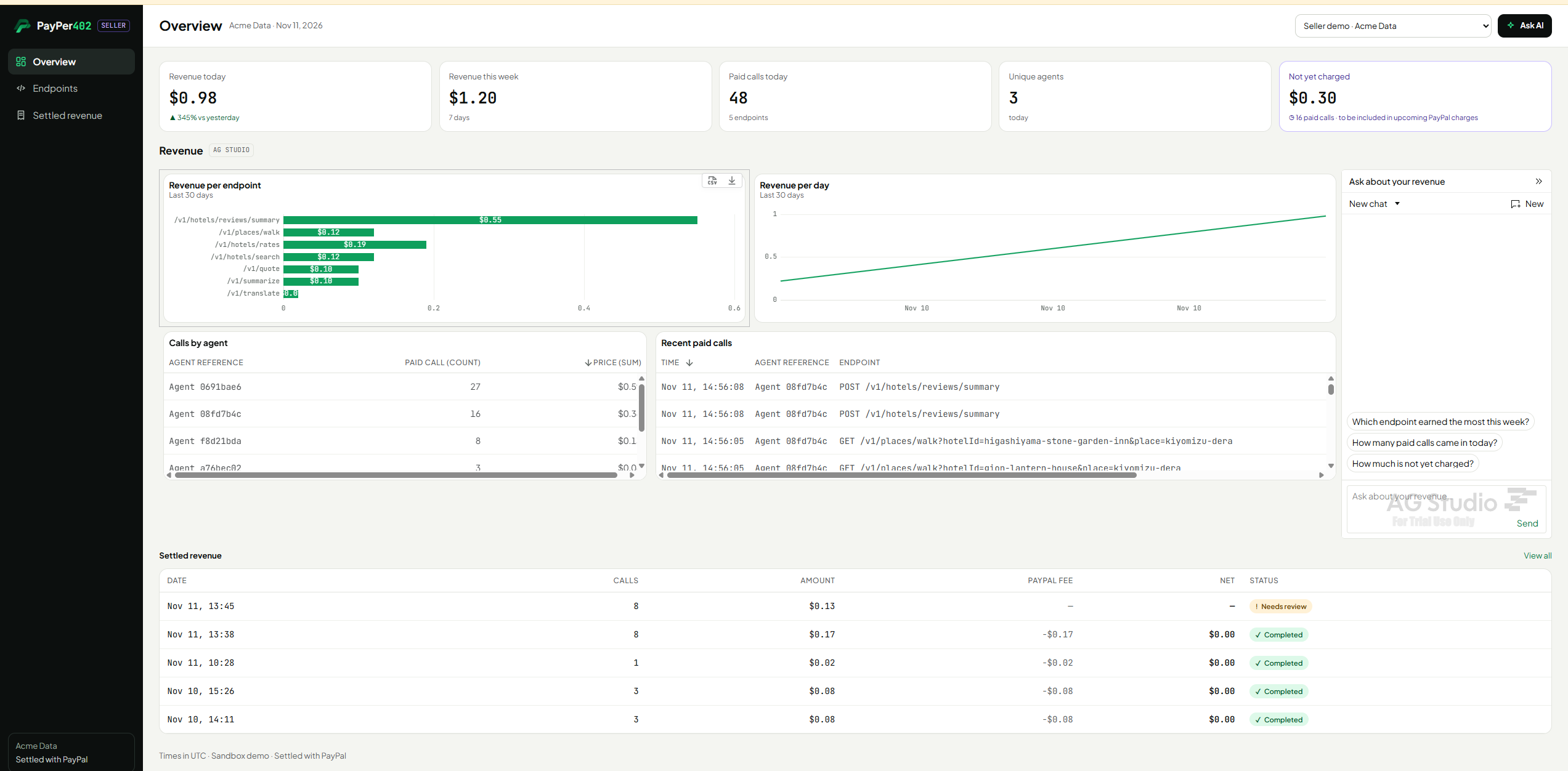
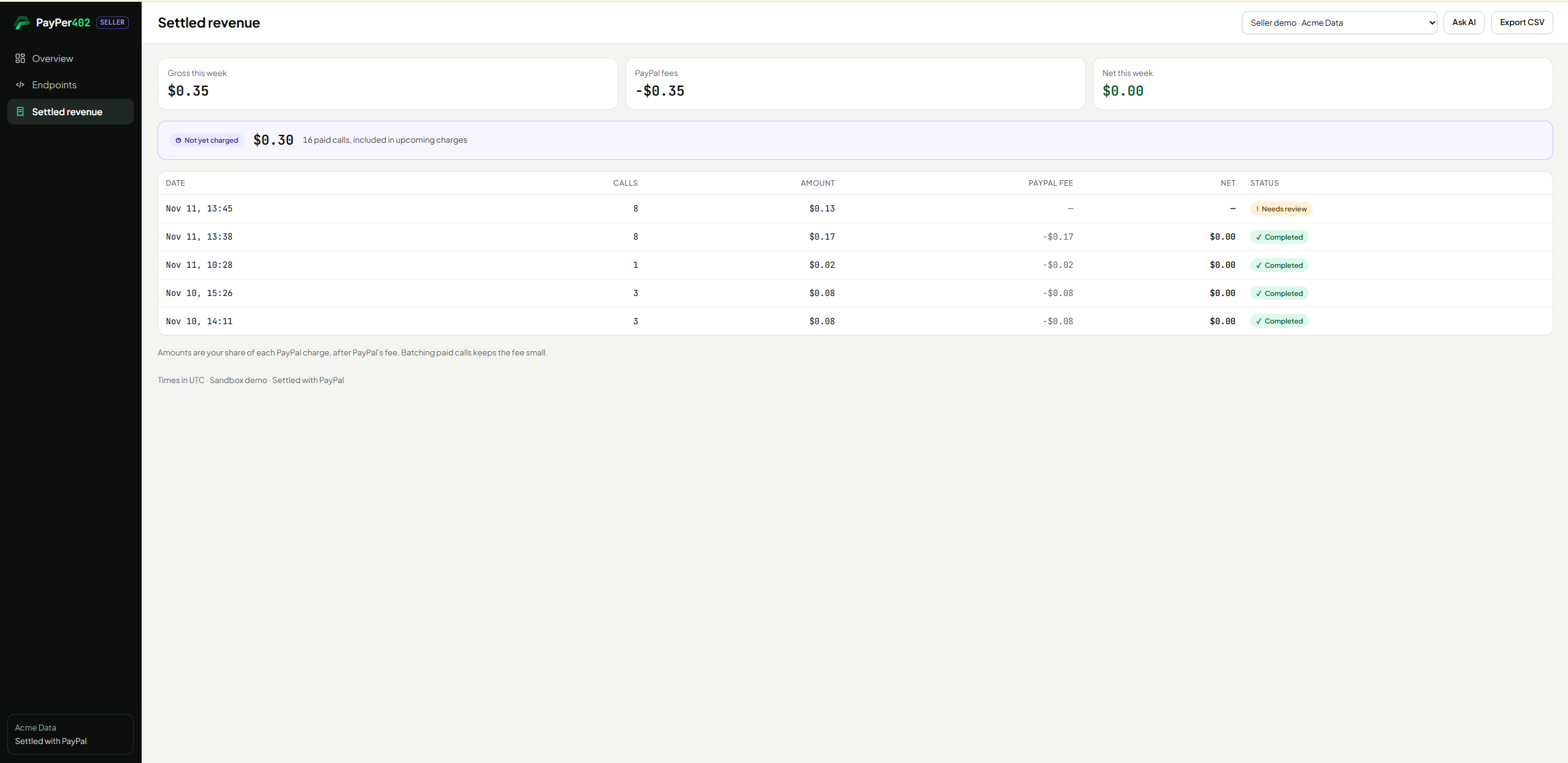
- Sellers: revenue per endpoint and settlement status.
- Developers: the
payper402npm command and an MCP server, so Claude Code or Claude Desktop can pay per call too.
The operator and seller dashboards are built with AG Studio, with a read-only Claude analyst inside.
How we built it
- An x402 network binding for PayPal: network
paypal:sandbox, assetUSD, schemebatch-settlement. It is written as plug-ins for the official@x402/coreSDK (client, resource server, facilitator). Sellers use the stock@x402/expressmiddleware and agents use@x402/fetch; nothing is forked. The binding has its own spec, in the style of the x402 scheme specs. - A facilitator (Express, SQLite, zod): verifies commitments, keeps the ledger, enforces caps, runs the settlement job, and handles revocation.
- PayPal (sandbox): OAuth; Vault v3 setup and payment tokens with
usage_pattern: UNSCHEDULED_POSTPAID; Orders v2 create-and-capture withpayment_source.paypal.vault_idandPayPal-Request-Idfor idempotency; Payments v2 to read a capture back ("Verify with PayPal"); and Webhooks (VAULT.PAYMENT-TOKEN.DELETED) for instant revocation. - AI: a Claude agent with tool use and adaptive thinking (Anthropic SDK), Jev
jev-1.14.0as the decision layer, Claude behind a server route as the AG Studio analyst, and Claude powering one of the seller's paid APIs. - Web: Next.js, React, Tailwind CSS v4, and AG Studio 3.0.0 with a custom
AgLlmAdapter, so the Anthropic key never reaches the browser. - TypeScript everywhere, in an npm workspaces monorepo, with more than 1,000 Vitest tests. Every PayPal, Anthropic and TypeSafe call is mocked in tests; the real sandbox is exercised by explicit end-to-end scripts.
We proved the riskiest assumptions first with small spikes: charging a saved PayPal wallet again and again with no payer present, plugging a fake network into the x402 SDK, Jev latency, and AG Studio in Next.js. Only then did we build.
Challenges we ran into
- x402 assumes settle-per-call. On a blockchain, every payment settles on its own. With PayPal we had to split commitment from settlement: a call is served against a signed commitment, and money moves later in a batch. We had to do this inside the SDK's scheme interfaces without forking them.
- Postpaid means credit risk. If a payer revokes before the next charge, unsettled usage is lost. We added an unsettled cap: when it is reached, the facilitator settles at once, and stops serving if that fails. The same threshold drives batching.
- One agreement per payer and merchant. On sandbox, linking the same PayPal account to a second operator returned the same payment token. So a revocation must stop every operator that holds that token, and unlinking may delete the token only when nobody else uses it.
- Noticing revocation fast. Webhooks need public HTTPS. So we combined three signals: the webhook, a wallet health check every 30 seconds, and PayPal's own errors on a charge (
AGREEMENT_ALREADY_CANCELLED,TOKEN_NOT_FOUND). - Keeping the model away from the money. Payment tools accept only catalog ids, never free-form amounts, URLs or recipients. Every price is checked against the catalog, the per-call limit and the remaining budget before anything is signed. The numbers in the spend report come from the ledger, never from the model.
- Calibrating Jev. Our first thresholds caught nothing on the newer Jev model. We built a labelled evaluation and took the thresholds from its results.
Accomplishments that we're proud of
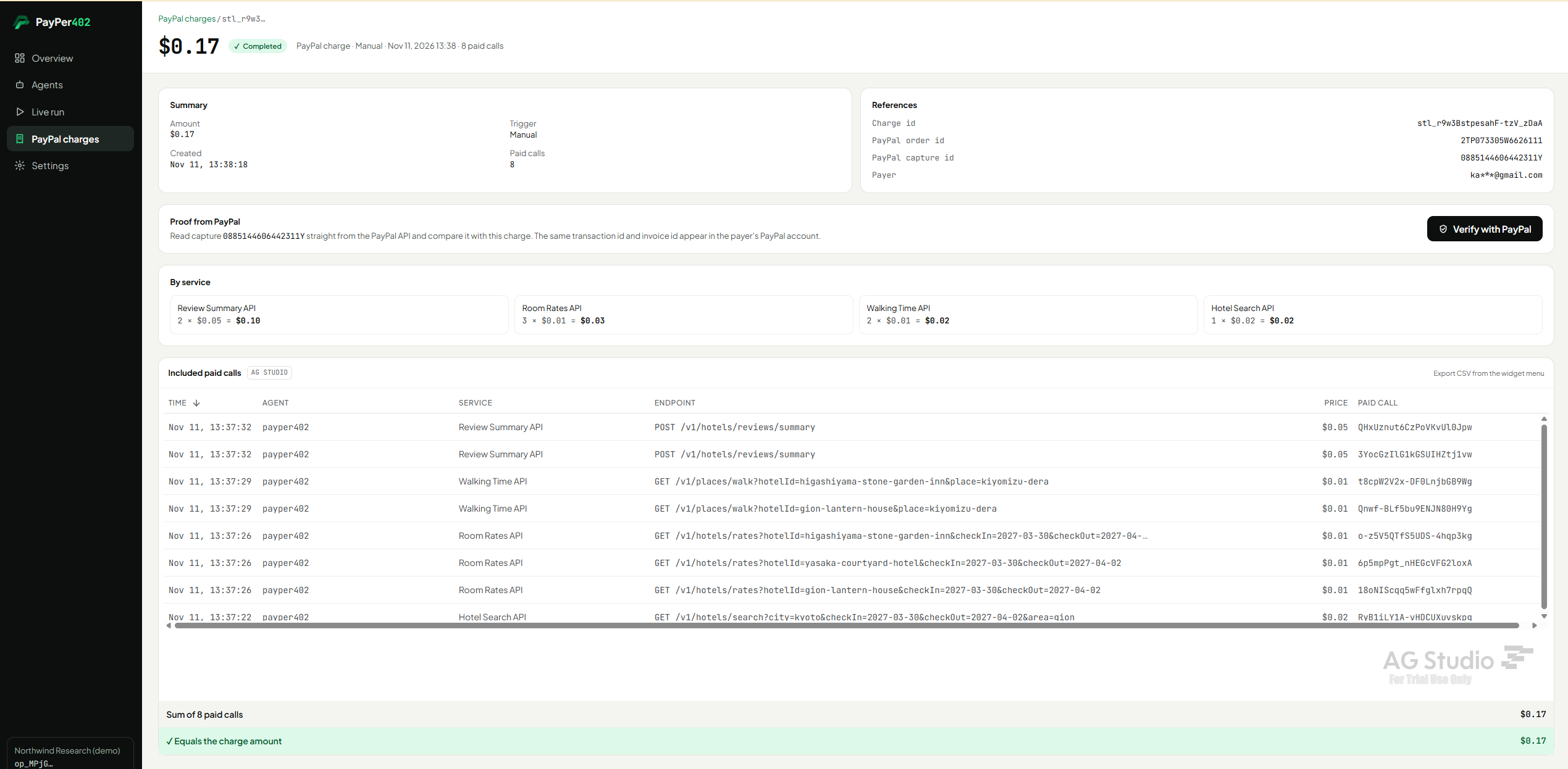
- The full flow works end to end on the real PayPal sandbox: link, pay per call, one batched charge, and revocation. For example, 8 paid calls became one $0.17 capture (
4M443028VK142725B), checkable with "Verify with PayPal". - "Stop paying with PayPal" in the payer's account blocks the agent on its very next call.
- An open x402 binding for the PayPal wallet, with no fork of the SDK and a written spec.
- A complete product, not a script: onboarding, caps, live runs, operator and seller dashboards, empty and error states, an npm CLI, and an MCP server.
- More than 1,000 tests.
What we learned
- Fixed fees, not percentages, are what kill micropayments. Batching signed commitments, with credit bounded by a cap, is what makes cent-level pricing work on a card-style rail.
- PayPal's Vault v3 with
UNSCHEDULED_POSTPAIDis a good fit for machine payments: the human approves once, and the payer keeps a clear way to stop it from their own PayPal account. - x402 is more open than it looks: a new network and scheme fit through its plug-in interfaces.
- For decisions that move money, it works better to let a calibrated model give probabilities and let code decide than to let the LLM judge its own plan.
What's next for PayPer402
- Go live: production PayPal credentials and merchant review.
- Pay many sellers from one batch with PayPal Payouts.
- Propose the
paypalbinding upstream to the x402 specs. - More seller tooling: drop-in middleware for other frameworks, and pricing per customer.
- Optionally, a PYUSD settlement path next to the PayPal wallet.
Built With
- ag-grid
- ag-studio
- claude
- docker
- jev
- mcp
- next.js
- node.js
- paypal
- react
- typesafe
- typescript
- vitest
- x402
