PayPal Shield AI — Smarter Payments. Safer Decisions.
💡 Inspiration
Online payments have become a normal part of our everyday lives. We use them to shop, pay bills, and transfer money. But behind this convenience is an important challenge: how can businesses identify unusual or potentially suspicious transactions?
We were inspired by the idea of making payment monitoring smarter and easier for merchants. Traditional dashboards can show whether a payment succeeded or failed, but understanding why a transaction might be risky is another challenge.
We wanted to build something that goes beyond displaying payment information. We wanted to create an intelligent assistant that could help merchants understand transaction patterns, identify potential risks, and make more informed decisions.
That idea became PayPal Shield AI.
🚀 What We Built
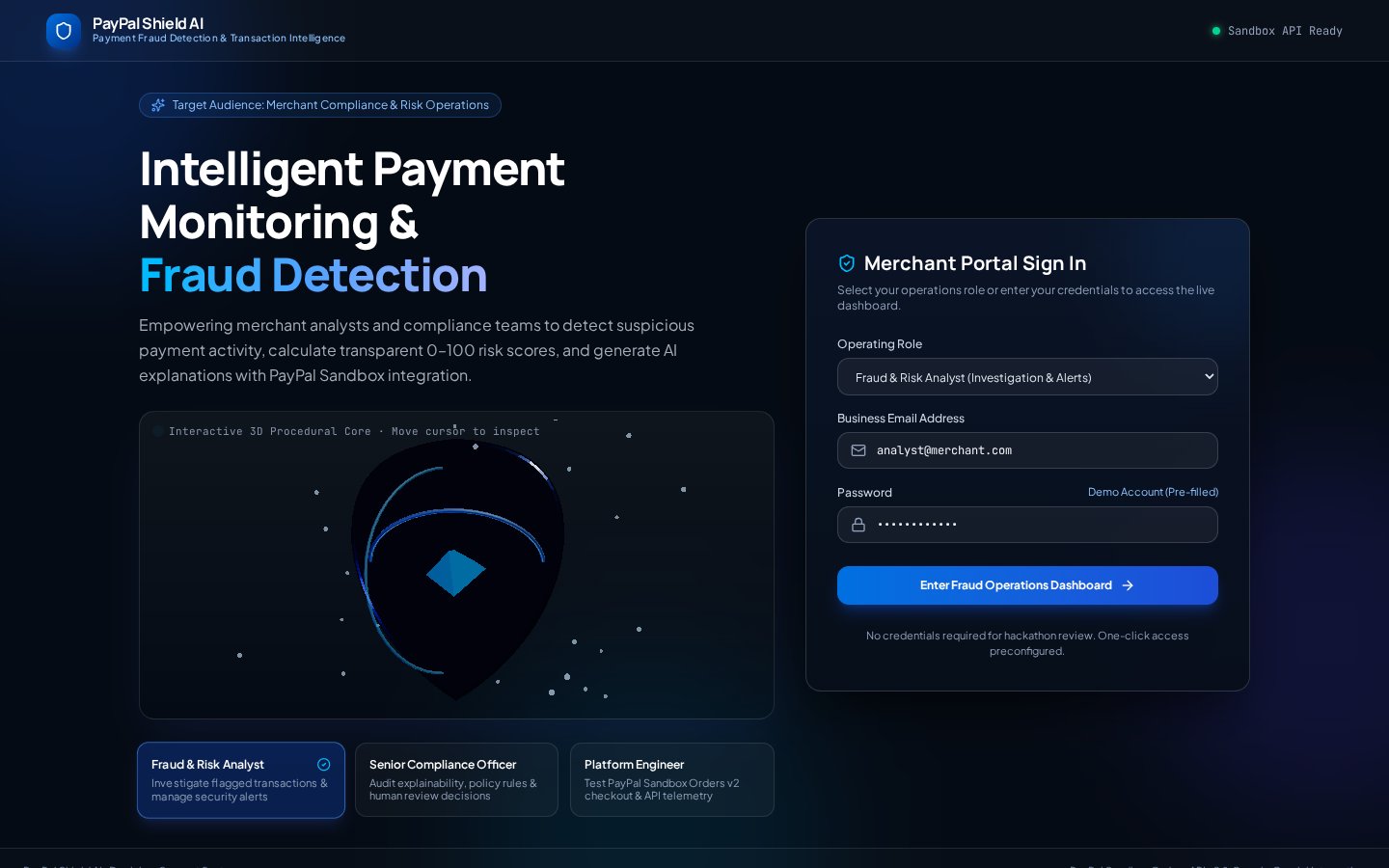
PayPal Shield AI is an AI-powered payment monitoring and fraud-risk analysis platform that combines PayPal's payment technology with Google's Gemini AI.
Our platform is designed to help merchants:
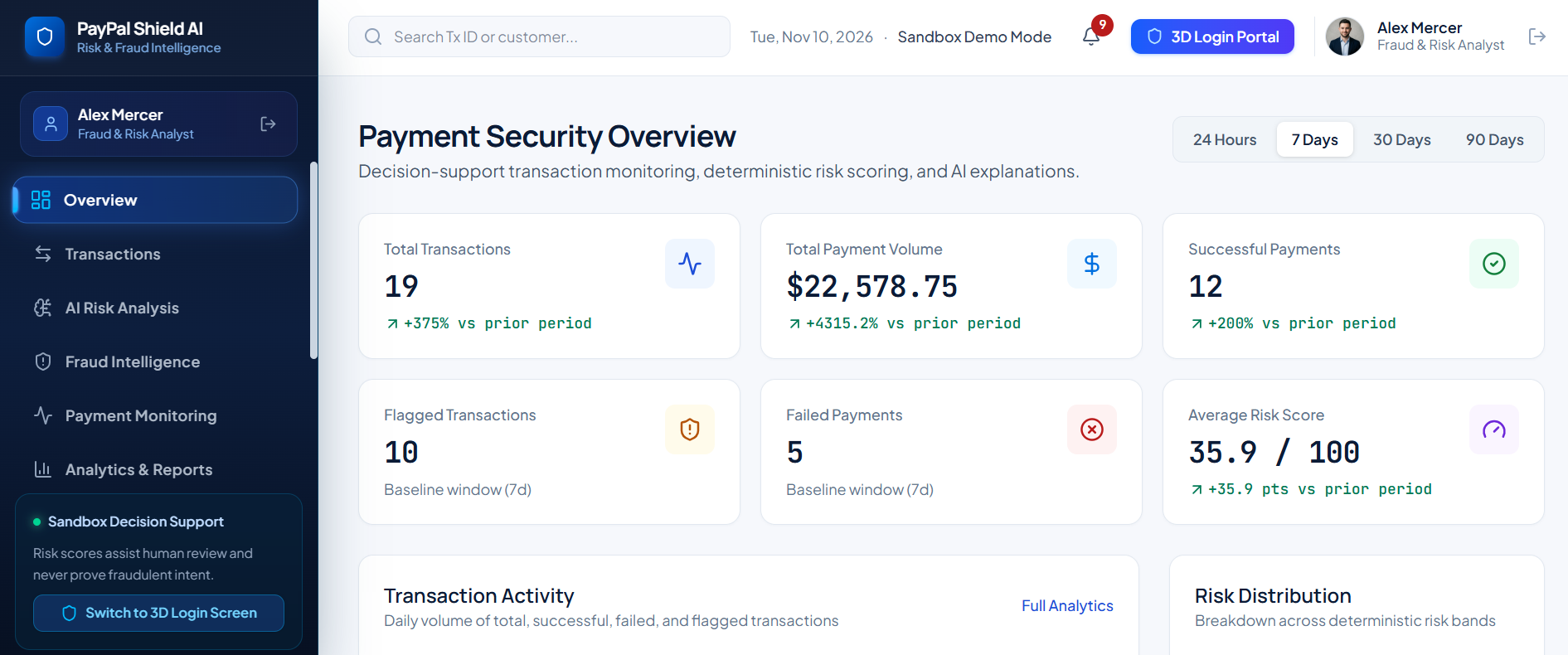
- Monitor payment transactions through a single dashboard.
- Identify potentially suspicious transaction patterns.
- Calculate transaction risk scores.
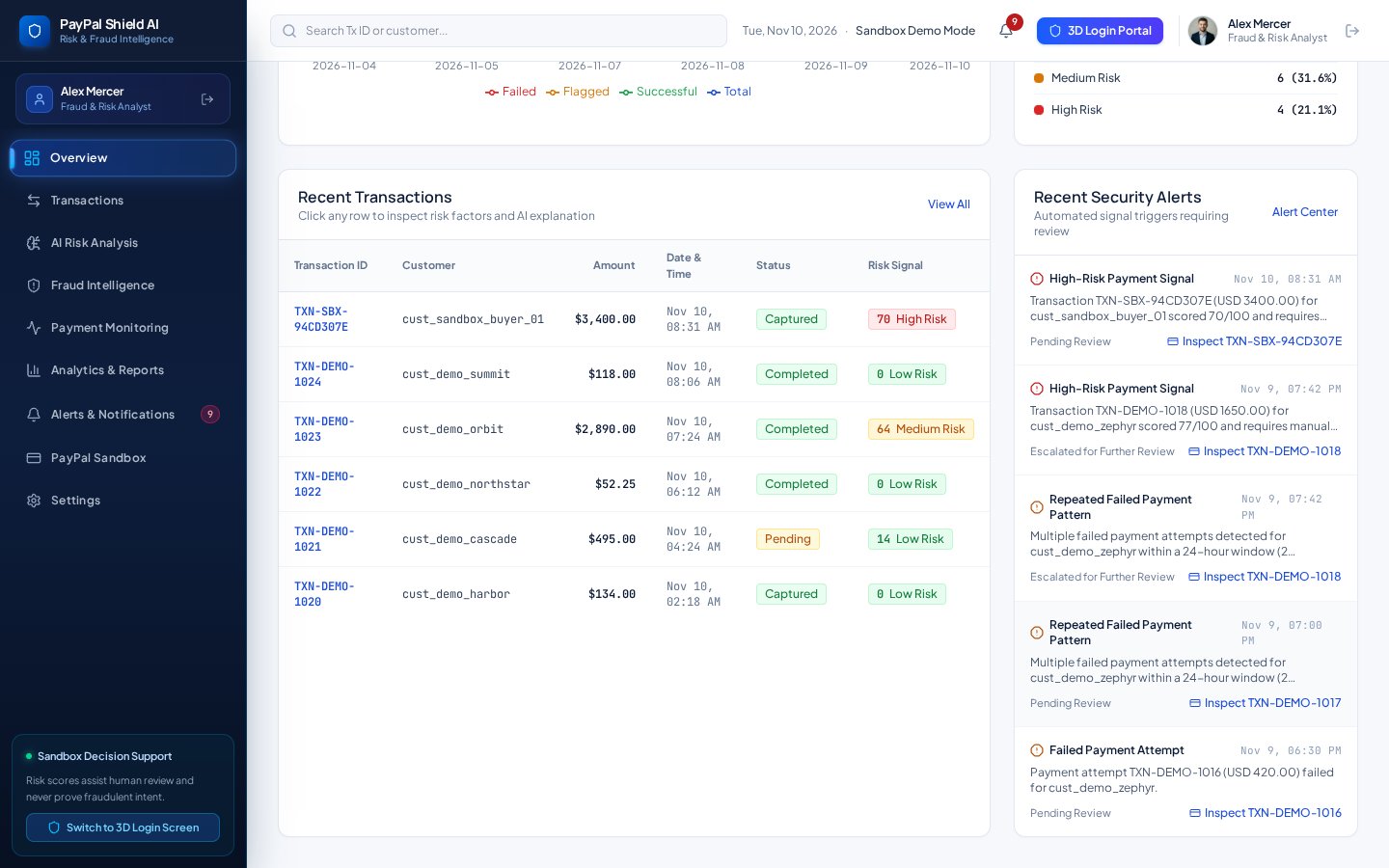
- Understand why a transaction has been flagged through AI-generated explanations.
- Monitor successful, pending, failed, and flagged payments.
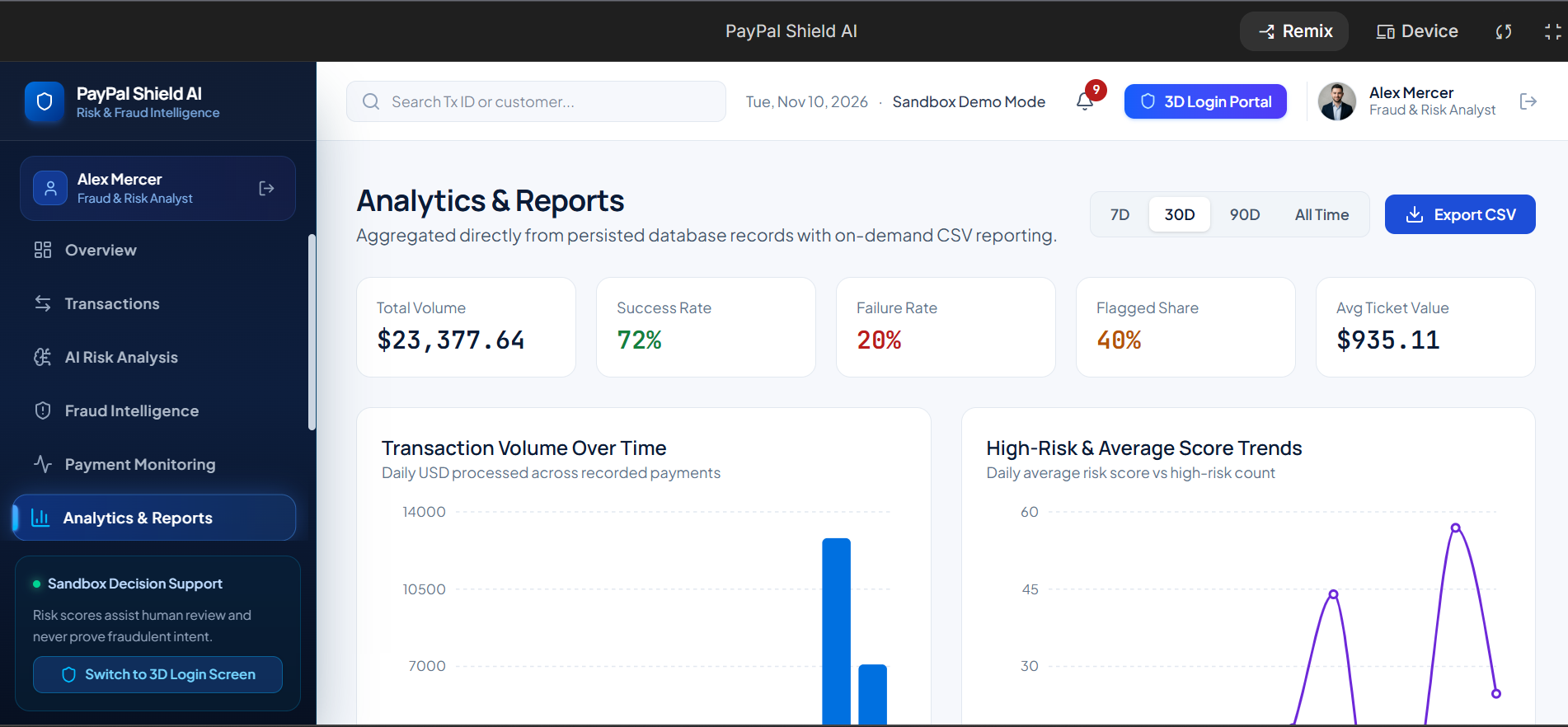
- View transaction analytics and risk distribution.
- Receive alerts about unusual payment activity.
- Review suspicious transactions and record decisions.
One of our main goals was to make AI explanations understandable. Instead of simply showing a risk score, we want merchants to understand the factors behind that score.
⚙️ How We Built It
We approached the project by dividing it into frontend, backend, AI, and payment integration components.
1. Frontend Development
We used React, TypeScript, and Tailwind CSS to create a modern, responsive fintech dashboard. We focused on making transaction information, analytics, and risk indicators easy to understand.
2. Backend Development
We used Python and FastAPI to build the backend APIs. The backend manages transaction information, communicates with external services, processes risk assessments, and stores application data in an SQLite database.
3. AI Integration
We integrated Google Gemini to generate human-readable explanations of transaction risk factors. We also designed a transparent risk-scoring engine that evaluates available transaction signals and assigns a score between 0 and 100.
4. PayPal Integration
We used the PayPal Developer Sandbox and Orders API to demonstrate the payment workflow, including order creation, customer approval, and payment capture. This allows us to test the payment experience without processing real money.
5. Analytics and Monitoring
We designed transaction charts, risk distribution, payment monitoring, and alert features to help merchants understand activity from one place.
🧠 What We Learned
Building PayPal Shield AI helped us understand that developing an AI-powered application involves much more than connecting an AI API to a website.
We learned about:
- Integrating third-party payment APIs.
- Working with PayPal Sandbox and payment workflows.
- Building REST APIs using FastAPI.
- Connecting a React frontend to a Python backend.
- Designing database models for transaction records.
- Using Gemini to generate understandable AI explanations.
- Creating transparent and explainable risk-scoring logic.
- Handling API errors, missing credentials, and fallback scenarios.
- Testing individual components and connecting them into one application.
Most importantly, we learned that AI should support human decision-making rather than blindly replace it, especially when financial transactions are involved.
🧩 Challenges We Faced
Like any development project, PayPal Shield AI comes with technical challenges.
Payment API Integration: Understanding the PayPal order creation, approval, and capture workflow required careful implementation. We also needed to ensure that payment status was verified by the backend rather than simply trusted from the frontend.
AI Reliability: We wanted AI-generated explanations to be useful and understandable without allowing the model to invent transaction details. We addressed this by separating numerical risk scoring from AI-generated explanations.
Frontend and Backend Communication: Connecting multiple dashboard components to backend APIs required consistent data structures, validation, and error handling.
Data Accuracy: We needed a clear distinction between actual PayPal Sandbox transactions and simulated demonstration data so that the dashboard would not present sample information as real payment activity.
Time and Scope: As a two-member team, managing the frontend, backend, AI integration, payment workflow, and documentation required careful prioritization.
These challenges helped us think more carefully about reliability, security, and practical implementation.
🌟 What Makes Our Project Different?
PayPal Shield AI brings together three important capabilities:
- PayPal: Demonstrates the actual payment workflow through Sandbox.
- Gemini AI: Makes transaction risk factors easier to understand.
- Intelligent Monitoring: Helps merchants monitor, investigate, and review unusual transaction activity.
Rather than treating an AI prediction as a final decision, our platform is designed to keep merchants involved in the review process.
🔮 What's Next?
We see several opportunities to improve PayPal Shield AI in the future:
- More advanced anomaly-detection models.
- Better transaction-pattern analysis using historical data.
- PayPal webhook integration for payment-event updates.
- More detailed fraud analytics and reporting.
- Role-based access for merchant teams.
- PostgreSQL support for larger deployments.
- Improved monitoring and configurable risk policies.
Our long-term vision is to make payment monitoring more intelligent, explainable, and accessible to businesses.
❤️ Final Thoughts
PayPal Shield AI started with a simple question: What if merchants could understand the risks behind their transactions instead of just seeing payment statuses?
Building this project gave us an opportunity to explore the practical combination of payment technology, artificial intelligence, and full-stack development.
We believe technology is most useful when it solves real problems and helps people make better decisions.
PayPal Shield AI — Smarter Payments. Safer Decisions.
Built With
- ai
- artificial-intelligence
- database.com
- freeapi
- gemini
- gemini-api
- javascript
- jss
- machine-learning
- node.js
- python
- react
- rest-api
- supabase
- three.js
