-
-
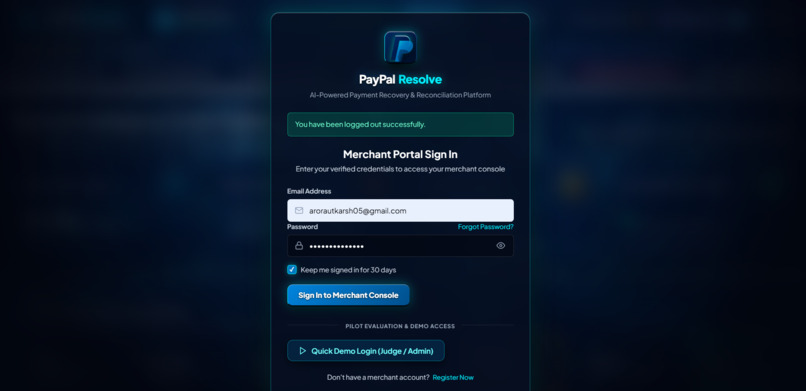
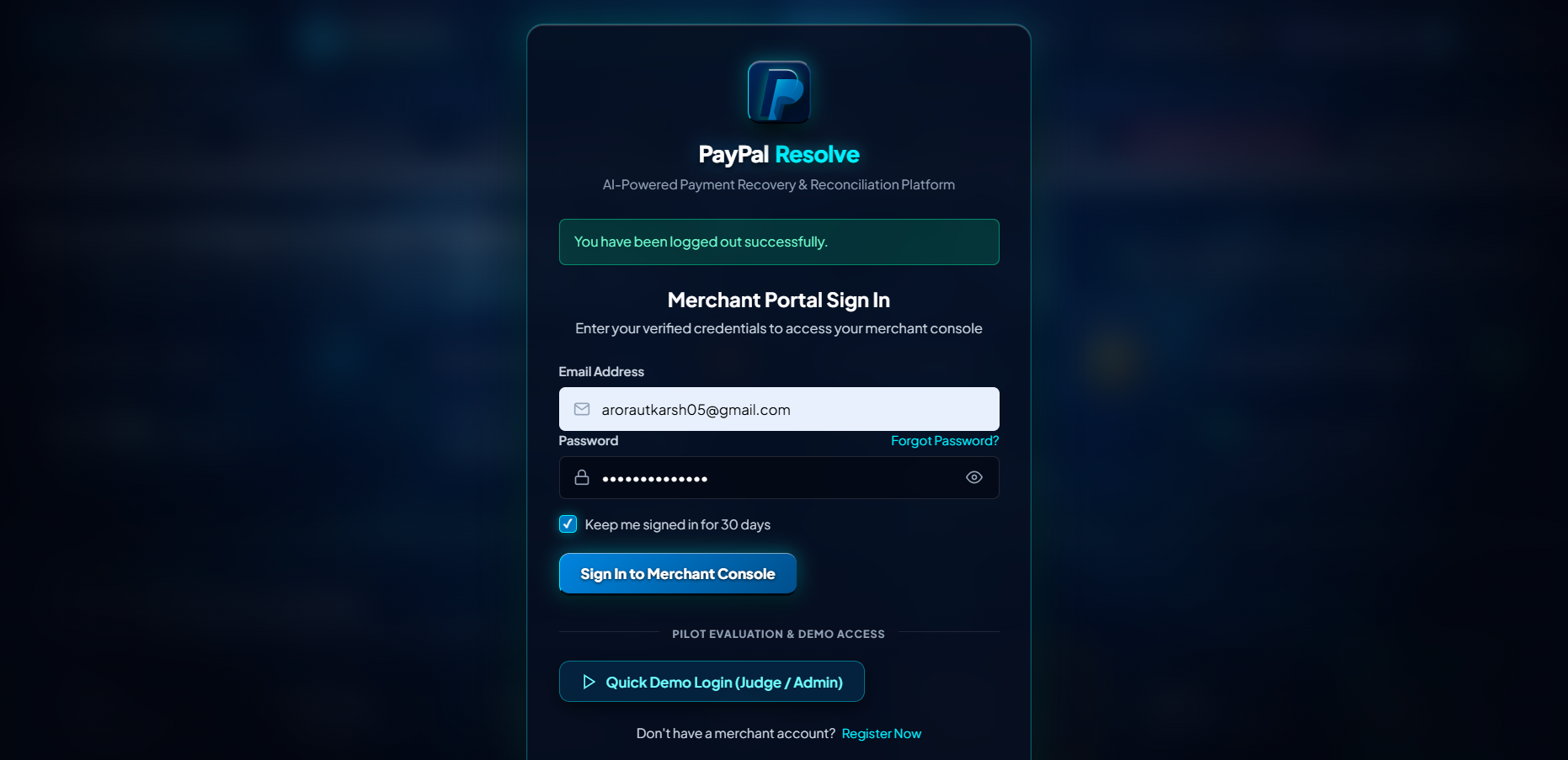
Login Page: Secure merchant login provides authenticated access to PayPal Resolve platform.
-
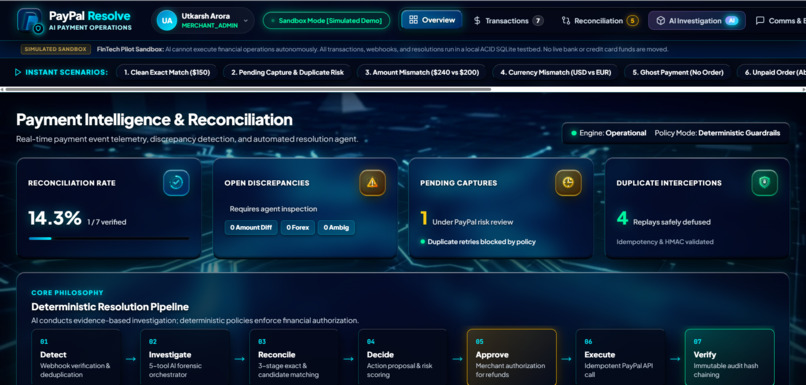
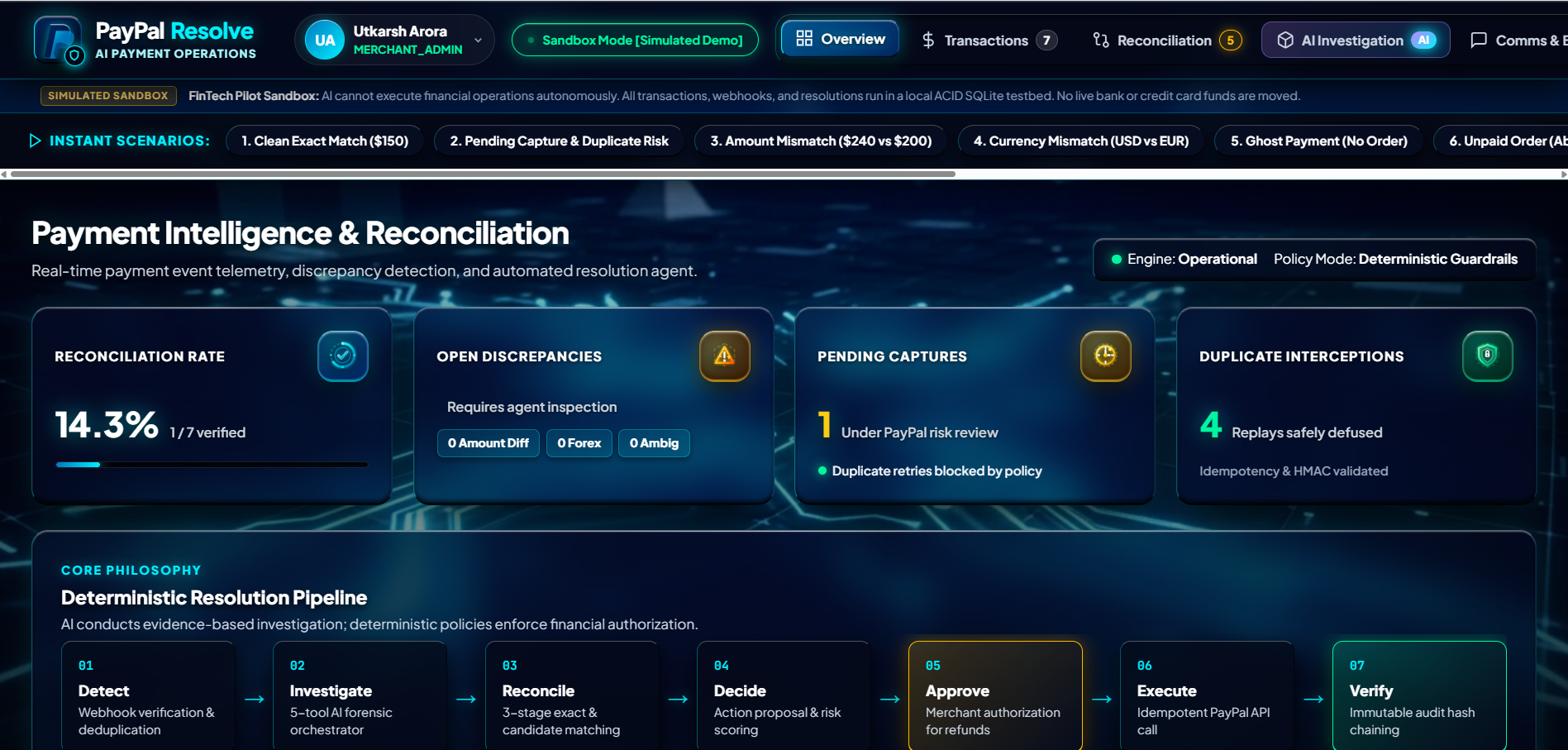
Dashboard: Dashboard summarizes payment intelligence, reconciliation metrics, pending captures, and safeguards.
-
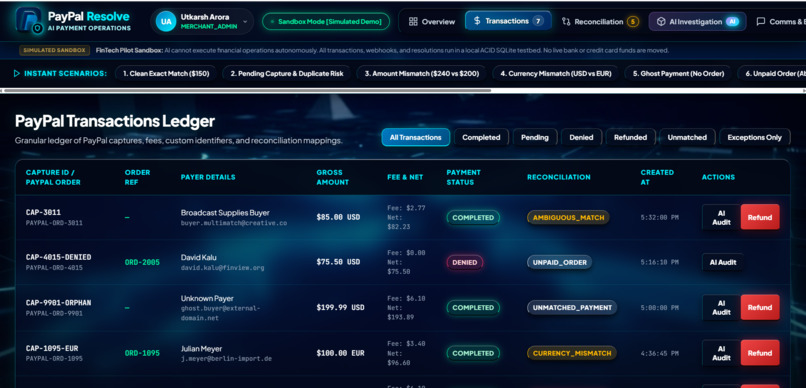
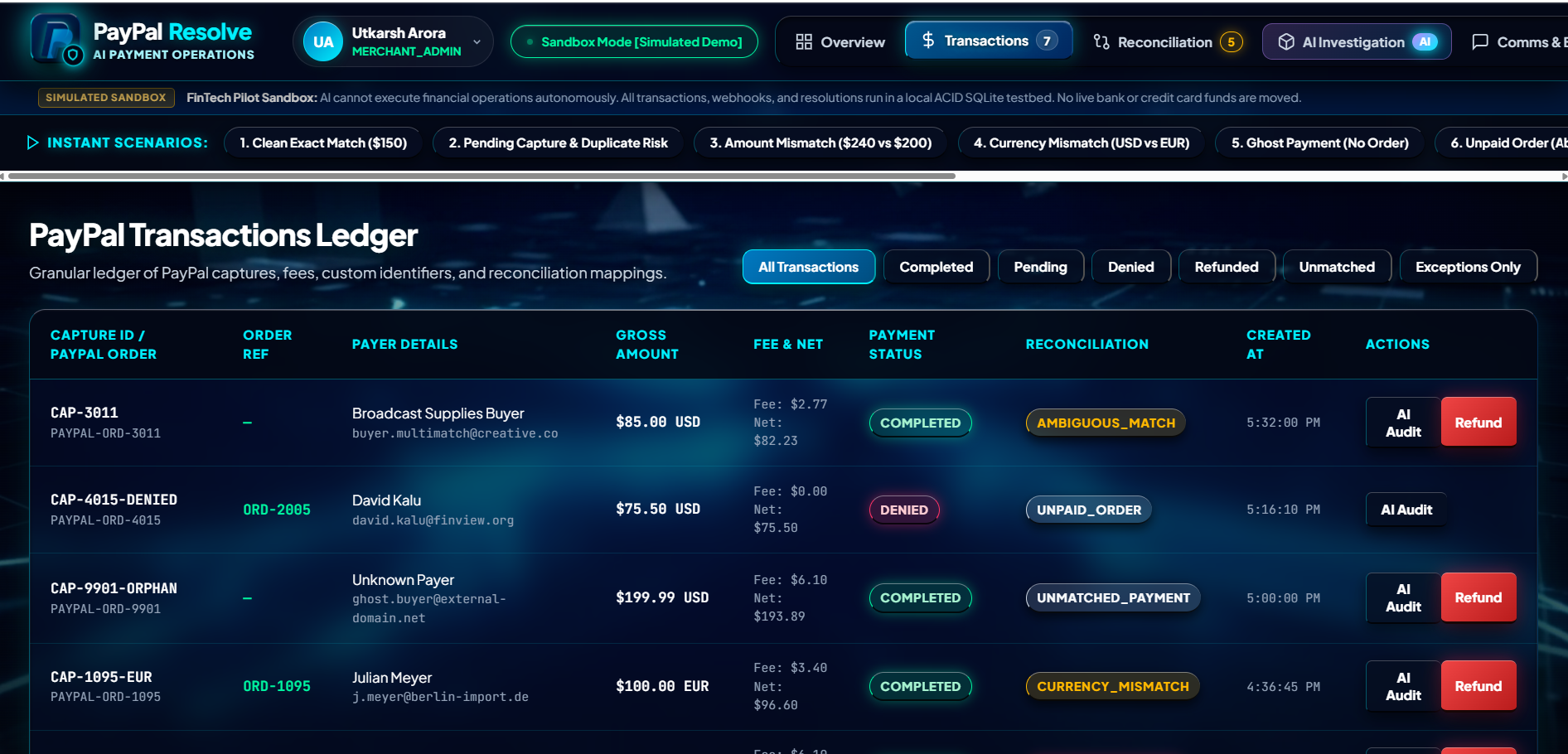
Transactions: Transaction ledger displays payment statuses, amounts, fees, reconciliation, and actions.
-
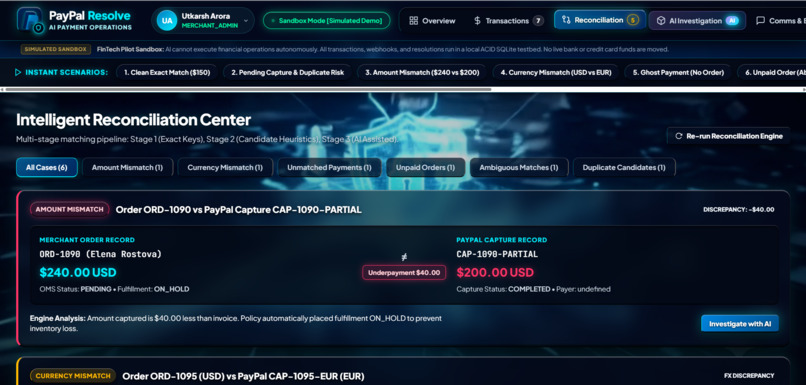
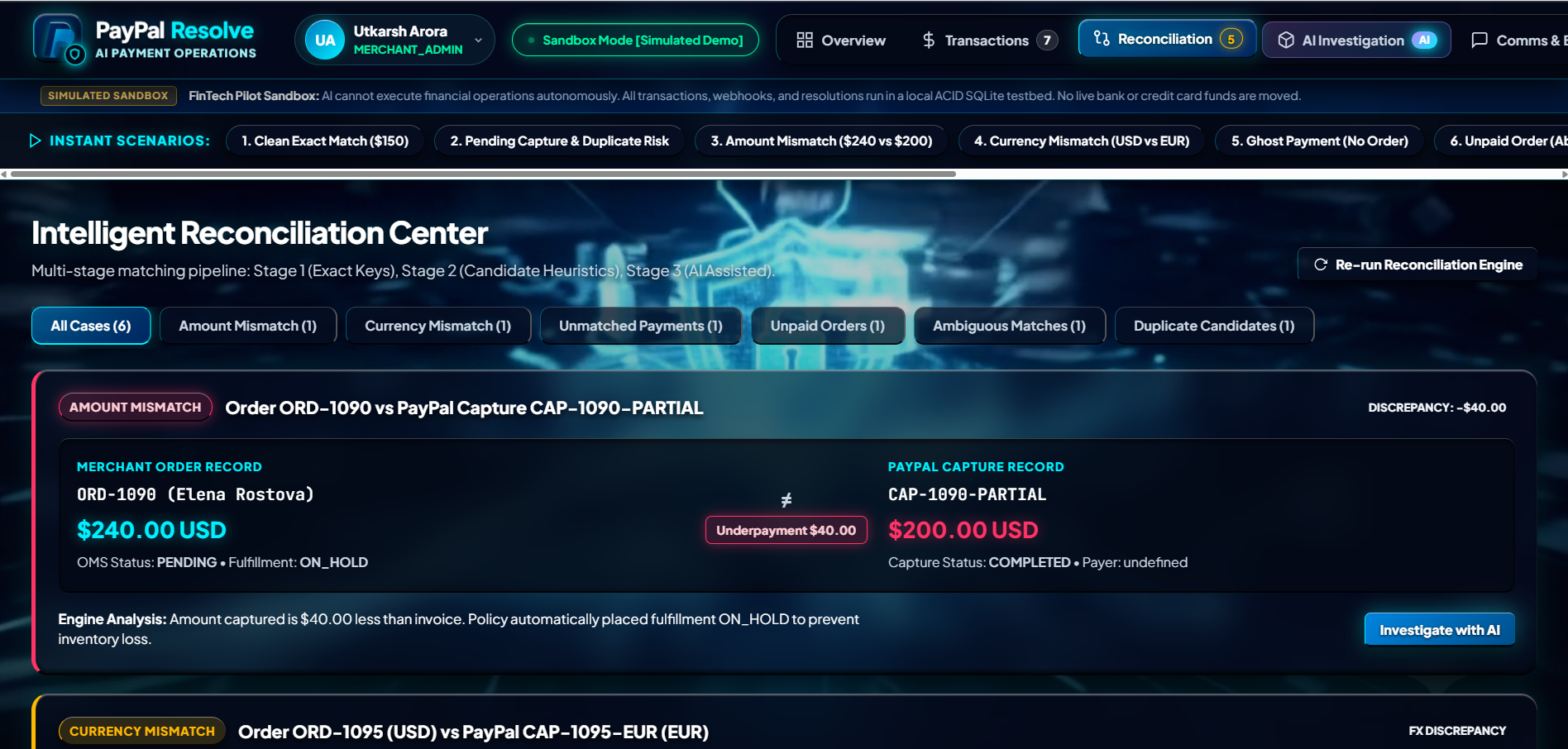
Reconciliation: Reconciliation center identifies payment discrepancies through multi-stage intelligent matching workflows.
-
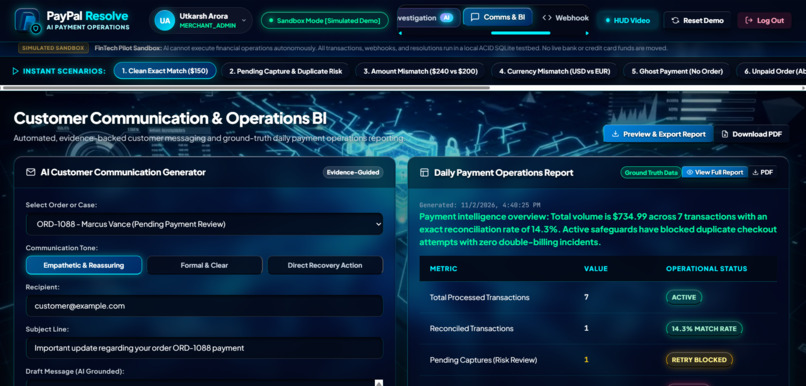
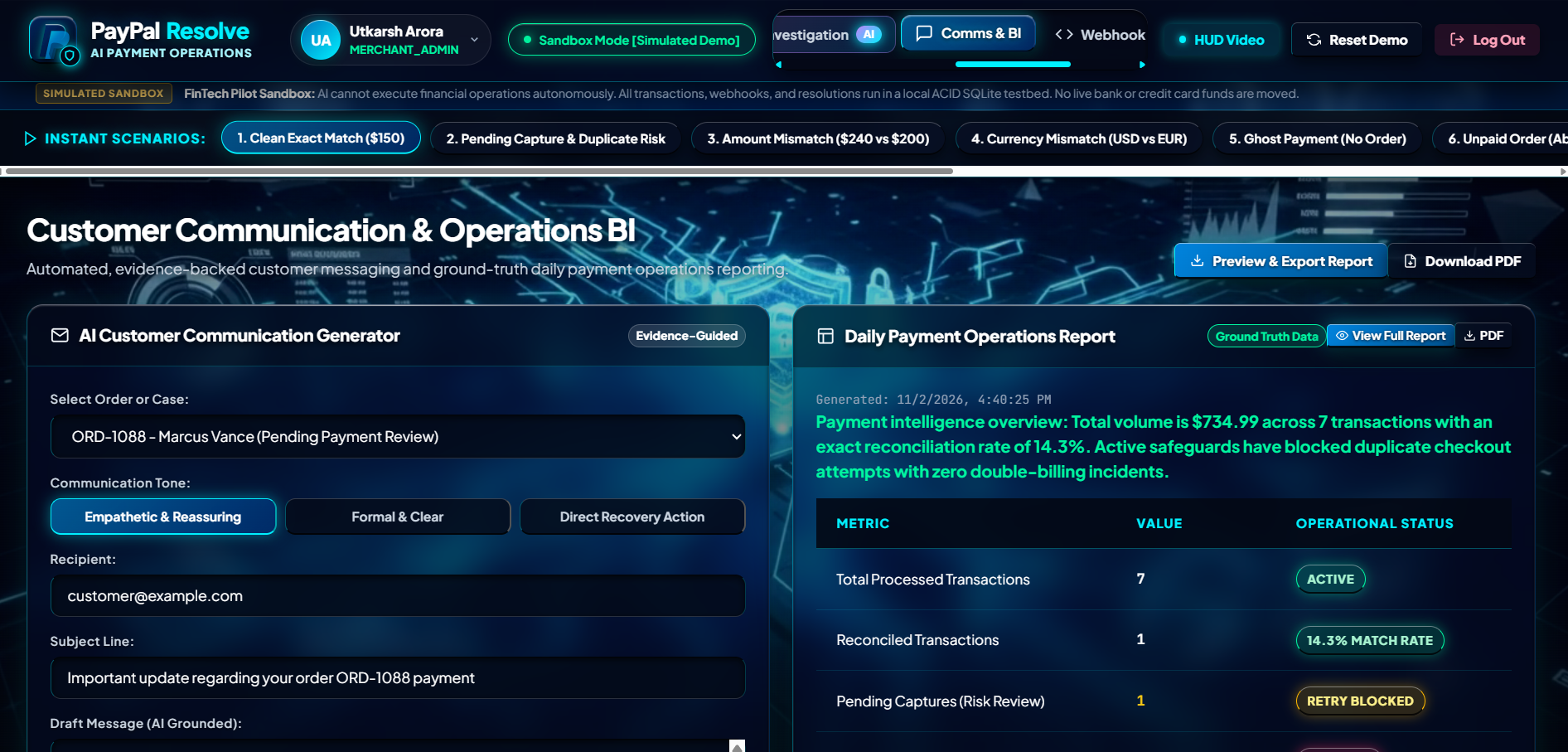
Communication & BI: Communication and BI module generates evidence-backed customer messages and reports.
-
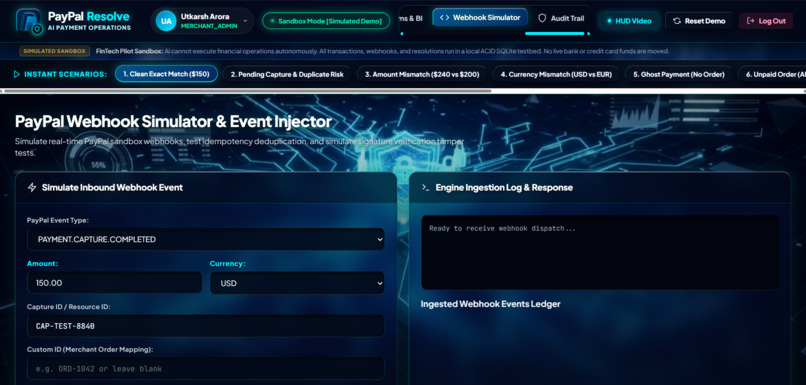
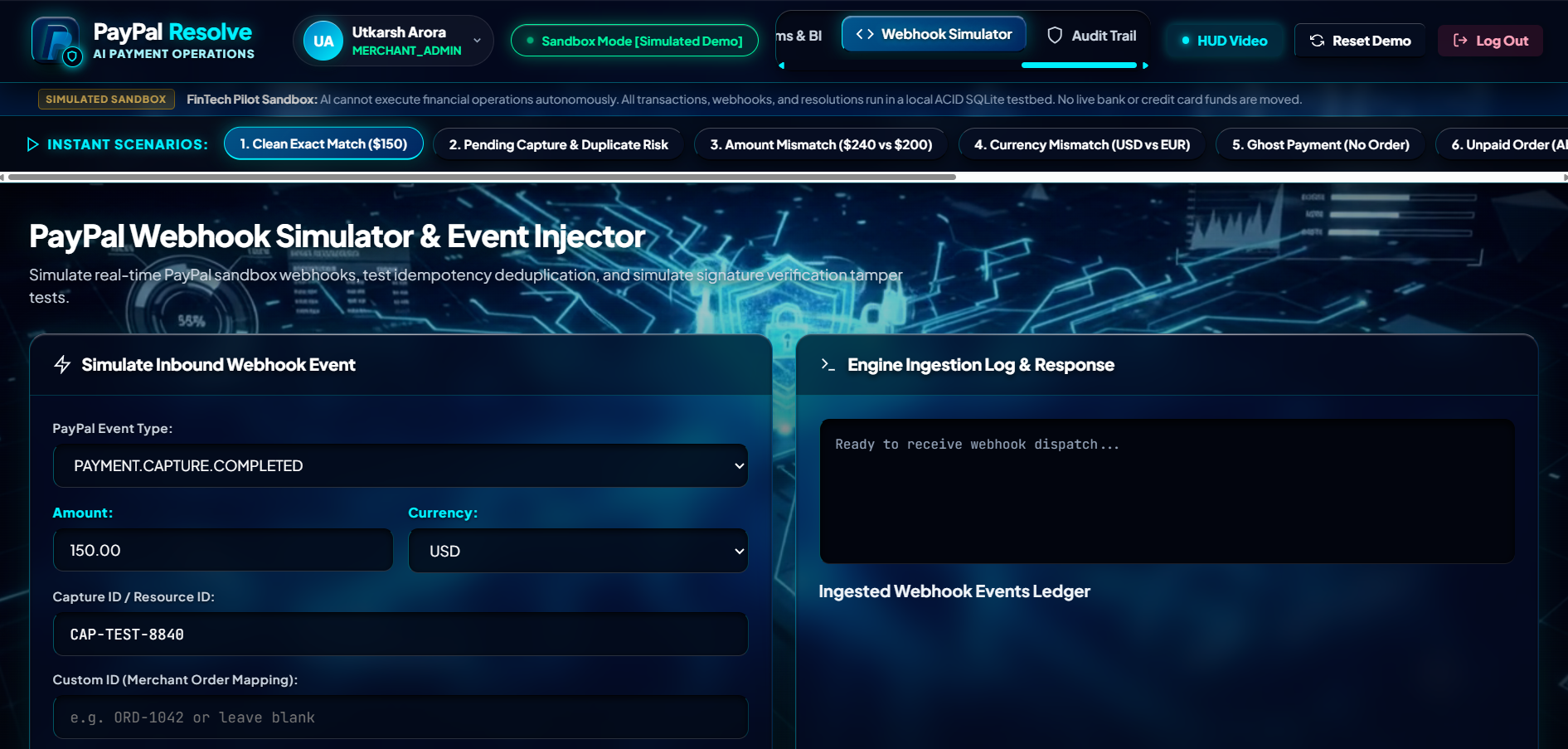
Webhook Simulator: Webhook simulator tests event ingestion, signature verification, and duplicate-event protection.
-
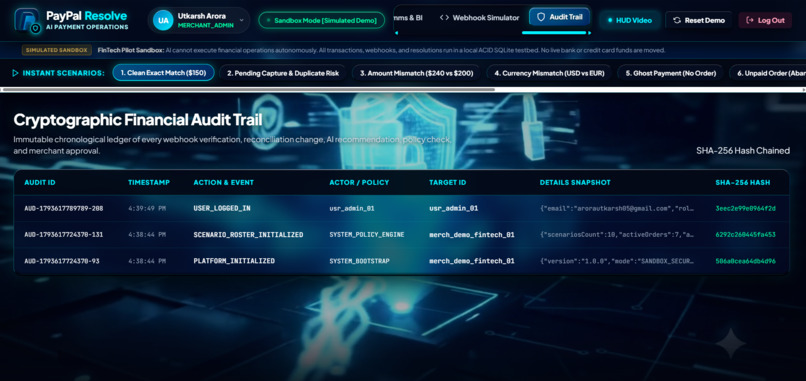
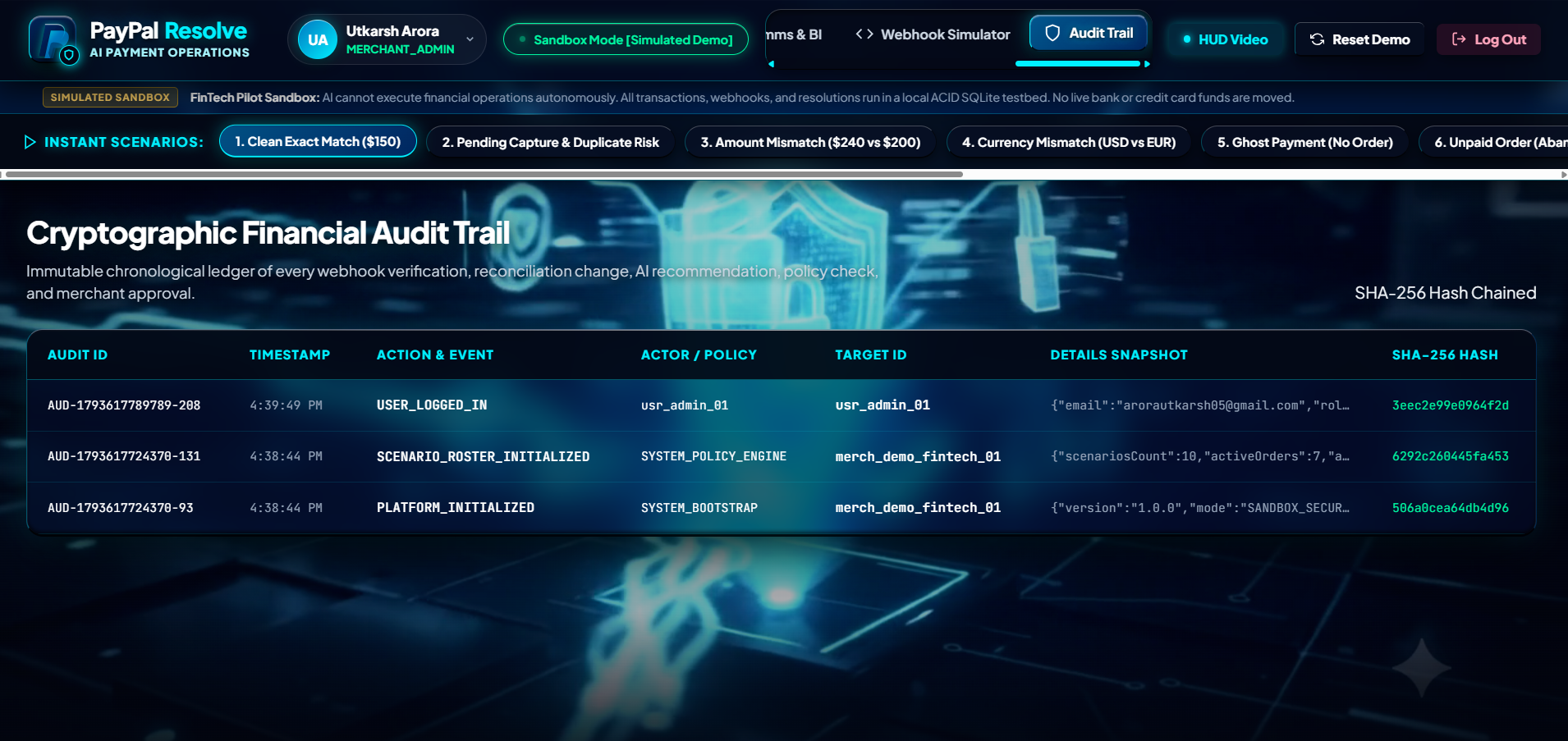
Secure cryptographic financial audit trail showcasing immutable AI payment operations.
Inspiration
Money moves quickly, but resolving payment-related problems doesn't always happen at the same speed.
Imagine running a small online business. A customer makes a $150 payment, but the payment capture remains pending, a transaction gets duplicated, or the payment status becomes unclear. The business owner now has to investigate transaction records, verify payment statuses, identify discrepancies, and determine what action is safe to take.
We realized that payment recovery and reconciliation are not just about identifying failed transactions. They are about making the right financial decision without introducing additional risks.
This inspired us to build PayPal Resolve, an AI-powered payment recovery and reconciliation agent designed to help businesses investigate payment issues, understand discrepancies, and safely manage recovery workflows.
Our vision was simple: make payment resolution intelligent, transparent, and controlled by the business owner.
What We Built
PayPal Resolve transforms traditional payment troubleshooting into an intelligent, structured workflow.
Instead of simply displaying transaction statuses, our system helps users:
- Investigate pending, failed, and potentially inconsistent payment transactions.
- Analyze payment information and identify reconciliation discrepancies.
- Generate AI-powered recovery recommendations.
- Apply deterministic financial rules before allowing sensitive operations.
- Require merchant approval before executing controlled financial actions.
- Maintain transaction ledgers and auditable decision histories.
- Prevent duplicate operations through idempotency mechanisms.
The core workflow follows:
Detect → Investigate → Reconcile → Recommend → Approve → Execute → Verify
A key design principle is that AI should assist with financial decisions, not have unrestricted authority over money.
The AI agent analyzes information and proposes actions, while the backend enforces financial rules, validates permissions, and controls execution.
How We Built It
We approached the project as a fintech engineering challenge rather than simply building an AI chatbot.
We developed the application around a modular backend architecture, a user-facing dashboard, database-backed transaction management, and PayPal Sandbox integration.
Some of the important engineering components include:
1. Authentication and Access Control
We implemented user registration, login, secure password hashing, session management, and role-based access controls to protect user accounts and financial records.
2. Payment Processing and PayPal Integration
We integrated PayPal Sandbox workflows to demonstrate payment creation, capture, and controlled payment operations without relying on real financial transactions.
3. AI-Powered Investigation
The AI component helps interpret payment-related information, investigate discrepancies, and generate structured recovery recommendations.
4. Financial Safety Engine
We implemented deterministic safeguards, including integer-based currency calculations, refund limits, transaction locking, and idempotency protection.
5. Auditability and Reliability
Webhook signature verification, duplicate event detection, and hash-chained audit records help maintain the integrity and traceability of important financial events.
6. Database and Testing
We designed database-backed workflows to maintain users, transactions, recovery cases, and audit records. We also developed automated tests to validate authentication, financial calculations, payment concurrency, and webhook handling.
Challenges We Faced
Building PayPal Resolve came with several challenges.
1. Making AI Safe for Financial Operations
One of our biggest challenges was preventing AI-generated recommendations from becoming unrestricted financial actions.
We addressed this by separating AI reasoning from financial execution. The AI can recommend an action, but the backend independently validates financial constraints and requires the appropriate approval.
2. Preventing Duplicate Financial Operations
Payment systems must handle retries and repeated requests carefully. Executing the same operation multiple times could create serious financial inconsistencies.
We implemented idempotency mechanisms and database-level transaction controls to make sensitive operations safer.
3. Maintaining Transaction Accuracy
Even small calculation errors can cause problems in financial applications. We used integer-based currency calculations rather than relying on floating-point arithmetic for monetary values.
4. Building Reliable Payment Workflows
Handling pending payments, webhook events, payment captures, and reconciliation discrepancies required careful coordination between the frontend, backend, and database.
We focused on making these workflows predictable, testable, and auditable.
What We Learned
Developing PayPal Resolve taught us that building AI-powered fintech applications requires much more than integrating an AI model.
We learned:
- How to design AI-assisted financial workflows.
- How to integrate PayPal Sandbox payment operations.
- Why deterministic validation is essential in financial systems.
- How authentication and user-level data isolation protect financial information.
- How idempotency and database transactions improve payment reliability.
- Why audit trails and explainable decisions matter in fintech applications.
- How to test complex backend workflows involving concurrency and external payment events.
Most importantly, we learned that the best financial AI agent is not the one that makes the most decisions independently, but the one that helps people make better decisions while keeping control and accountability in their hands.
What's Next?
PayPal Resolve is an evolving project, and we see several opportunities to expand it:
- More advanced AI-driven payment anomaly detection.
- Intelligent reconciliation across multiple payment providers.
- Automated recovery recommendations based on historical transaction patterns.
- Real-time financial monitoring and alerts.
- Improved merchant analytics and financial reporting.
- More comprehensive security and production deployment capabilities.
Our long-term goal is to make PayPal Resolve a reliable financial operations assistant for small businesses that cannot afford complex enterprise payment management systems.
PayPal Resolve: Investigate smarter. Recover safer. Stay in control.
Challenges we ran into
Accomplishments that we're proud of
What we learned
What's next for PayPal Resolve
Built With
- api
- cyber
- data
- database.com
- javascript
- node.js
- paypal
- python
