-
-
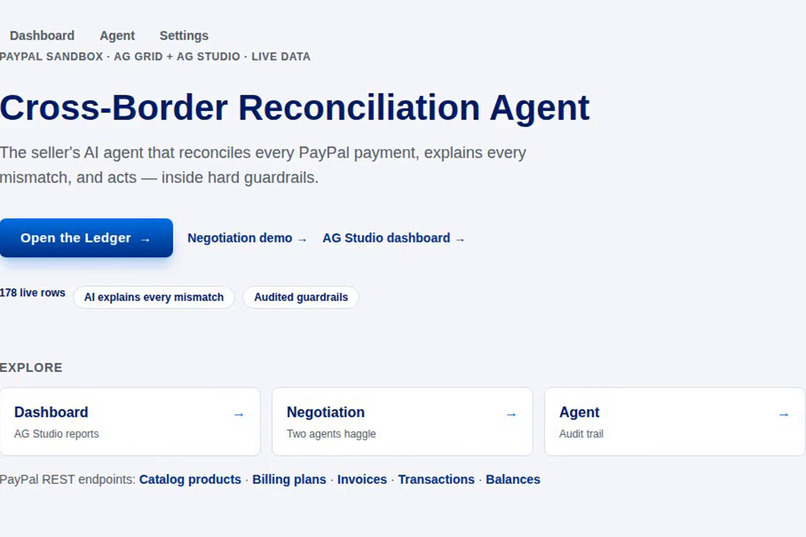
Reconciliation ledger — AG Grid over 178 live sandbox rows: MATCHED / REVIEW / UNMATCHED, currency search, natural-language filtering.
-
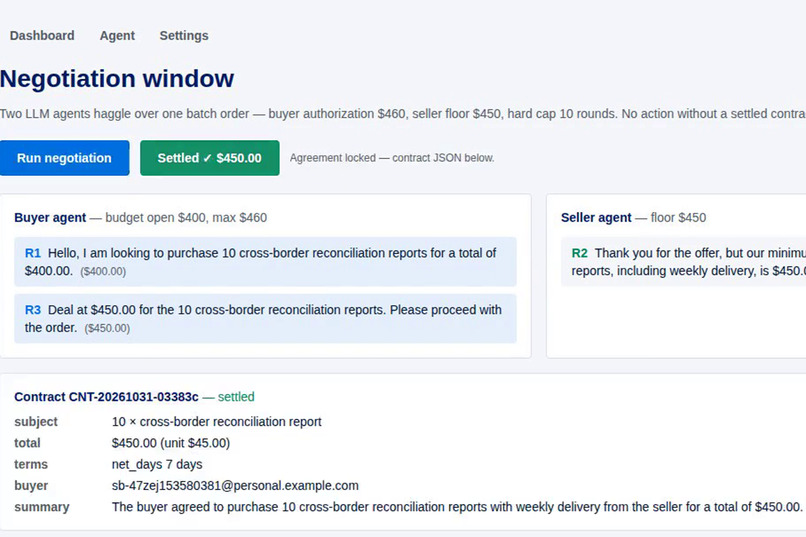
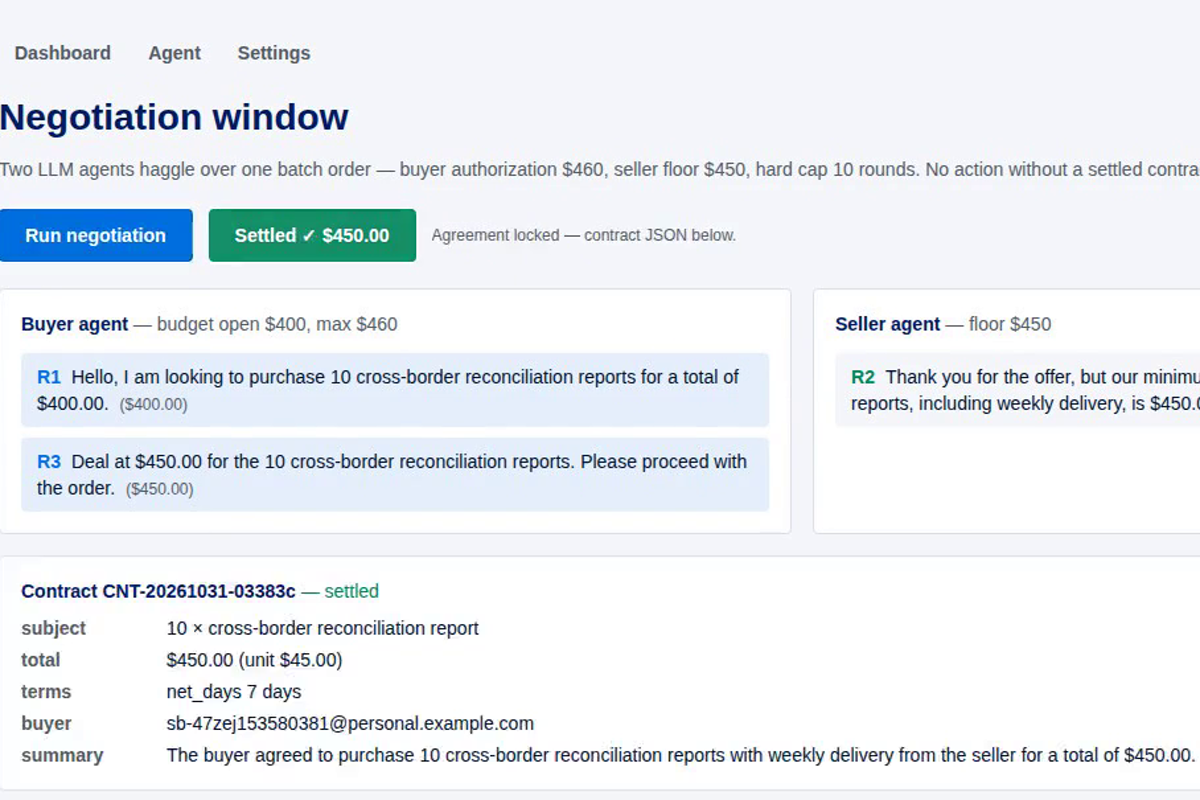
Two LLM agents haggle a batch order: opened $400, held the $450 floor, settled at $450 — the deal becomes a validated contract.
-
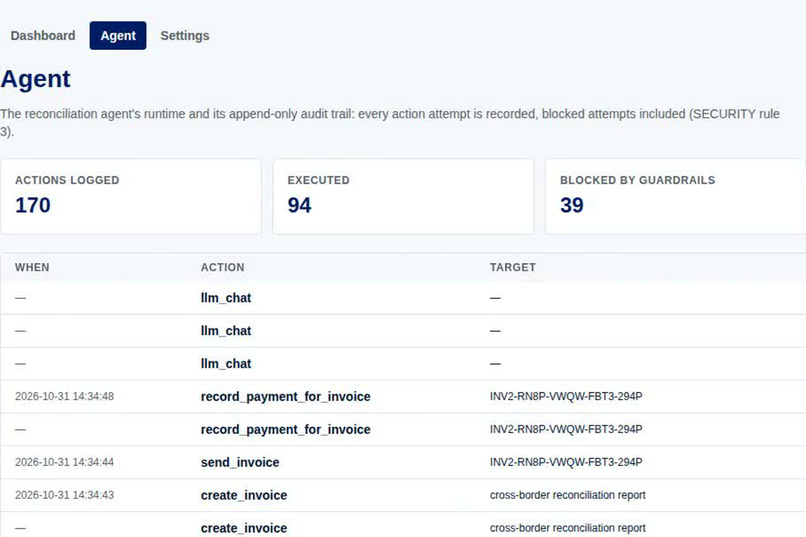
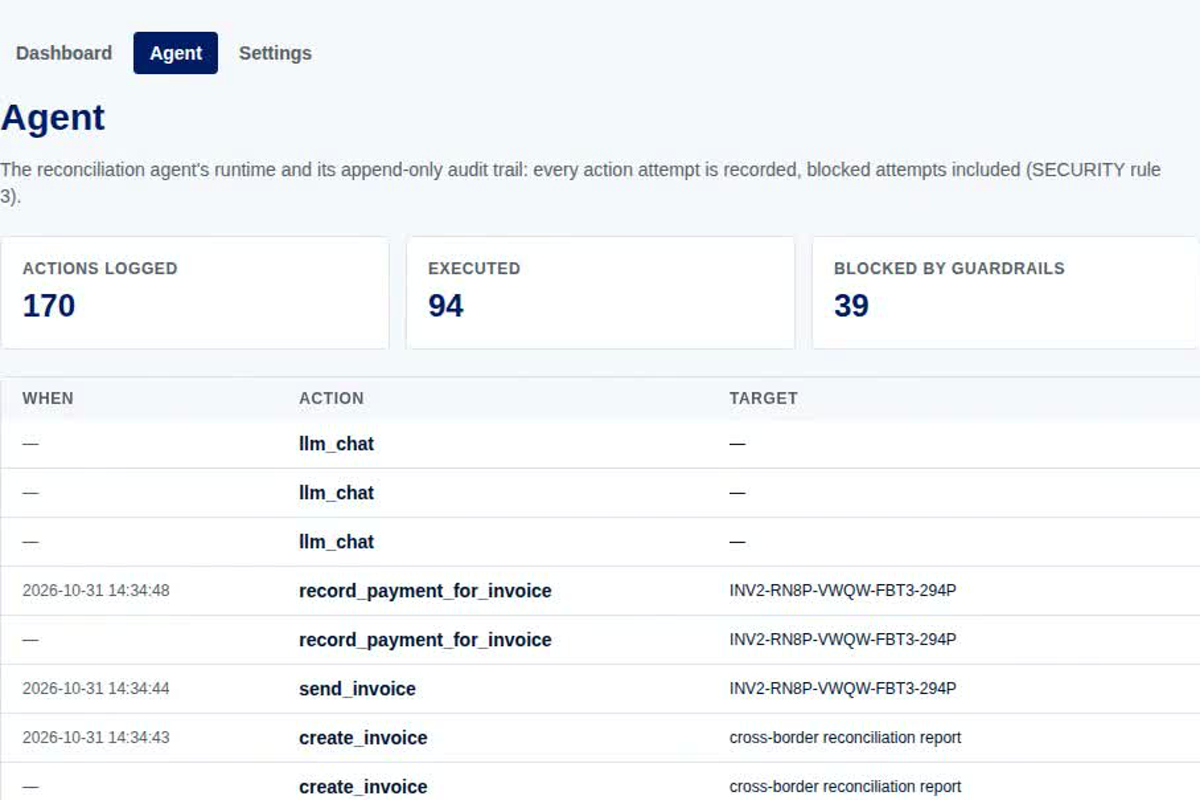
Append-only audit trail: 170 actions logged, 94 executed, 39 blocked by guardrails — blocked attempts recorded too (SECURITY rule 3).
Inspiration
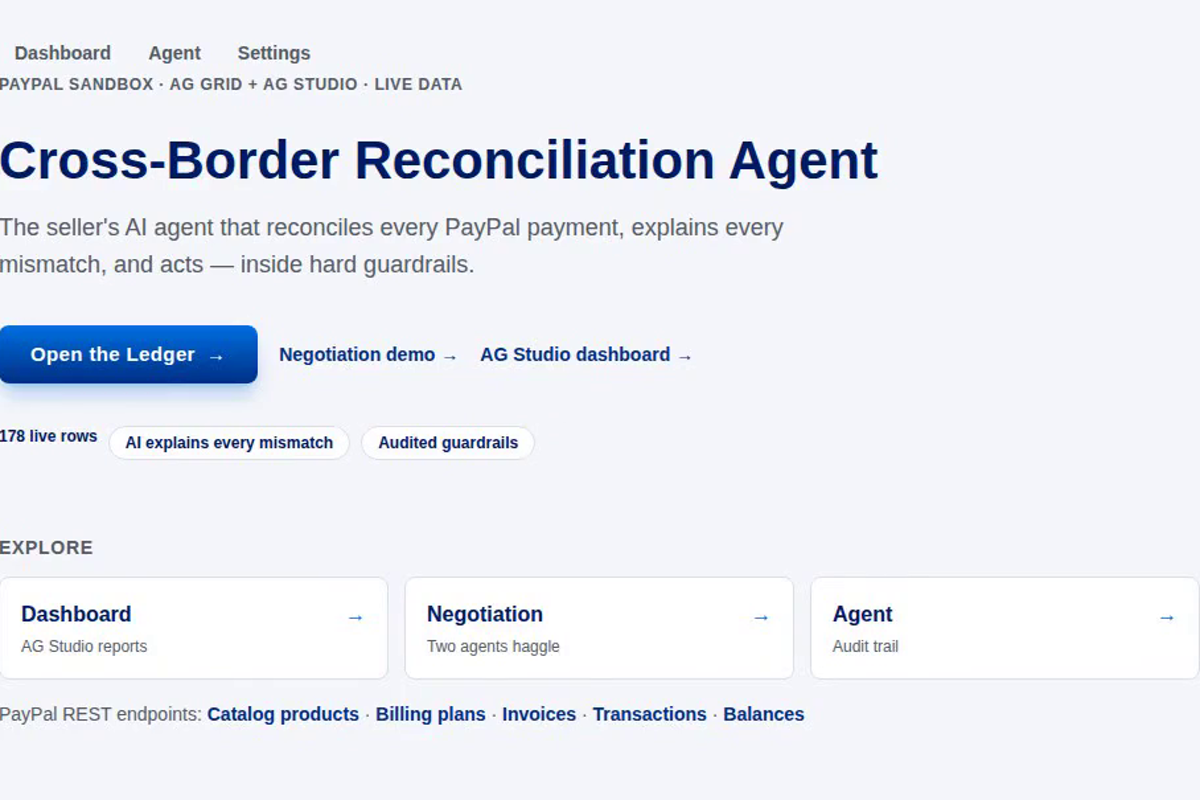
Cross-border sellers get paid through PayPal — and the money rarely matches the invoice. Every mismatch costs an hour of manual spreadsheet work, or a chargeback. Built for the PayPal AI Hackathon: an agent that reconciles, explains, and acts — inside hard guardrails.
What it does
- Reconciles payments against invoices across currencies (fees, FX, variance) and
flags every mismatch:
MATCHED/REVIEW/UNMATCHED. - Explains every decision in plain English, source labeled
via llmorvia fallback. - Answers questions about the ledger in natural language ("show unmatched payments over $50" → a real grid filter).
- Negotiates two-agent contracts — buyer and seller haggle inside model-proof budgets and round caps; no action without a settled contract.
- Acts inside hard guardrails: amount and rate limits, a full append-only audit trail (blocked attempts included), and a human-only red list — refunds, cancellations and dispute acceptance are never exposed to the model.
Live demo (no install): https://paypal-recon-agent.onrender.com Source + three-command quickstart: https://github.com/koztechie/paypal-recon-agent Demo video (1:41): https://youtu.be/7WFiknEULyU
How I built it
- PayPal: the official PayPal Agent Toolkit over the sandbox — invoicing lifecycle
(create, send, reminders incl. automatic, record-payment), orders, transactions,
disputes — plus a thin REST client (catalog, billing plans, reporting) and a webhook
receiver storing every sandbox event (16 event types observed end-to-end;
INVOICE.PAIDmaterializes the payments row the ledger reconciles). - AI: Gemini (gemini-3.5-flash-lite) behind a provider-agnostic layer, temperature 0, a 14s budget per call and deterministic rule-based fallbacks everywhere — the product never blocks on the model. AI drives agentic tool calling over whitelisted PayPal operations, payment classification, plain-English explanations, REMIND/WAIT decisions, NL → grid filters, and the two-agent negotiation.
- UI & data: Next.js + AG Grid / AG Studio, SQLite, TypeScript/Node.
- Hosting: Render.
Challenges I ran into
- Money math: cross-currency fees and variance had to be exact — solved with ECB-based FX conversion and explicit zero-decimal currency formatting; every AI money path has a deterministic fallback.
- Safety vs. autonomy: the model may call PayPal, but never the red-list operations — guardrails live in code, not in the prompt, and every attempt (blocked included) lands in an append-only audit trail.
- Unreliable edges: strict webhook signature verification plus a self-healing ledger keep the books correct even when events arrive late or malformed.
What I learned
- For money paths, determinism beats cleverness: a 14s budget plus rule-based fallbacks is more trustworthy than a faster prompt.
- Guardrails must be enforced where the action happens — in code — and proven by an append-only trail, not promised in prose.
Verified
E2E sandbox cycles (paid → reconciled MATCHED; partial → REVIEW → human resolution),
zero-touch agent runs, 5/5 final QA, judge cold-start in 63s, public video audited
frame-by-frame. Full audit trail in the repo's evidence/ directory.
Built With
- ag-grid
- ag-studio
- gemini
- next.js
- node.js
- paypal-agent-toolkit
- paypal-rest-apis-sandbox
- render
- sqlite
- typescript