-
-
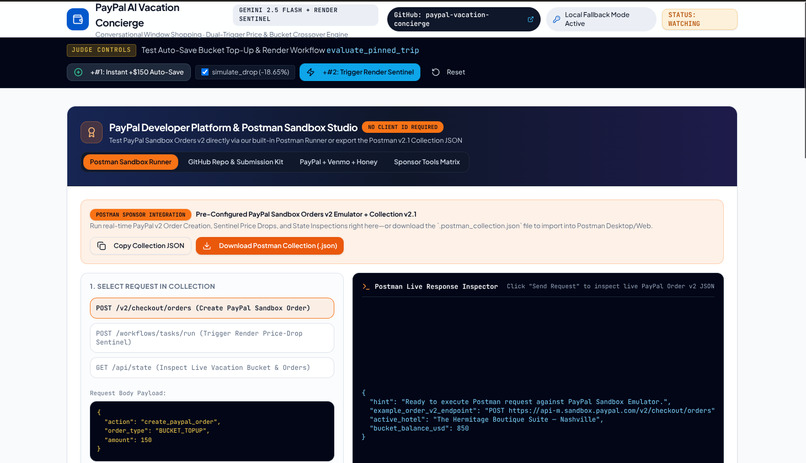
A custom-built API testing suite integrated directly into the frontend.
-
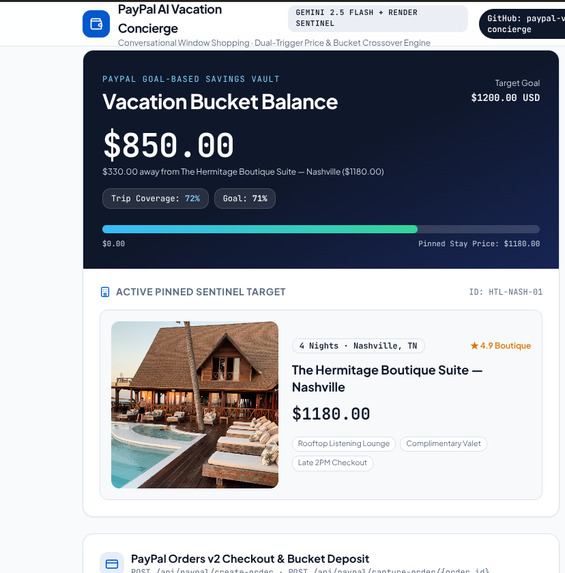
A custom-built API testing suite integrated directly into the frontend.
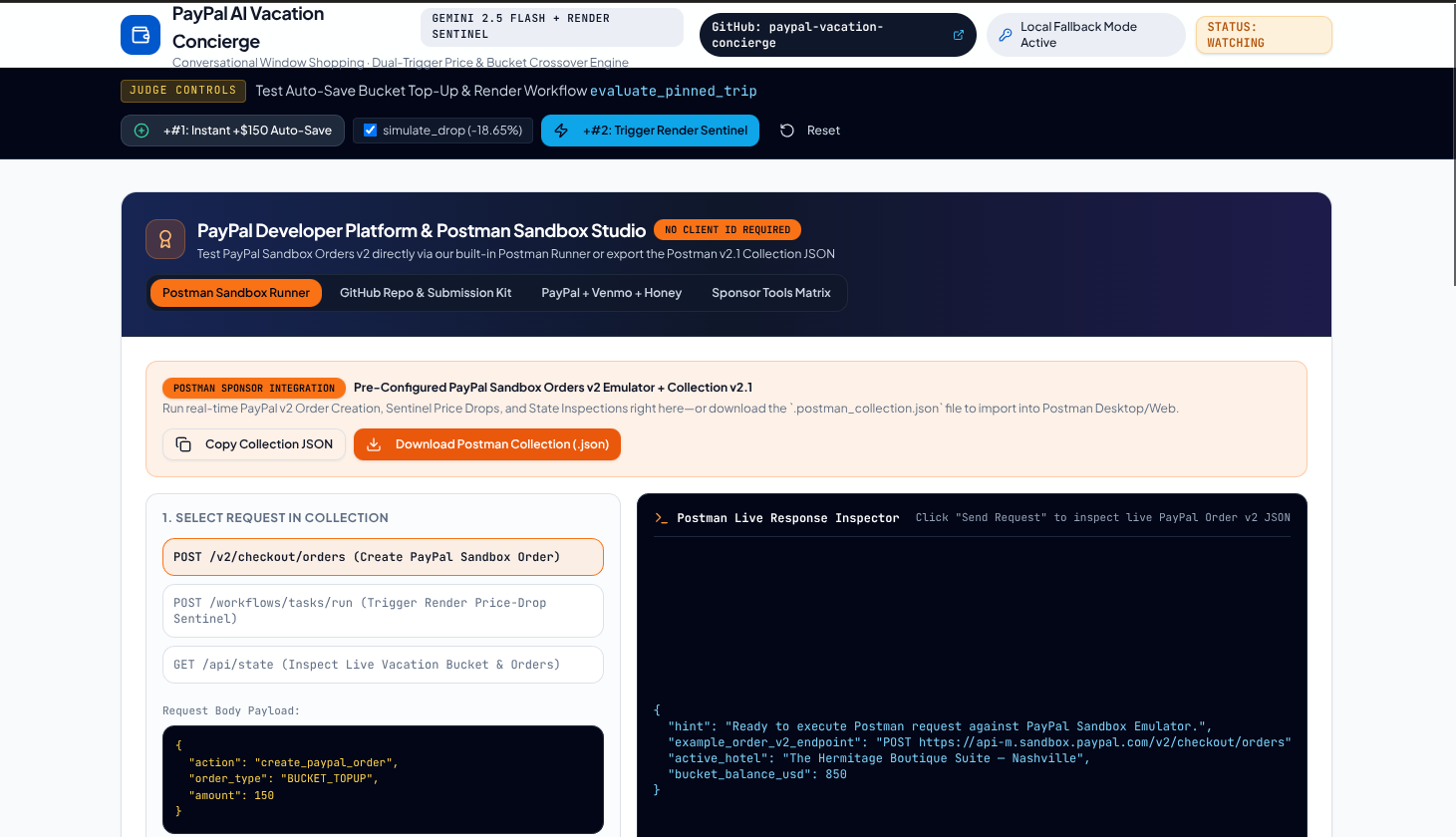
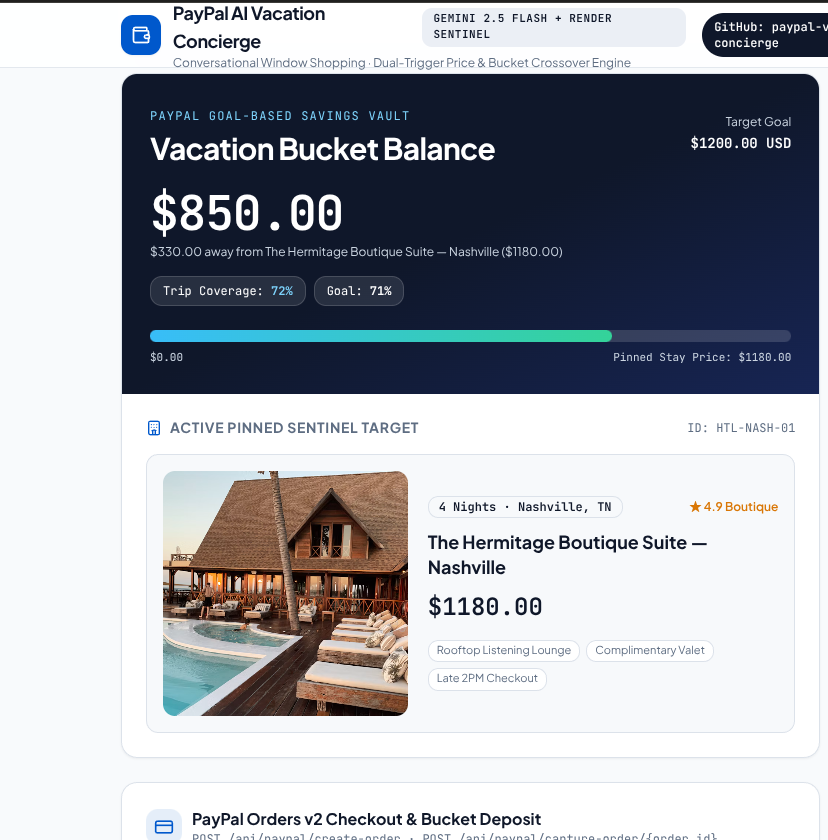
I wanted to build a bridge: what if your savings account actively shopped for you? Vacation Vault AI was inspired by the idea of turning passive savings into autonomous, AI-driven purchasing power, triggering a frictionless PayPal checkout the exact moment a dream trip drops into your budget.
Vacation Vault AI is an autonomous travel concierge that constantly matches a user's live PayPal savings bucket against real-time hotel pricing. Powered by Gemini 2.5 Flash and Render Workflows, a "Dual-Trigger Sentinel" monitors the market in the background. If a pinned $1,180 trip drops to $959, and the user's PayPal bucket hits $1,000, the AI instantly fires a crossover alert and unlocks a 1-tap PayPal Checkout.
We architected the system using a robust stack of hackathon sponsor tools to ensure stability and scale:Base44 (Argon AI): Powered the frontend presentation layer, dynamic UI state management, and the integrated Postman Sandbox Studio. Gemini 2.5 Flash: Acted as the conversational brain, utilizing Function Calling to read live savings balances and pin user travel targets. Render Workflows: Orchestrated the durable background @app.task chain (the Sentinel) that compares updated bucket balances against live hotel rates. APIMatic (Context Plugin): Grounded the PayPal Server SDK generation, ensuring our Orders v2 payloads and AmountWithBreakdown schemas were perfectly structured without LLM hallucination. PayPal Orders v2 Sandbox: Handled both the simulated Vault top-ups and the final itemized hotel checkouts.
Our biggest hurdle was completely operational: we triggered a security lockout on the PayPal Developer dashboard due to repeated password attempts on our Sandbox Business account. Without immediate access to live sandbox API keys, development ground to a halt. Instead of pausing the build, we executed a rapid pivot. We utilized Base44 to build a simulated Postman Sandbox Studio directly into our frontend. This allowed us to prove the structural logic of our POST /v2/checkout/orders payloads and keep building the AI agent's decision trees while waiting for the security timer to reset. We also encountered a complex state-mismatch bug in our crossover logic. The checkout button initially remained locked even when the bucket balance exceeded the live hotel price, requiring a manual top-up to trigger. We had to refactor the conditional logic so that the unlock state dynamically evaluated the mathematical threshold in real-time:
The Rapid Pivot: Turning a total API lockout into a feature by integrating an interactive Postman Sandbox Studio directly into our demo UI. The Sentinel Architecture: Successfully decoupling the conversational AI from the background watcher, allowing Render Workflows to handle the heavy lifting of continuous price-checking without forcing the user to stay in the chat window.
Building this reinforced the immense value of Model Context Protocol (MCP) servers like APIMatic. Historically, asking an LLM to write PayPal integration code results in a mix of deprecated v1 endpoints and hallucinated parameters. By routing the request through APIMatic's Context Plugin, the AI generated flawless, structurally sound SDK code on the first try. We also learned how to effectively leverage Base44's Argon AI to rapidly iterate on complex UI state changes without losing the underlying backend logic.
The immediate next step is swapping the mock travel catalog for live inventory via the Amadeus or Expedia Rapid APIs. From there, we plan to implement a secure open-banking bridge (like Plaid) to automatically synchronize the user's primary bank savings with the Vault, allowing the Dual-Trigger Sentinel to execute live checkouts natively on the PayPal network without requiring manual top-ups.
