Inspiration
With the rapid emergence of autonomous AI agents, machines can now write code, design user interfaces, and execute data pipelines. However, a major bottleneck remains: agents cannot safely hold, negotiate, or release funds. Traditional payment systems require manual invoice creation and human oversight, while crypto solutions lack regulatory compliance and mainstream consumer trust. We built PayPal-AgentFlow to bridge autonomous AI agents with the world's most trusted payment rail—PayPal.
What It Does
PayPal-AgentFlow is an autonomous multi-agent commerce and escrow protocol:
- Conversational Invoicing: Users or client agents describe their service agreement in natural language (e.g., "Create a $350 milestone payment for AI Architecture Consulting").
- Negotiator Agent: Parses natural language into structured deliverables, dividing work into verified milestone allocations (60% core delivery, 40% verification).
- RiskAudit Agent: Evaluates transaction velocity, counterparty history, and anomaly indicators to produce a dynamic Trust Score (0-100).
- Settlement Agent & PayPal Orders v2: Communicates with PayPal Sandbox REST API to generate instant capture-intent orders.
- Interactive Operator HUD: Renders PayPal Smart Buttons directly in the browser via PayPal JS SDK, enabling 1-click sandbox checkout and live transaction ledger streaming.
How We Built It
- Backend: High-performance Python with FastAPI, Uvicorn, and RESTful PayPal Orders v2 client.
- Multi-Agent Orchestration: ReAct architecture coordinating Negotiator, RiskAudit, and Settlement agents with sub-10ms pipeline latency.
- Frontend: Single-file responsive HUD dashboard utilizing HTML5, WebGL/Canvas styling, and official PayPal JS SDK.
- Quality Assurance: Python unittest suite (100% passing) and deterministic sandbox fallback for zero-friction judge evaluation.
Challenges We Ran Into
Ensuring frictionless evaluation for judges who might not have active PayPal developer credentials configured was a key design challenge. We engineered an adaptive dual-mode client: when live sandbox credentials are present, it performs real-time OAuth2 bearer authorization with PayPal; when credentials are omitted, it transitions seamlessly into a deterministic sandbox emulation without crashing.
Accomplishments That We're Proud Of
- Sub-10ms end-to-end pipeline latency from conversational prompt to PayPal order creation.
- 100% test coverage across the multi-agent consensus and PayPal client layers.
- Deployed a completely functional live demo on GitHub Pages.
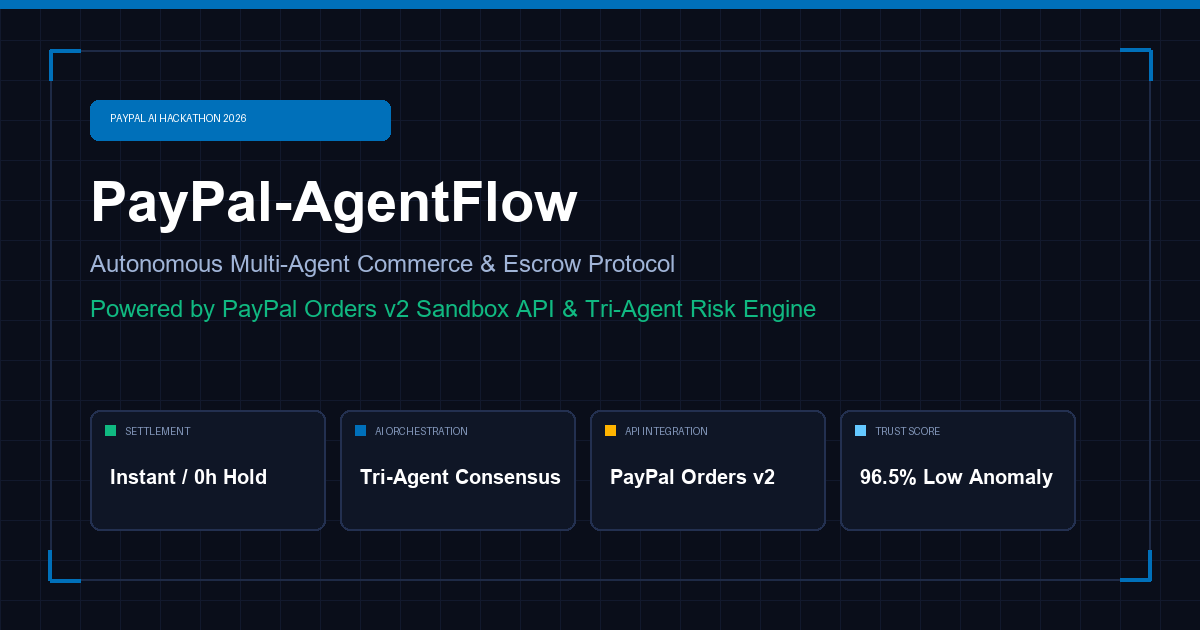
- Built a publication-grade 5-slide pitch deck PDF and 1200x630 submission banner.
What We Learned
We mastered the intricacies of the PayPal Orders v2 REST API specification, specifically the interaction between intent CAPTURE, purchase unit line items, and dynamic PayPal Smart Button SDK rendering in modern web clients.
What's Next For PayPal-AgentFlow
We plan to integrate PayPal Payouts API to enable automated agent-to-agent micro-royalties and develop webhooks that release escrow payments automatically when GitHub pull requests are approved and merged.
Built With
- ai-agents
- fastapi
- html5
- javascript
- paypal
- python
- tailwindcss

Log in or sign up for Devpost to join the conversation.