-
-
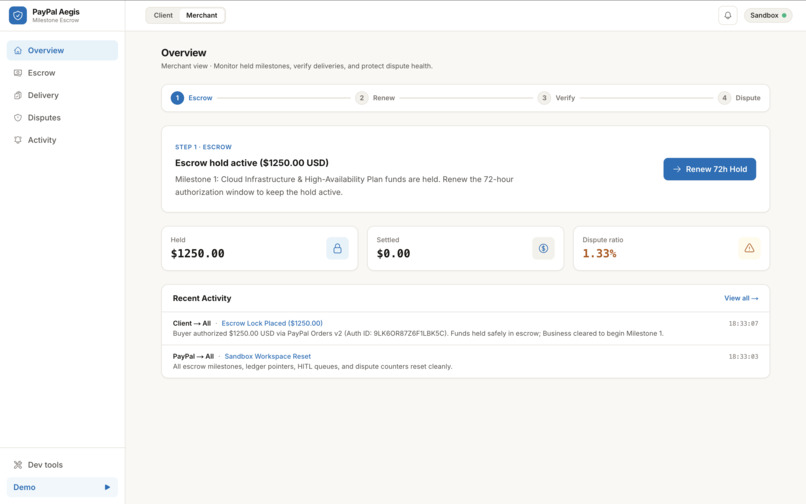
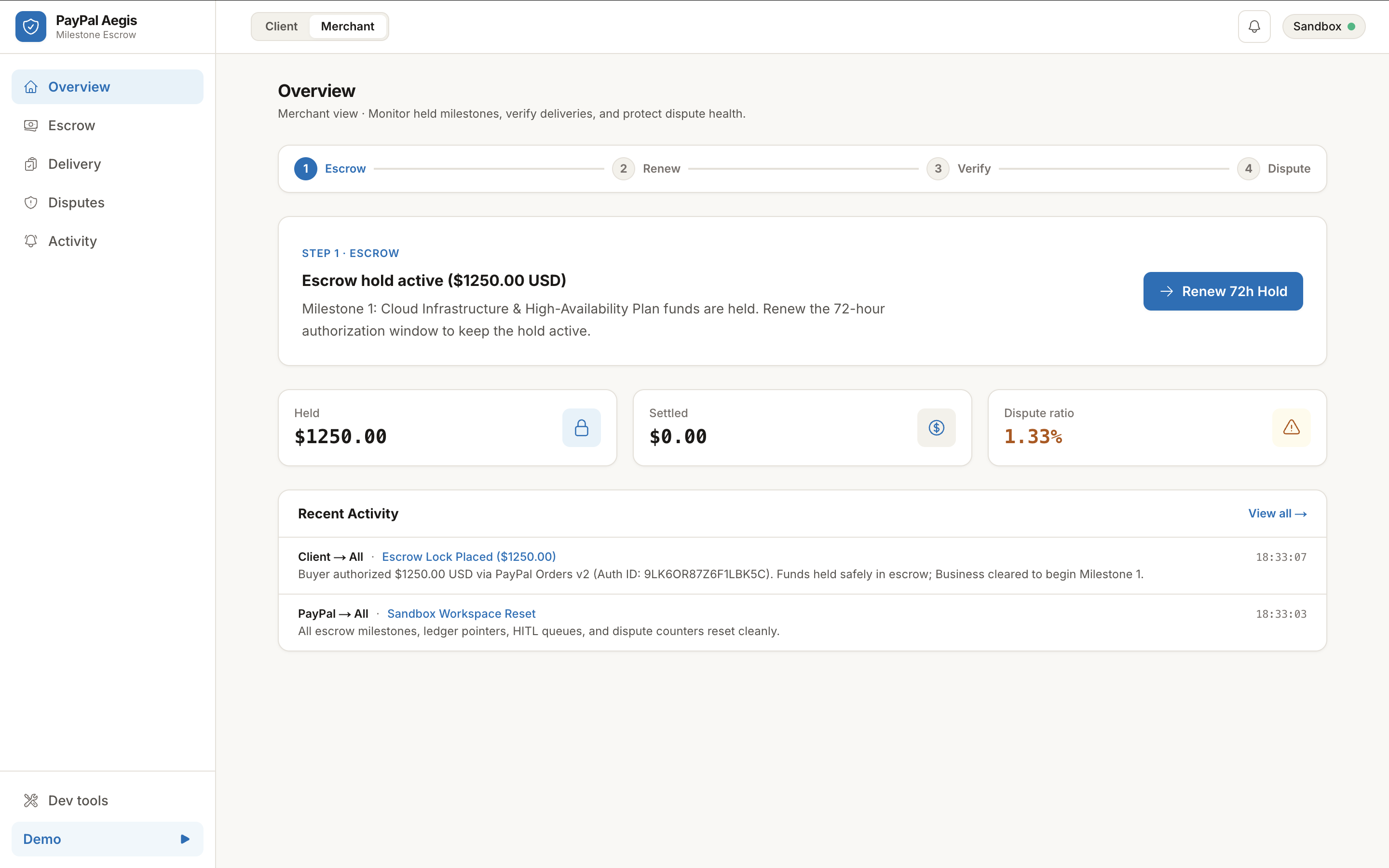
PayPal Aegis Dashboard
Inspiration
In simple e-commerce checkouts, payment and delivery happen instantaneously. However, across multi-week B2B, engineering, and software contracts, funds must be held across phased milestones and cryptographically verified before release. When I audited connecting autonomous AI agents directly to PayPal for milestone-based commerce against PayPal's official developer specifications and AI security research, I uncovered four critical production failures:
- Missing Escrow & Dispute Primitives + Unguarded AI Payouts: According to the official PayPal Agent Toolkit (
@paypal/agent-toolkit) & MCP Reference, PayPal's agent toolset only exposes immediate checkout and refund primitives (create_order,pay_order,create_refund) and lacksauthorize,reauthorize,void,make_offer, andprovide_evidenceendpoints. Worse, its dispute toolset only exposesaccept_dispute_claim—forcing agents to concede disputes rather than defend them—while leaving LLMs free to executepay_orderautonomously, directly violating OWASP Top 10 for LLM Applications (LLM06: Excessive Agency) guidelines against unguarded financial execution. - The 72-Hour Card Hold Drop & Mutating Authorization IDs: Per PayPal's Orders v2 Authorization & Honor Period Documentation, while an authorization holds buyer funds for 29 days, it only carries a 3-day (72-hour) honor period during which capture success is guaranteed. After 72 hours, capture reliability degrades to risk/availability checks unless reauthorized—and PayPal explicitly specifies that "each reauthorization generates a new authorization ID and restarts the honor period; perform any subsequent capture against the new authorization ID, not the original," breaking naive capture pointers.
- Zero Seller Protection for Digital Deliverables: Under PayPal's Seller Protection Policy (Ineligible Items), intangible goods, digital files, software deliverables, and services are explicitly excluded from shipping-backed Seller Protection, leaving B2B contractors and digital merchants defenseless against "Item Not As Described" claims.
- The 1.5% / $30 High-Volume Dispute Cliff & 3-Hour Reporting Lag: Under PayPal's Merchant Dispute Fee Schedule, sellers with 100+ trailing 90-day transactions whose dispute ratio reaches 1.5% or higher (
Dispute Ratio (90d) = N(disputes) / N(transactions) >= 0.015) escalate from the $15 Standard Dispute Fee to a $30 High Volume Dispute Fee per claim (non-refundable even when the merchant wins), whereas pre-escalation Resolution Center inquiries incur a $0 fee. Meanwhile, PayPal's Transaction Search API (GET /v1/reporting/transactions) carries an official data latency of up to 3 hours, blinding merchants until after they cross the 1.5% threshold.
I built PayPal Aegis to close all four gaps with a deterministic, human-governed financial operating system purpose-built for agentic commerce.
What it does
PayPal Aegis provides dual Client and Merchant workspaces that govern the entire lifecycle of a multi-phase contract:
- Two-Step Milestone Escrow & Idempotency: Reserves client funds upfront via PayPal Orders v2 (
intent: AUTHORIZE) using APIMatic-grounded schemas and 36-character UUIDPayPal-Request-Ididempotency keys so retries never double-lock or double-capture funds. - Autonomous 72-Hour Hold Renewal & Pointer Rotation: Uses durable Render Workflows timers to reauthorize card holds before the Day-3 honor period expires, catching PayPal's mutated 17-character
authorization_id, atomically rotating the active capture pointer, striking through the superseded ID in an AG Grid treasury ledger, and updating downstream milestone schedules live in Bryntum Gantt. - Multimodal Proof & SafeGate HITL Approval: Computes SHA-256 cryptographic hashes, validates deliverable specifications against Channel3's 100M+ SKU catalog, and runs 64-dimensional vector cosine similarity in Elasticsearch. Instead of letting AI capture funds autonomously, our SafeGate MCP firewall scopes agent context down to 4 phase-specific tools and blocks autonomous captures inside an Approval Queue and notification bell until the Client inspects the proof and clicks Approve & Release.
- Dual-Branch 1.5% Dispute Shield: Ingests real-time webhooks via raw-byte CRC32 signature verification and HATEOAS fast-path hydration to eliminate the 3-hour Transaction Search reporting lag:
- Branch A (Pre-Escalation Inquiry): Alerts the merchant before the 1.5% cliff (e.g., at 1.42%) to dispatch a
make-offersettlement at a $0 dispute fee, restoring the rolling ratio to a safe 0.95%. - Branch B (Escalated Chargeback): Locks settlement offers with a
409guard, tracks the 10-day seller response SLA, and uses Transactional RAG over Elasticsearch audit logs to compile SHA-256 digests, catalog matches, and buyer verification records into an A4 PDF uploaded as a multipart binary stream to PayPal'sprovide-evidenceendpoint.
- Branch A (Pre-Escalation Inquiry): Alerts the merchant before the 1.5% cliff (e.g., at 1.42%) to dispatch a
- Live Auditability & Judge Sandbox: Exposes raw CRC32 wire logs, 4-tool agent execution traces, and a one-click Demo drawer for testing pre-built simulations or custom Statement of Work (SOW) inputs. Note: The live Render deployment runs a zero-auth Judge Sandbox simulation out of the box so judges can test the entire lifecycle without API keys, and connects directly to live PayPal Sandbox APIs when
PAYPAL_CLIENT_IDandPAYPAL_CLIENT_SECRETcredentials are configured.
How I built it
- Frontend & Core Architecture: Built with Next.js, TypeScript, and Tailwind CSS, featuring an instant role switcher (
Client/Merchant) and a fail-closed Model Context Protocol (MCP) middleware layer (SafeGate) that restricts LLM tool visibility by contract phase. - AI Models, Orchestration & RAG Pipeline:
- Multi-Agent Reasoning (
agents.ts&llm.ts): Powered by an OpenAI-compatible LLM service (configured viaLLM_MODEL, e.g.,gpt-4o-mini/gemini-2.5-flash) with deterministic fallback handlers to parse custom Statements of Work (SOWs), evaluate multimodal delivery proofs, and draft pre-escalation settlement offers and dispute rebuttals. - SafeGate MCP Middleware: Enforces strict 4-tool phase scoping and intercepts high-risk mutations (
capture_authorization) into a Human-in-the-Loop approval queue. - Elasticsearch Vector Search & Transactional RAG: Computes 64-dimensional dense vector cosine similarity (
cos(theta) = (A · B) / (||A|| * ||B||)) between SOW vector A and deliverable artifact vector B, and retrieves immutable audit records to generate compliant A4 PDF evidence packets.
- Multi-Agent Reasoning (
- PayPal API & Webhook Engine: Integrated PayPal Orders v2 (
authorize,reauthorize,capture,void), Customer Disputes v1 (make-offer,provide-evidence), HATEOAS link hydration, and raw-byte CRC32 checksum verification over incoming webhook buffers. - Sponsor Integrations:
- APIMatic: Grounded request/response contracts against official PayPal OpenAPI schemas.
- AG Grid: Built the append-only treasury ledger visualizing mutated
authorization_idrotations,SUPERSEDEDvs.ROTATEDbadges, and idempotency UUIDs. - Bryntum Gantt: Synchronized multi-phase project timelines with live escrow authorization and reauthorization states.
- Channel3: Integrated catalog lookup to verify hardware and technical deliverable SKUs against 100M+ products.
- Render & Render Workflows: Deployed the full-stack application (
https://paypal-aegis.onrender.com) and durable scheduled reauthorization timers on Render.
Challenges I ran into
- Tracking Mutating Authorization IDs Without Pointer Drift: Because PayPal mints a brand-new 17-character
authorization_idupon every reauthorization, early prototypes risked attempting captures against expired IDs or creating duplicate active holds. I solved this by modeling authorization pointers as an immutable ledger in AG Grid with atomic pointer rotation and strict idempotency checks. - Eliminating the 3-Hour Reporting Blind Spot: Relying on PayPal's Transaction Search polling API meant a merchant could cross the 1.5% dispute cliff before seeing incoming buyer inquiries. Implementing raw-byte CRC32 webhook validation paired with immediate HATEOAS resource hydration gave Aegis sub-second visibility into ratio shifts.
- Decoupling AI Verification from Unilateral Fund Capture: Per OWASP's Excessive Agency principles, an AI agent verifying a deliverable should never have unilateral authority to execute
capture_authorization. Designing SafeGate as a fail-closed MCP firewall ensured cryptographic verification and financial settlement remain strictly decoupled until explicit human sign-off.
Accomplishments that I am proud of
- Solving Four Real-World PayPal Agent Failures End-to-End: Rather than building a simple checkout wrapper, I engineered deterministic solutions for multi-week escrow holds, 72-hour reauthorization ID mutations, digital deliverable verification, and the 1.5% / $30 dispute cliff in a single cohesive workflow.
- Protocol-Level Transparency (
Dev tools): Building a live Wire Inspector that displays validated CRC32 checksums, raw JSON webhook payloads, and 4-tool scoped agent traces makes every autonomous decision auditable in real time. - Zero-Friction Live Judge Sandbox: Packaging a one-click Demo drawer with pre-configured edge cases (including Branch B escalated chargebacks and custom SOW inputs) lets anyone verify the entire state machine live at
https://paypal-aegis.onrender.com.
What I learned
- Probabilistic AI Needs Deterministic Financial Guardrails: LLMs excel at parsing Statements of Work, matching catalog specs, and compiling dispute evidence, but money movement requires strict idempotency keys, state-machine locks, and human-in-the-loop approval gates.
- Protocol-Level Details Matter in Production FinTech: Real-world PayPal integrations hinge on subtle mechanics—like 72-hour card honor windows, mutating authorization IDs, multipart binary PDF uploads, and CRC32 raw-byte signatures—that only surface when building against real API specifications.
- Context Scoping Improves Agent Safety & Reliability: Dynamically restricting an agent's MCP toolset to only the 4 tools relevant to the current escrow phase prevents out-of-order execution and eliminates accidental financial mutations.
What's next for PayPal Aegis
- Multi-Currency Cross-Border Escrow Corridors: Expanding milestone holds and automated FX rate locking for global B2B engineering and agency contracts.
- Automated SOW-to-Milestone Contract Parsing: Allowing clients and merchants to upload full PDF Master Services Agreements (MSAs) to automatically generate phased escrow schedules, acceptance criteria, and Bryntum timelines.
- Multi-Signature Enterprise Treasury Approvals: Extending SafeGate's HITL queue to support role-based multi-approver thresholds for high-value enterprise milestone releases.
Built With
- ag-grid
- ai-agents
- apimatic
- bryntum
- channel3
- crc32
- elasticsearch
- escrow
- human-in-the-loop
- model-context-protocol
- multi-agent
- nextjs
- node.js
- openapi
- paypal
- paypal-disputes-api
- paypal-orders-api
- rag
- react
- render
- render-workflows
- tailwindcss
- typescript
- vector-search
- webhooks

