-
-
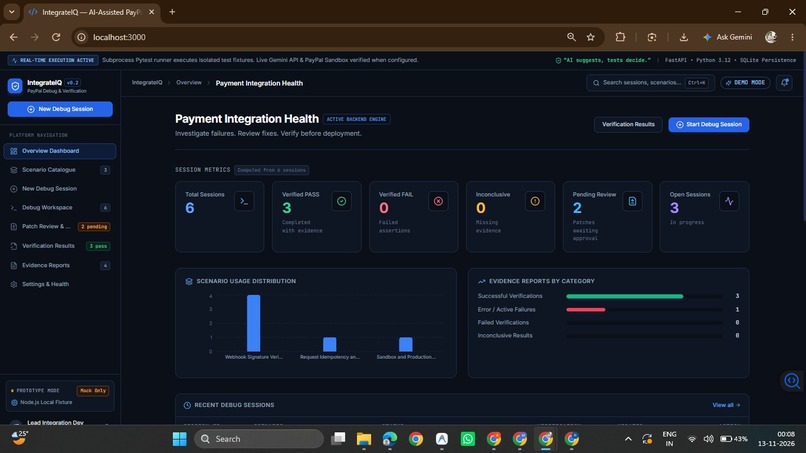
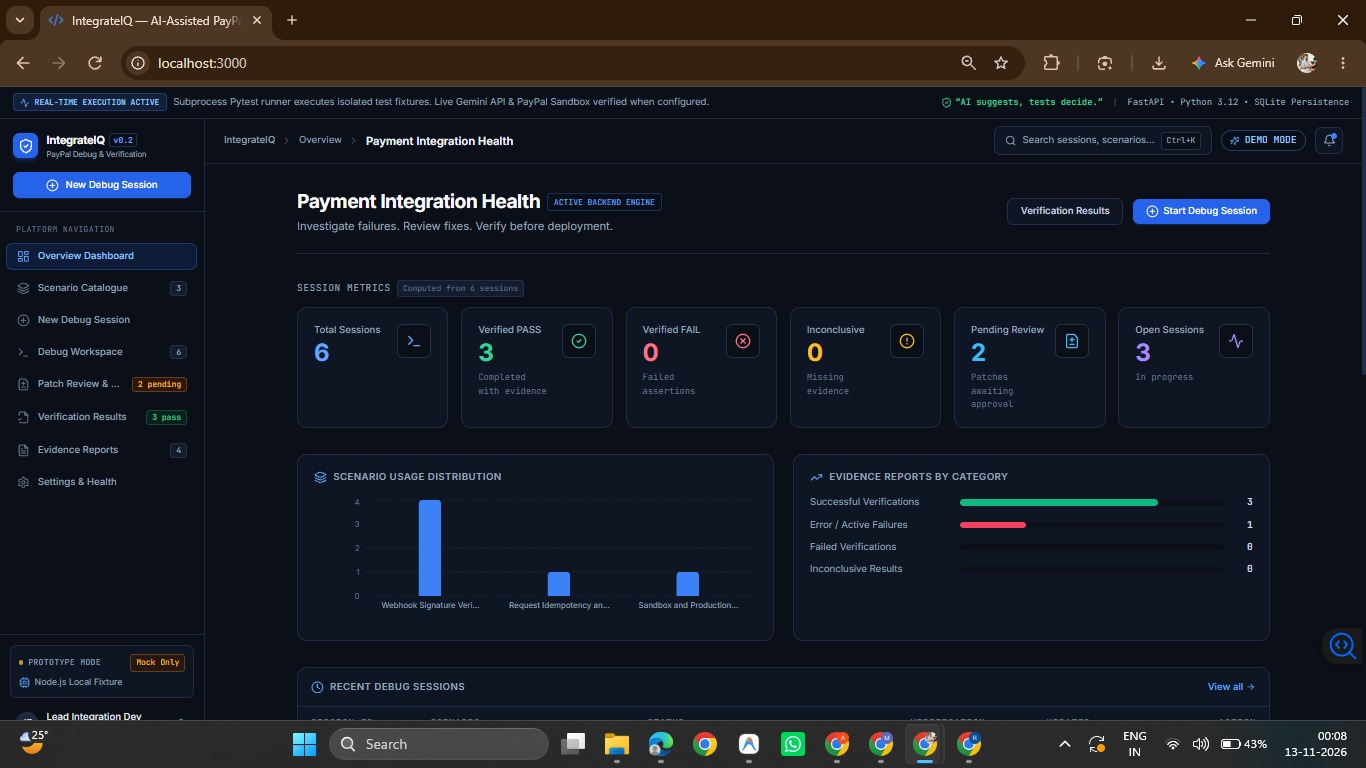
IntegrateIQ Dashboard Real-time payment integration monitoring with AI-assisted debugging, verification metrics and evidence-based.
-
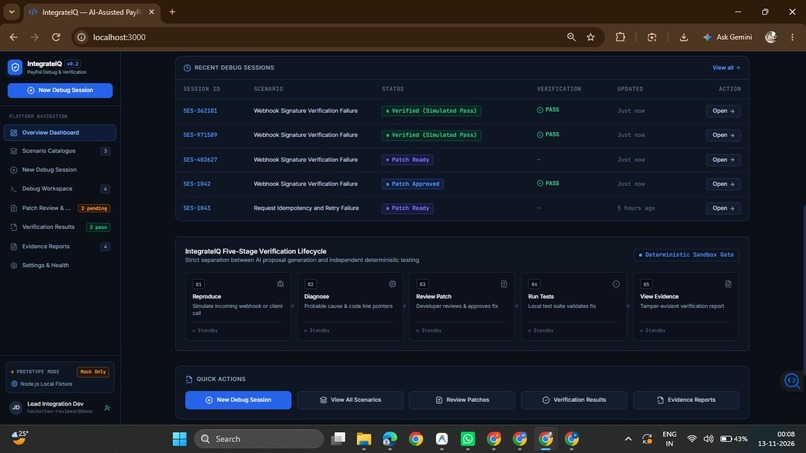
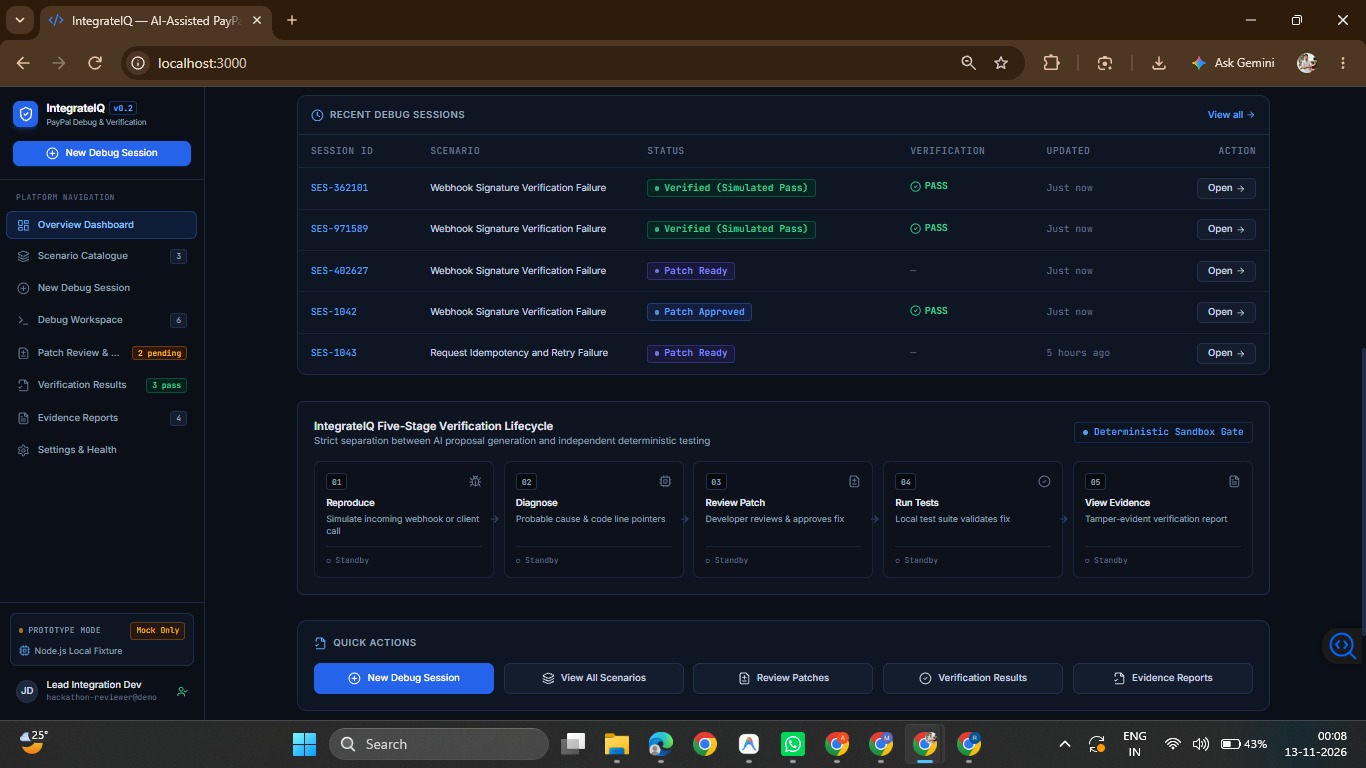
Track webhook failures, AI fixes, developer approvals & verification results across sessions. Detect → Analyze → Review → Test → Verify.
-
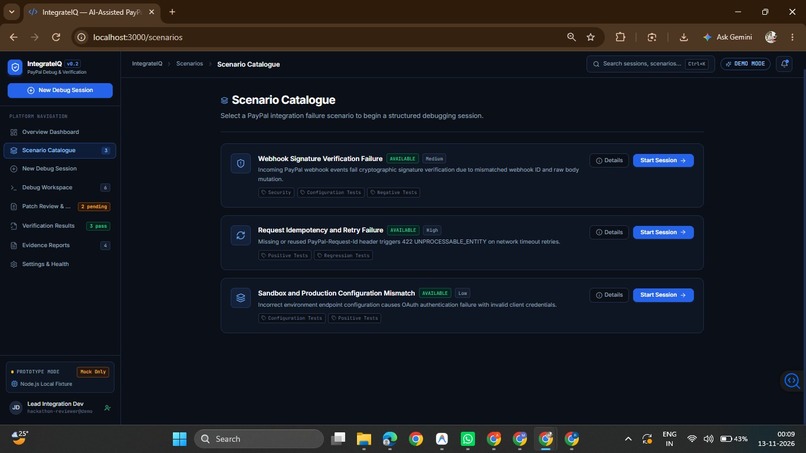
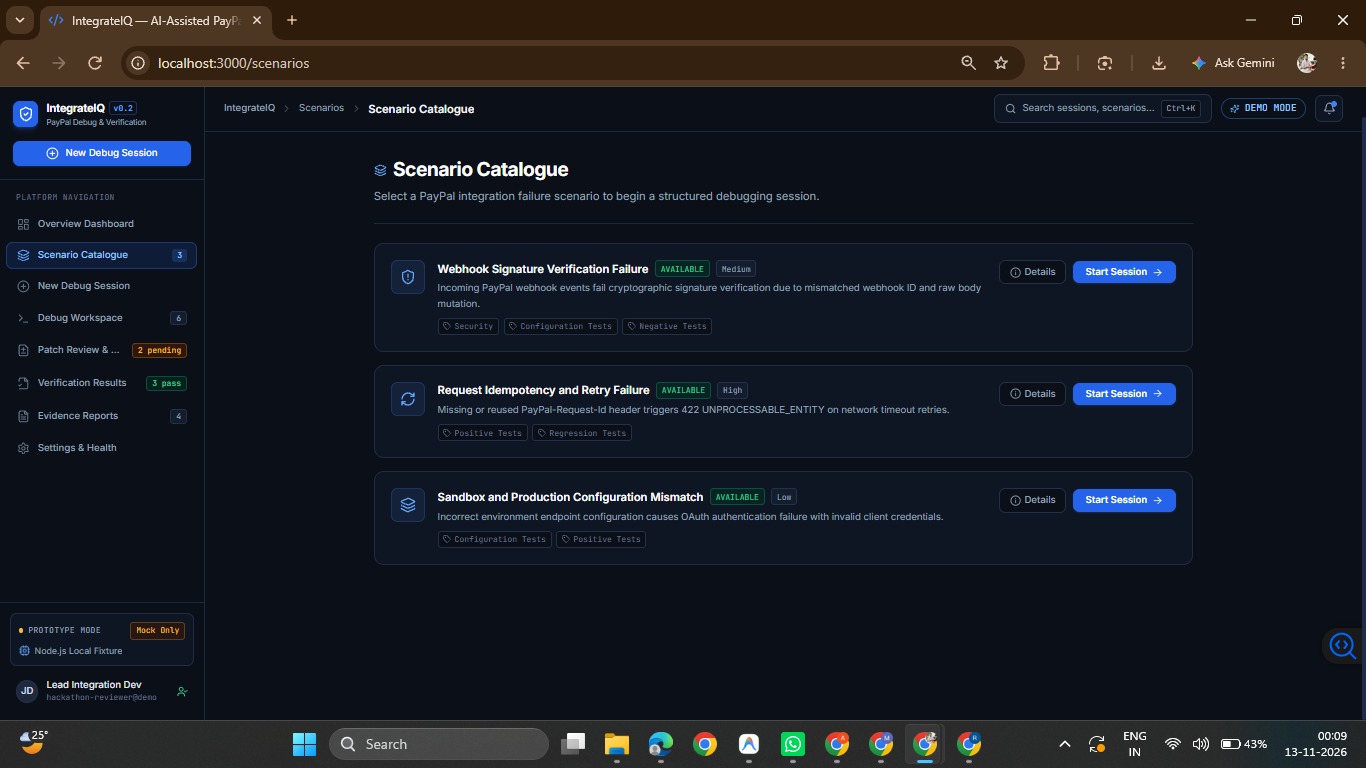
Scenario Catalogue: Three PayPal failure scenarios for webhook signatures, idempotency & sandbox-production mismatches.
-
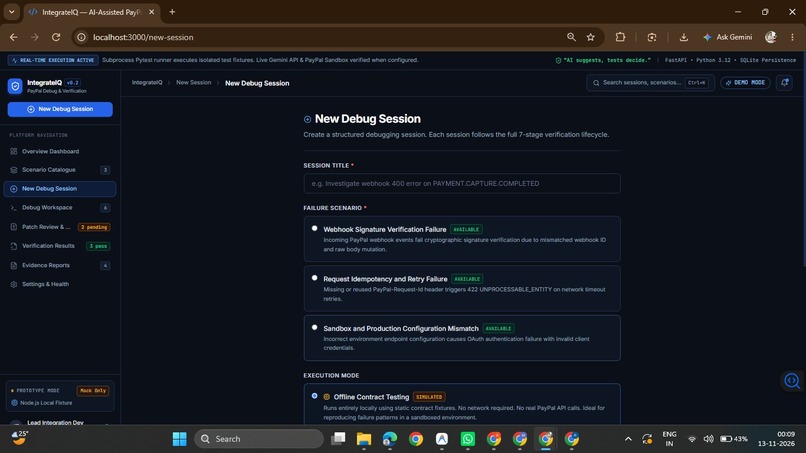
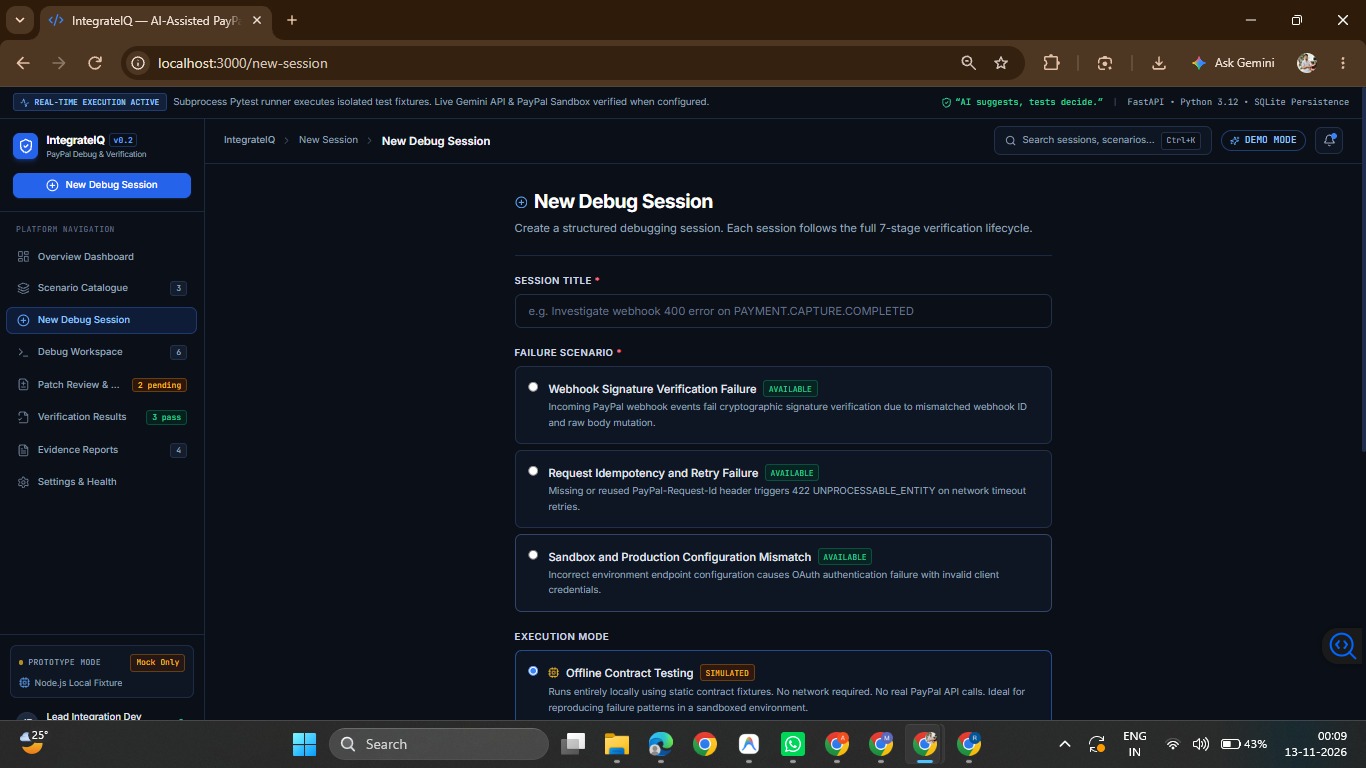
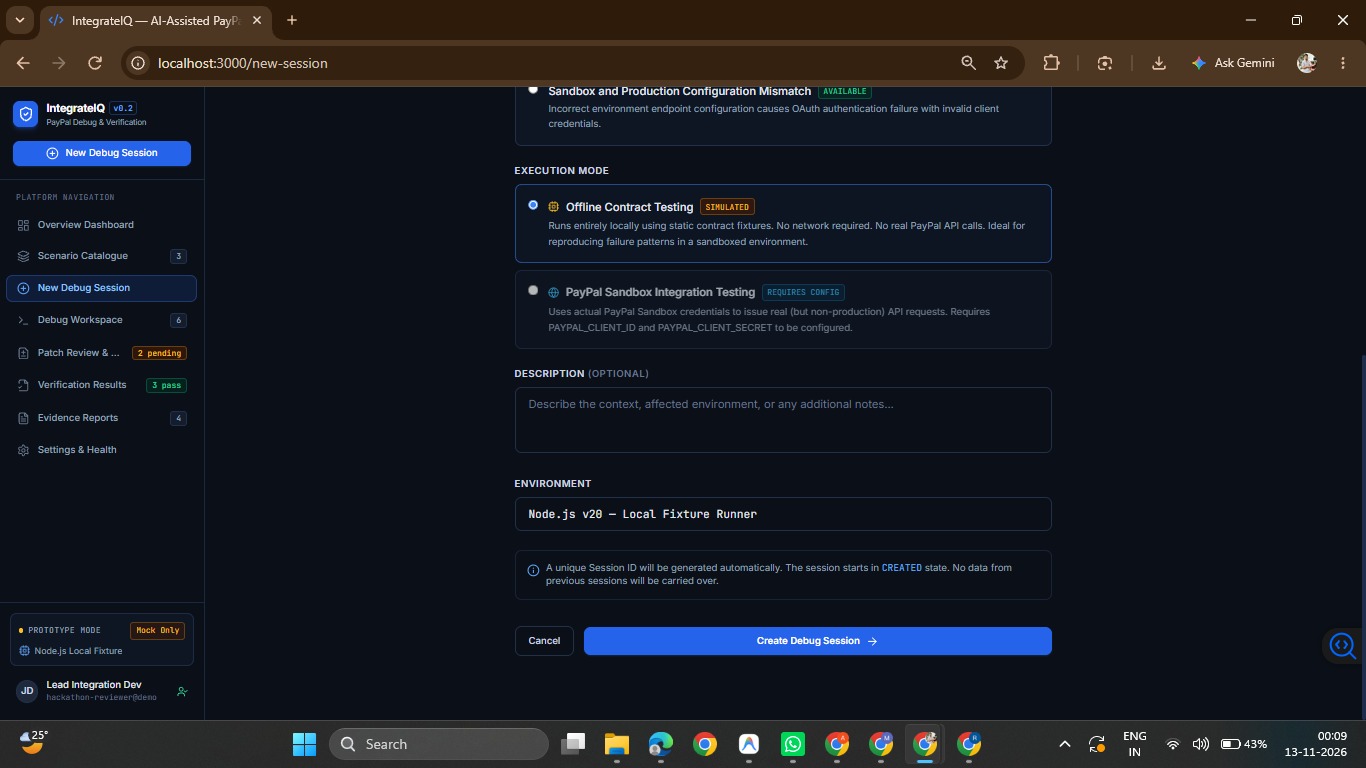
New Debug Session: Select a failure scenario and execution mode to reproduce PayPal issues and validate fixes.
-
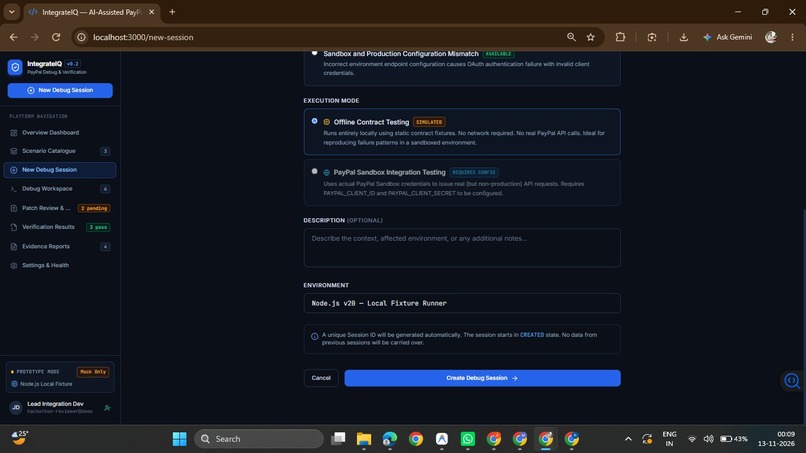
Execution Configuration: Choose offline fixture testing or live PayPal Sandbox testing, then add environment details
-
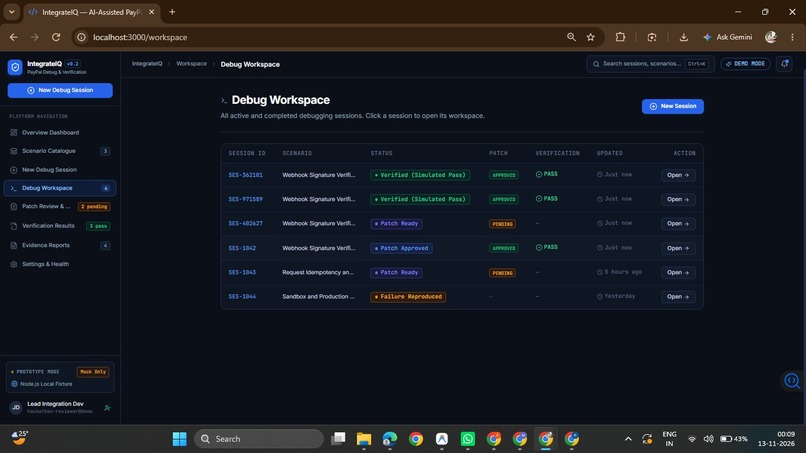
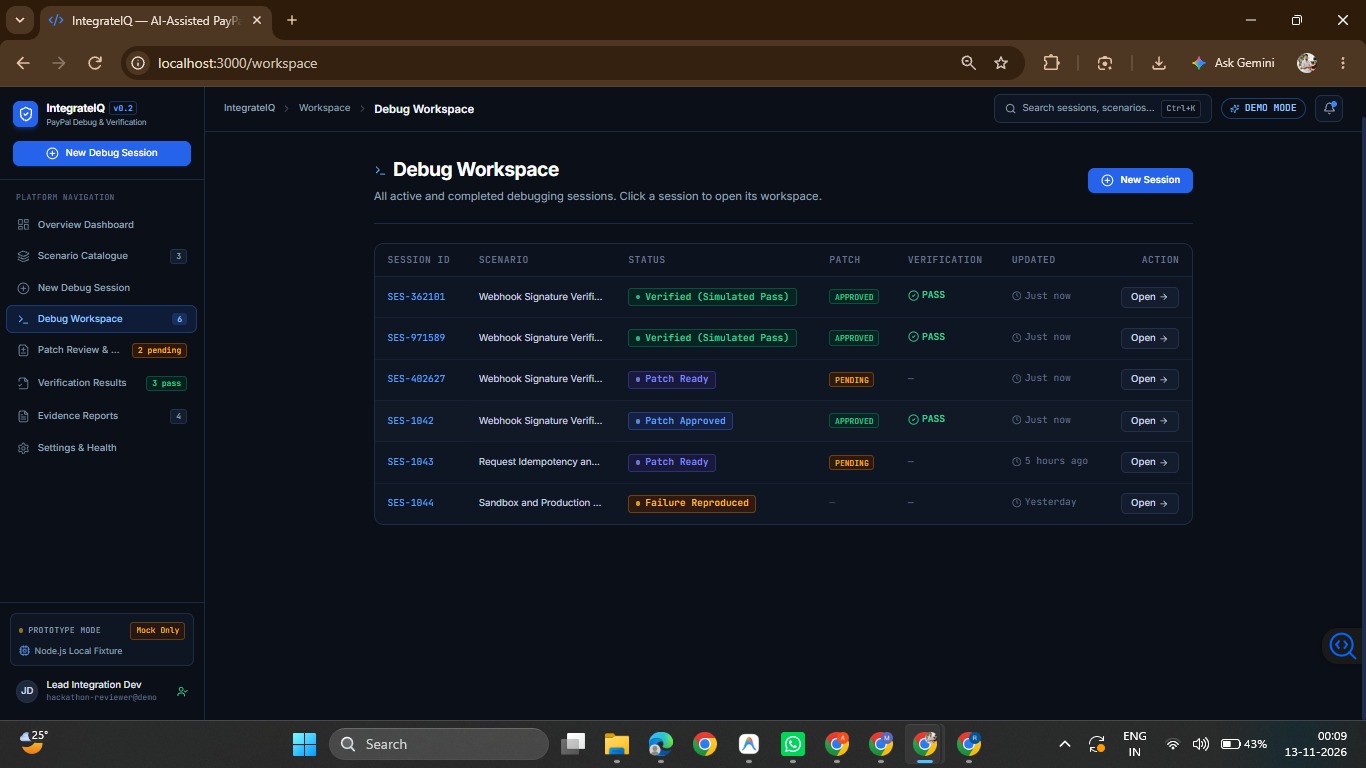
Debug Workspace: View all sessions, track failure status, patch approvals & verification results, and continue debugging.
-
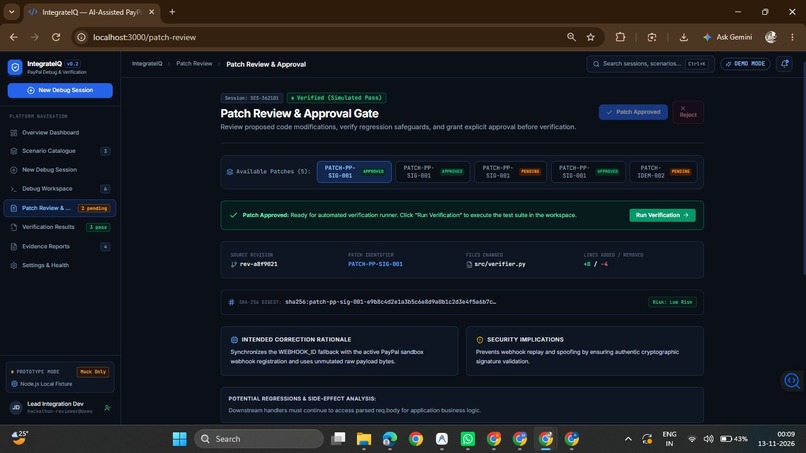
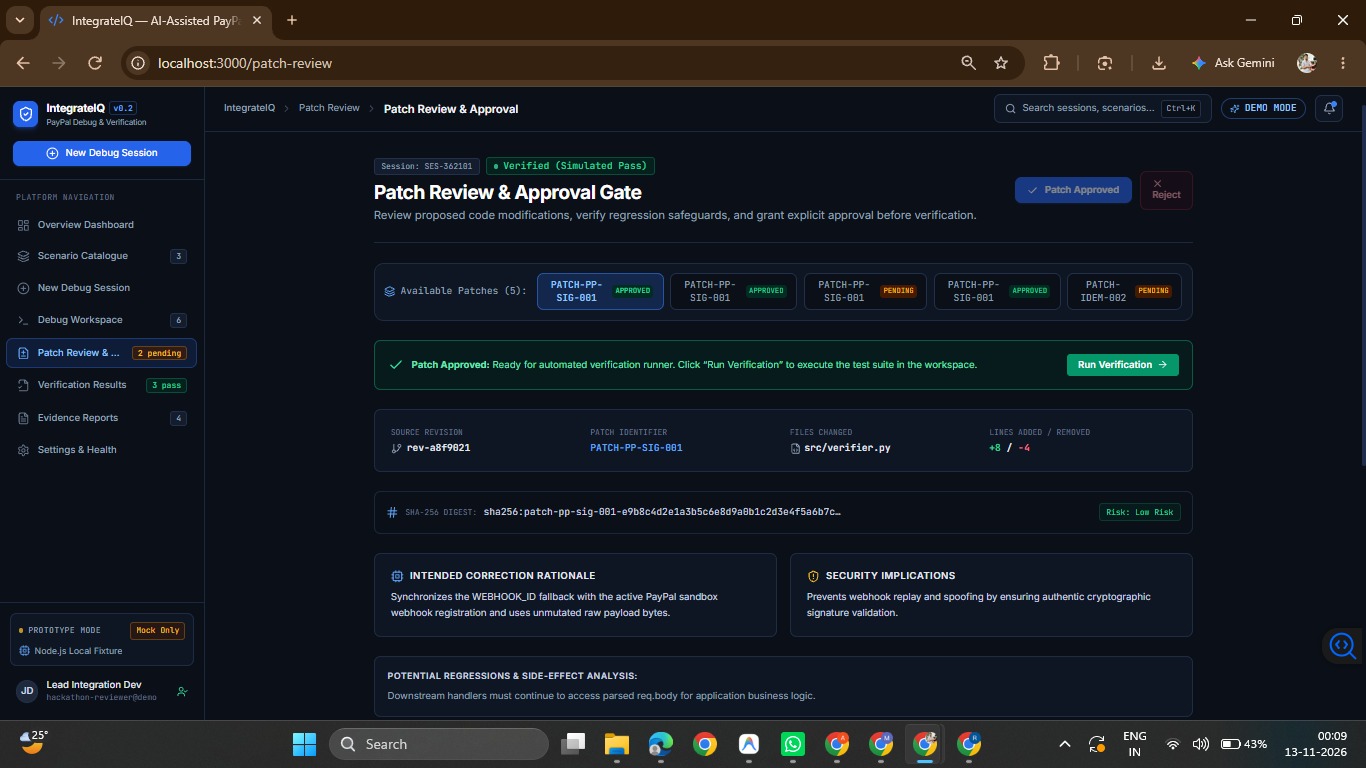
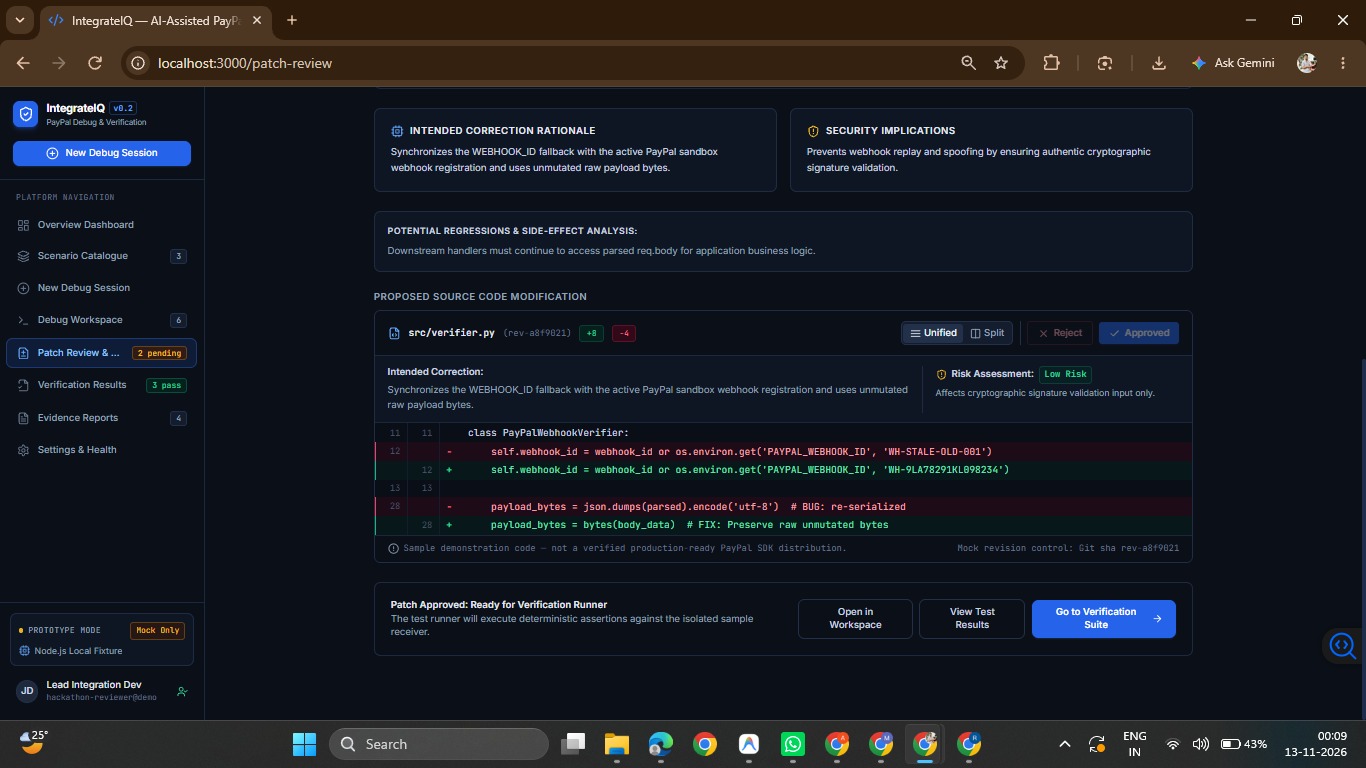
Patch Review & Approval: Review AI fixes, assess security risks & regressions, and approve patches for automated testing.
-
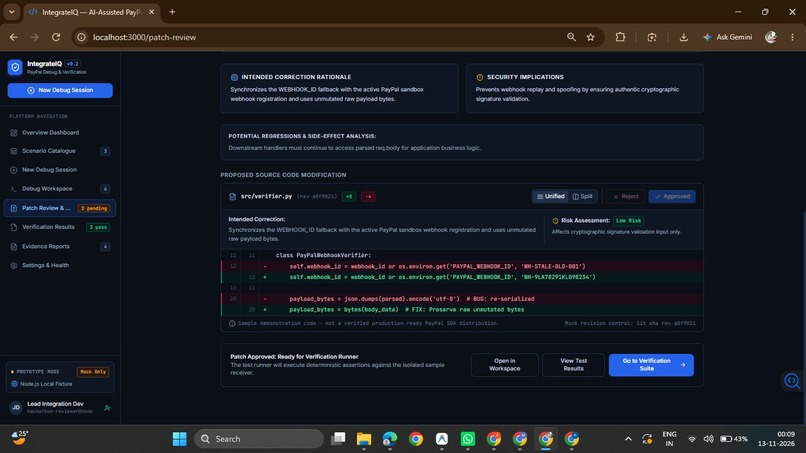
Proposed Code Modification: View AI patches, side-by-side diffs, explanations & security risks. Approve or reject changes before testing.
-
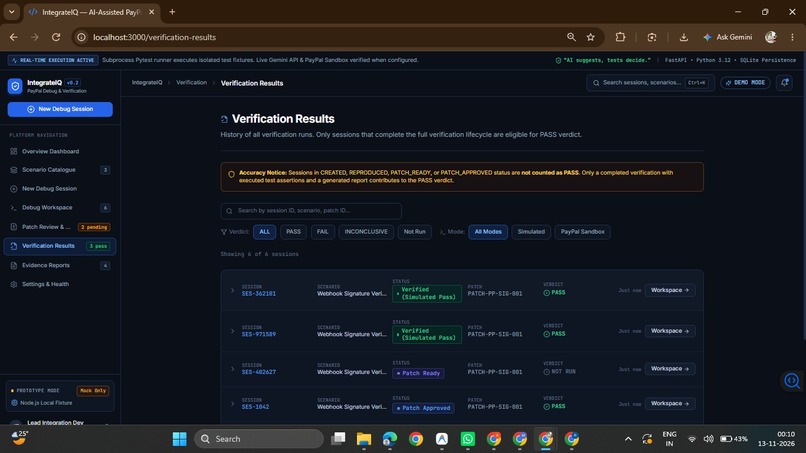
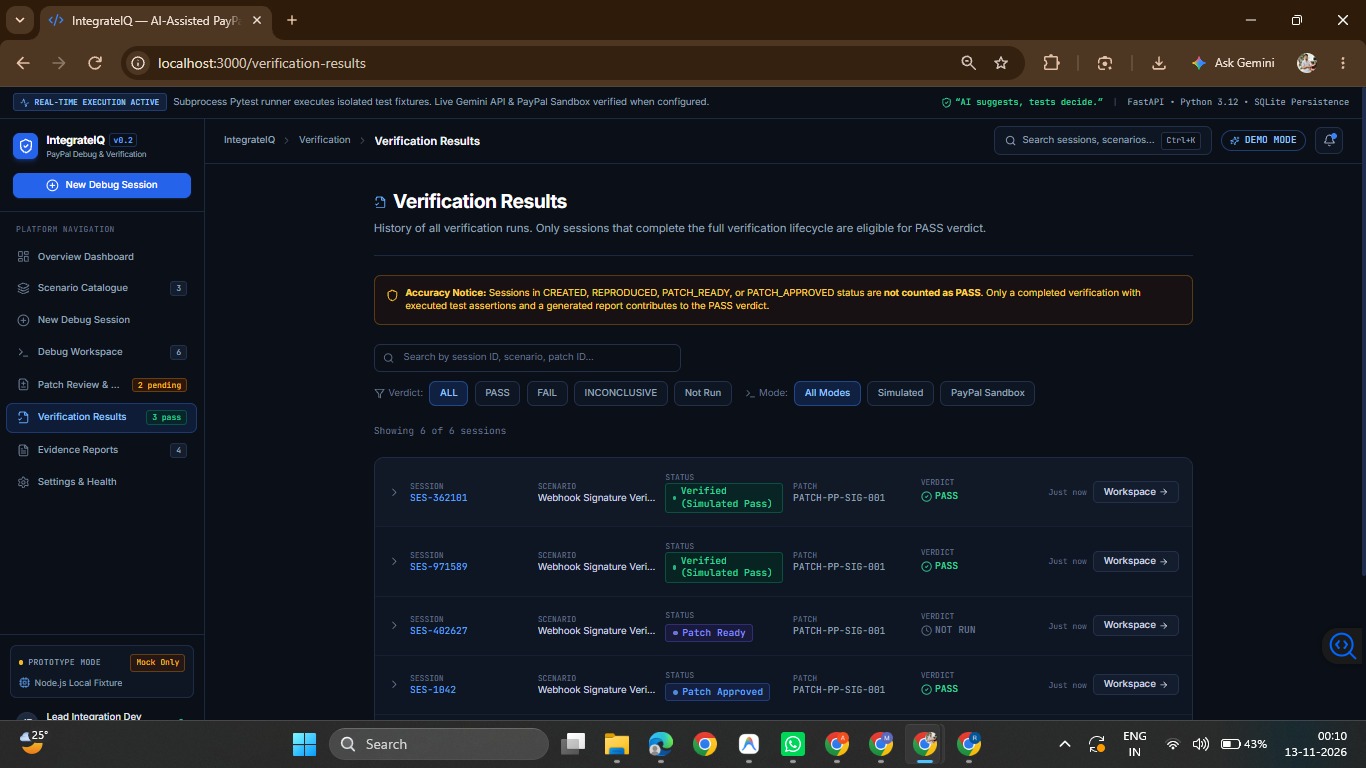
Verification Results: View test history and PASS, FAIL, INCONCLUSIVE & NOT RUN verdicts. PASS requires completed tests with evidence.
-
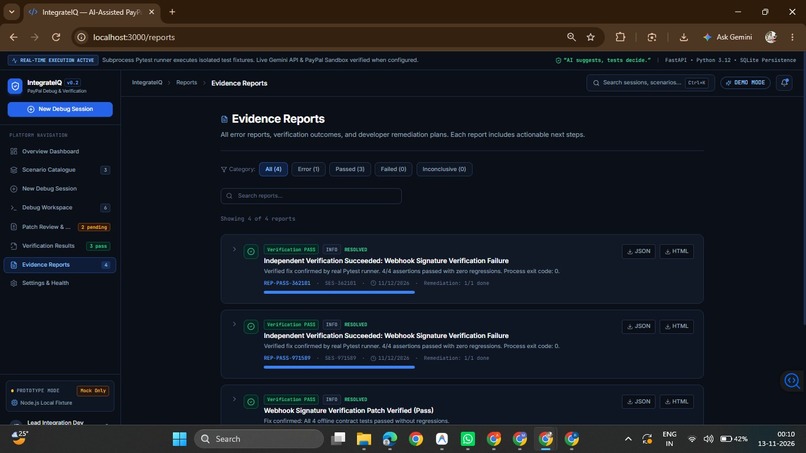
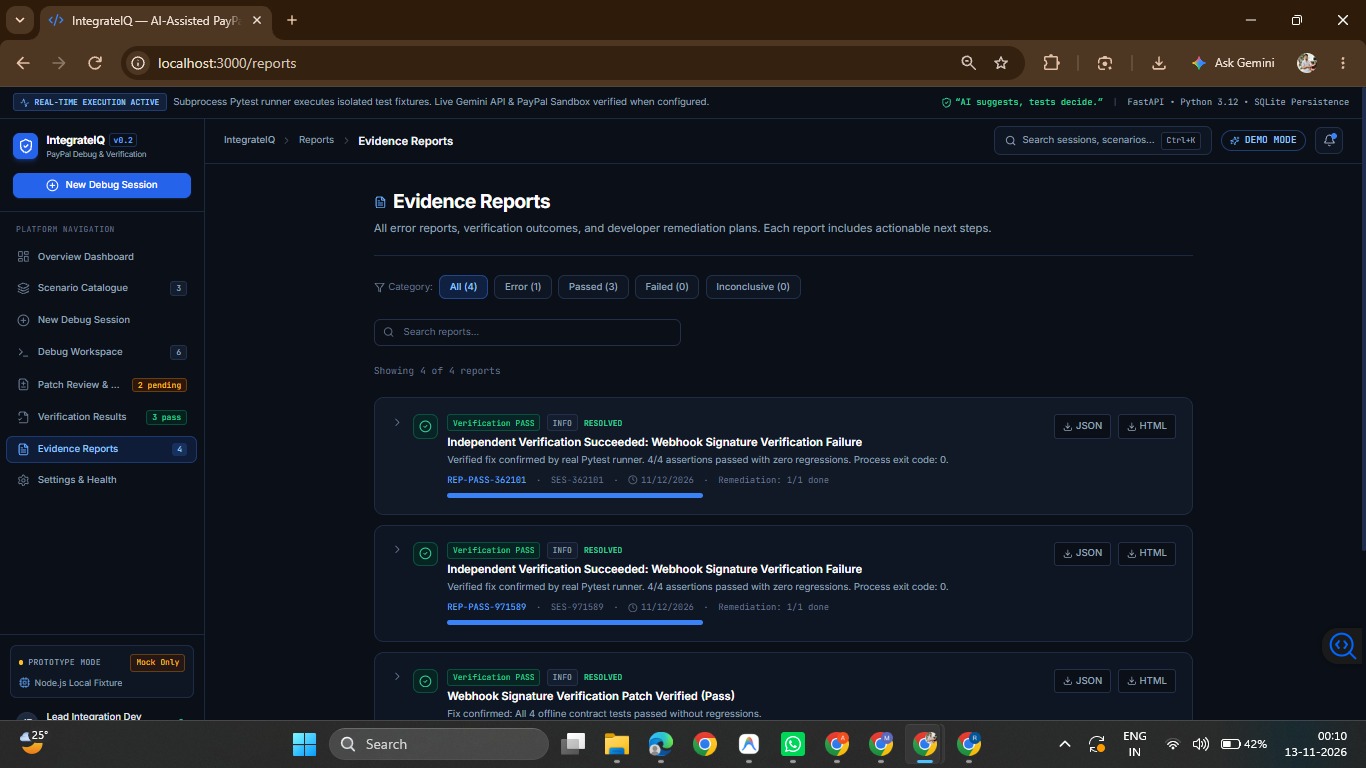
Evidence Reports: View test results, error summaries & remediation steps. Export transparent verification reports in JSON and HTML formats.
-
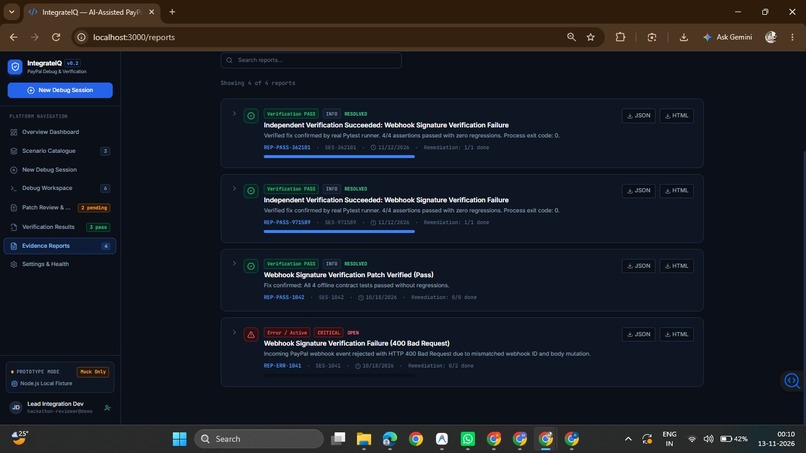
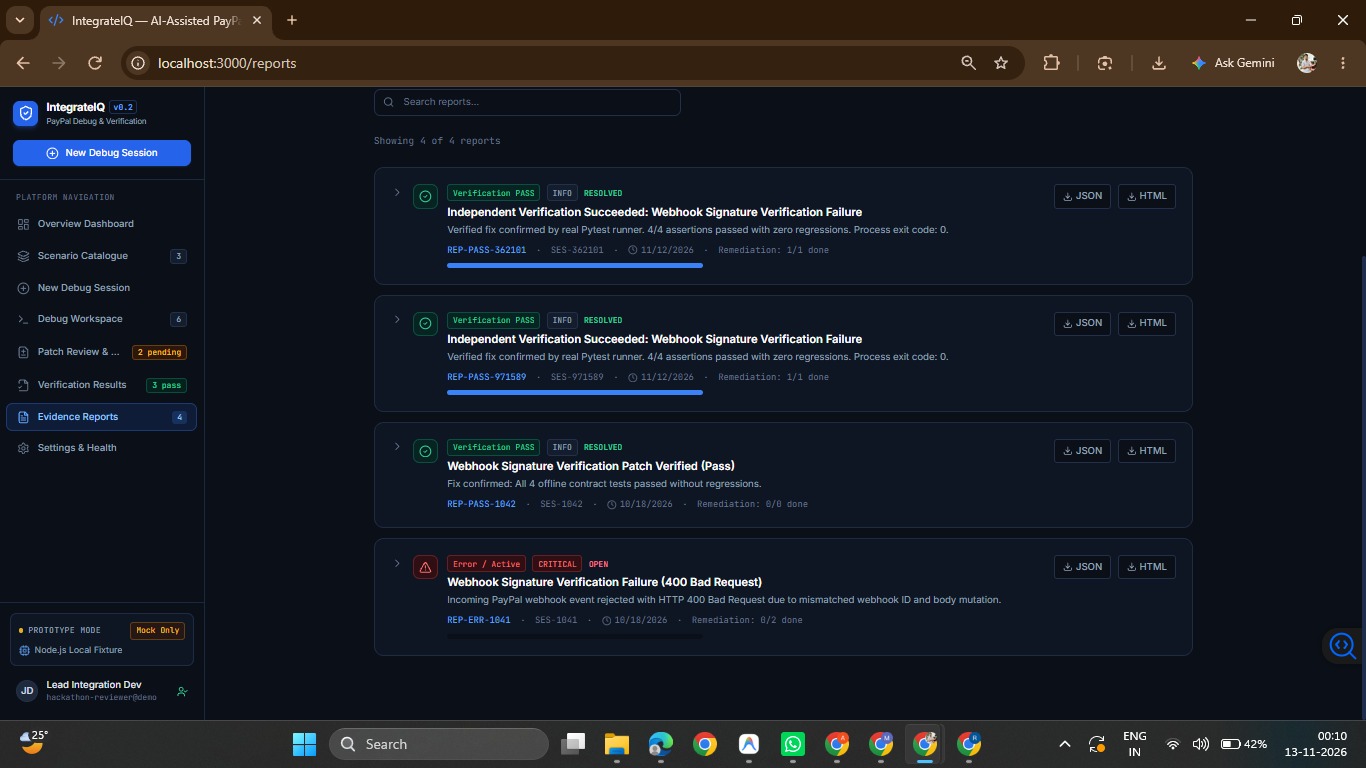
Report Details: View fixes, unresolved errors & remediation progress. Expand and export individual reports in JSON or HTML.
-
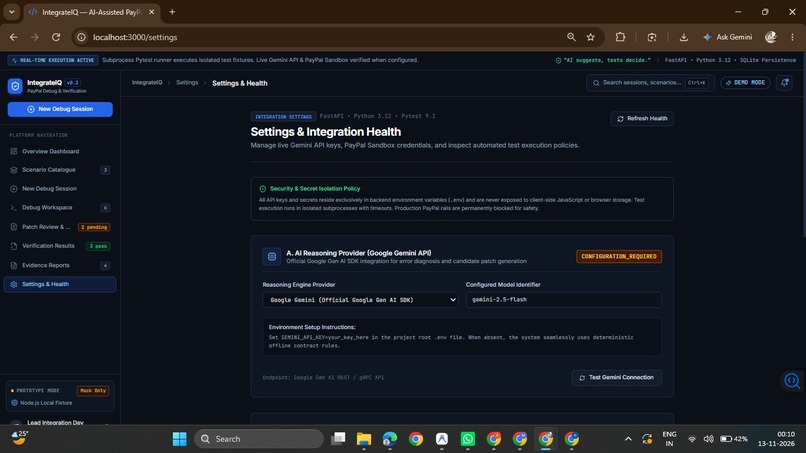
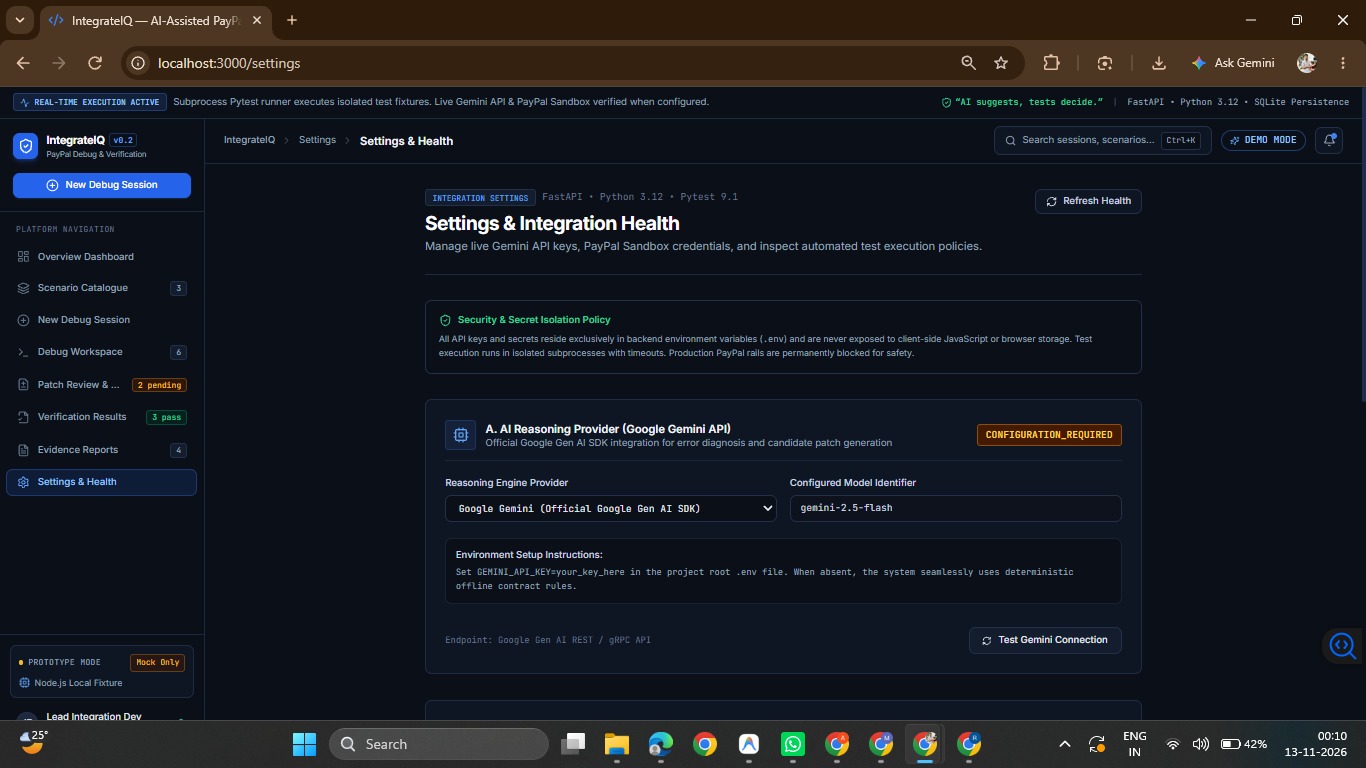
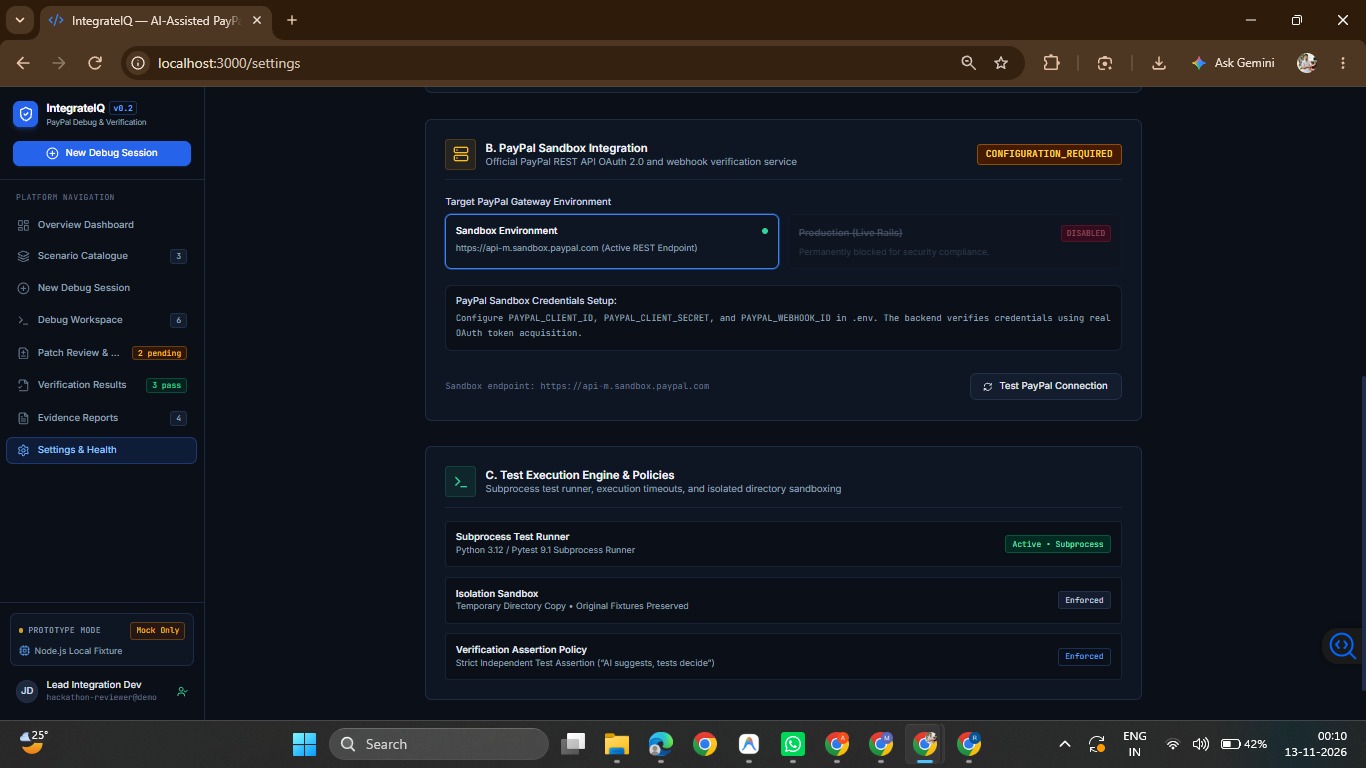
Settings & Integration Health: Manage Gemini API, PayPal Sandbox credentials & testing policies. Secure keys and monitor connection health.
-
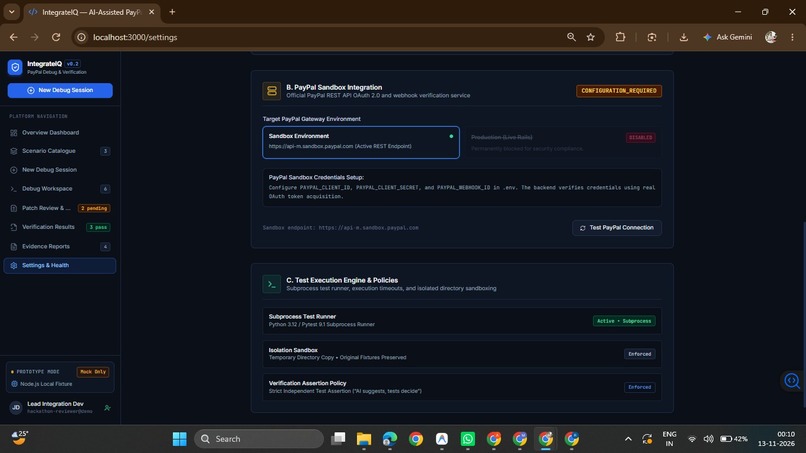
PayPal Sandbox & Test Execution: Configure credentials, monitor Pytest runs & ensure independent verification: “AI suggests, tests decide.”
IntegrateIQ – AI-Assisted PayPal Integration Debugging and Independent Verification
Inspiration
Payment integration is a critical part of modern applications, but debugging payment integration issues can be challenging and time-consuming for developers. Problems such as webhook failures, API errors, configuration issues, unexpected responses, and integration inconsistencies can make troubleshooting complicated.
We wanted to address this challenge by combining the PayPal Developer Platform with artificial intelligence to create a smarter and more reliable debugging experience.
This inspired us to build IntegrateIQ, an AI-powered PayPal integration debugging and verification platform that helps developers investigate integration failures, understand their root causes, review potential fixes, and independently verify solutions.
Our vision was to go beyond basic error reporting and build a structured, end-to-end debugging workflow that keeps developers in control.
What it does
IntegrateIQ is a full-stack developer platform designed to investigate PayPal integration failures and help developers move from identifying an issue to verifying a proposed solution.
Its key capabilities include:
- PayPal Developer Platform Integration
IntegrateIQ is designed to work with the free PayPal Developer Sandbox using PayPal REST API v1/v2 configuration. It focuses on PayPal-related integration diagnostics and webhook-related debugging scenarios.
- AI-Powered Debugging
Uses the Google Gemini API (Gemini 2.5 Flash) to analyze actual failure logs and source code, identify potential root causes, and produce structured diagnostic insights.
- Webhook Failure Analysis
Supports debugging scenarios involving webhook signature verification failures and other PayPal integration issues.
- AI-Generated Code-Fix Suggestions
Generates proposed code changes in unified diff patch format to help developers understand and address identified issues.
- Developer Approval
Provides a patch review and approval workflow, allowing developers to inspect, approve, or reject AI-generated changes before verification.
- Before-and-After Testing
Reproduces failures before a proposed fix and runs automated tests after an approved patch is applied.
- Regression Detection
Checks whether previously passing test cases are affected by proposed changes.
- Automated Verification and Evidence-Backed Reporting
Runs Pytest suites in isolated working environments, captures actual test results, and generates downloadable JSON and HTML verification reports.
Our core principle is:
AI suggests, tests decide.
How we built it
We developed IntegrateIQ by combining frontend development, backend processing, PayPal Developer Sandbox integration, AI-powered analysis, and automated software testing.
Technology Stack
- Frontend: React 18, TypeScript, Tailwind CSS
- Backend: Python 3.12, FastAPI
- Database: SQLite
- PayPal Integration: PayPal Developer Sandbox, REST API v1/v2
- AI Integration: Google Gemini API, Gemini 2.5 Flash, Official Google Gen AI Python SDK
- Testing: Pytest
- Communication: REST APIs, Server-Sent Events (SSE), WebSockets
Our End-to-End Workflow
- Issue Identification: Developers create a debugging session using available integration failure scenarios.
- Failure Reproduction: The backend runs Pytest against an unpatched test fixture in an isolated temporary environment and captures the failure output.
- AI-Powered Diagnosis: Gemini analyzes the failure logs and relevant source code to generate a structured root-cause diagnosis.
- Code-Fix Generation: The AI proposes a unified diff patch addressing the identified issue.
- Developer Review: Developers inspect the proposed changes and explicitly approve or reject the patch.
- Independent Verification: The backend applies an approved patch to an isolated working copy and executes the automated test suite again.
- Regression Detection: Test results are evaluated to identify failures or regressions introduced by the proposed changes.
- Evidence-Backed Reporting: Verification results are stored and made available through downloadable JSON and HTML reports.
The application also supports Offline Contract Testing Mode when external API credentials are unavailable. In this mode, deterministic rules and test fixtures are used instead of presenting simulated external API connections as successful.
Challenges we ran into
During development, we encountered several technical and design challenges:
- Root-Cause Identification: Distinguishing the underlying cause of integration failures from their visible error messages.
- AI Accuracy: Making AI-generated diagnoses and code suggestions relevant to the actual failure context.
- Safe Code Modification: Designing a workflow that preserves developer control over proposed changes.
- Testing Reliability: Establishing independent before-and-after validation instead of relying solely on AI-generated explanations.
- Regression Detection: Identifying unintended effects on previously working functionality.
- System Integration: Connecting frontend, backend, AI analysis, PayPal-related workflows, and automated testing into one coherent application.
Working through these challenges helped us prioritize reliability, transparency, and developer confidence.
Accomplishments that we're proud of
We are proud to have developed IntegrateIQ as an AI-assisted debugging and independent verification platform rather than simply another error-reporting tool.
Our key accomplishments include:
- Integrating the Google Gemini API for intelligent debugging and root-cause analysis.
- Building a PayPal-focused integration debugging workflow with Developer Sandbox configuration.
- Implementing webhook-related failure scenarios.
- Generating structured AI-assisted code-fix suggestions.
- Introducing developer approval before patch verification.
- Implementing isolated automated testing using Pytest.
- Incorporating regression checks into the verification workflow.
- Generating evidence-backed JSON and HTML reports.
- Bringing the frontend, backend, AI assistance, and testing components together in a full-stack application.
Most importantly, we transformed a common developer challenge into a structured workflow that combines AI assistance with independent testing and human decision-making.
What we learned
Building IntegrateIQ gave our five-member team valuable experience in full-stack development, PayPal API integration, AI engineering, software testing, debugging, and system integration.
We learned that integrating an AI model into a development workflow requires more than generating suggestions. Those suggestions must be reviewed, tested, and independently verified before developers can confidently rely on them.
We also strengthened our understanding of REST APIs, webhook-related troubleshooting, backend architecture, frontend-backend communication, automated testing, and collaborative product development.
Our biggest takeaway:
AI should not just suggest a solution; it should help developers understand, validate, and confidently implement that solution.
With IntegrateIQ, we aim to make PayPal integration debugging smarter, safer, and more reliable.
Built With
- ai-powered-debugging
- api
- artificial-intelligence
- automated-testing
- code-analysis
- developer-tools
- fastapi
- full-stack-development
- gemini-2.5-flash
- google-gemini
- paypal
- paypal-sandbox
- pytest
- python
- react
- regression-detection
- rest-api
- software-engineering
- sqlite
- tailwind-css
- typescript
- webhooks


