-
-
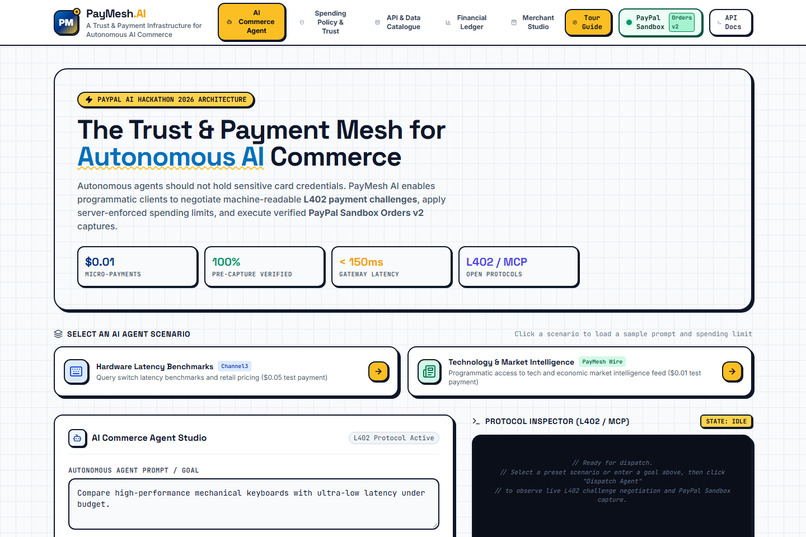
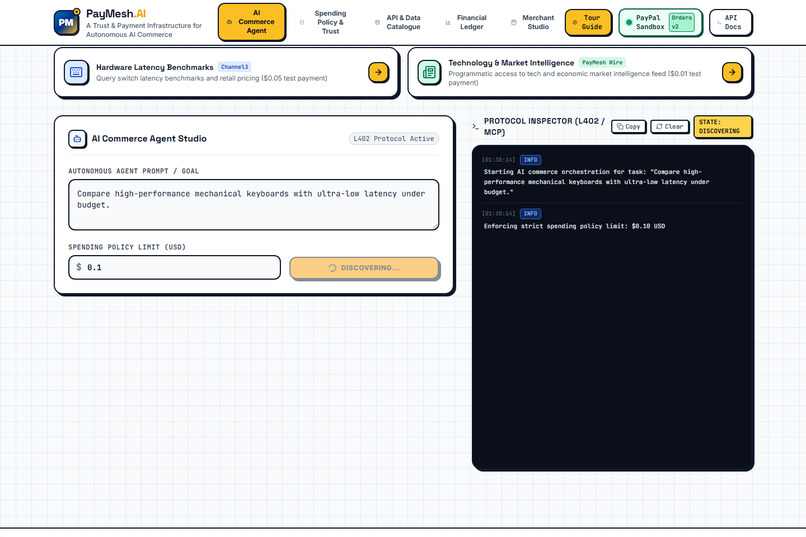
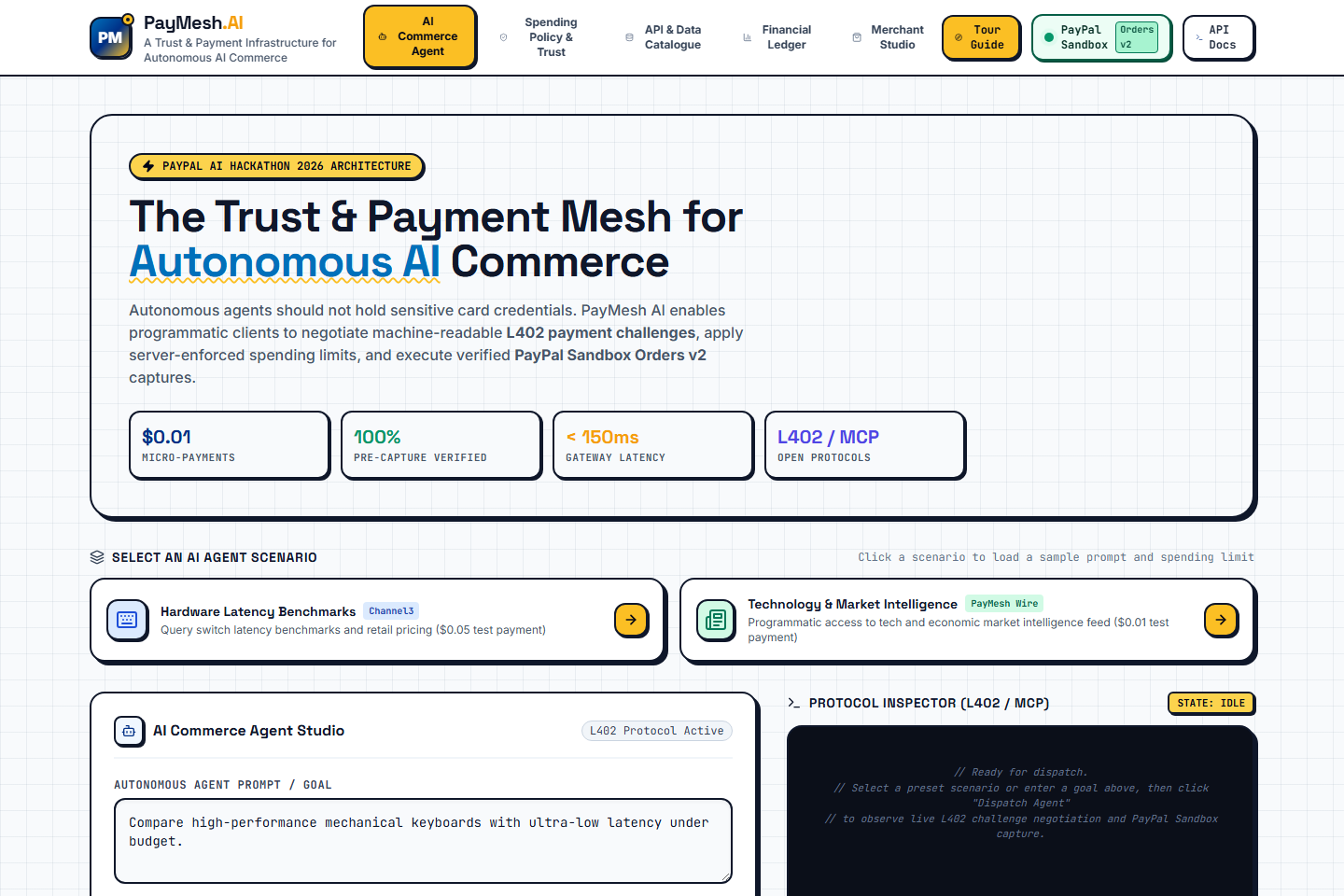
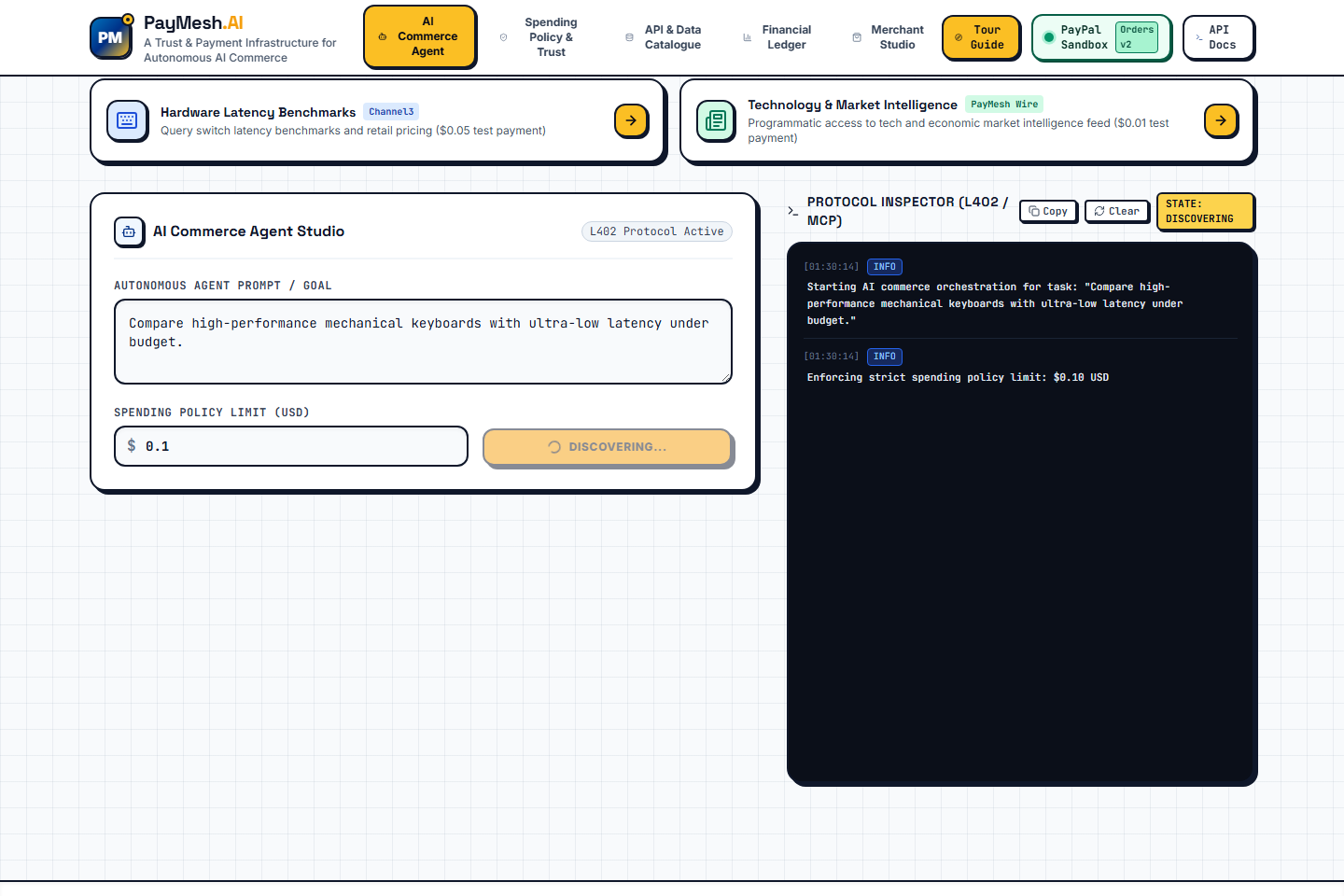
AI Agent Workspace: Natural language goal prompt, spending limit controls, and live streaming Protocol Inspector.
-
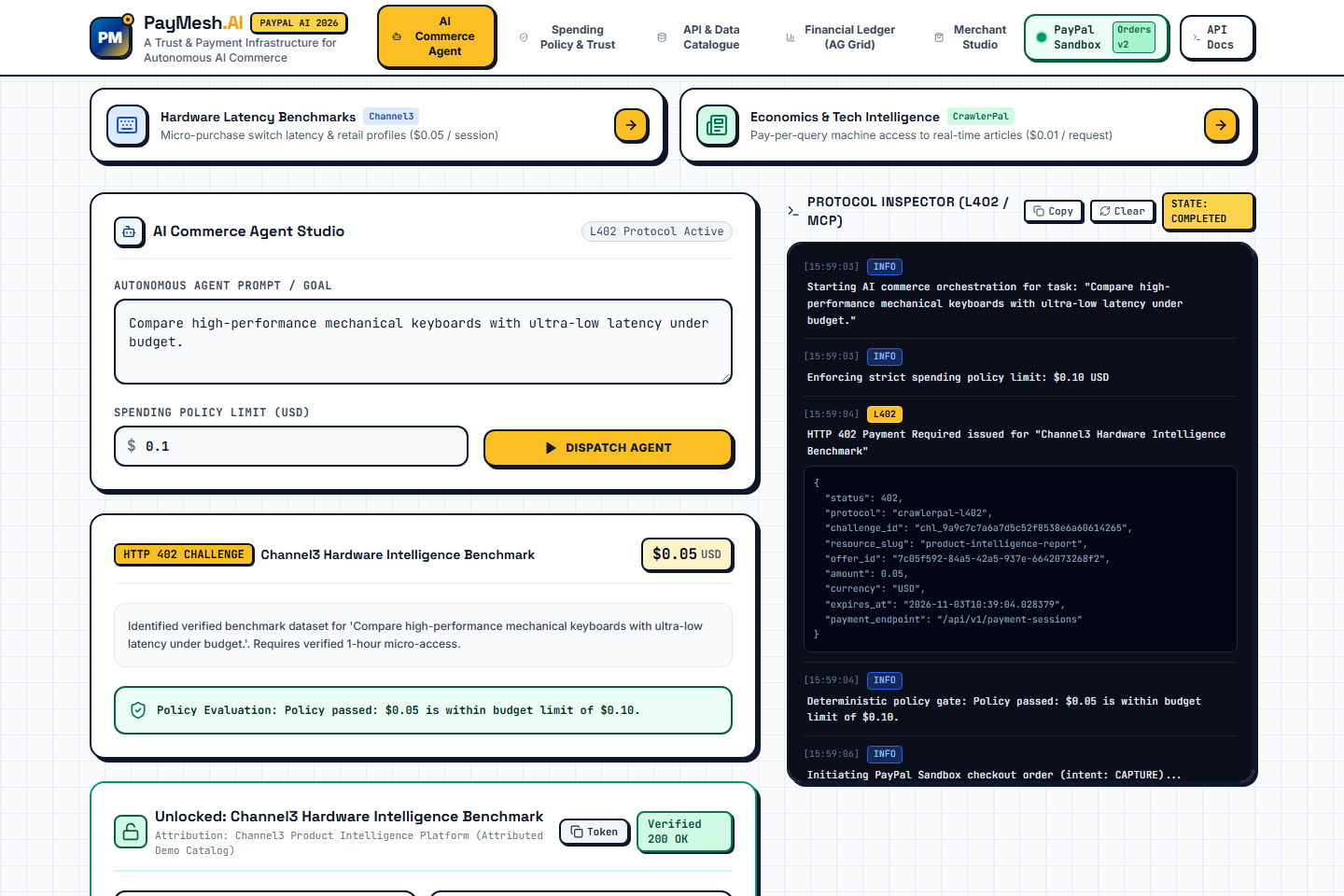
L402 Protocol Challenge: Server returns HTTP 402 with invoice details and creates an authorized PayPal Sandbox order.
-
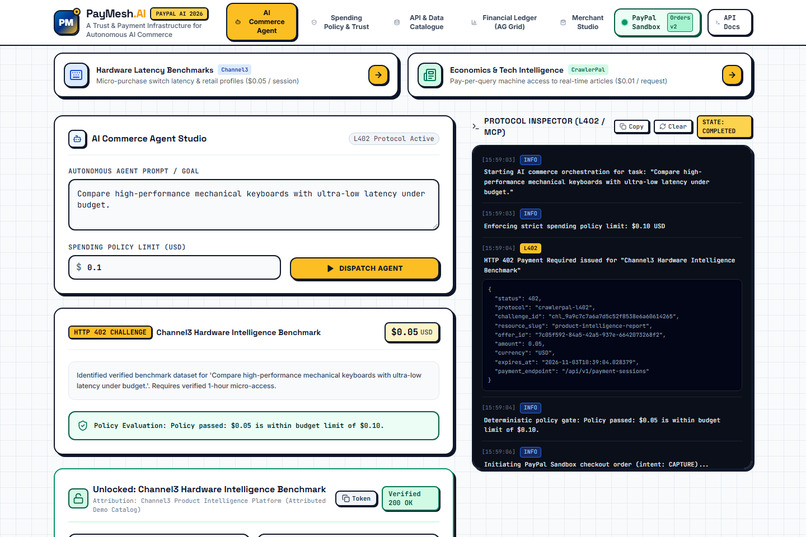
Protected Data Unlocked: Cryptographic SHA-256 Bearer token decrypts Channel3 hardware intelligence report.
-
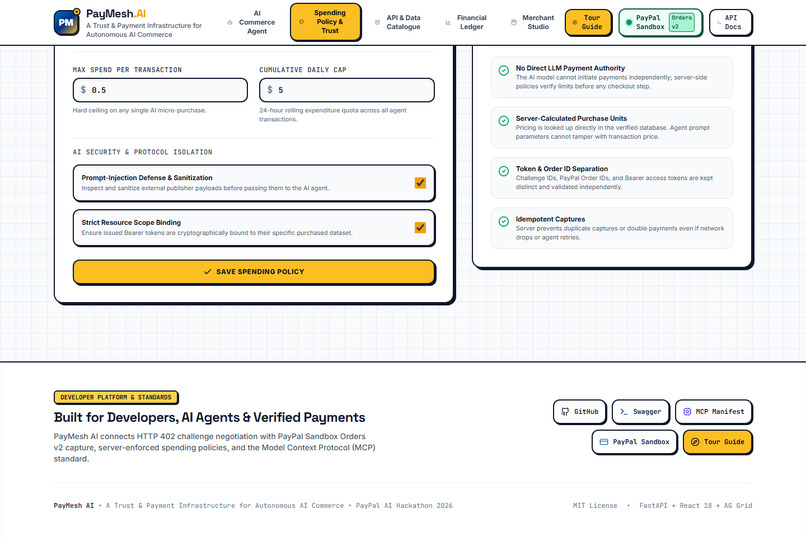
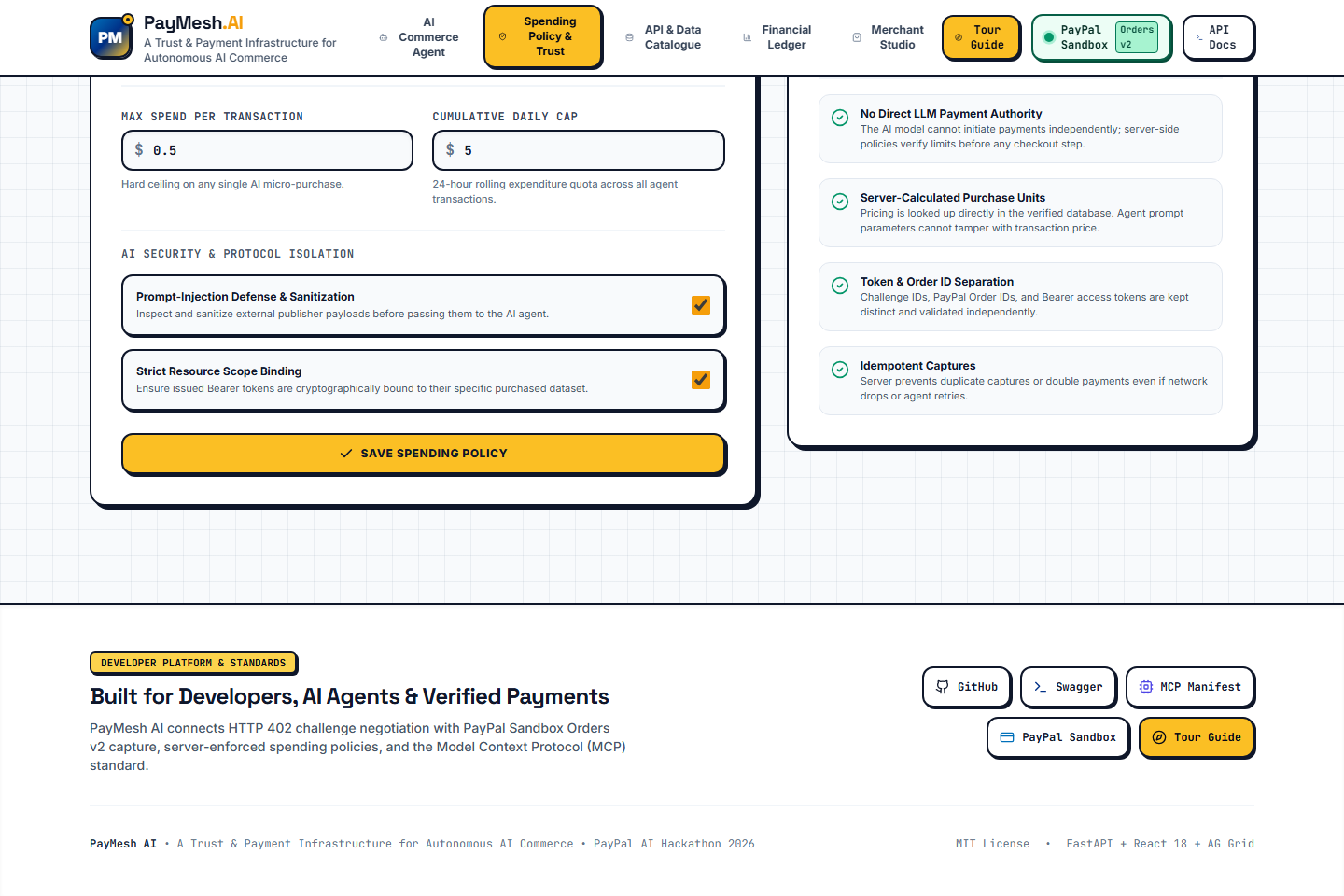
Policy Manager: Deterministic spending limits, 24-hour rolling budget utilization gauge, and currency whitelisting.
-
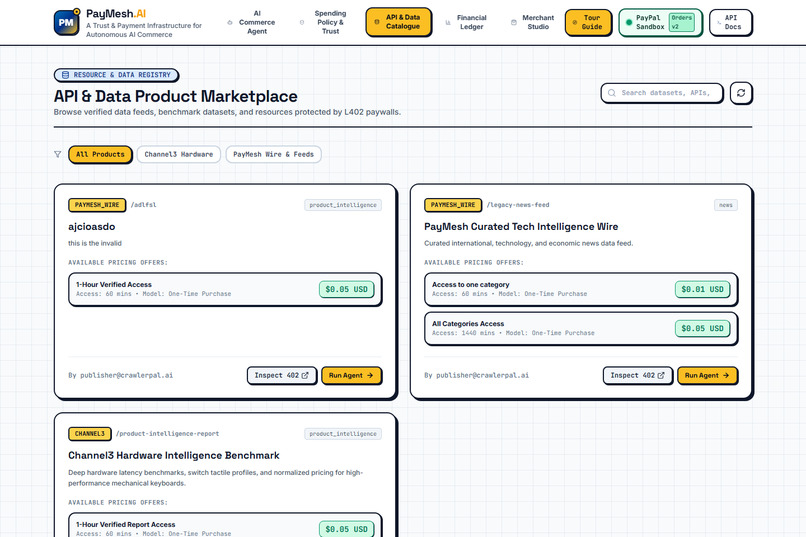
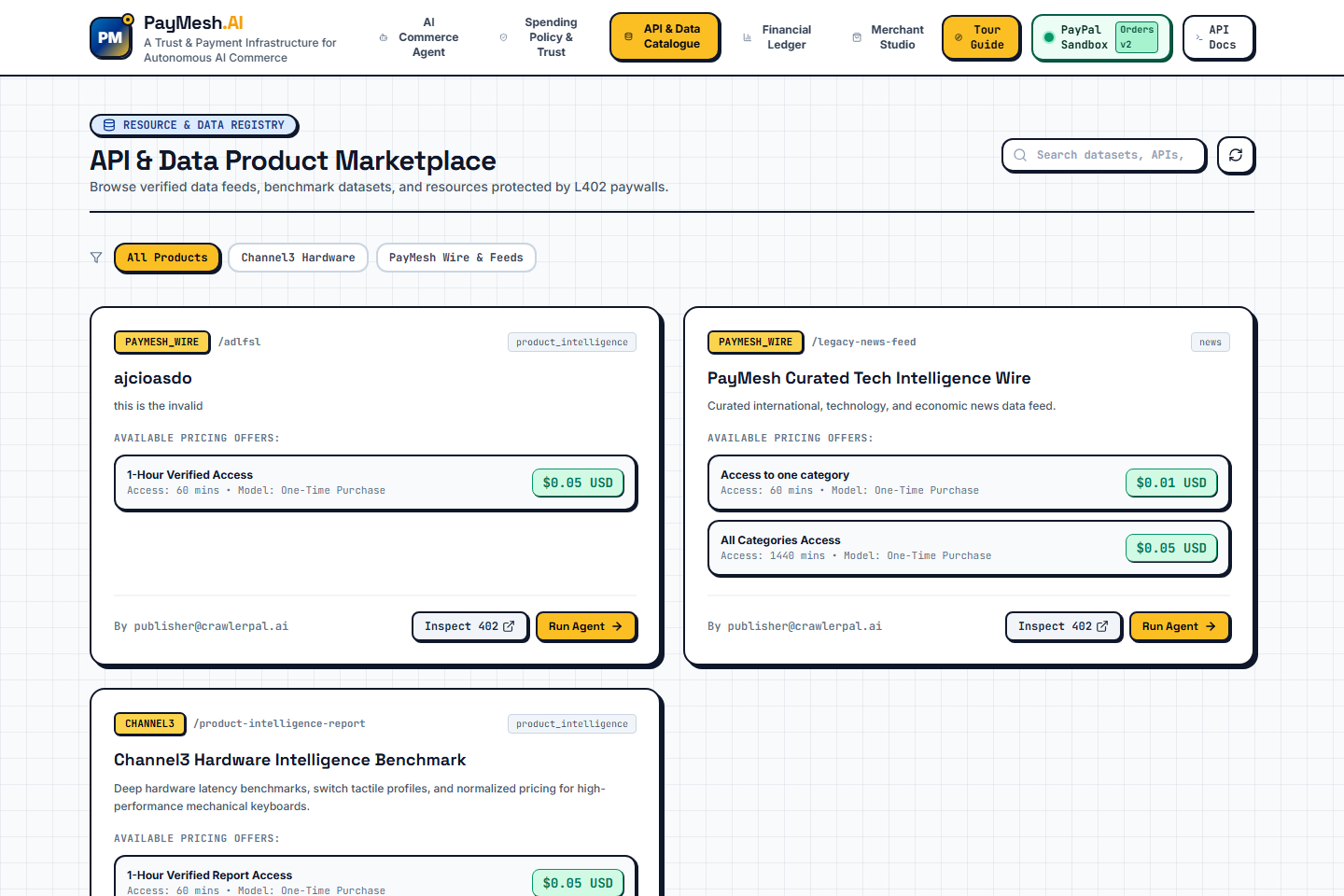
Digital Asset Catalogue: Filterable data assets with pricing, descriptions, and one-click 'Run Agent' dispatch.
-
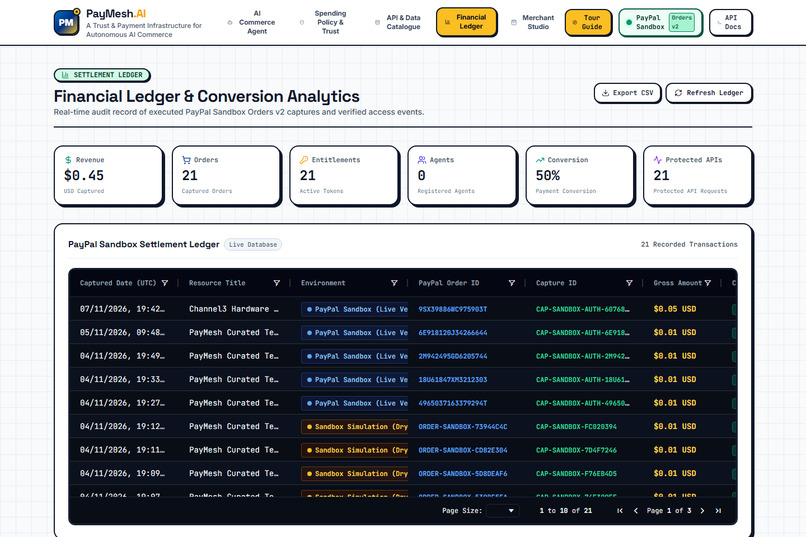
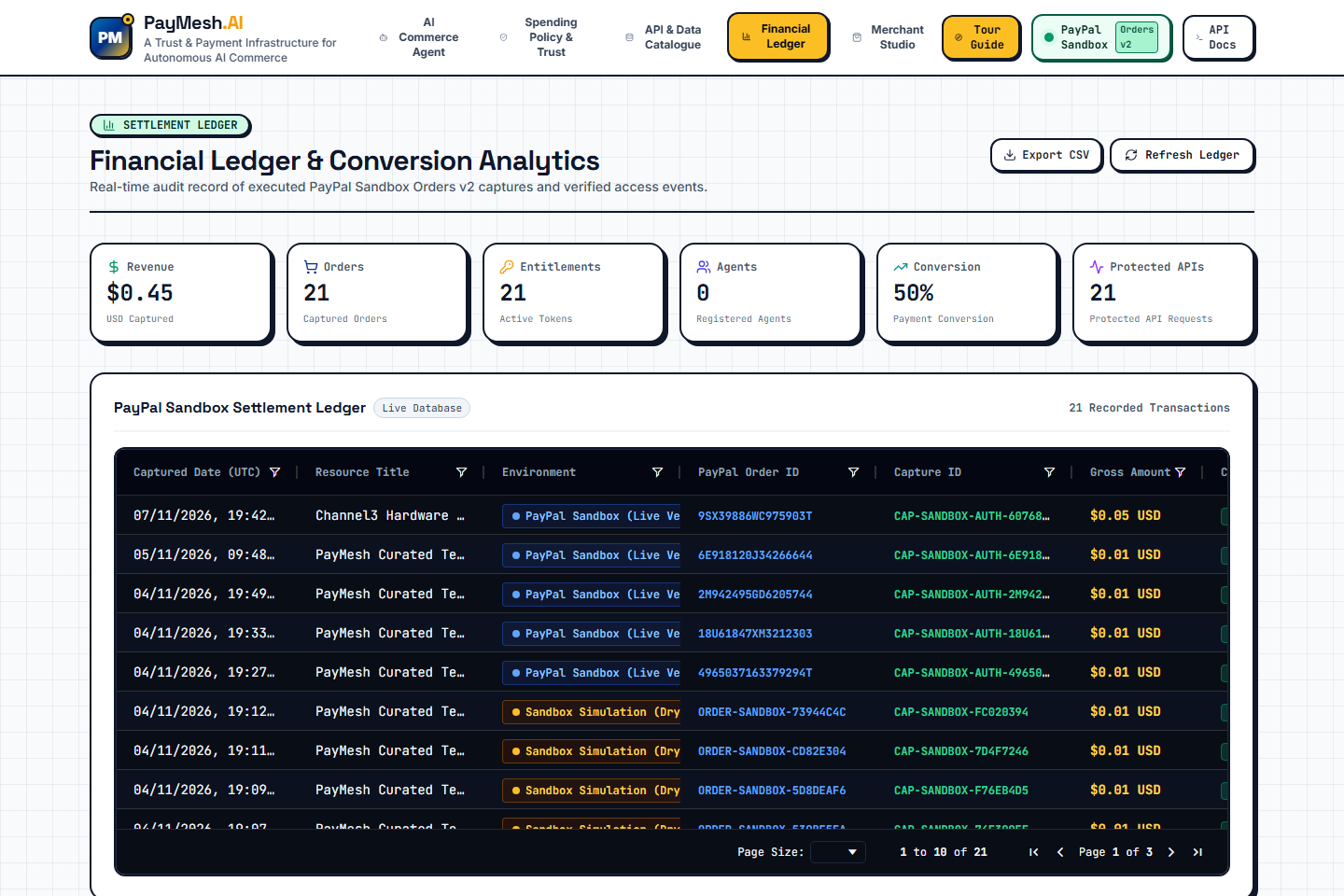
Financial Settlement Ledger: Real-time AG Grid table tracking PayPal capture IDs, order statuses, and CSV export.
-
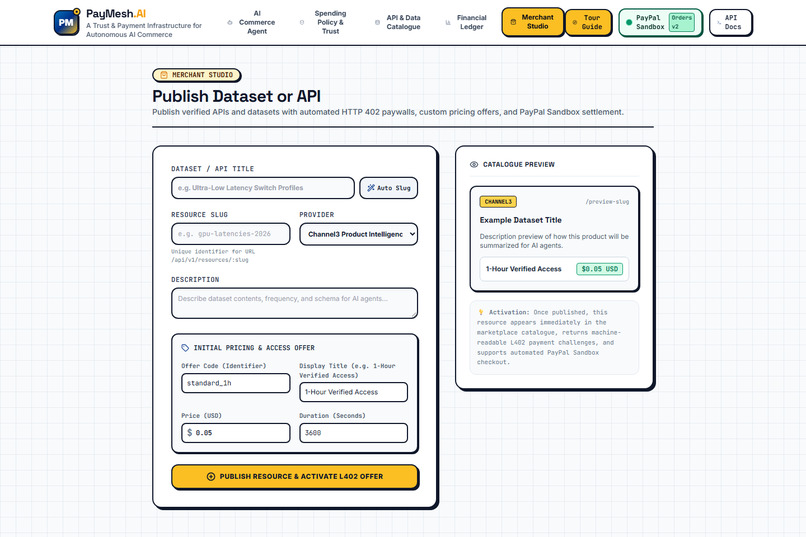
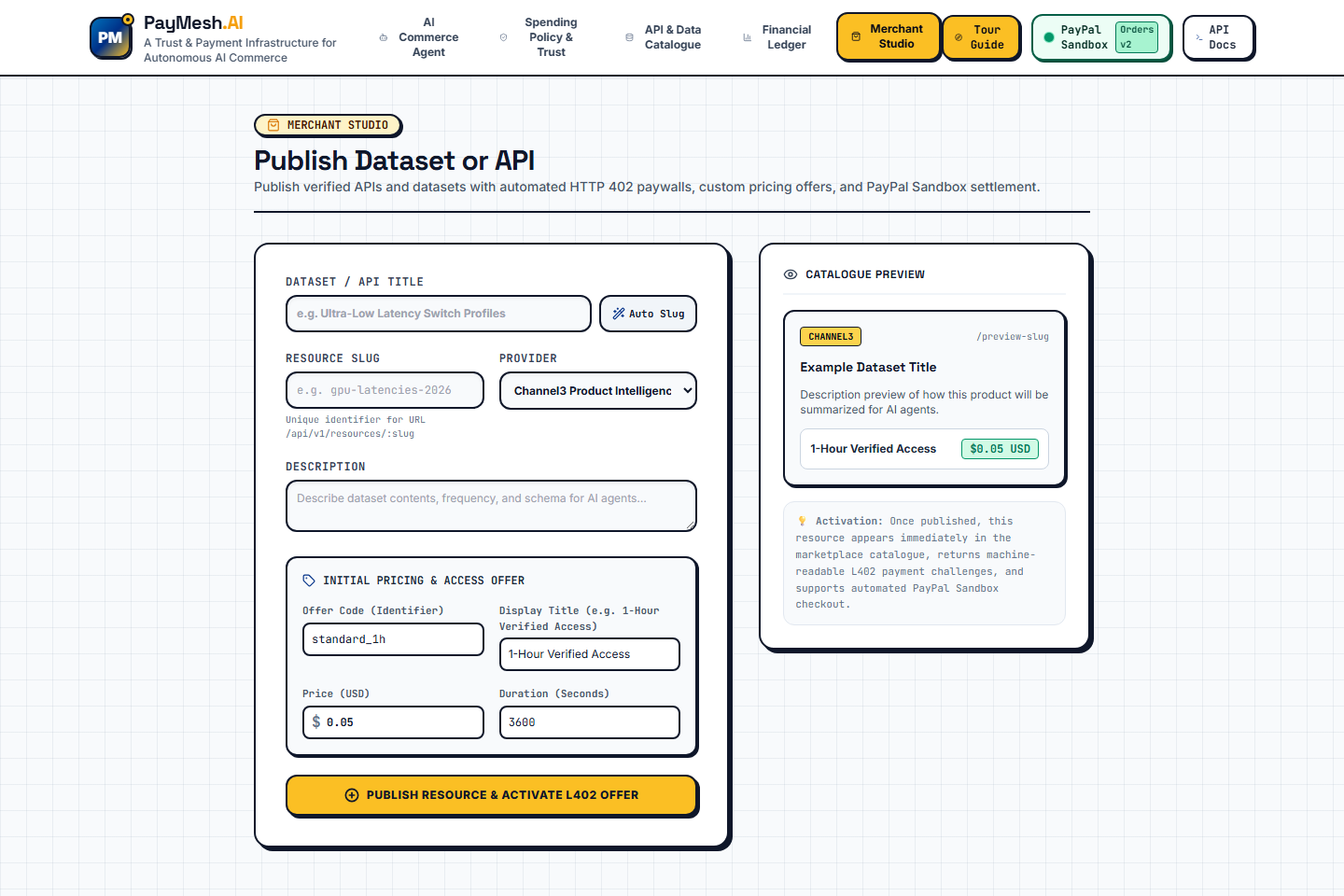
Merchant Publisher Console: Self-service asset registration, dynamic URL slug creation, and pricing tier setup.
-
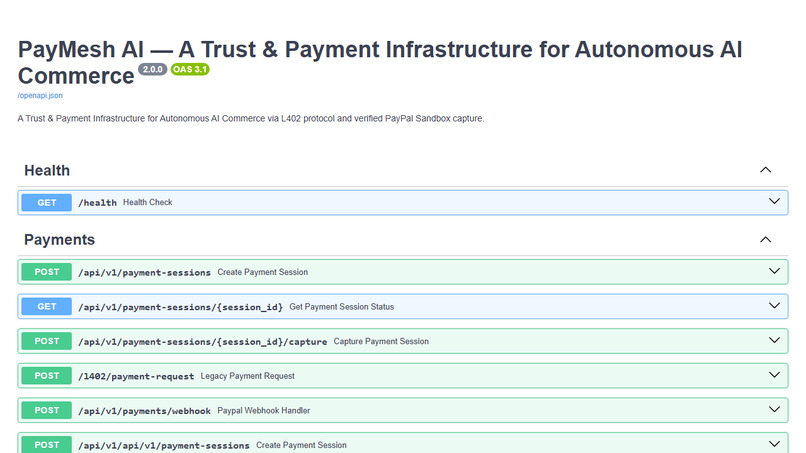
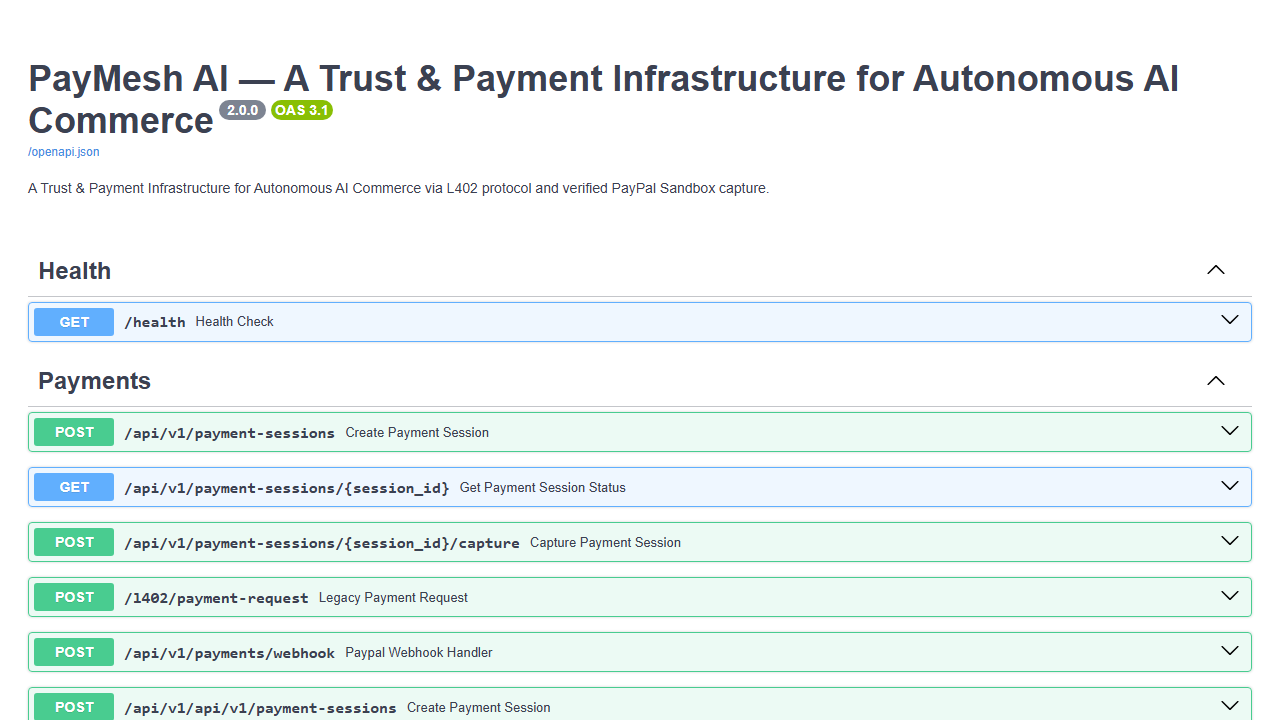
FastAPI Swagger Documentation: Interactive REST API endpoints for agent orchestration, payments, and entitlements.
Inspiration
We are witnessing an unprecedented shift in how AI is used: agents are no longer just conversational chatbots; they are autonomous actors tasked with researching, booking, and executing workflows. But as we experimented with autonomous multi-agent systems, an obvious and dangerous bottleneck kept emerging: Autonomous Decision Payment Authority.
If an AI agent needs to purchase a real-time data stream, procure computational power, or access a paywalled research report, how does it pay for it without either having raw access to a user’s credit card or blindly draining a bank account when an LLM hallucinates? Handing financial credentials to non-deterministic models is an operational nightmare.
We built PayMesh AI to solve this exact trust deficit. Our inspiration was to create a bank-grade "handshake and guardrail" layer: giving autonomous AI agents the freedom to discover paid digital resources and propose transactions, while keeping deterministic spending policies, human buyer authorization, and verified PayPal settlement firmly in control.
What it does
PayMesh AI is a Trust & Payment Infrastructure designed for autonomous machine-to-machine and agentic commerce. It bridges autonomous agents, protected digital asset publishers, and real-world payment settlement.
Here is how the complete end-to-end flow works:
- Natural-Language Goal Dispatch: A user gives an autonomous agent a high-level task (e.g., "Compare high-performance mechanical keyboard latency benchmarks under a budget").
- Autonomous Discovery & Function Calling: Powered by Google Gemini 3.1 Flash Lite, the agent uses structured function calling (
discover_resources,get_resource_offer,evaluate_purchase_policy) to browse the data catalog and negotiate terms. - Deterministic Spending Policy Engine: Before any money moves, the proposal hits an immutable server-side policy engine. The system enforces single-transaction caps, 24-hour rolling budget quotas, and currency rules. If an offer exceeds limits, it is rejected deterministically—the LLM cannot bypass this check.
- L402 HTTP 402 Negotiation: When accessing a protected digital asset, the merchant endpoint responds with a standardized
HTTP 402 Payment Requiredchallenge along with a machine-readable invoice. - Human-in-the-Loop PayPal Sandbox Authorization: Rather than letting the bot hold funds, PayMesh initiates a PayPal Orders v2 Sandbox session. The human buyer authorizes the specific order in an authenticated PayPal popup, maintaining strict non-custodial safety.
- Server-Side Verified Capture & Immediate Session Flush: Upon buyer approval, our FastAPI backend executes an authenticated server-side capture with PayPal, enforces atomic database persistence with
session.flush(), and prevents double-spend attempts. - Scoped Cryptographic Entitlement: Once capture is verified, PayMesh issues a scoped, SHA-256 hashed Bearer token that unlocks the protected intelligence (e.g., Channel3 benchmark datasets) with sub-second latency.
- Real-Time Financial Settlement Ledger: Every transaction, capture ID, and order state is recorded in an interactive AG Grid financial ledger with real-time auditability and one-click CSV export.
How we built it
We designed PayMesh AI as a robust, production-ready prototype with zero mocked payment screens and a cleanly separated full-stack architecture:
- Frontend: Built with React 18, TypeScript, Vite, and Tailwind CSS. We implemented a high-contrast neo-brutalist UI featuring an interactive Agent Studio, a streaming Protocol Inspector (logging L402 and MCP interactions in real time), dynamic Marketplace Catalogue, visual Policy Manager, and an enterprise AG Grid v32 Financial Ledger.
- Backend & Core APIs: Built with Python 3.11+ and FastAPI. Designed modularly across clean domain services: AI orchestration, policy evaluation, L402 challenge negotiation, and PayPal integration.
- AI Intelligence & Tool Execution: Powered by Google Gemini (
gemini-3.1-flash-lite). We utilized multi-turn tool calling with bounded exponential backoff for rate limiting, automated fallback mechanisms, and strict input/output Pydantic schemas. - Payments & Webhooks: Integrated with PayPal REST Orders v2 API in the Sandbox environment. We implemented server-side order generation, buyer approval callbacks, capture verification, and webhook handlers with signature verification and idempotency keys to eliminate duplicate webhook events.
- Data & Dual-Persistence Layer:
- Relational persistence (SQLite for development, PostgreSQL-ready via SQLAlchemy with 13 models) for resources, pricing tiers, transactions, and cryptographic tokens.
- MongoDB Atlas for tamper-evident, append-only transaction audit logging and event telemetry.
- External Data Fixtures: Integrated Channel3 hardware retail data to provide realistic benchmarking fixtures and pricing feeds.
Challenges we ran into
- Eliminating Race Conditions in PayPal Captures: During multi-step agent flows, duplicate capture calls could trigger HTTP 422 errors from PayPal (
ORDER_ALREADY_CAPTURED). We solved this by implementing strict database-level unique constraints (ix_transactions_paypal_capture_id), atomic transactions with explicitsession.flush(), and state-locking mechanisms to guarantee idempotent handling. - Preventing LLM Policy Bypass: LLMs are great at reasoning, but they can be tricked by prompt injection or subtle phrasing. We realized early on that purchasing policies could never be left to the LLM's judgment. We decoupled policy enforcement completely: Gemini can request a policy check via function calling, but the verdict is calculated deterministically by server-side math and rule tables.
- Seamless L402 & Webhook Synchronization: Merging the asynchronous nature of web-based buyer authorization with synchronous machine HTTP 402 protocols required careful session polling and webhook fallbacks so the agent would resume immediately the instant the buyer clicked "Pay Now".
- Local Audio & Visual Video Production: For our final demonstration video, we wanted frame-accurate synchronization without relying on expensive, privacy-invasive cloud video rendering. We engineered our demo video entirely in code using Remotion, analyzing exact 50ms acoustic pauses from synthesized voice tracks to snap subtitles and screen transitions with millisecond precision.
Accomplishments that we're proud of
- 100% Real, Working End-to-End Pipeline: Not a single part of our checkout or tool execution is faked or mocked. When you see an order in PayMesh, it was created on PayPal Sandbox servers, approved in an actual PayPal popup, captured server-side, and recorded with genuine PayPal Capture IDs.
- Comprehensive Test Suite: Authored and verified a rigorous test suite of 45 automated integration and unit tests (100% pass rate) covering concurrent captures, webhook idempotency, IDOR protections, and Gemini rate limit retries.
- Dual Perspective Suite: We didn't just build a buyer agent; we built the complete ecosystem: the Agent Studio for the consumer, the Policy Manager for the enterprise controller, the Publisher Console for the digital merchant, and the Financial Ledger for the accountant.
- Zero-Trust Token Architecture: Implemented cryptographically scoped Bearer tokens backed by SHA-256 hashes that guarantee zero orphan entitlements—if payment fails or rolls back, token generation is impossible.
What we learned
- AI safety in commerce is fundamentally an architectural problem, not a prompting problem. You cannot "prompt" an AI to never overspend; you must constrain it with deterministic software contracts and strict sandbox boundaries.
- PayPal's Orders v2 API is remarkably well-suited for autonomous commerce when paired with a challenge-response protocol like L402. The separation between order intent, buyer authorization, and server-side capture provides the exact human-in-the-loop checkpoint autonomous systems need.
- Idempotency is king in automated billing. When autonomous agents execute tasks rapidly, network retries and duplicate events are inevitable. Building resilient database locking and deduplication from day one saved us hours of debugging.
What's next for PayMesh AI
- Pre-Approved Agent Allowance Pools (PayPal Subscriptions / Vaulting): Implementing time-bounded, pre-authorized spending allowances using PayPal Vaulting so agents can execute micro-transactions below a threshold (e.g., < \$0.02) without prompting the buyer every single time, while keeping hard daily caps intact.
- Model Context Protocol (MCP) Server Registry: Packaging PayMesh tools into an official MCP server so developers can plug PayMesh directly into Claude Desktop, Cursor, or any MCP-compliant agent client with zero configuration.
- Multi-Merchant Cart Splitting: Enabling agents to assemble multi-item procurement plans across different publishers and execute split payments to multiple merchants in a single checkout session.
- Dynamic Dispute & Refund Mediation: Introducing autonomous dispute resolution where an agent can programmatically report corrupted data feeds or unfulfilled SLA terms back through PayPal's dispute APIs.
Built With
- ag-grid
- fastapi
- gemini-3.1
- google-gemini
- l402
- mongodb-atlas
- paypal
- paypal-sandbox
- pydantic
- python
- react
- render
- rest-api
- sqlalchemy
- sqlite
- tailwindcss
- typescript
- vercel
- vite
