-
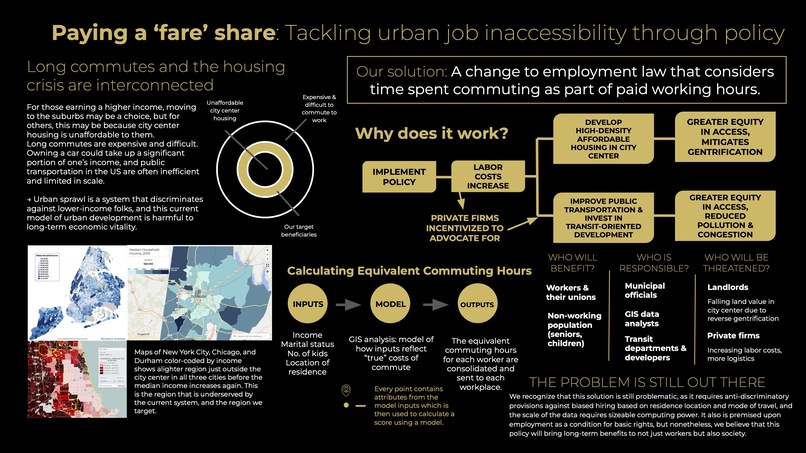
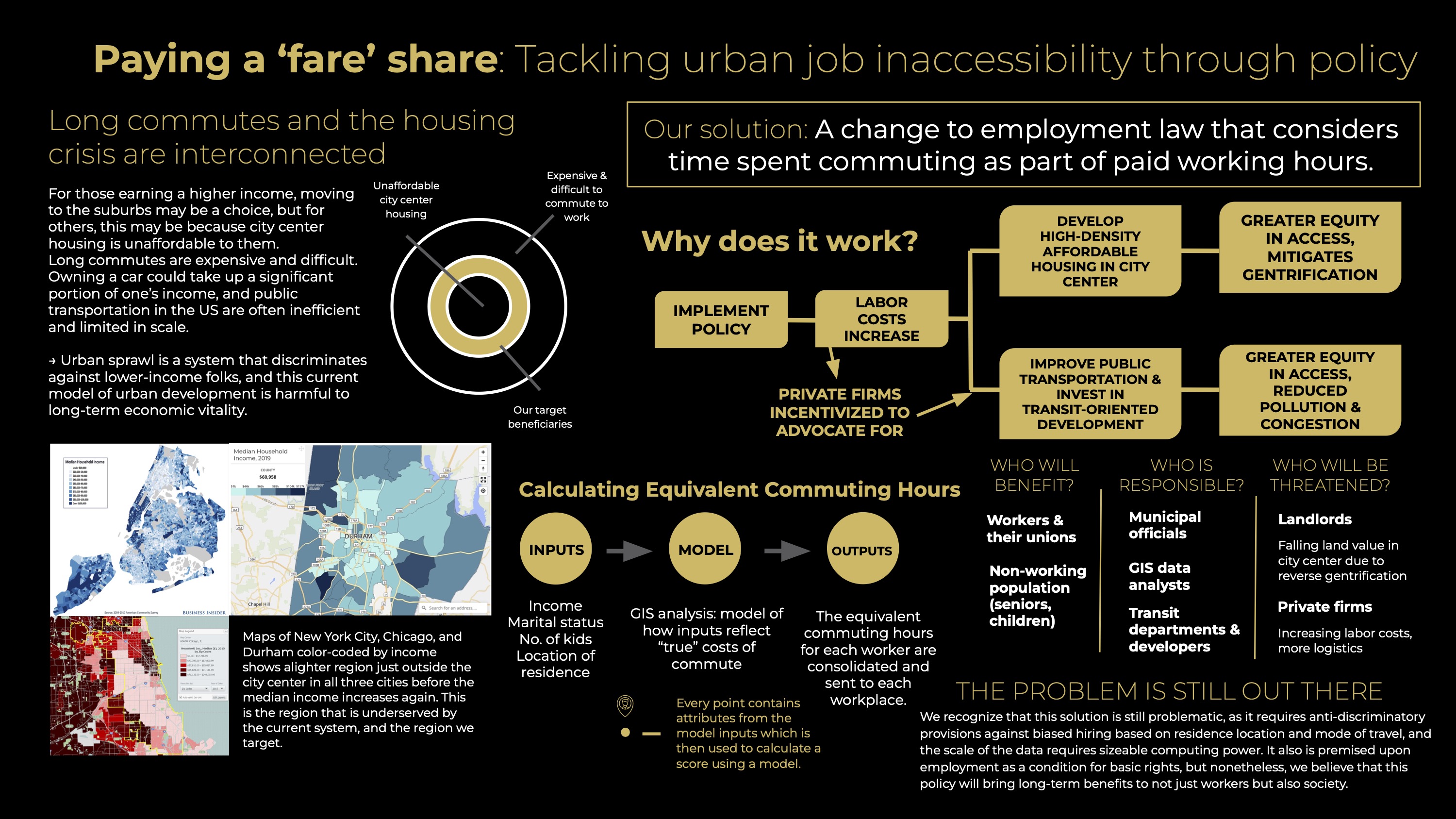
Policy infographic
Inspiration
Both of us are from Hong Kong, a city renowned for its public transit system. So we were shocked by the American sprawling city and the injustice that came with unequal access to inefficient transportation.
The Problem
We decided to tackle the problem of long commuting into urban areas, a result of urban sprawl. For those earning a higher income, moving to the suburbs may be a choice, but for others, this may be because city center housing is unaffordable to them. As one can imagine, long commutes are expensive and difficult. Owning a car could take up a significant portion of one’s income, especially for middle and lower-income workers, and public transportation in the US are often inefficient and limited in scale. So, it is clear urban sprawl is a system that discriminates against lower-income people, and this current model of urban development is harmful to the long-term economic vitality of any city.
Our solution
We propose a change to employment policy that considers time spent commuting as part of paid working hours.
What it does
When commuting hours become part of the paid workday, labor costs of firms will increase, now that they have to pay workers extra for the amount of time it takes for them to get to and from work. But now, companies have an incentive to advocate for the development of high-density affordable housing in the city center, and also the investment in public transportation and transit-orientated development, along with the extension of utilities to people’s homes. As a result, there is greater equity in access throughout the city, gentrification in the city center is mitigated, and there is reduced congestion and pollution from cars.
How to implement it
But just how does one measure commuting hours? What if the worker needs to pick up groceries, or drop off their kids? What if they just missed the bus? Our solution involves a metric called “equivalent commuting hours” that accounts for invisible labor.
A city-run algorithm takes inputs such as a workers’ income, marital status, number of kids they have, and their residence, and runs it through a model to calculate how inputs reflect the “true” costs of commute on the worker. This can be done via geospatial analysis, where each worker is a point on a map with attributes attached to that point. Those attributes are the inputs fed into the model to calculate the equivalent commuting hours for each worker. The model outputs are then sent to each firm from the city government and used to pay workers more.
Challenges we ran into
We were struck with the logistical difficulties of implementing the policy, and other situations where firms could skirt the policy or workers trying to take advantage of the system. We also had to check our heuristics and unconscious biases, for instance perceptions of abuses from poor or marginalized people run rampant, but are often untrue and feeds into the harmful notion of poverty as lack of virtue. Additionally, during office hours we were told that employers might just encourage working from home to save commuting pay - however, that does not really apply to our target population as >60% of workers have to attend their jobs in-person. We also had to consider every scenario that the policy would be placed under and every consequence of the policy while making sure that it is technologically possible and politically feasible to run analyses. We will need to continuously update the algorithm every so often to ensure that the algorithm captures the natural changes in layout, amenities, and transportation of the city.
What we learned
We learned that it is difficult if not impossible for a technology/app to solve a structural crisis. Additionally, the rationale that it should be ‘feasible’, that is, require minimal investment and human intervention runs counter to the logic of any equitable practice to work on a challenge of such scale and depth. Ultimately, this policy solution, as well as any genuine attempts to remedy the housing/transit/basic services crisis necessitates massive social investments as well as community and stakeholder engagement in order to ensure they are done right. We also foresee this being potentially extremely difficult to implement given pressure from the business community on City Council. But we believe that it is much more effective to articulate a vision and work to achieve it rather than always basing our strategic thinking and solutions around notions of ‘realism’ and trying to piecemeal or patchwork our way into solving a social crisis.
What's next
We will consult with data analysts and social scientists to learn how a model can be designed to account for the socioeconomic factors that contribute to how long a worker’s commute really is. How does one additional child affect how long and stressful commuting is for a parent? What if they’re a single parent? How will the distance to a workplace be calculated in GIS? How will we protect the privacy of workers?
In the future, we believe that a prototype of this policy could be implemented in a city rife with urban sprawl and gentrification, and the effects tracked over the next 5-10 years.
Link to presentation: https://docs.google.com/presentation/d/18OUCg35nu4dMN8AbnNDY6mjXvwyh8aGiNkUH5PAgMqU/edit#slide=id.g6cd5d46934_0_22

Log in or sign up for Devpost to join the conversation.