-
Guide
-
Submit contract
Inspiration
Most young tech workers in Nigeria sign job offers without understanding what they're agreeing to. Contract terms are written in dense legal language, and few graduates know their statutory rights under the Labour Act: notice periods, wage deductions, maternity leave, pension contributions, let alone which clauses are actually enforceable. This leaves workers, especially women entering the industry, vulnerable to unfair terms they don't have the confidence or knowledge to challenge.
PayHer Contracts grew out of PayHer, an existing project focused on closing the pay and negotiation gap for women in Nigerian tech. We extended that work into contract literacy: helping people understand what they're signing before they sign it.
What it does
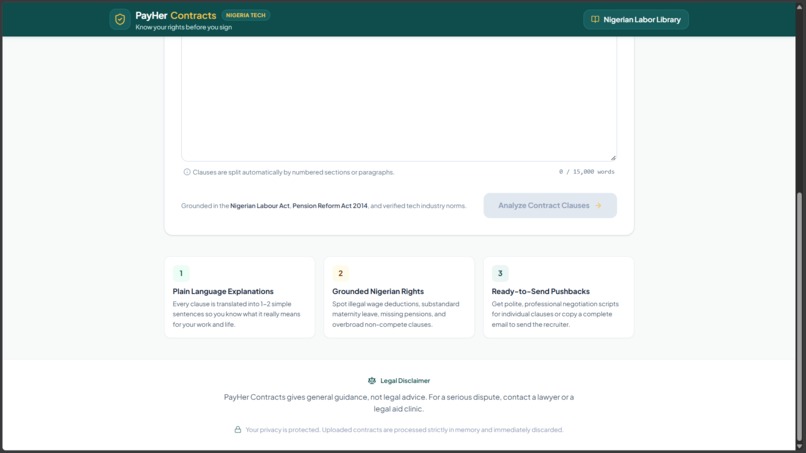
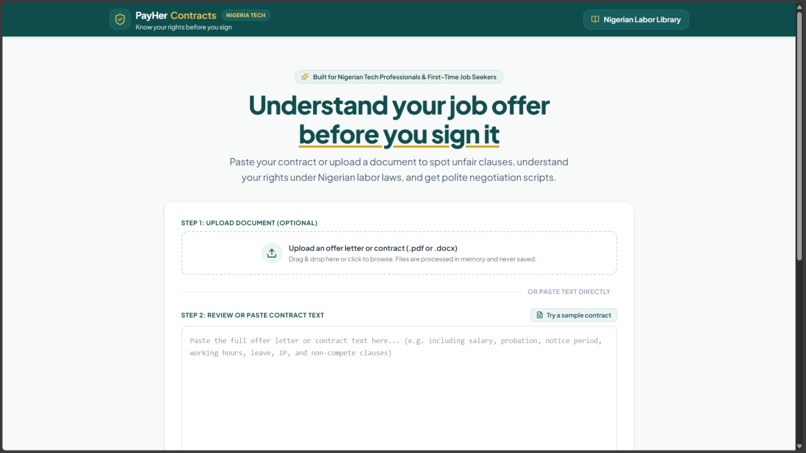
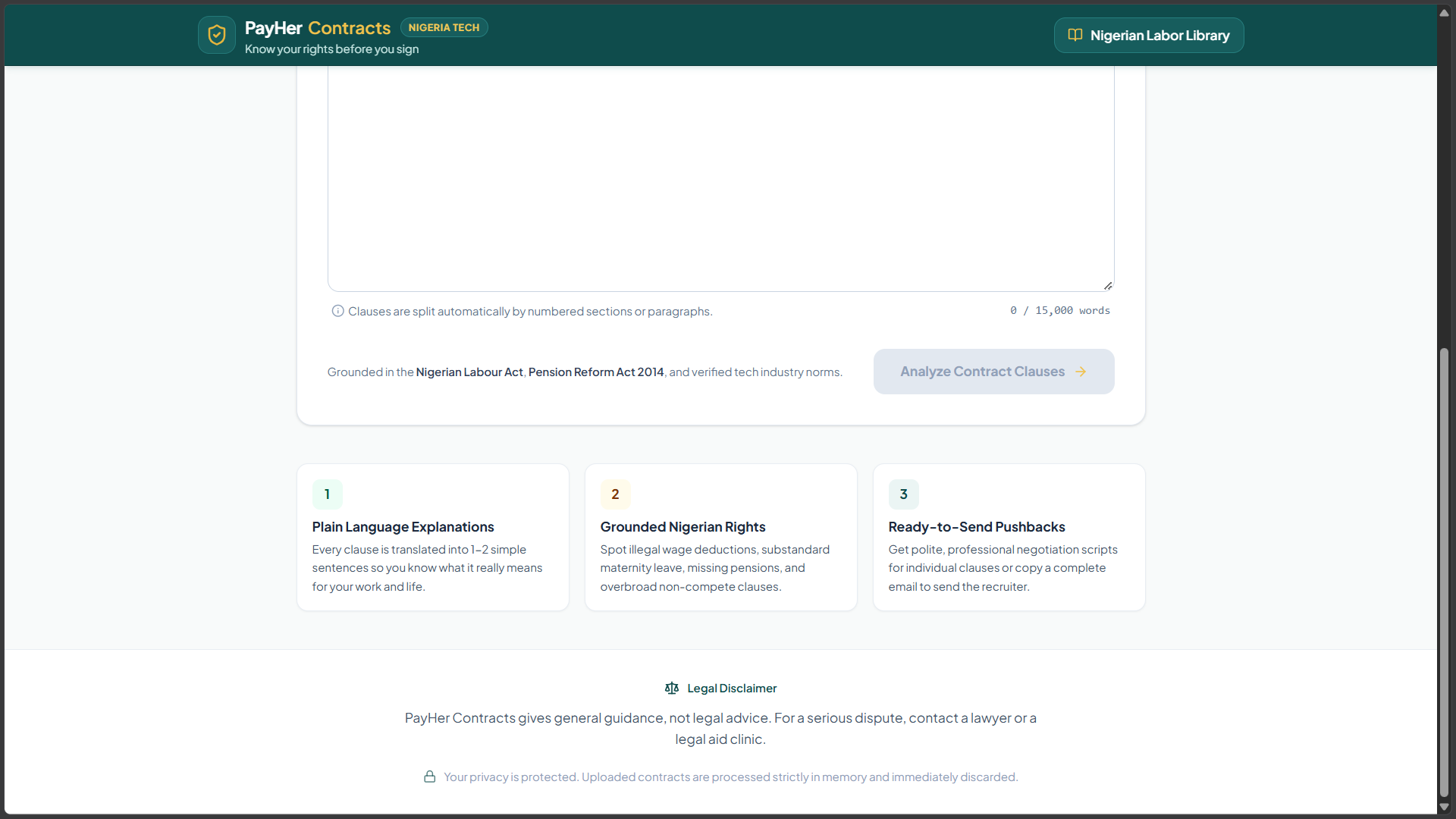
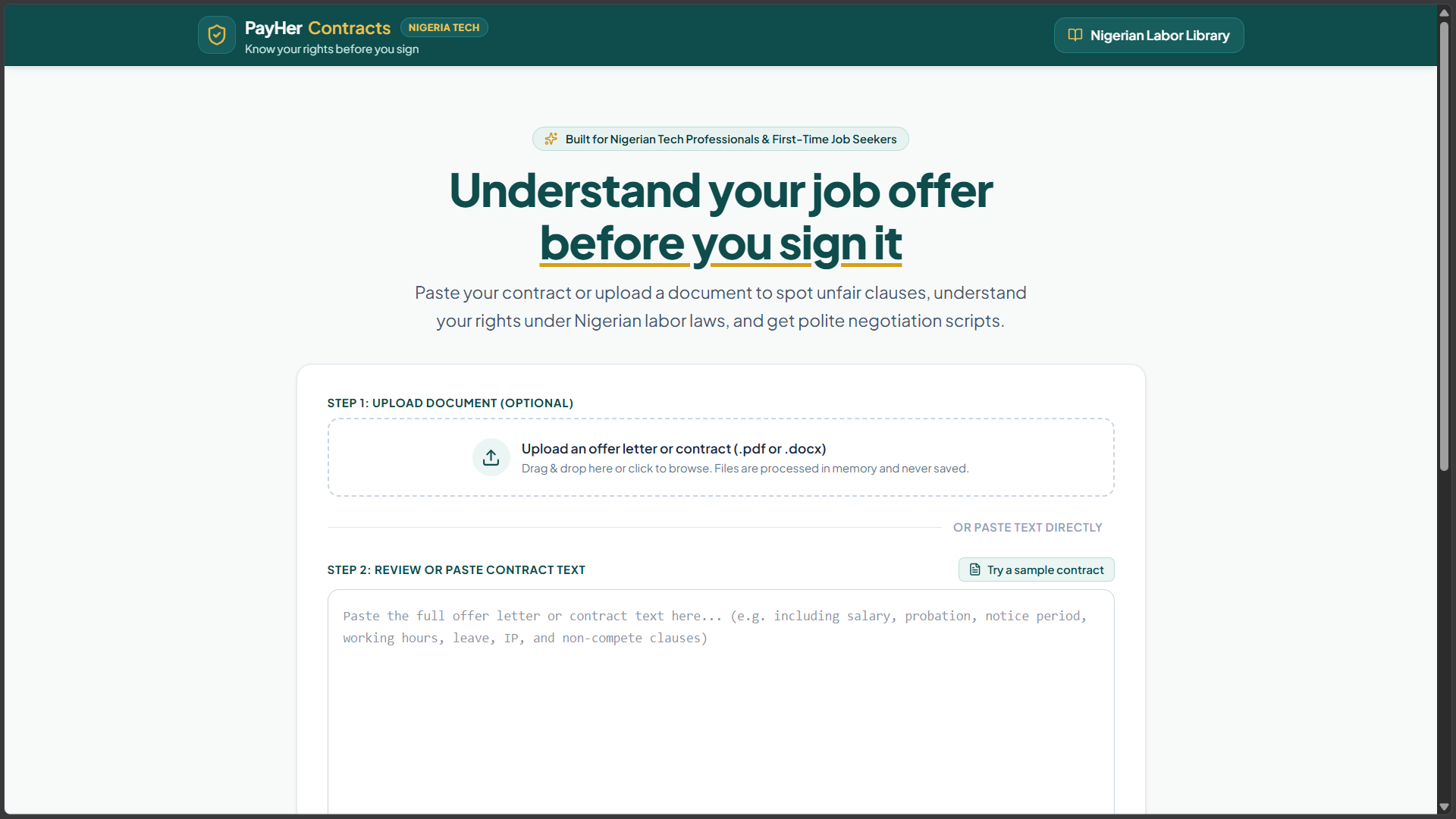
PayHer Contracts lets you paste or upload a job offer or employment contract. It splits the document into clauses and analyzes each one against a curated library of Nigerian labour law and tech-industry norms. Every clause is scored Fine, Worth Questioning, or Red Flag, explained in plain language, paired with a ready-to-send negotiation script. Nothing is left to the AI's imagination: every flag cites a real source (a specific Labour Act section, the Pension Reform Act, the National Minimum Wage Act, or a documented market norm). If no source matches, the app says so honestly instead of inventing one.
How we built it
We built PayHer Contracts using Google AI Studio's Build mode, with the Gemini API handling clause classification, plain-language explanation, and negotiation script generation via structured JSON output. The core of the project is a hand-curated legal reference library covering Nigerian labour law (notice periods, wage deductions, annual and maternity leave, pension contributions, minimum wage) and common tech-industry contract norms (probation length, non-compete enforceability, IP ownership, training bonds). Every AI-generated flag is required to cite an entry from this library rather than generate legal claims freely, which keeps the tool grounded and honest about what it doesn't know.
Challenges we ran into
Grounding an LLM in real law without letting it hallucinate citations was the central challenge. We iterated through several rounds of testing against sample contracts, catching and fixing issues like:
- A clause-splitting bug that merged a contract's closing sign-off into the final clause and broke analysis
- A field-contamination bug where flag explanations leaked into negotiation scripts
- A schema issue where a "Fine" clause could still carry flag content
- Verifying every citation in our reference library against the actual text of the Nigerian Labour Act, Pension Reform Act, and National Minimum Wage (Amendment) Act 2024, rather than trusting the AI's first draft of them
Accomplishments that we're proud of
A working, end-to-end tool that reads a real Nigerian employment contract and gives specific, source-cited, actionable feedback, not generic AI disclaimers, but a genuine attempt at contract literacy for people who've never had a lawyer review an offer before.
What we learned
Legal-adjacent AI tools need discipline, not just capability. The hardest and most valuable work was constraining the model to a verified reference library rather than letting it "sound confident" about Nigerian law.
What's next for PayHer Contracts
Expanding the reference library to cover more contract types (freelance, remote/international contracts), adding multi-language support, and integrating directly with PayHer's negotiation-coaching features so users go from "understanding the contract" to "confidently negotiating it" in one flow.
Built With
- ai
- css
- gemini-api
- google-ai-studio
- html
- javascript
- legal-tech
- nigerian-labour-law
- vercel

Log in or sign up for Devpost to join the conversation.