Inspiration
Digital payments have become essential to modern businesses, but identifying suspicious transactions and understanding why they are risky remains a challenge.
We wanted to build something beyond another fraud detection dashboard. We envisioned a platform that could help businesses identify potentially risky transactions, understand the reasons behind those risks, and manage investigations in one place.
That idea became PayGuard AI.
What it does
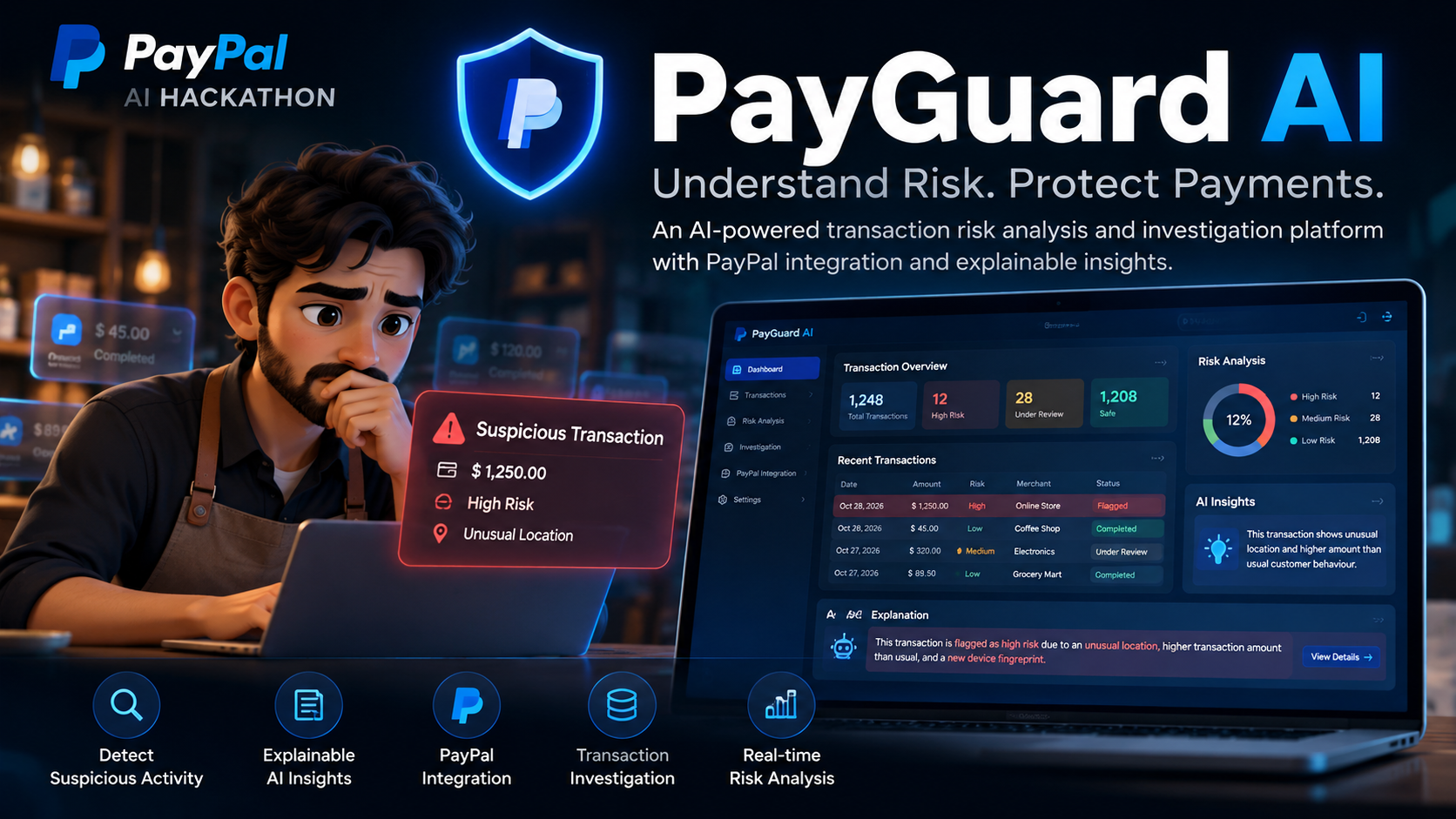
PayGuard AI is an AI-powered transaction risk analysis and investigation platform featuring:
- Transaction Monitoring: Explore transaction activity through interactive dashboards, metrics, and visualizations.
- Risk Detection: Apply explainable risk rules to identify potentially suspicious transactions.
- AI-Powered Insights: Generate natural-language explanations to help users understand flagged transactions.
- Investigation Management: Record investigation notes and track transaction-related cases.
- PayPal Integration: Create, approve, verify, and capture payments through the PayPal Sandbox Orders API.
How we built it
We built PayGuard AI using Python and Streamlit, with Pandas and NumPy for transaction data processing, Plotly for interactive visualizations, and SQLite for persistent local application data.
For AI-powered explanations, we integrated an LLM through the Groq API using an OpenAI-compatible interface.
PayPal Sandbox integration uses server-side API calls to create orders, verify buyer approval, and capture payments. Verified Sandbox transactions can then enter the risk assessment workflow.
Challenges we faced
One of our biggest challenges was integrating the complete PayPal payment lifecycle rather than simply displaying payment information.
We implemented checkout state management, request identifiers, approval verification, capture handling, and duplicate-request safeguards. We also had to ensure that Sandbox payment records remained distinguishable from synthetic demonstration transactions.
Another challenge was making risk analysis explainable. Instead of presenting users with scores alone, we combined deterministic risk rules with AI-generated explanations to make findings easier to understand.
What we learned
Building PayGuard AI taught us how to connect payment APIs, transaction processing, AI-powered explanations, and investigation workflows into one application.
More importantly, we learned that useful AI is not just about generating predictions. It is about making complex information understandable and helping people make better decisions.
PayGuard AI — Understand Risk. Protect Payments.


Log in or sign up for Devpost to join the conversation.