-
-
-
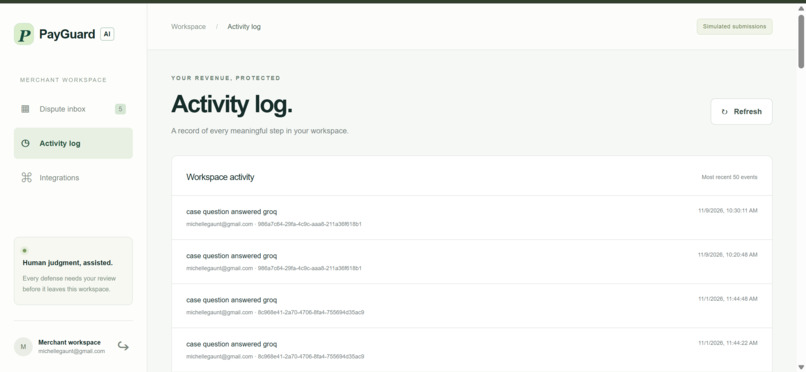
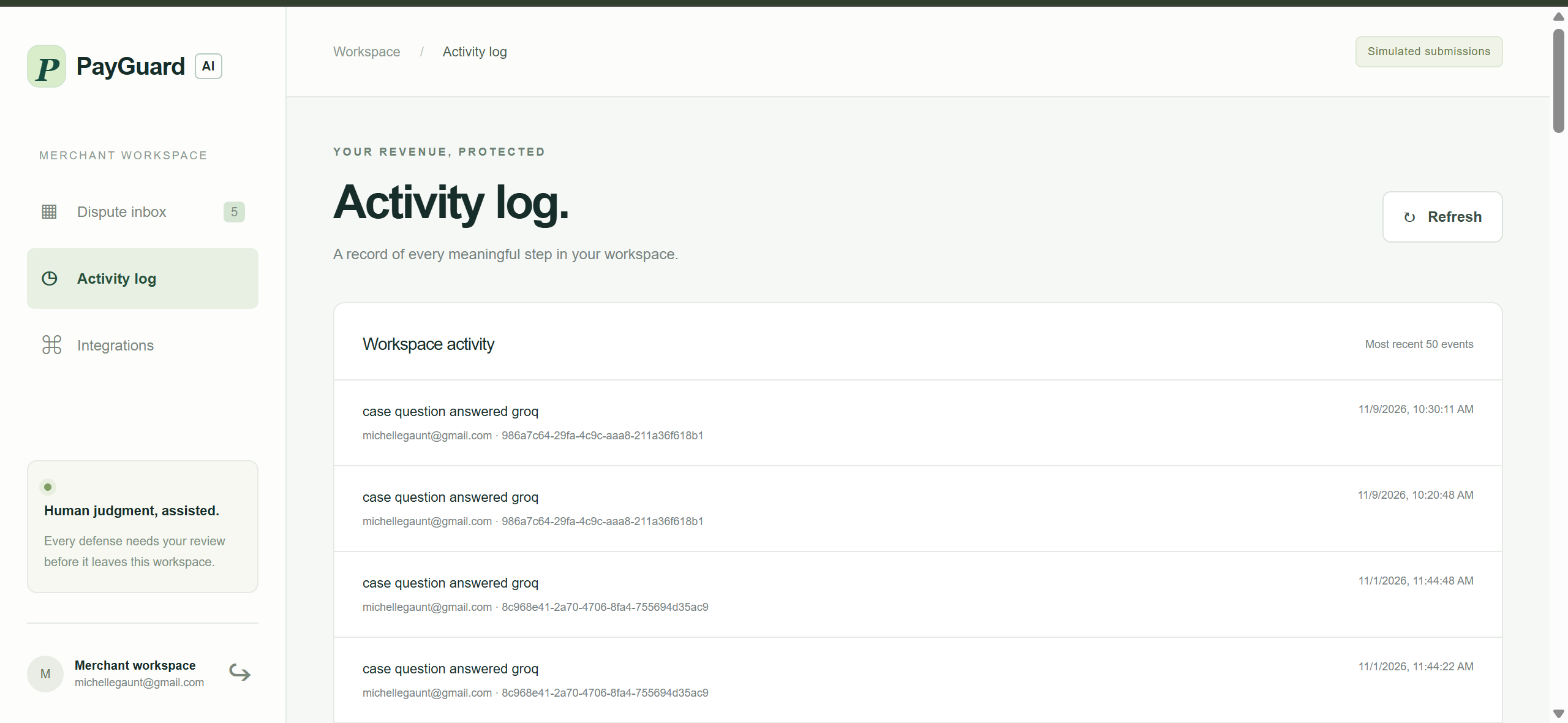
Activity history records AI question events with the responsible account and timestamp.
-
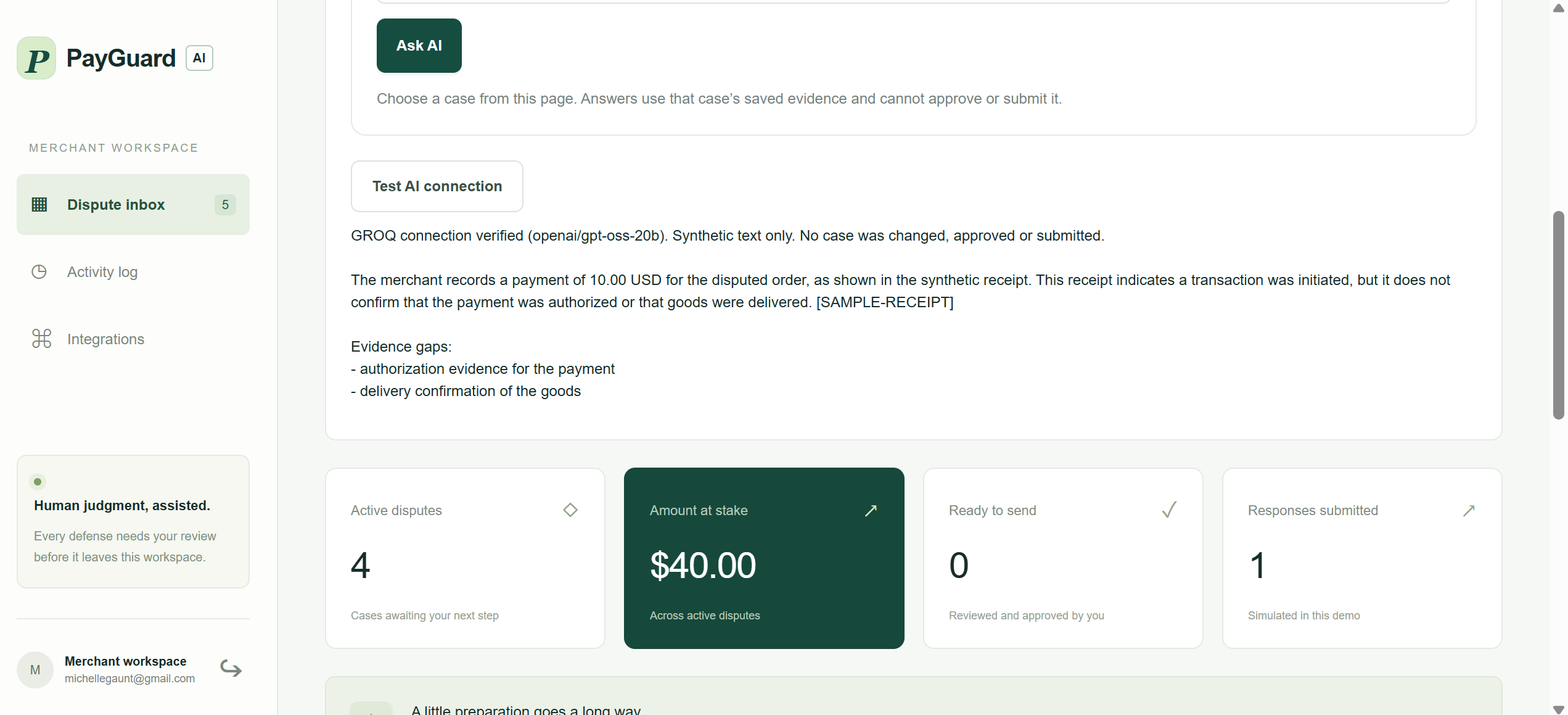
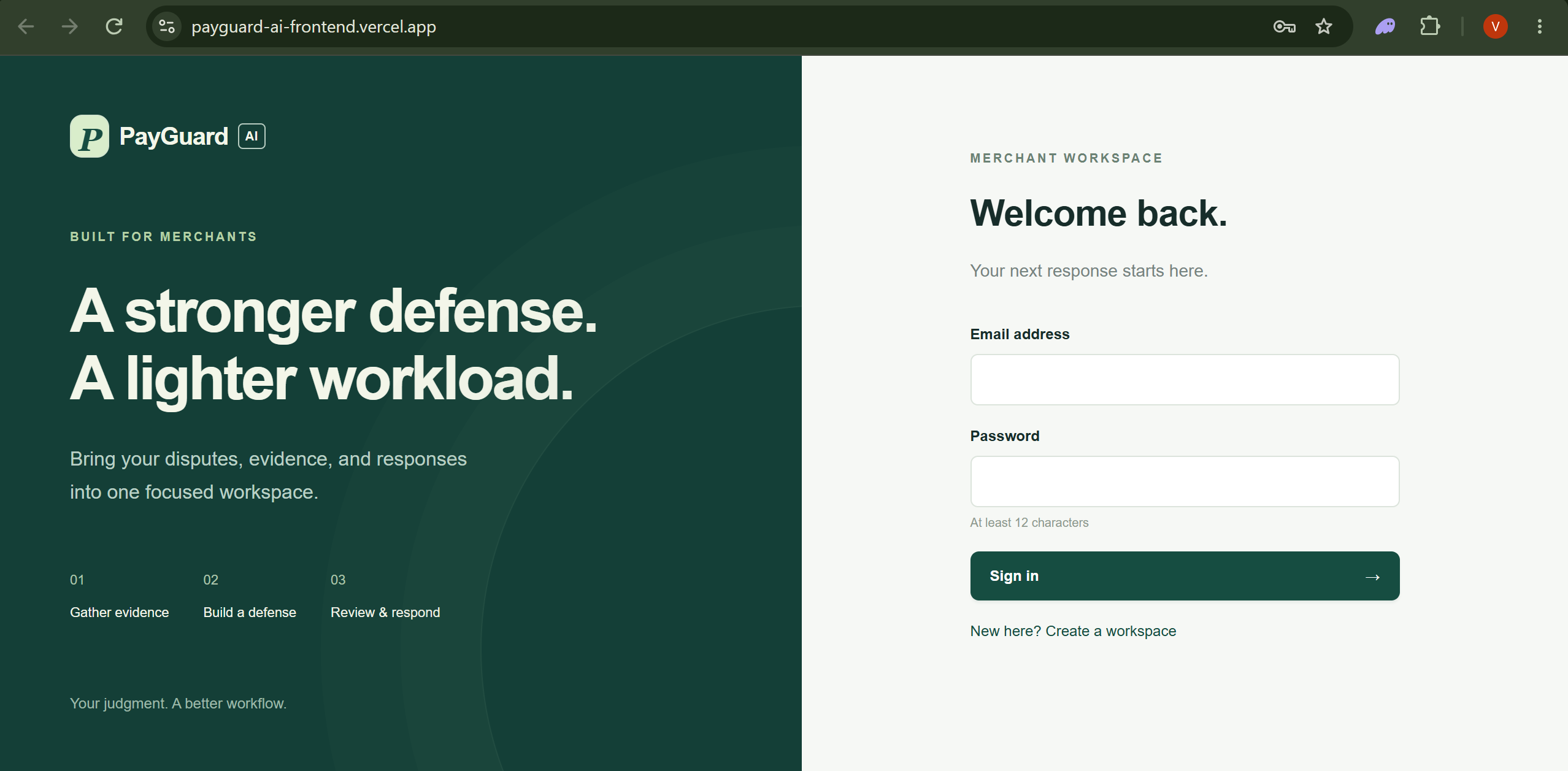
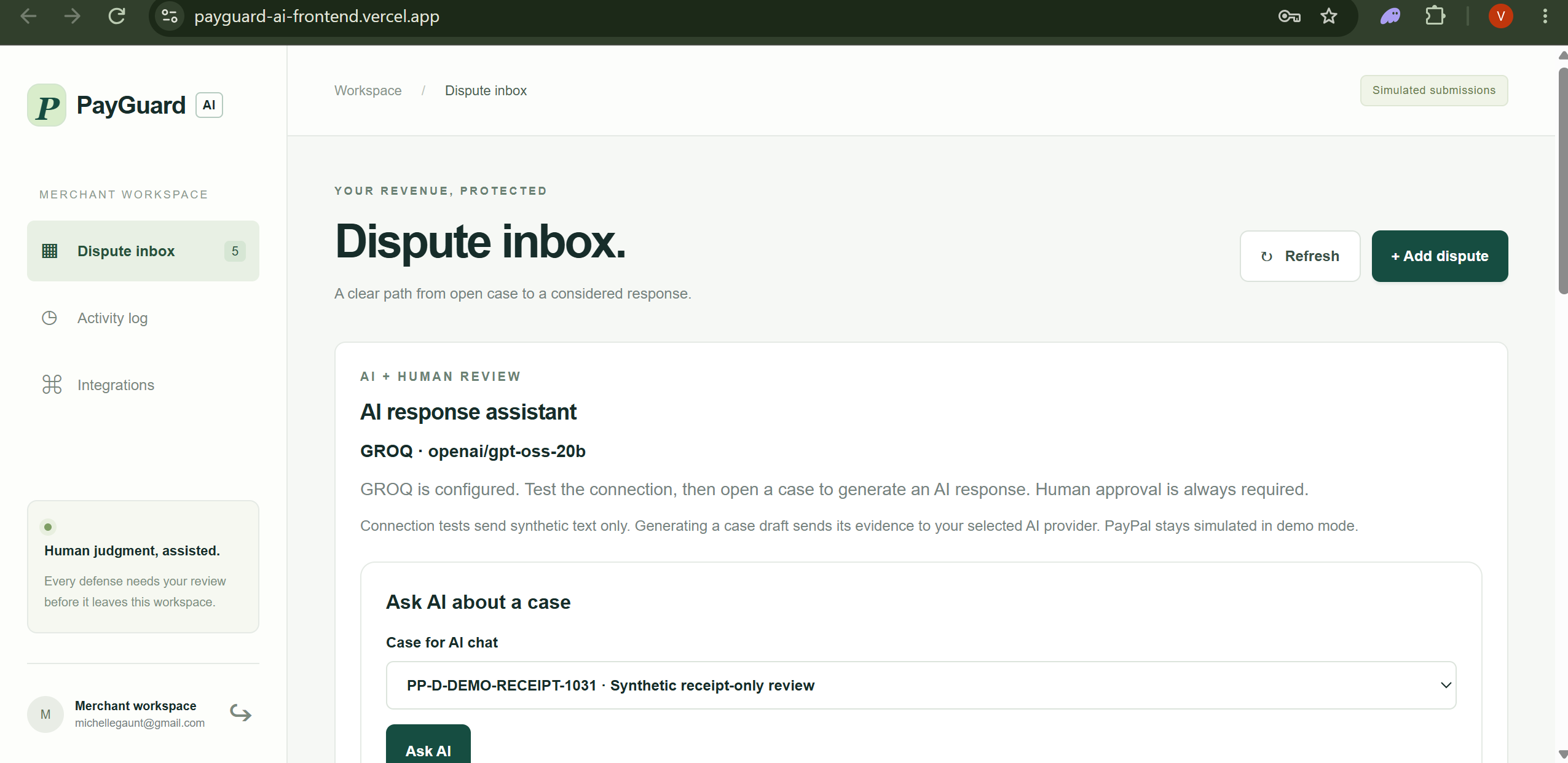
Merchant dashboard with Groq-powered case questions and human review before response approval.
-
-
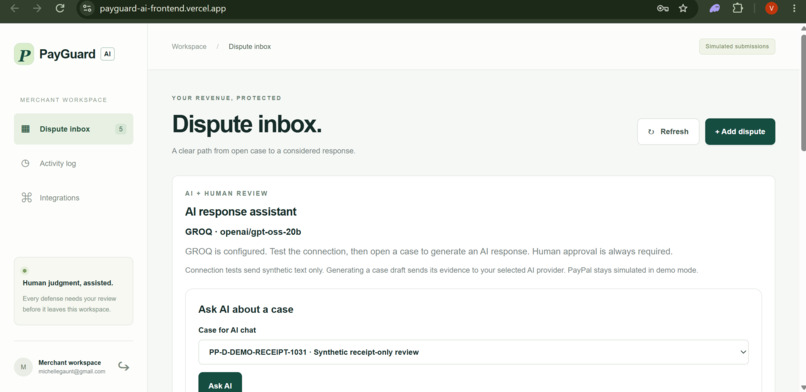
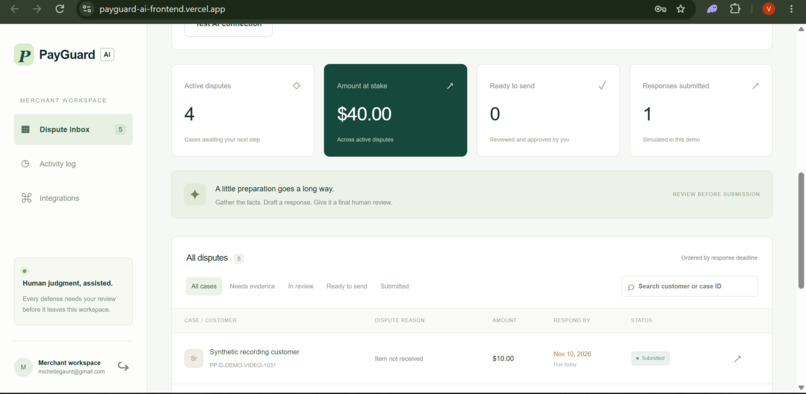
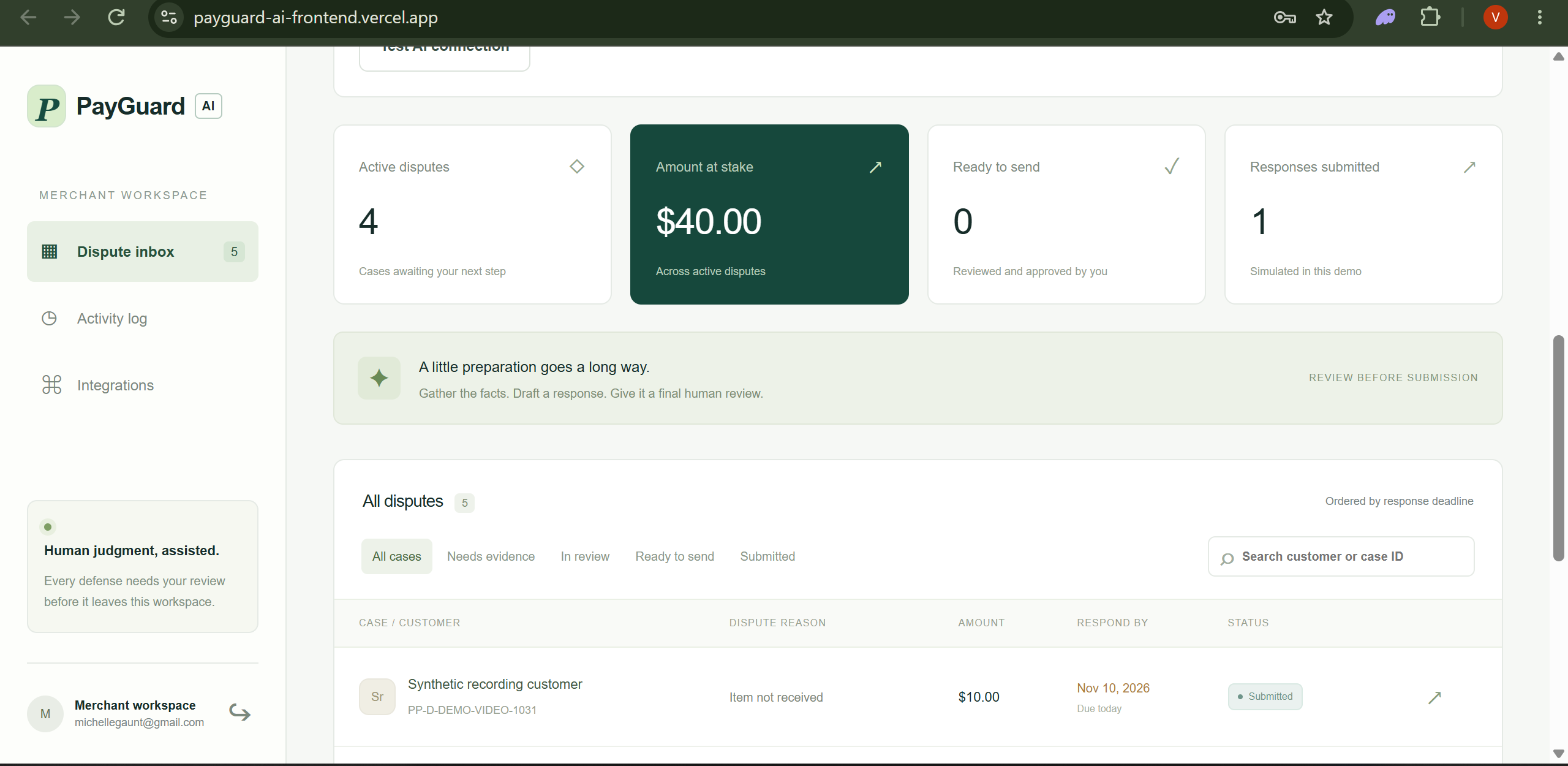
Dashboard summarizes active cases, disputed amounts, approval readiness, and simulated submissions
-
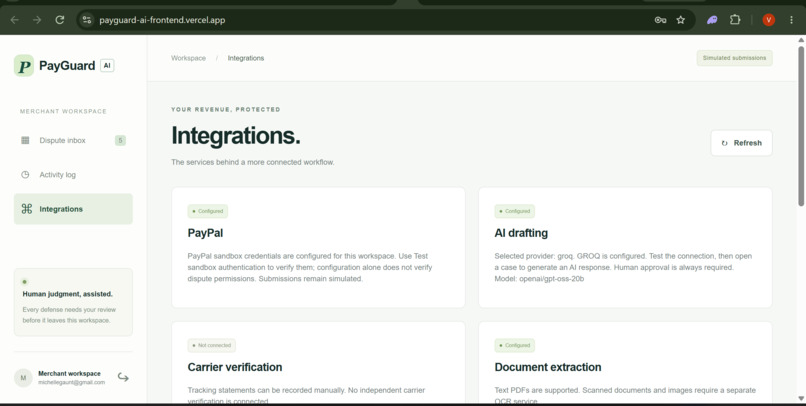
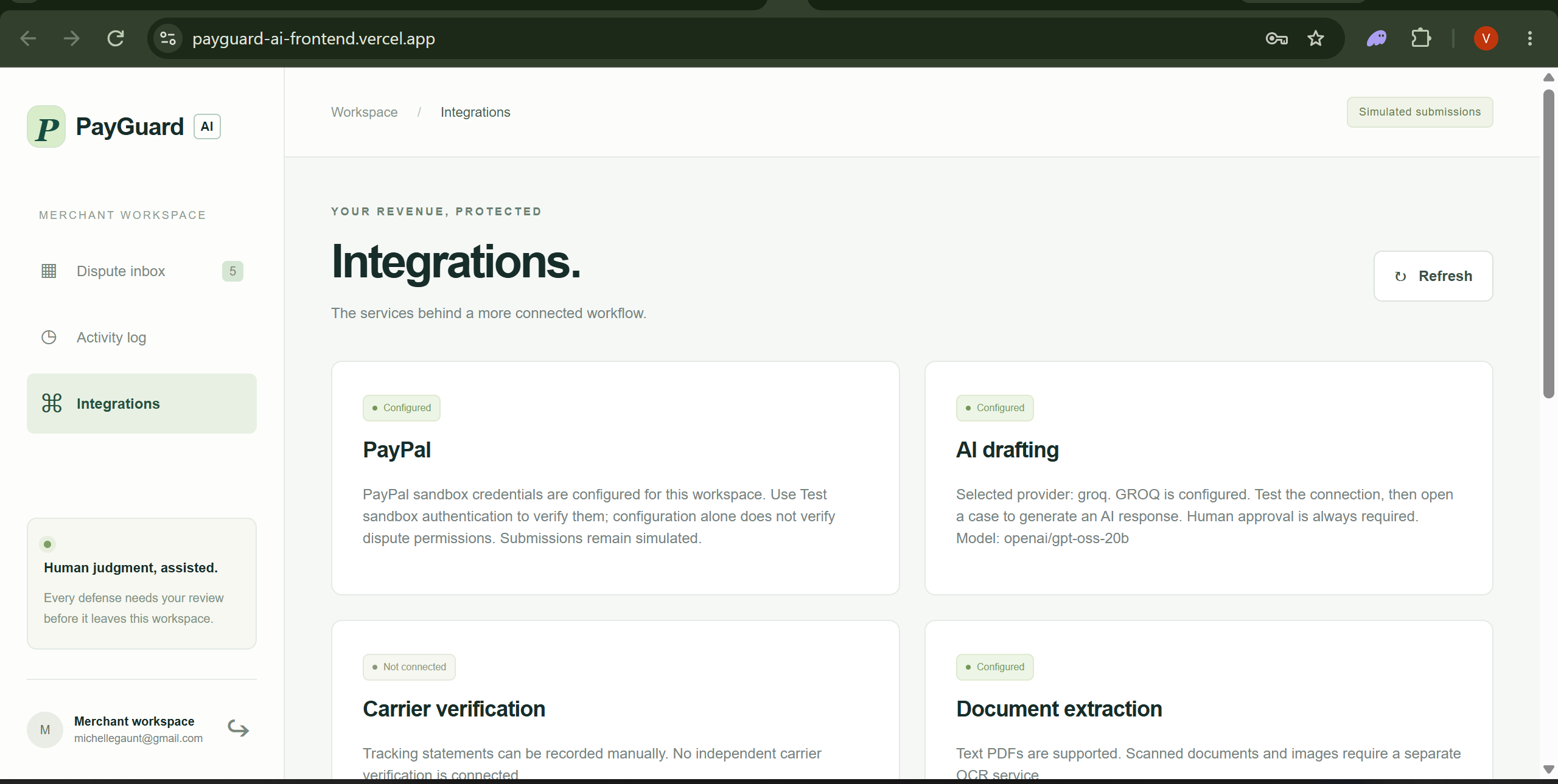
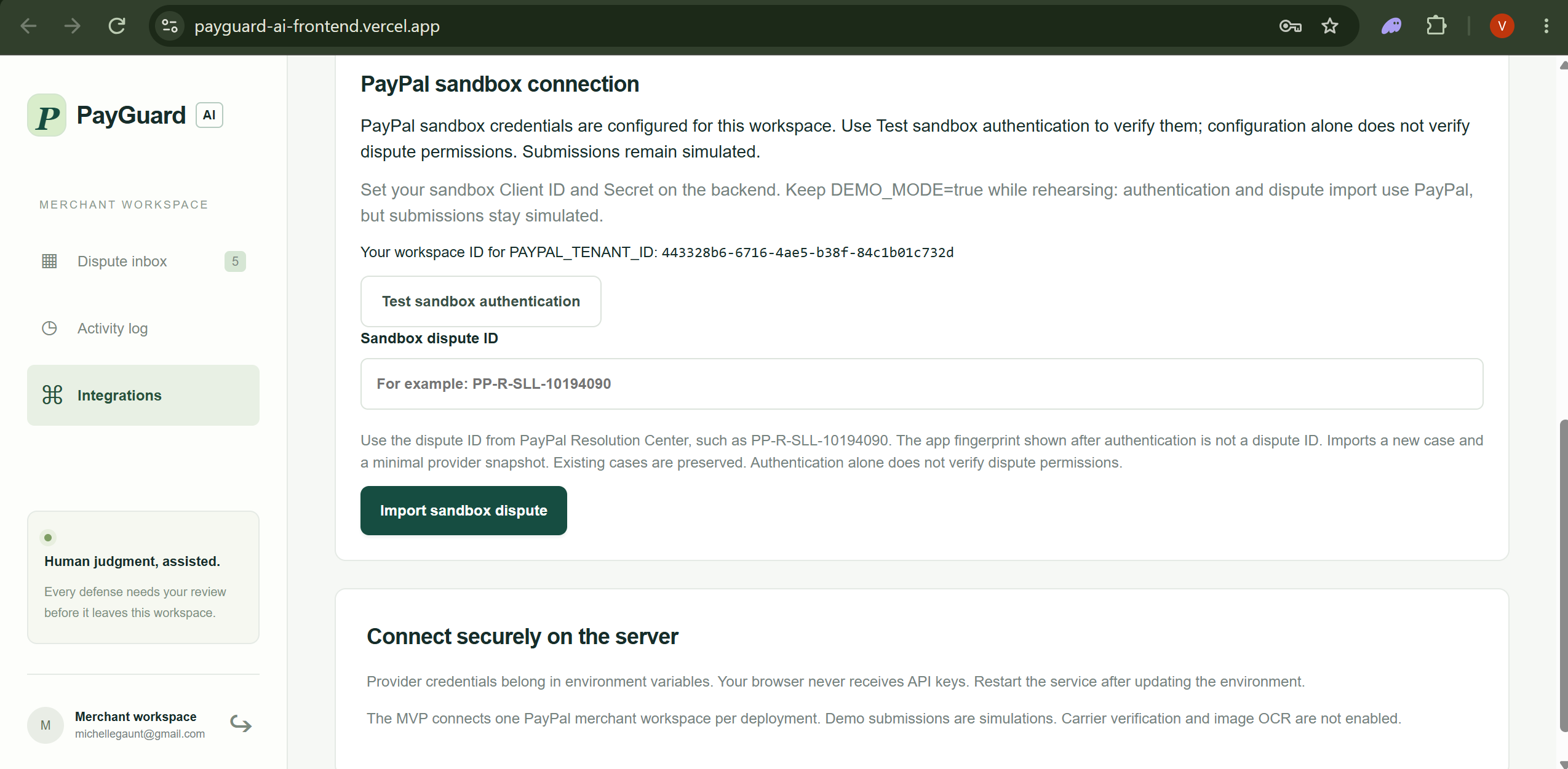
Integration status shows PayPal sandbox and Groq configuration, plus current carrier and document extraction limits.
-
-
-
-
-
Inspiration
What it does
How we built it
Challenges we ran into
Accomplishments that we're proud of
What we learned
What's next for payguard-ai
Inspiration
A payment receipt can show that money was recorded without proving that an order was delivered. When preparing a dispute response, merchants need to distinguish documented facts, unsupported claims, and missing evidence.
We built PayGuard AI to make those distinctions easier to inspect while keeping the merchant responsible for the final response.
What it does
PayGuard AI is a merchant workspace for preparing PayPal dispute responses.
It brings together:
- PayPal sandbox dispute import and status refresh.
- Evidence records and text extraction from PDFs.
- AI evidence checks that identify gaps and conflicting statements.
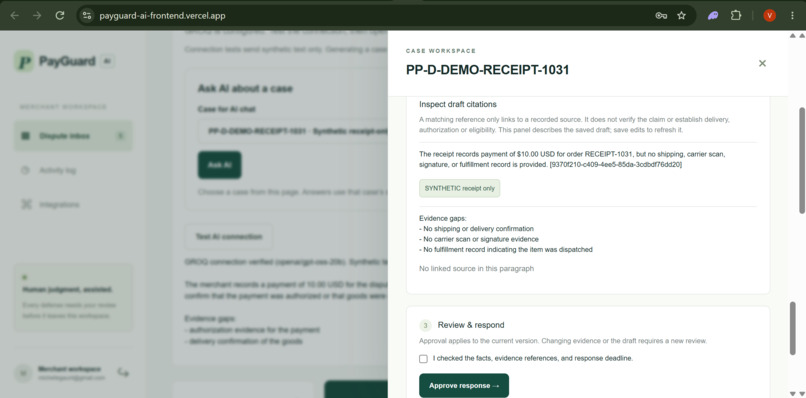
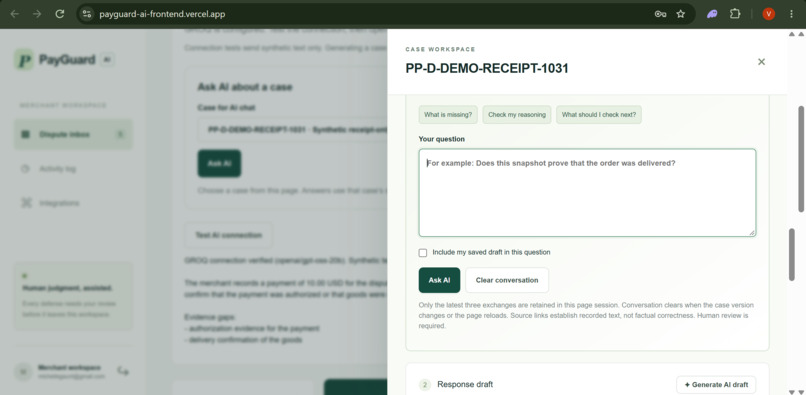
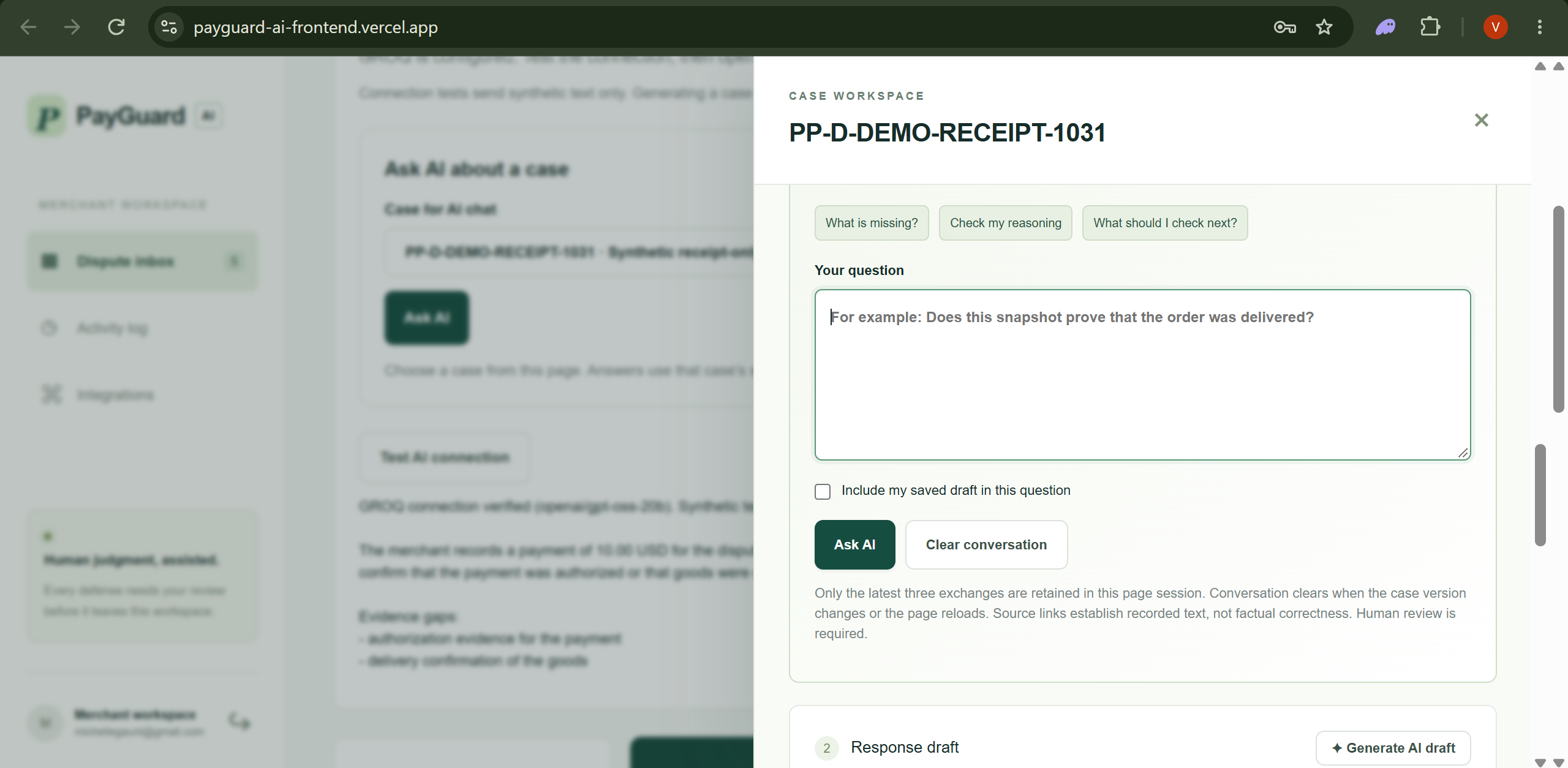
- Case-specific questions and answers with inspectable source references.
- AI-assisted response drafting and merchant editing.
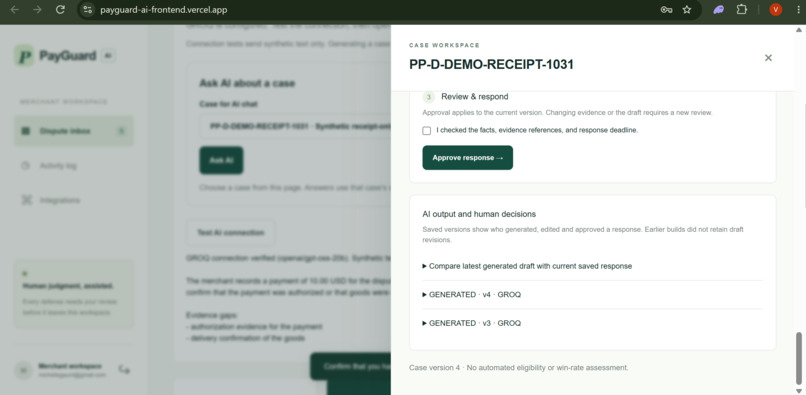
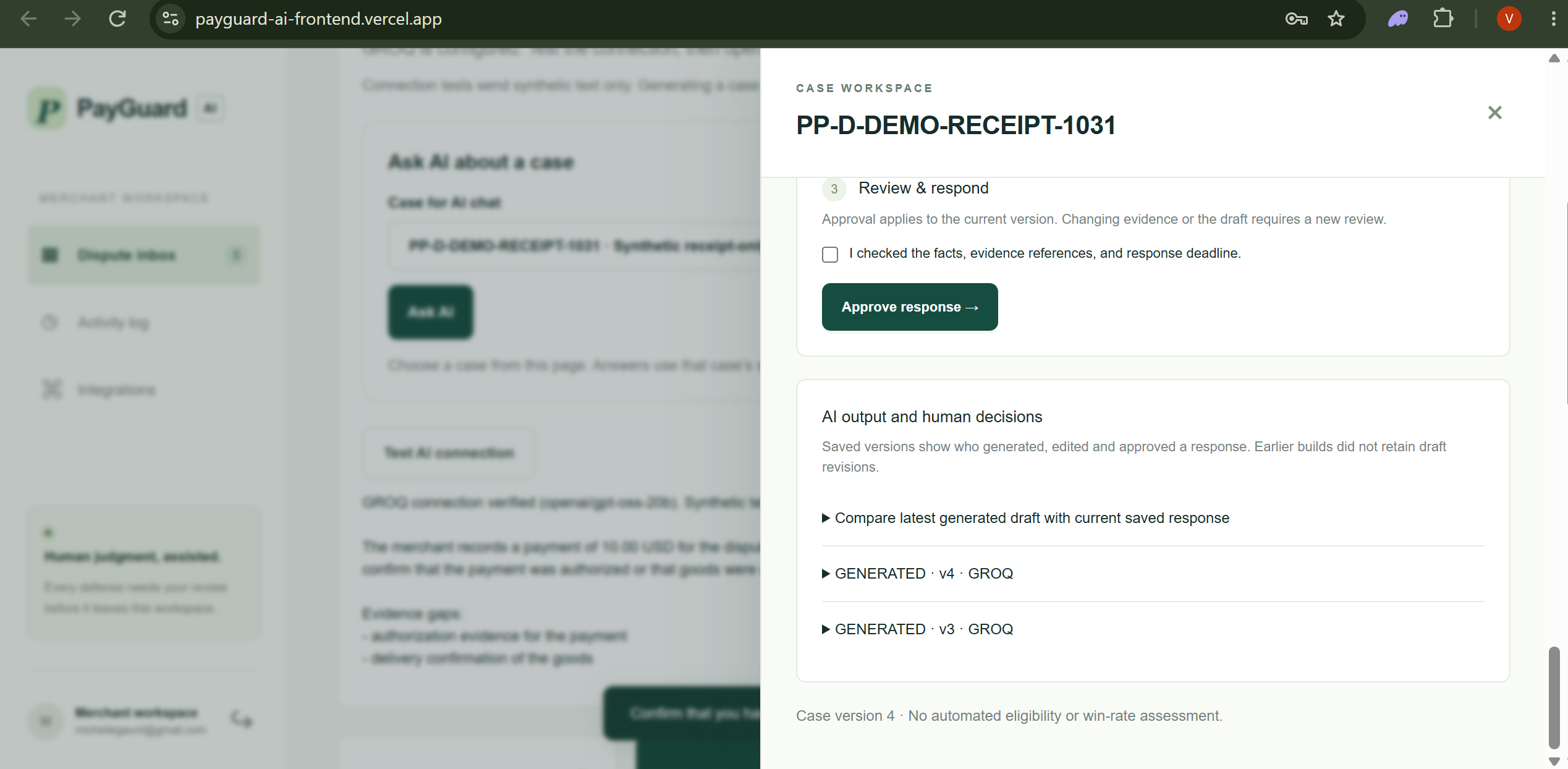
- Version-specific human approval and an activity history.
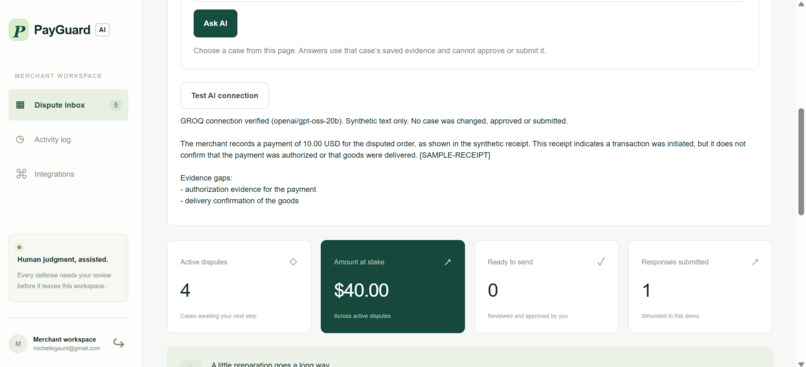
The Ask AI feature uses the selected case’s saved evidence. It cannot approve or submit a response.
How we built it
The backend uses Python, FastAPI, SQLAlchemy, and PostgreSQL hosted on Neon. The separate HTML, CSS, and JavaScript frontend is deployed on Vercel, while the backend runs on Render.
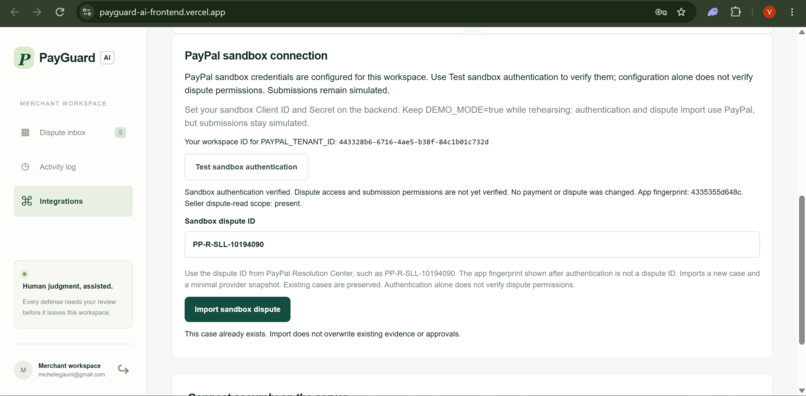
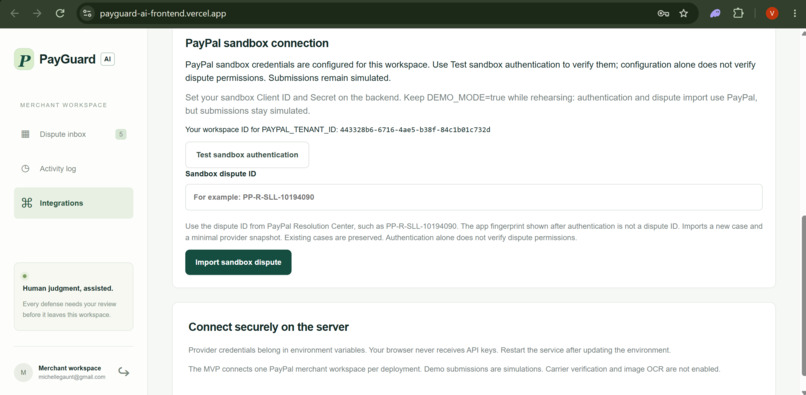
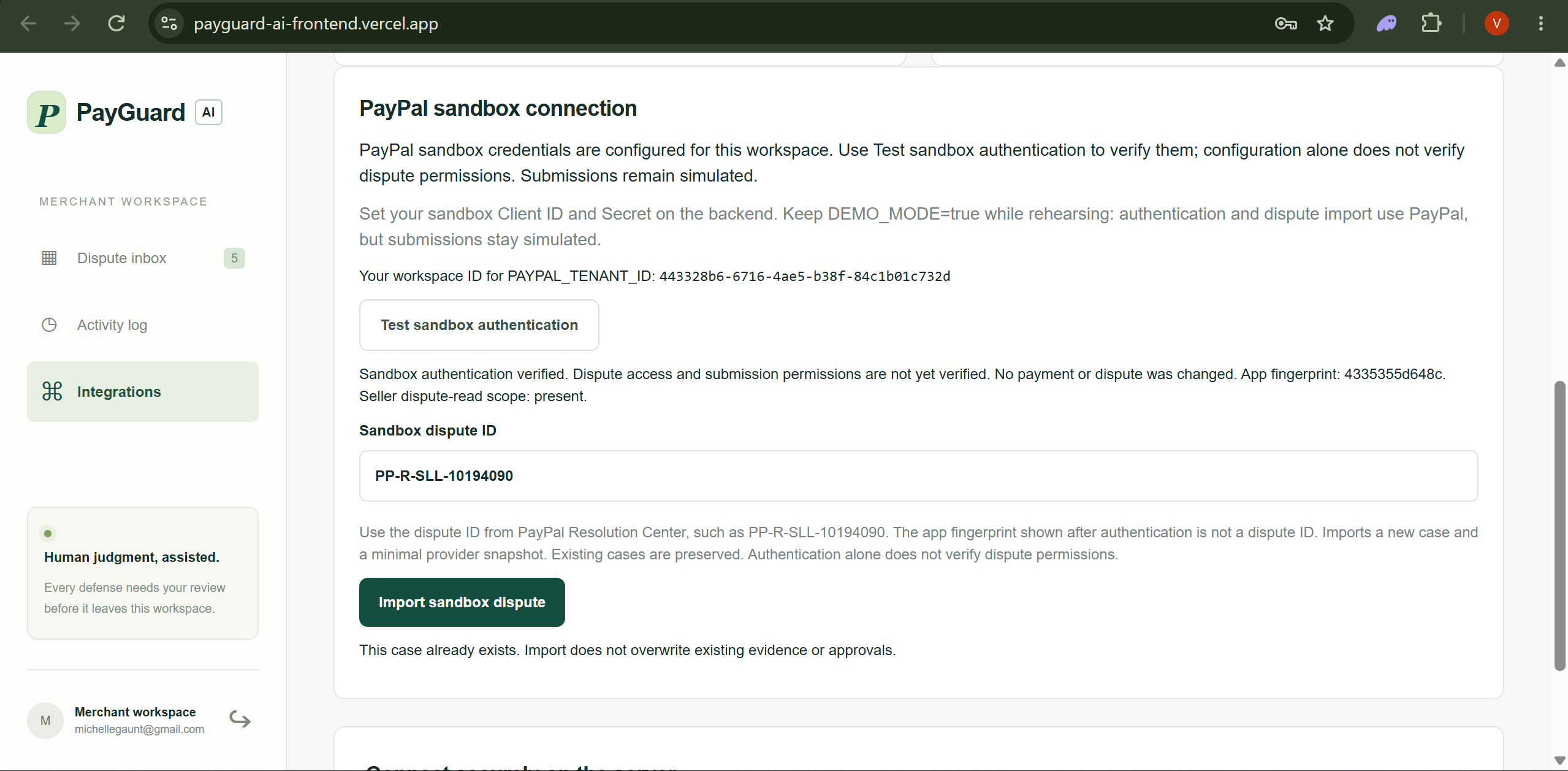
PayPal sandbox APIs authenticate the seller connection, import disputes, and retrieve their current status and available actions.
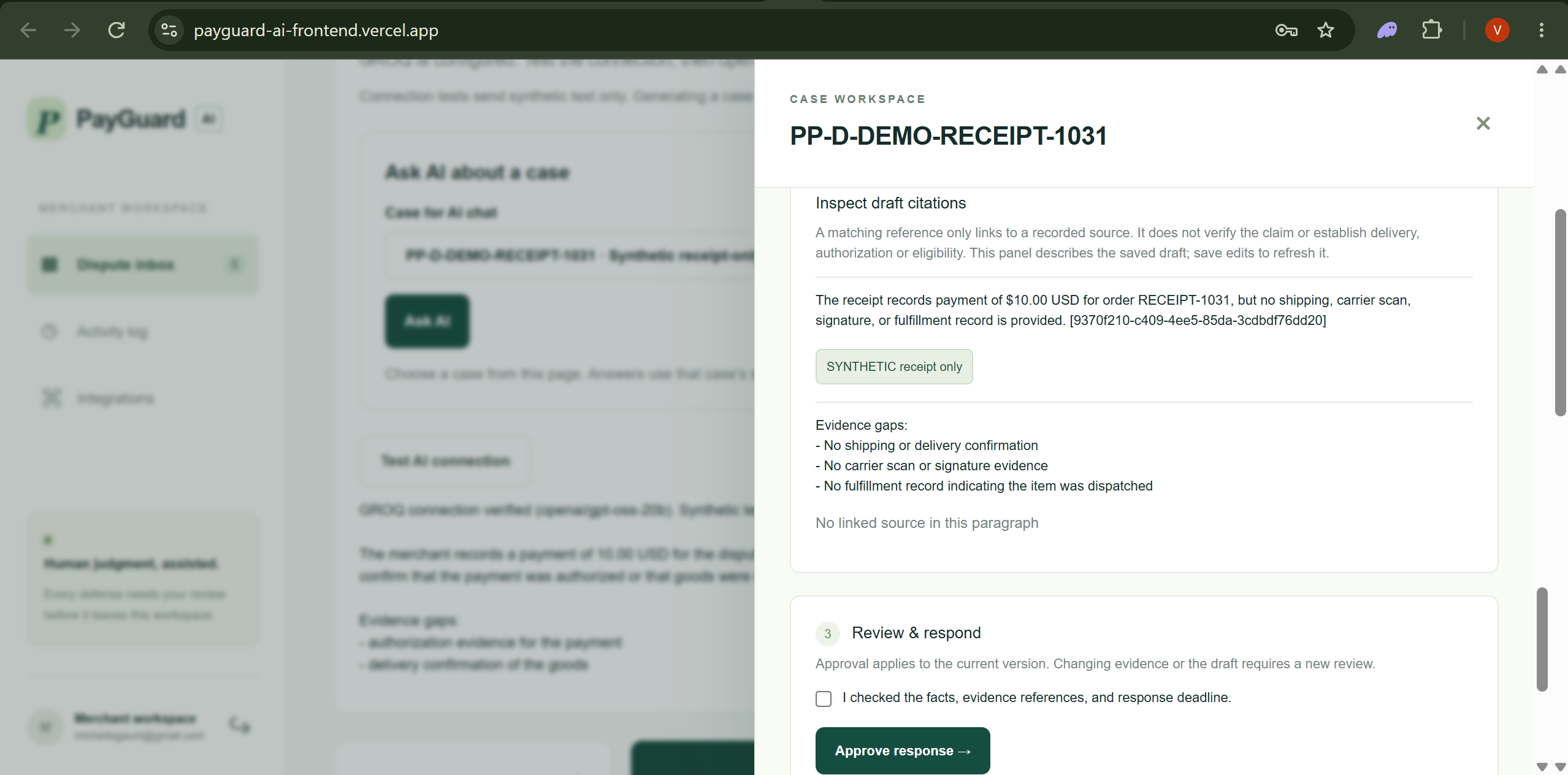
Groq, using the openai/gpt-oss-20b model, powers evidence analysis, response drafting, and case questions. Structured AI output is validated before it is saved. Source references let reviewers inspect the underlying records.
Challenges we faced
Connecting to the correct PayPal sandbox seller was essential: successful authentication alone did not prove that the application could access a particular dispute.
AI output also required careful handling. We added validation, clearer failure messages, and tests for incomplete evidence, conflicting records, missing authorization information, and untrusted instructions embedded in evidence.
Another challenge was preserving human control. Changing the evidence or response requires a new review rather than silently retaining an earlier approval.
Accomplishments we are proud of
We connected a working hosted application to an actual PayPal sandbox dispute created through a $10 test transaction.
We also demonstrated a fresh Groq question and answer, inspectable evidence sources, saved response drafts, and human-review controls in the deployed application.
Our automated checks cover backend workflows, frontend rendering, access boundaries, and AI response handling. Synthetic AI evaluations exercise several evidence scenarios; passing their mechanical checks is not a claim of measured AI accuracy.
What we learned
A useful dispute assistant needs to communicate uncertainty clearly. A merchant statement is not independent verification, and a valid source reference does not prove that a claim is true.
We also learned that PayPal’s current dispute stage determines which provider actions are available. The application should show those limits rather than imply that every case supports the same response.
Current demonstration limits
PayPal sandbox authentication, dispute import, and status reads use the sandbox API. Submissions in the hosted demonstration are simulated; no real money is moved.
Fictional evidence scenarios are labelled separately from the imported sandbox dispute. Carrier verification and OCR for scanned documents are not currently connected.
AI suggestions require human assessment. PayGuard does not guarantee dispute outcomes or determine seller-protection eligibility.
What's next
We want to add independently verified carrier information, OCR for scanned evidence, broader human-reviewed AI evaluations, and further accessibility improvements.
We also plan to validate additional PayPal sandbox lifecycle actions before enabling any broader submission workflow.
Try it
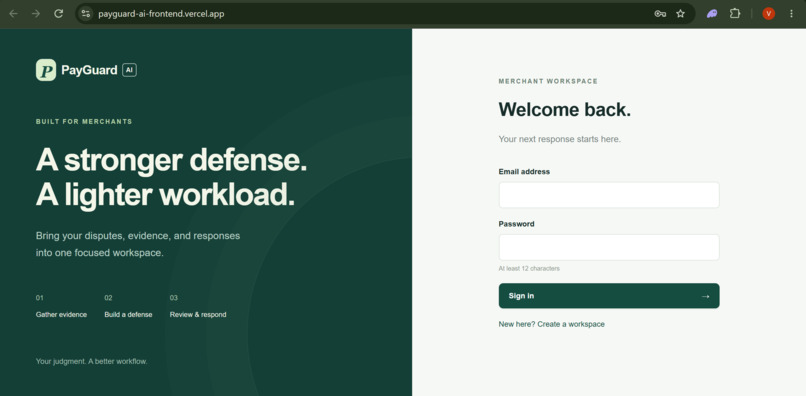
- Application: https://payguard-ai-frontend.vercel.app/
- Public MIT-licensed source: https://github.com/Rathorate/payguard-ai
- Setup and testing guide: https://github.com/Rathorate/payguard-ai/blob/main/docs/JUDGE_GUIDE.md
Built With
- css
- fastapi
- groq
- html
- javascript
- paypal
- postgresql
- python
- render
- sqlalchemy
- vercel

