PayGuard Agent — Project Summary
Inspiration
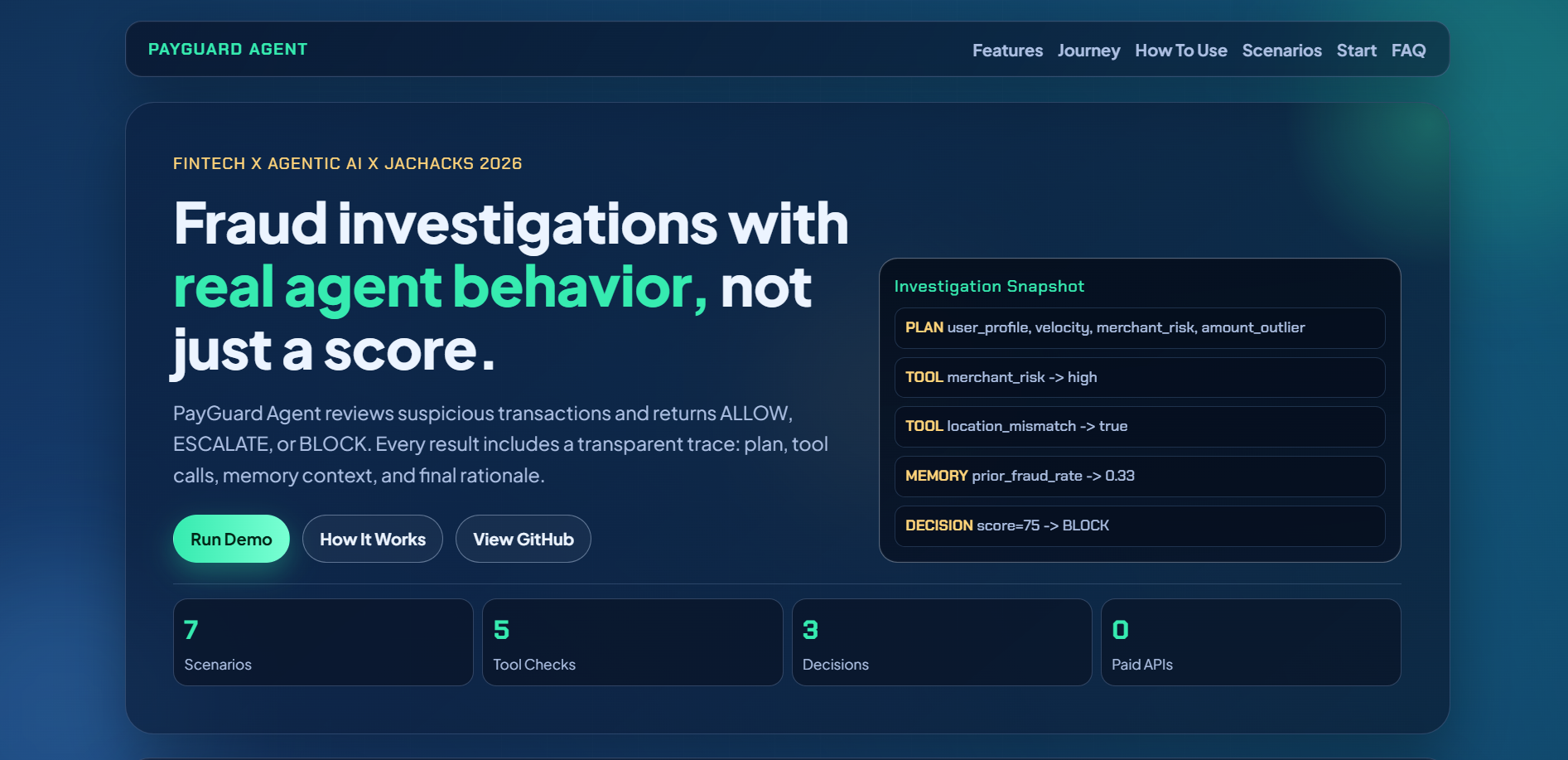
Fraud detection systems often return opaque risk scores without revealing the reasoning or tool usage behind decisions. For judges and operators, reproducible, explainable autonomy that shows PLAN → TOOL CALLS → MEMORY → DECISION is far more compelling than a black‑box score. PayGuard Agent was built to demonstrate clear, agentic behavior for transaction investigations that is easy to verify during a live demo.
What it does
- Runs a deterministic demo suite of realistic transaction scenarios (baseline purchase, account takeover, travel-like false positives, and mule-pattern transactions).
- For each transaction it builds a simple investigation plan, calls local tools (user profile, velocity, merchant risk, amount anomaly, location mismatch), reads prior cases from local memory, scores the outcome, and returns one of:
ALLOW,ESCALATE,BLOCK. - Produces a full investigation trace (plan, tool outputs, memory context, scoring, reasons) and a compact explainability object with a human label and one-line summary (e.g.,
Fraud — High-risk merchant; confidence=0.88). - Persists investigations to
memory/cases.jsonso repeated runs can show persistence effects.
How we built it
- Language: Python 3.14 for the demo runner and tooling.
- Agent logic:
src/agent.pyimplements deterministic planning, tool orchestration, scoring, and the explainability helper. - Tools: small local functions in
src/tools.pyproviding merchant risk, velocity counting, amount outlier checks, and simple location mismatch logic. - Memory:
src/memory_store.pypersists case records tomemory/cases.json. - Web demo: a static single‑page site (
index.html,styles.css,script.js) readsdemo_results.json(synced from memory) to showcase explainability badges and summaries. - Jac scaffold:
jac/payguard_agent.jaccontains the Jac design for porting the logic to Jaseci/Jac for a Jac‑first submission.
Challenges we ran into
- Keeping the demo fully local and reproducible for judges while still demonstrating multi-step, agentic behavior (no paid APIs).
- Designing investigation logs that are informative but compact for display in a terminal and on a webpage.
- Balancing deterministic outputs (for video) with realistic variability and memory effects.
Accomplishments that we're proud of
- A compact, judge-friendly demo that is runnable in minutes and produces transparent traces for every decision.
- Clear explainability layer (label + one-line summary) added to each investigation result to aid human review.
- A modern static demo site and one-line bootstrap installers so judges can reproduce the demo quickly.
- Jac scaffold included so the project can be migrated to a Jac‑primary runtime for the hackathon requirement.
What we learned
- Small deterministic agents can be very effective for demo clarity: planable, testable, and easy to explain to judges.
- Memory and persistence are powerful storytelling tools for demonstrations — they let you show how the agent's posture adapts over time.
- Prioritizing reproducibility (reset mode, sync script, one-liners) drastically reduces demo fragility.
What's next for PayGuard Agent
- Wire
jac/payguard_agent.jacinto a Jaseci runtime so the repo can run Jac as the primary execution path. - Add a small local API to let the web UI run single synthetic transactions and show live agent traces.
- Improve the scoring model and add a merchant whitelist override and confidence-driven step‑up checks.
- Prepare a short Devpost writeup and a 3‑minute demo video script based on the deterministic scenario run.
Quick run notes
- (Optional) Activate the virtual environment:
powershell Set-ExecutionPolicy -Scope Process -ExecutionPolicy RemoteSigned & ".venv\Scripts\Activate.ps1" - Run deterministic demo (resets memory):
powershell python src/app.py --reset-memory - Sync results for the site and open the static page:
powershell
python scripts/sync_demo_results.py
python -m http.server 5500
# open http://localhost:5500/
Built With
- jac
- python


Log in or sign up for Devpost to join the conversation.