Inspiration
Small businesses and independent professionals often struggle with managing invoices, tracking payments, and handling customer interactions efficiently. These processes can become time-consuming when handled through multiple disconnected tools.
We wanted to build a single platform that simplifies these workflows by combining invoice management, online payments, payment tracking, and artificial intelligence.
This idea inspired us to create PayFlowAI — a smarter way to manage business payments.
What it does
PayFlowAI is an AI-powered payment and invoice management platform designed to simplify business financial workflows.
Our platform provides separate experiences for Developers and Clients.
Key Features:
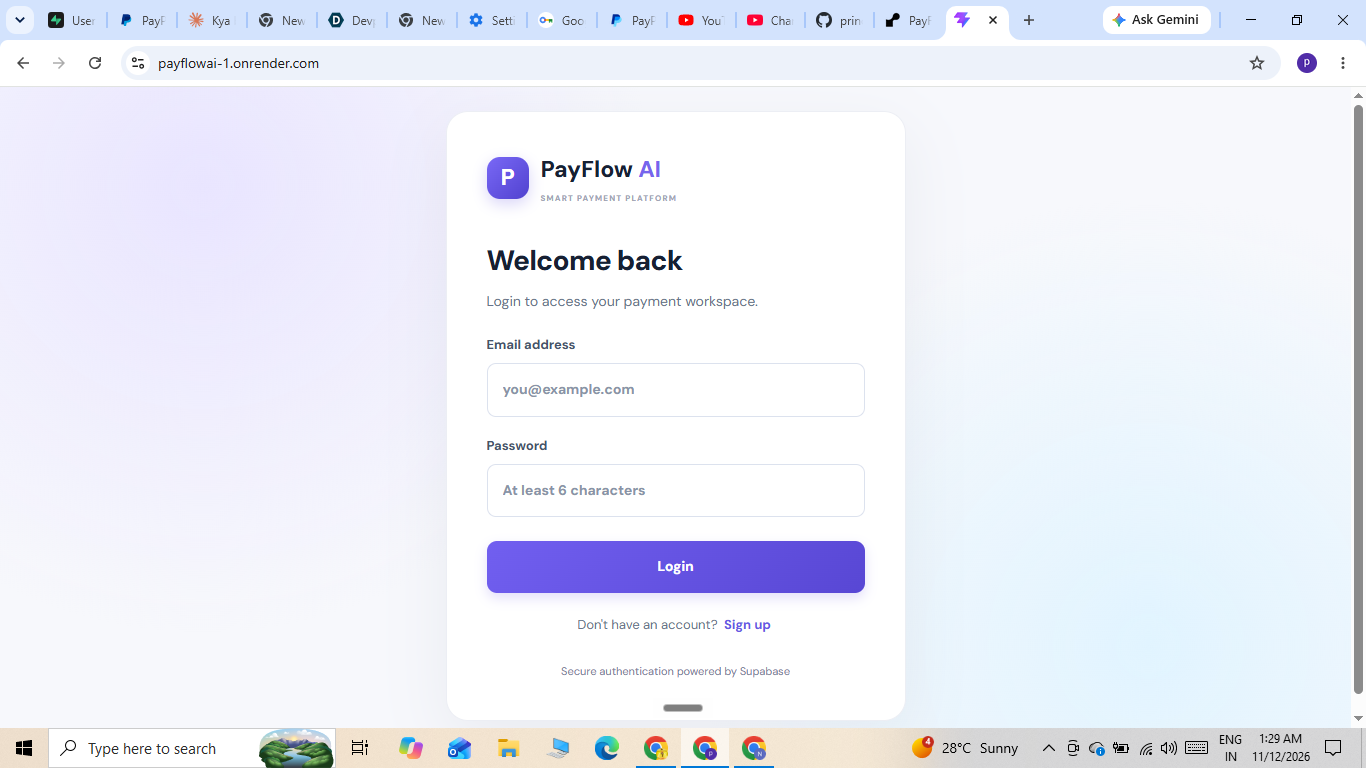
- Developer Authentication: Secure developer registration and login.
- Client Authentication: Separate client login and portal.
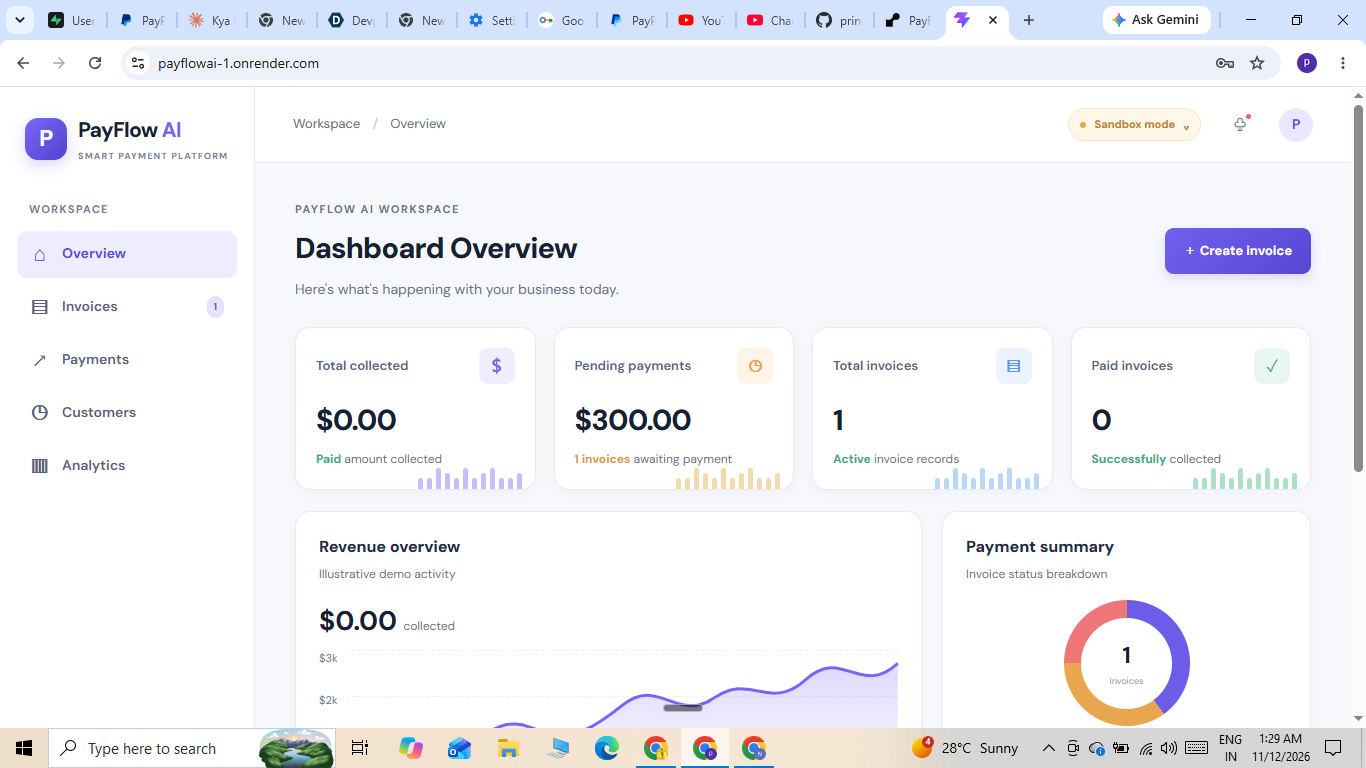
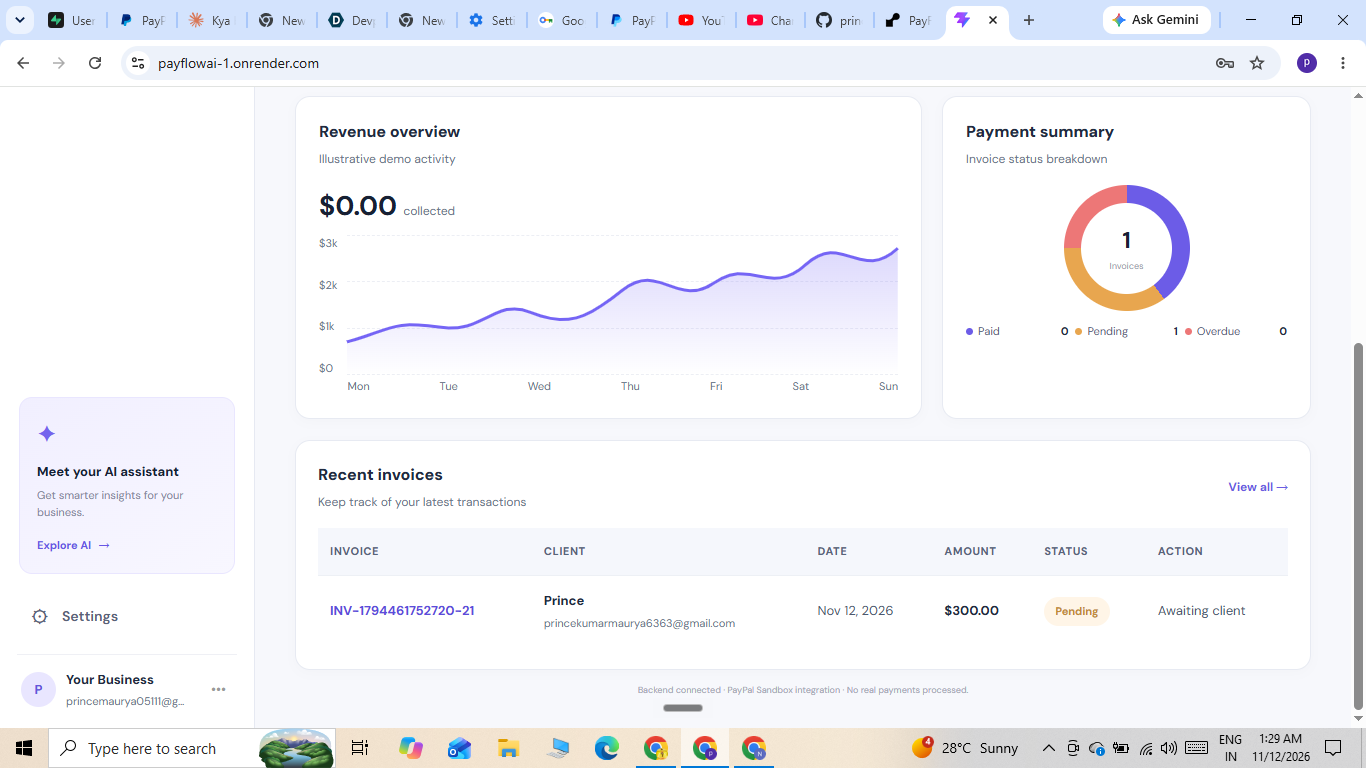
- Smart Dashboard: Overview of invoices, payments, customers, and business activities.
- Invoice Management: Create, view, and manage customer invoices.
- Client Portal: Clients can access their invoices and payment information.
- PayPal Integration: Online payment processing through PayPal Sandbox.
- Payment Tracking: Track transactions and update invoice payment statuses.
- Gemini AI Assistant: AI-powered conversational assistance using Google Gemini.
- Customer Management: Manage customer information.
- Analytics Dashboard: Visualize available business and payment statistics.
- Search and Notifications: Convenient navigation and access to application notifications.
How we built it
We built PayFlowAI using a modern full-stack technology stack.
- Frontend: React.js, JavaScript, and CSS for an interactive user interface.
- Backend: Node.js and Express.js for API development and backend operations.
- Database & Authentication: Supabase for data storage and user authentication.
- Payment Gateway: PayPal Developer Sandbox for testing payment transactions without using real money.
- AI Integration: Google Gemini API for the AI-powered assistant.
- Deployment: Render for hosting the frontend and backend.
We connected these technologies to create an end-to-end workflow:
- The Developer logs in and creates an invoice.
- The Client logs in and views the invoice.
- The Client proceeds to PayPal Sandbox checkout.
- The payment is processed through the Sandbox environment.
- PayFlowAI processes the payment response and updates the invoice status.
- The Developer verifies the updated payment information from the dashboard.
Challenges we ran into
During development, we faced several technical challenges.
- Integrating the React frontend with the Node.js backend.
- Implementing separate authentication experiences for Developers and Clients.
- Managing user roles and invoice records using Supabase.
- Integrating PayPal Sandbox and handling the payment workflow.
- Ensuring invoice payment statuses update correctly after successful transactions.
- Integrating Google Gemini AI with the application.
- Configuring environment variables and deploying the frontend and backend on Render.
- Debugging issues related to authentication, API communication, and deployment.
We addressed these challenges through continuous testing, debugging, and improving the integration between different components.
Accomplishments that we're proud of
We are proud to have developed a working full-stack application that brings multiple business operations together in one platform.
Our major accomplishments include:
- Building separate Developer and Client portals.
- Implementing invoice creation and management.
- Integrating PayPal Sandbox for online payment testing.
- Demonstrating the complete invoice-to-payment workflow.
- Implementing payment status updates after successful payment processing.
- Integrating Google Gemini AI into the platform.
- Deploying the frontend and backend online.
- Bringing authentication, invoicing, payment processing, and AI assistance together in one application.
Most importantly, we transformed our idea into a working application that demonstrates a practical business payment workflow.
What we learned
Building PayFlowAI helped us gain practical experience in full-stack development and real-world software integration.
We learned:
- How to build and connect frontend and backend applications.
- How authentication and role-based application experiences work.
- How to manage application data using Supabase.
- How payment gateway integration works using PayPal Sandbox.
- How to integrate AI capabilities using Google Gemini.
- How to configure APIs and environment variables.
- How to deploy and debug applications in a production environment.
- How to solve technical problems through testing and collaboration.
This project helped us understand how different technologies can work together to solve real business problems.
What's next for PayFlowAI
We plan to make PayFlowAI more intelligent, scalable, and useful for businesses.
Our future improvements include:
- AI-powered financial insights and business recommendations.
- Automated invoice generation and recurring billing.
- Automated payment reminders for clients.
- Advanced customer relationship management.
- More detailed financial reports and analytics.
- Additional payment gateway integrations.
- Improved security and role-based access controls.
- Multi-currency and international payment support.
Our long-term vision is to build a smart business payment platform that reduces manual work and makes financial management easier.
PayFlowAI — Smarter Payments. Simpler Business Management.
Built With
- artificial-intelligence
- css
- express.js
- fintech
- full-stack-development
- generative-ai
- google-gemini
- html
- invoice-management
- javascript
- node.js
- payment-processing
- paypal
- paypal-sandbox
- postgresql
- react
- rest-api
- supabase
- vite
