-
-
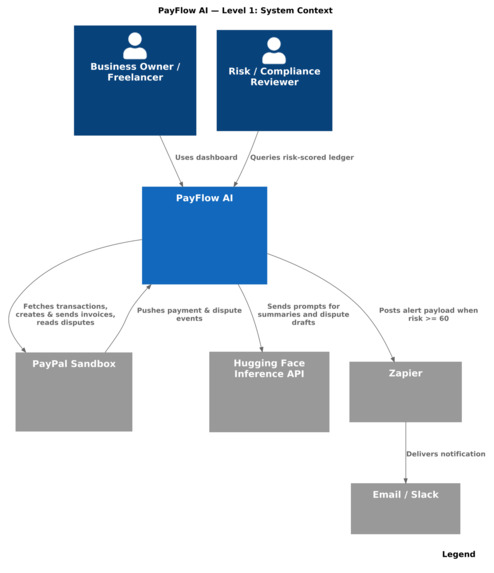
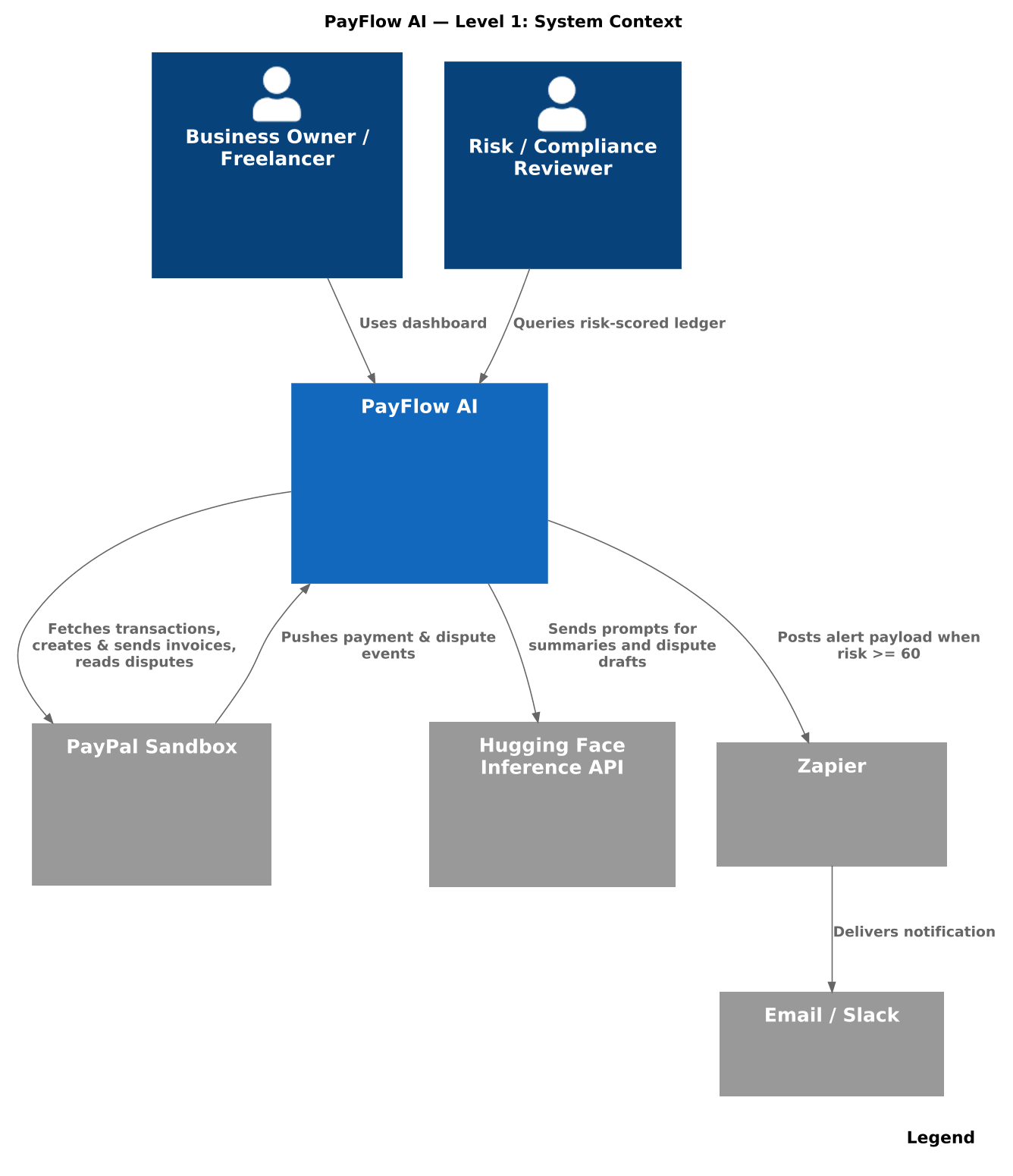
C4_1_context
-
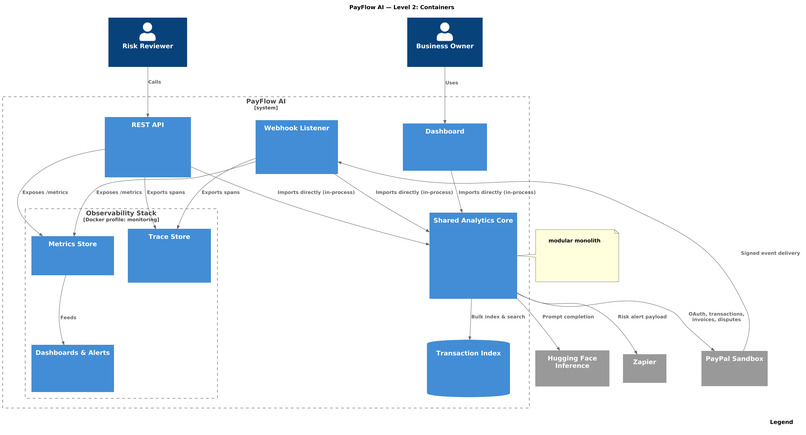
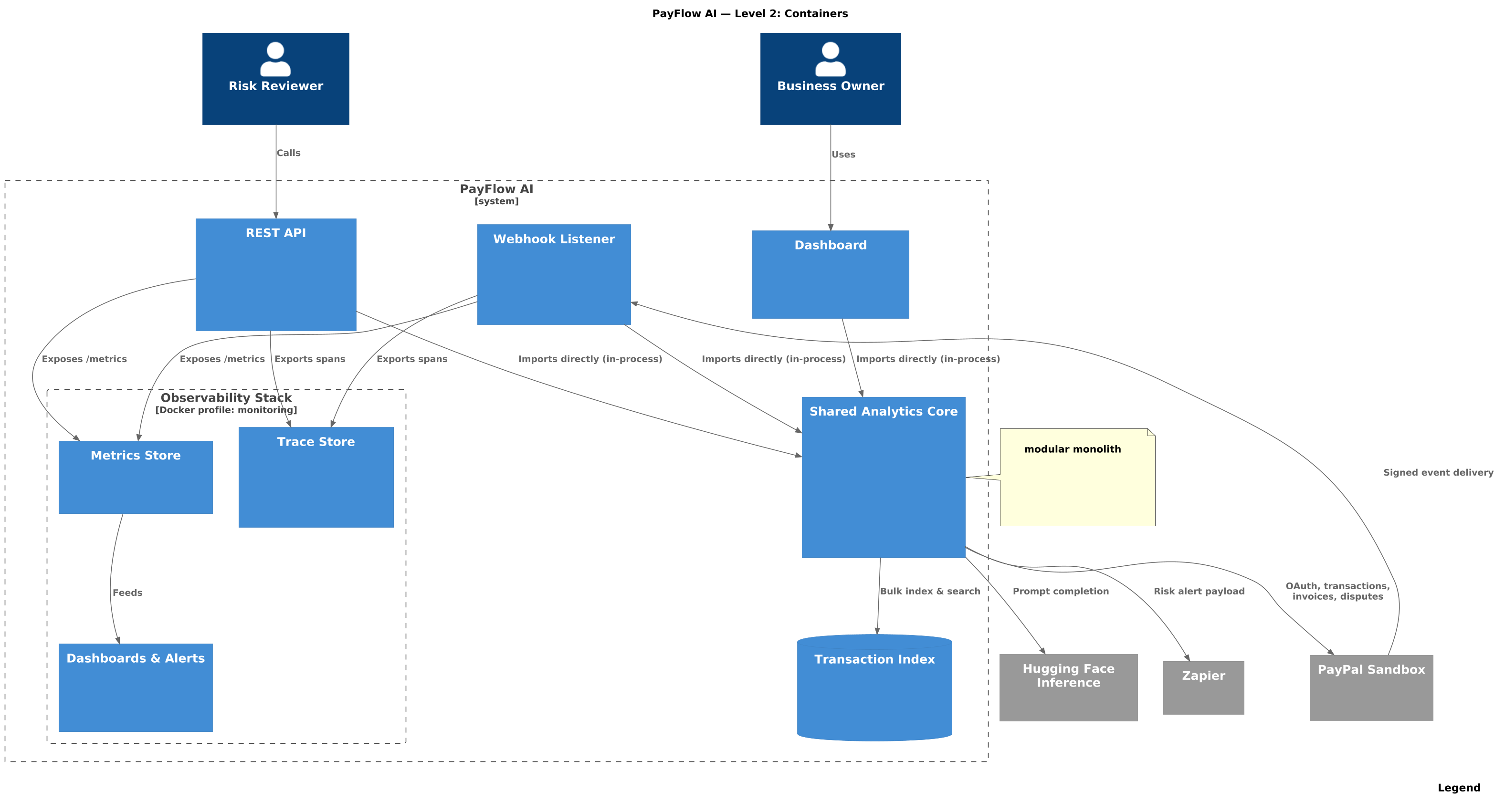
C4_2_container
-
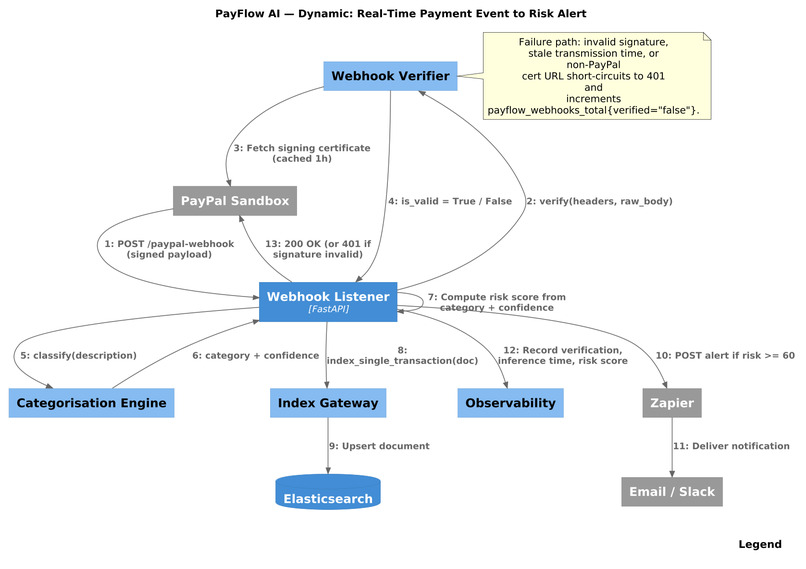
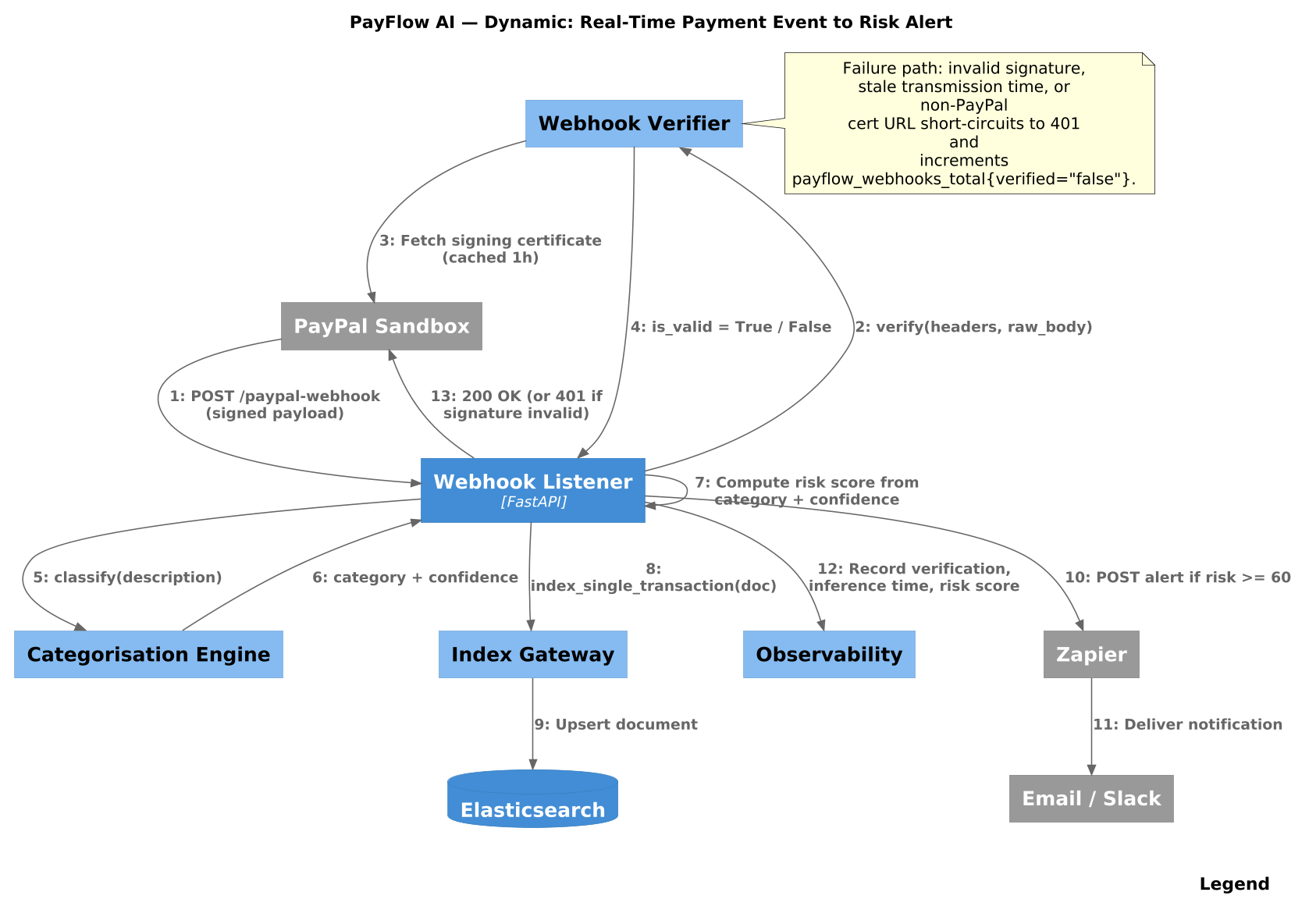
C4_4_dynamic_webhook
-
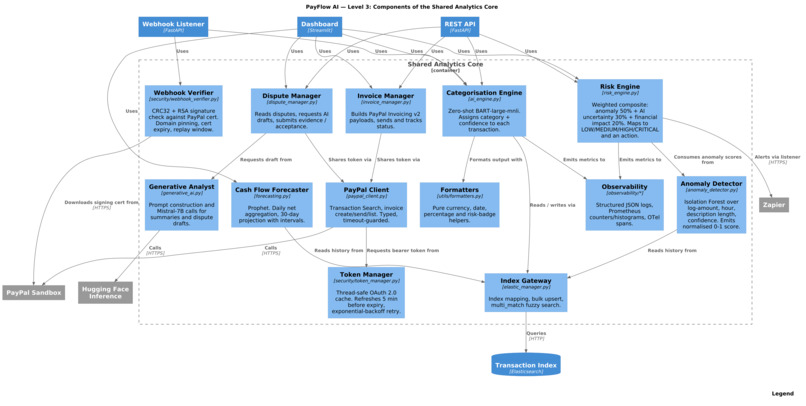
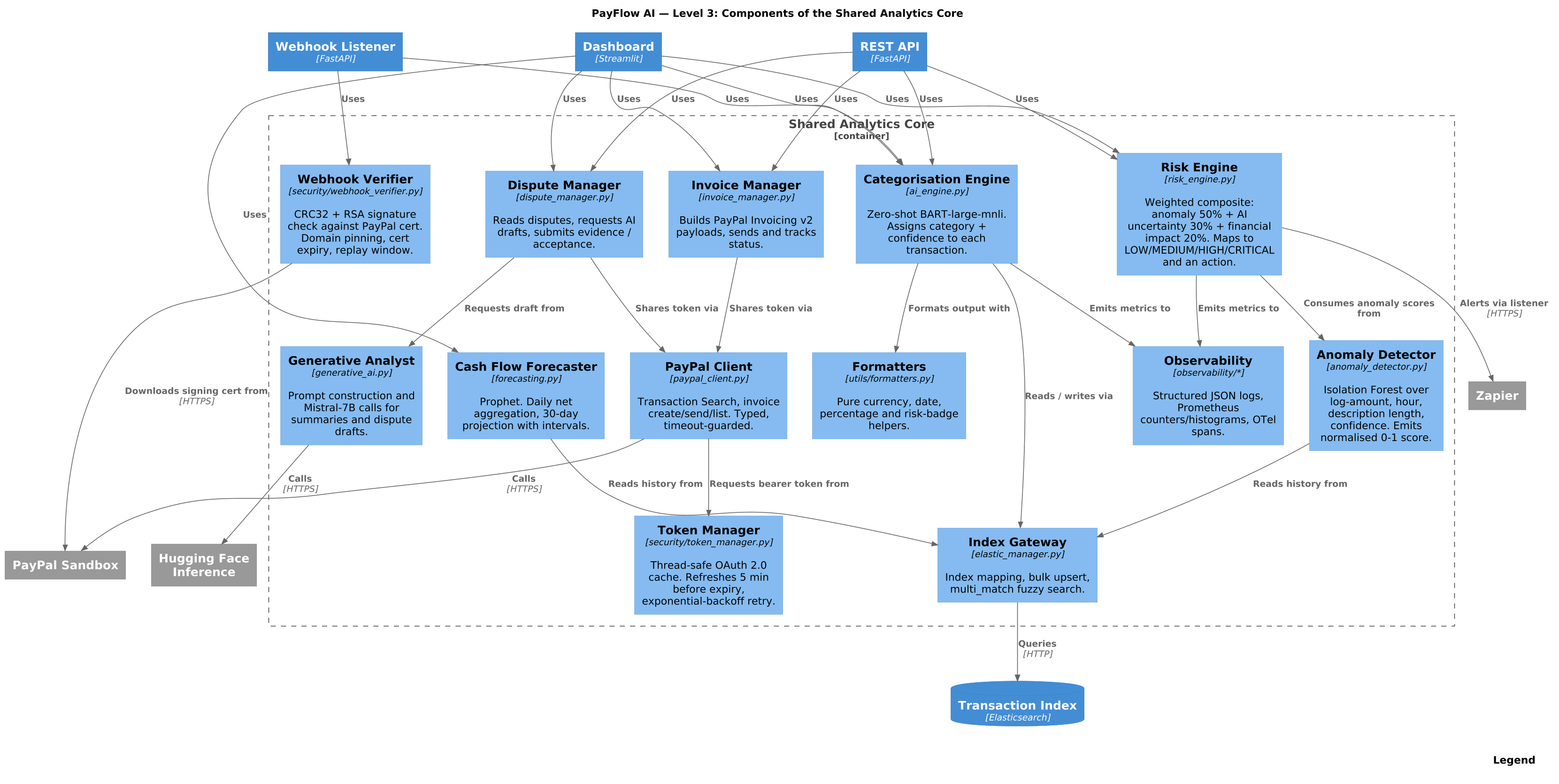
C4_3_component_core
-
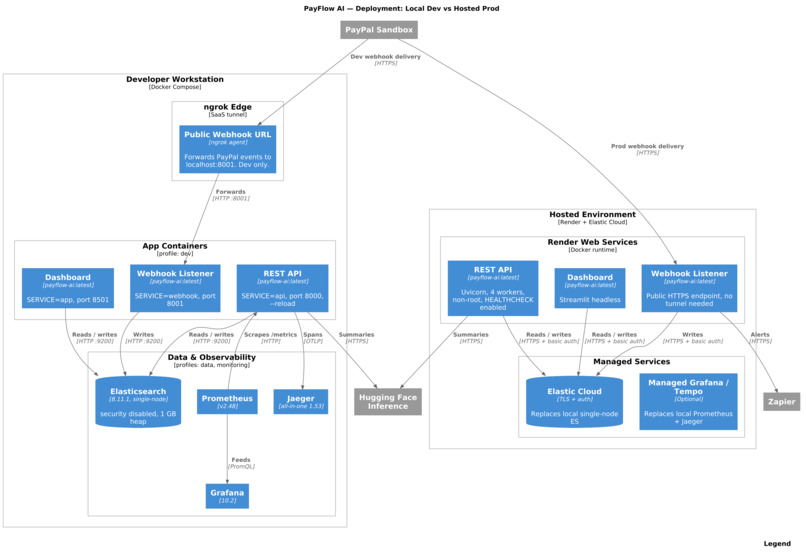
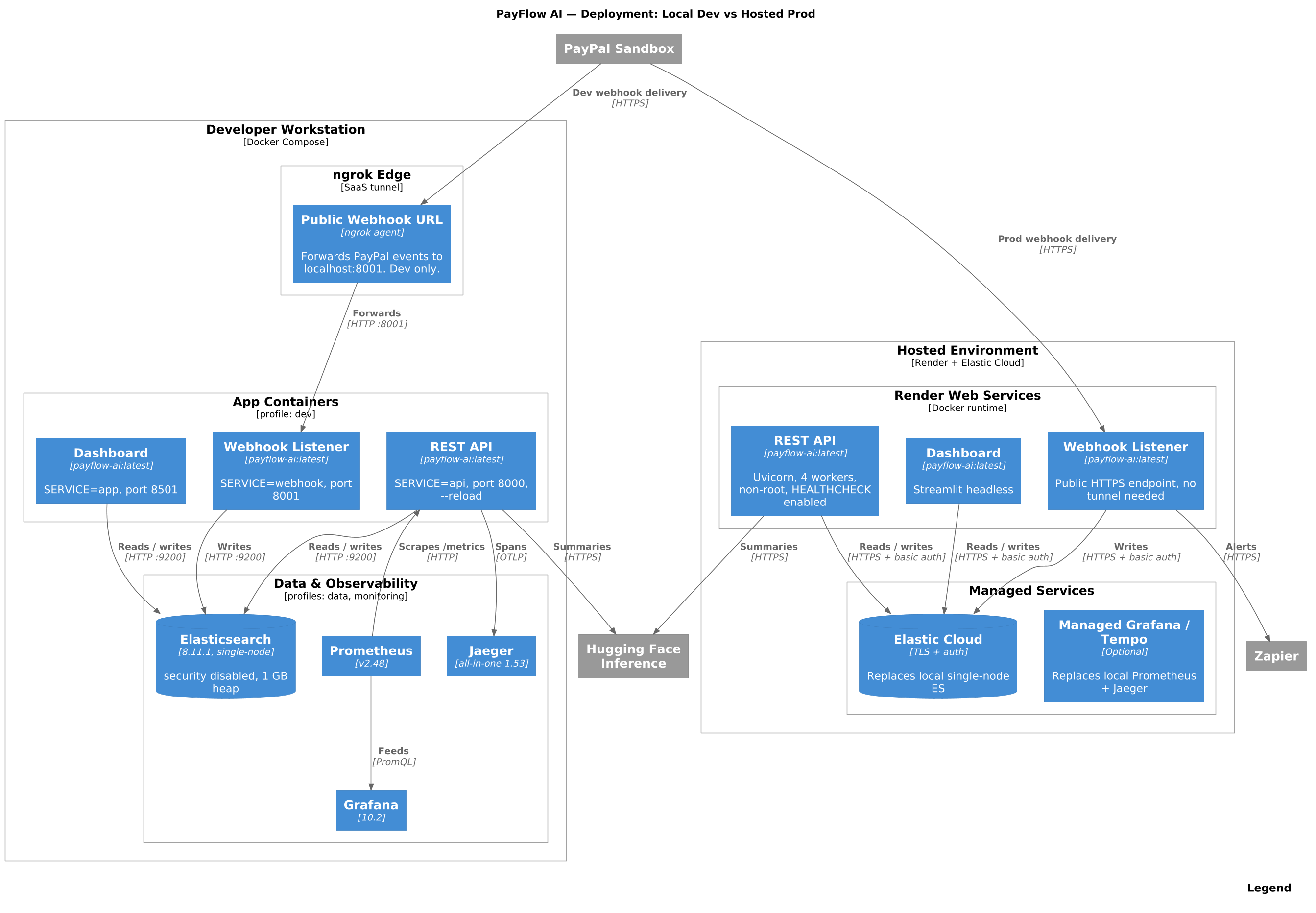
C4_5_deployment
-
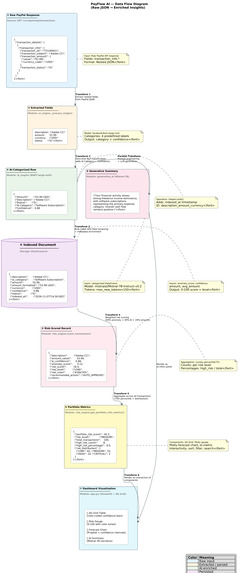
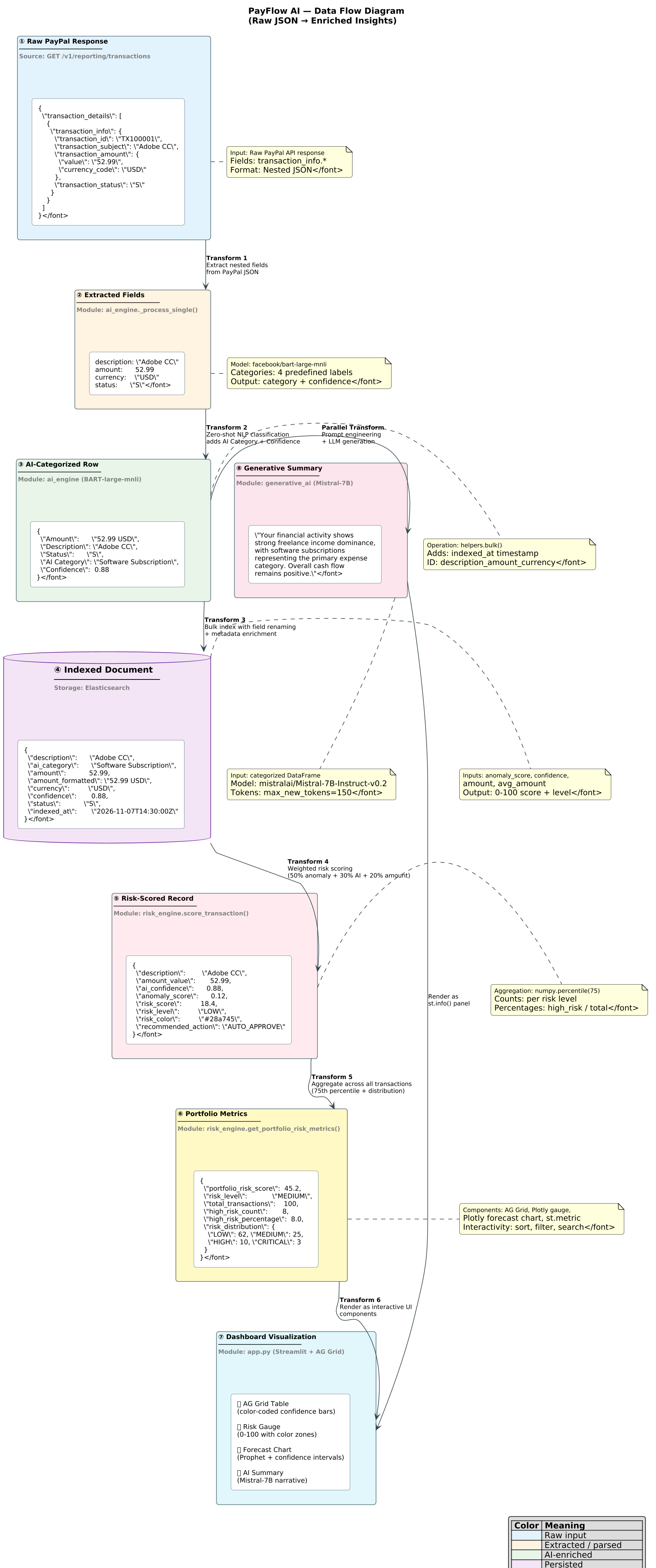
Data_Flow
-
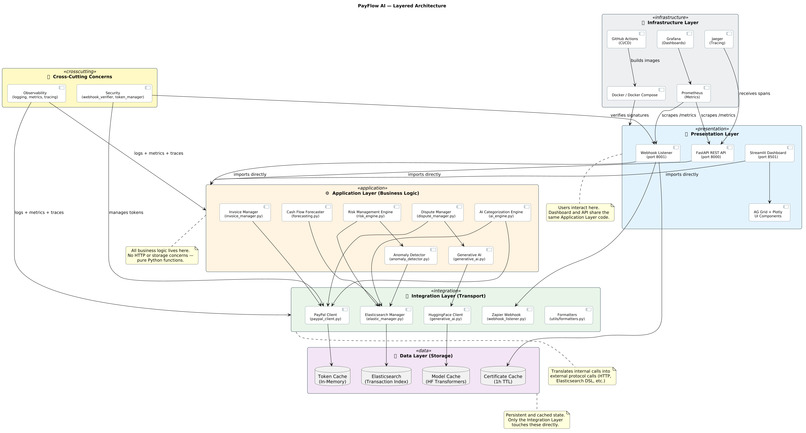
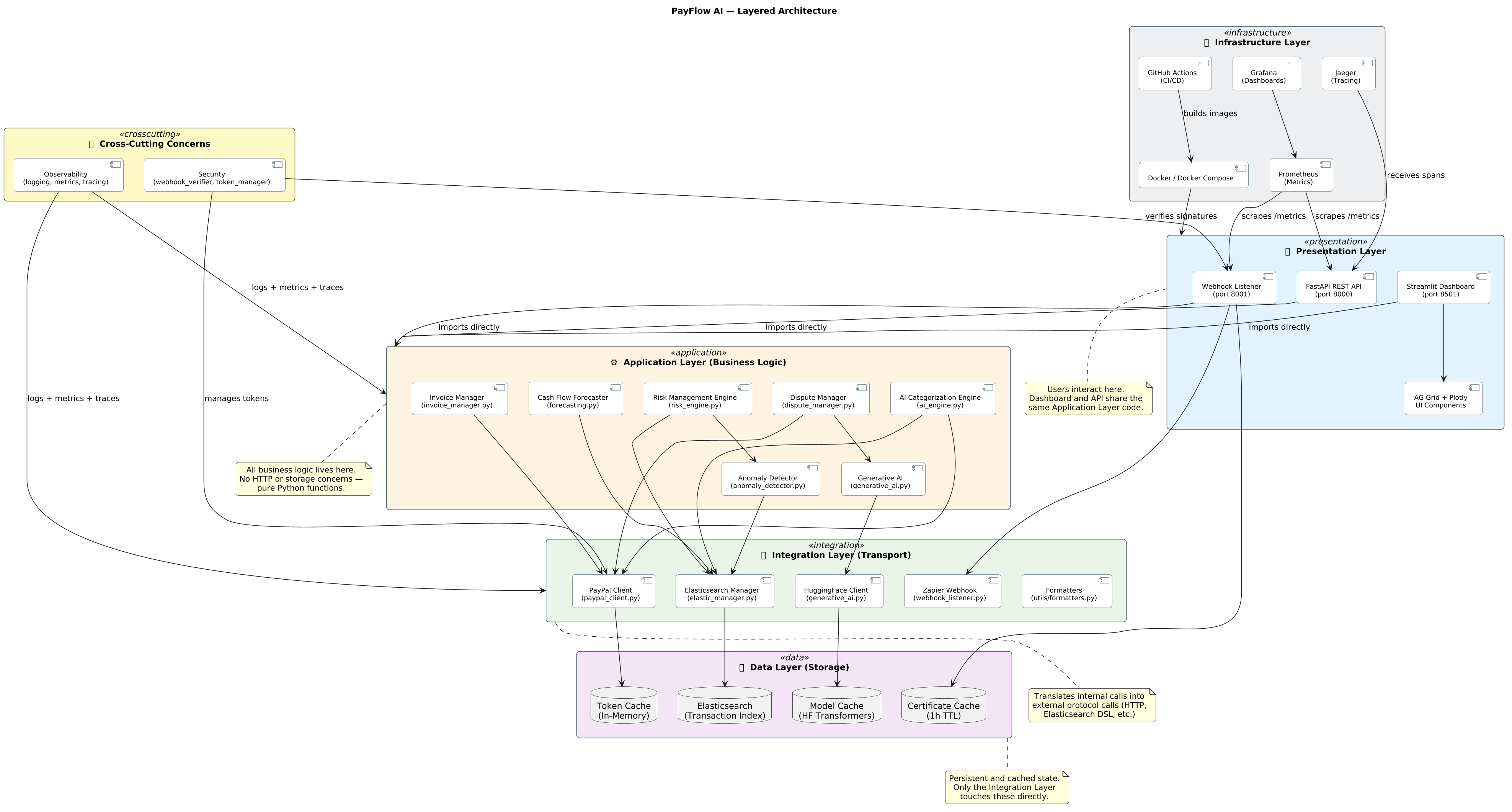
Layer_Architecture
Pay Flow AI Review
PayFlow AI is an intelligent financial operations platform that turns a passive PayPal ledger into a proactive decision engine. It automatically categorizes transactions using zero-shot NLP, forecasts cash flow 30 days out, detects fraud in real time through webhook-triggered risk scoring, and drafts professional dispute responses using a large language model. It's open-source, self-hostable, and built with enterprise-grade security and observability.
1.What exactly is the software product we have created?
We have built PayFlow AI, an enterprise-grade, AI-powered financial operations and risk management platform. It is a modular monolith that ingests financial transaction data, applies machine learning to categorize and analyze it, scores transactions for risk in real-time, and provides actionable business intelligence through a modern web dashboard and REST API.
2.What is the platform's primary goal?
To transform raw, unstructured financial data into proactive, actionable business intelligence. Instead of just recording what happened (like a traditional ledger), PayFlow AI understands what happened, predicts what will happen next, and alerts the user to potential risks before they become problems.
3.What key tasks does it address?
a) Automated Bookkeeping: Eliminating manual data entry by categorizing transactions instantly;
b) Real-Time Fraud/Risk Detection: Flagging unusual transactions the millisecond they occur via webhooks;
c) Cash Flow Visibility: Forecasting future financial health based on historical patterns;
d) Operational Efficiency: Automating the creation of invoices and drafting professional responses to customer disputes.
4.What are its main functions?
a) Data Ingestion: Pulling historical data via PayPal REST API and listening to real-time events via secure Webhooks;
b) AI Categorization: Using Zero-Shot NLP to assign categories and confidence scores to transaction descriptions;
c) Generative Insights: Using LLMs to write narrative financial summaries and dispute response drafts;
d) Predictive Analytics: Forecasting 30-day cash flow using time-series modeling;
e) Anomaly & Risk Scoring: Using unsupervised ML (Isolation Forest) combined with heuristic weighting to score every transaction from 0–100;
f) Search & Visualization: Providing an AG Grid-powered, Elasticsearch-backed dashboard with fuzzy search and interactive charts.
5.In which areas of industry can this software be used?
a) Freelancers & Creator Economy: Automating expense tracking and tax preparation;
b) Small to Medium Businesses (SMBs): Managing vendor payments, subscriptions, and cash flow without hiring a full-time CFO;
c) Fintech Startups: As a foundational engine for neobanks or financial management apps;
d) E-commerce: Monitoring payout health and detecting suspicious refund/dispute patterns;
e) Accounting Firms: As a white-labeled tool to provide clients with real-time financial health dashboards;
6.For which tasks is it best suited, and for which is it NOT recommended?
6.1.Best Suited For:
a) Pattern recognition in descriptive text (e.g., mapping «Starbucks» to «Personal Expense»);
b) SMB and freelance financial management (hundreds to low thousands of transactions per month);
c) Early-warning risk detection (flagging anomalies for human review);
d) Drafting first-pass responses to customer disputes;
6.2.NOT Recommended For:
a) High-Frequency Trading or Enterprise Banking: It is not built for millions of transactions per second (requires Kafka/distributed streaming);
b) Absolute Fraud Prevention: It is a decision-support tool, not a guarantee. A human must make the final call on «HOLD_AND_INVESTIGATE» actions;
c) Replacing Certified Auditors: AI can hallucinate or misclassify edge cases; it augments accountants, it does not replace legal/financial liability;
7.What are the limitations regarding its use?
a) Data Dependency: Forecasting and anomaly detection require at least 30-90 days of historical data to be accurate;
b) LLM Limitations: Generative summaries are based on prompts and can occasionally hallucinate if the input data is highly chaotic;
c) Third-Party Reliance: The platform depends on PayPal’s API uptime, Hugging Face’s inference API, and Zapier for alerts;
d) Sandbox Constraints: Currently configured for PayPal Sandbox; moving to production requires live API credentials, stricter compliance (PCI-DSS considerations if handling cards directly), and production-grade hosting;
8.What are the most promising avenues for its future development?
a) Source Aggregation: Integrate Plaid or Stripe APIs to pull data from bank accounts and credit cards, not just PayPal;
b) Custom Fine-Tuned Models: Replace the Zero-Shot BART model with your fine-tuned Mistral-7B (via QLoRA) specifically trained on financial ledgers for higher accuracy;
c) Event Streaming: Replace synchronous webhook processing with Apache Kafka or RabbitMQ for true asynchronous, high-throughput event handling;
d) Multi-Currency & Crypto Support: Add real-time FX conversion and integrate blockchain explorers for crypto transaction risk scoring;
9.What AI software products are utilized within the platform?
a) facebook/bart-large-mnli (Hugging Face): Zero-shot Natural Language Processing for transaction categorization;
b) mistralai/Mistral-7B-Instruct-v0.2 (Hugging Face Inference API): Large Language Model for generating narrative financial summaries and dispute response drafts;
c) IsolationForest (Scikit-Learn): Unsupervised machine learning algorithm for anomaly detection;
d) Prophet (Meta): Open-source time-series forecasting procedure for cash flow predictions;
10.How and to what extent are encryption and cryptography used within this platform?
Security is a first-class citizen in this platform:
a) Cryptographic Signature Verification: Every incoming PayPal webhook is verified using RSA public-key cryptography and SHA-256 hashing against PayPal’s official certificates to prevent spoofing and replay attacks;
b) OAuth 2.0: Secure, token-based authentication with PayPal, featuring intelligent caching and secure rotation;
c) Data in Transit: All external communications (PayPal, Hugging Face, Zapier) are enforced over HTTPS/TLS;
d) Secrets Management: Credentials are isolated in .env files, and the logging system actively masks sensitive fields (tokens, passwords) to prevent leakage in log files;
11.Do any counterparts to the platform we developed exist today?
Yes, sure. But with different focuses:
a) Enterprise/VC-Backed: Ramp, Brex, Expensify, Pleo. (These are polished, closed-source SaaS products focused heavily on corporate card spend management);
b) Open-Source/Self-Hosted: Firefly III, Actual Budget, Maybe. (These are great for personal finance but lack real-time AI risk scoring, webhook integrations, and generative AI features);
c) Our Unique Differentiator: PayFlow AI uniquely combines real-time webhook risk scoring, unsupervised anomaly detection, and generative AI dispute resolution in a fully observable, modular architecture. It is a "thinking" ledger, not just a tracking ledger.
12.What Economic and Financial Impact (The ROI)?
If deployed in a real SMB or freelance business, the ROI is highly measurable:
a) Time Savings (Labor ROI): Automating categorization saves ~5-10 hours of manual bookkeeping per month. At $50/hr, that’s $3,000+/year saved;
b) Fraud Mitigation (Risk ROI): Catching a single $5,000 fraudulent or erroneous transaction via the real-time Zapier alert pays for the entire infrastructure cost for years;
c) Cash Flow Optimization: Accurate 30-day forecasting prevents overdraft fees and allows for better timing of large purchases or investments;
d) Dispute Recovery: AI-assisted, professional dispute responses increase the win rate of chargeback disputes, directly recovering lost revenue;
13.Honest Limitations and Reality Check?
However, if we tried to sell this tomorrow to a mid-sized business as a live, production SaaS product, it would face harsh realities. Here is the unvarnished truth about the limitations and the gap between this project and an enterprise-grade Fintech product.
13.1.The Scale & Architecture Reality Check:
a) The Monolith Bottleneck: We built a «modular monolith». This is perfect for 10 to 10,000 transactions a day. But if a user processes 100,000 transactions a day, the shared Python process will bottleneck. The AI inference and bulk Elasticsearch indexing will block the webhook listener, causing PayPal to retry and eventually drop events;
b) Elasticsearch Single Node: We are running a single-node Elasticsearch instance with number_of_replicas: 0. In the real world, if that single node crashes or the disk fills up, the entire platform goes dark. There is no High Availability (HA) or failover;
c) Synchronous Processing: The webhook listener processes the AI categorization and risk scoring synchronously before returning a 200 OK to PayPal. If the Hugging Face API is slow (which it often is), the webhook takes 3-5 seconds to respond. PayPal might timeout and retry, causing duplicate processing;
13.2.The AI & Machine Learning Reality Check:
a) The «Cold Start» Problem: Isolation Forest (anomaly detection) and Prophet (forecasting) are statistically meaningless with fewer than 30–50 data points. A new user signing up will get garbage forecasts and zero anomaly detection until they build up months of history;
b) Zero-Shot NLP Limitations: bart-large-mnli is great, but it struggles with sarcasm, severe typos, or highly specific industry jargon (e.g., «AWS EC2 i3.2xlarge» might just get labeled «Personal Expense» if the prompt isn't perfectly tuned);
c) LLM Rate Limits & Costs: We are using the free/cheap Hugging Face Inference API for Mistral-7B. In production, this has strict rate limits. If 50 users click «Generate Summary» at the same time, the API will throttle you, and the dashboard will throw 503 errors. A real product needs a dedicated GPU instance or a paid enterprise API (like OpenAI or AWS Bedrock);
13.3.The Security & Compliance Reality Check (The Biggest Gap):
a) No RBAC (Role-Based Access Control): Currently, if you have the dashboard URL or the API key, you can see everything. A real financial platform needs strict user roles (e.g., «Viewer» can see dashboards, «Admin» can approve high-risk transactions, «Auditor» can only view logs);
b) Secrets Management: We are using a .env file. In a real enterprise, secrets (PayPal keys, HF tokens) are managed via AWS Secrets Manager, HashiCorp Vault, or Kubernetes Secrets, with automatic rotation;
c) GDPR / Data Privacy: We are storing transaction descriptions, amounts, and client emails in Elasticsearch in plain text. In Europe (GDPR) or California (CCPA), this is a massive compliance violation. Real fintechs encrypt PII (Personally Identifiable Information) at rest and in transit, and have «Right to be Forgotten» data deletion pipelines;
d) No Audit Trail: If a user manually overrides a «CRITICAL» risk score to «LOW», the system doesn't log who did it, when, or why. Financial regulators require immutable audit logs for every state change.
13.4. The Operational Reality Check:
a) No Disaster Recovery (DR): If the server burns down, we have no automated database backups. We would lose all indexed transaction history;
b) Log Rotation: Our structured logs write to logs/api.log. Without a tool like Logrotate or an ELK stack, this file will eventually grow to gigabytes, fill the disk, and crash the server;
c) Dependency Fragility: The platform relies on PayPal, Hugging Face, and Zapier. If Zapier changes its webhook format, or Hugging Face deprecates the Mistral-7B endpoint, the platform breaks silently until someone notices;
14.Project demonstration:
This project is attached a complete, self-contained demonstration Python script. The demo suite allows you to:
a) Showcase all features without requiring PayPal API credentials or external services;
b) Run instantly with zero setup - just Python and basic dependencies;
c) Demonstrate the complete platform including AI, forecasting, risk management, invoicing, and disputes;
d) Perfect for presentations to stakeholders, interviewers, or portfolio viewers.
For deeper technical details, refer to the companion documents in the directory folder: https://github.com/andrzimin72/PayFlow-AI/demo/readme-demo.md
15.PayFlow AI Quick Start
a) Instructions for using Demonstration Python script and Full-Setup Platform are posted in the directory folder https://github.com/andrzimin72/PayFlow-AI/docs/quickstart.md:
b) For deeper technical details, refer to the companion documents in the directory folder docs/:
High Architecture, C4 Models and Network Infrastructure (docs/architecture/);
Technical Whitepaper, Prerequisites, Installation, Configuration, and Quick Start Guide (docs/instructions/);
Tables of Risk Register and Risk Matrix (docs/instructions/).
16.Final Verdict and Thoughts for Reflection
We are fully aware of the gap between a prototype and enterprise production. If I were to take this to production tomorrow, my top three priorities would be:
a) Decoupling the Architecture: We would move the synchronous AI processing in the webhook listener to an asynchronous message queue like Apache Kafka or RabbitMQ. This ensures the webhook returns a 200 OK to PayPal in milliseconds, while the AI scoring happens in the background;
b) Hardening Security & Compliance: We would implement Role-Based Access Control (RBAC), migrate .env secrets to HashiCorp Vault, and add an immutable audit log for any manual overrides of the risk engine;
c) Solving the AI Cold Start: We would implement a fallback rule-based engine for new users with <30 transactions, and migrate the Hugging Face inference to a dedicated, auto-scaling GPU endpoint to prevent rate-limiting.
We built it this way initially to validate the core business logic and data flow quickly, and we have a clear roadmap for how to scale it.
Built With
- bart-large-mnli
- cryptography
- elasticsearch
- fastapi
- grafana
- jaeger
- mistral-7b-instruct
- numpy
- opentelemetry-api
- orjson
- pandas
- plotly
- prometheus-client
- prophet
- pydantic
- pyngrok
- python
- scikit-learn
- scipy
- slowapi
- streamlit
- torch
- transformers
