-
-
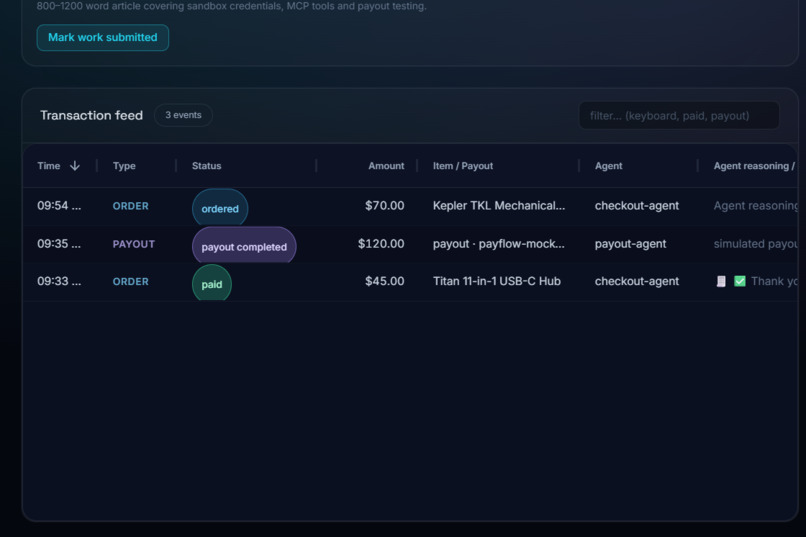
transaction history
-
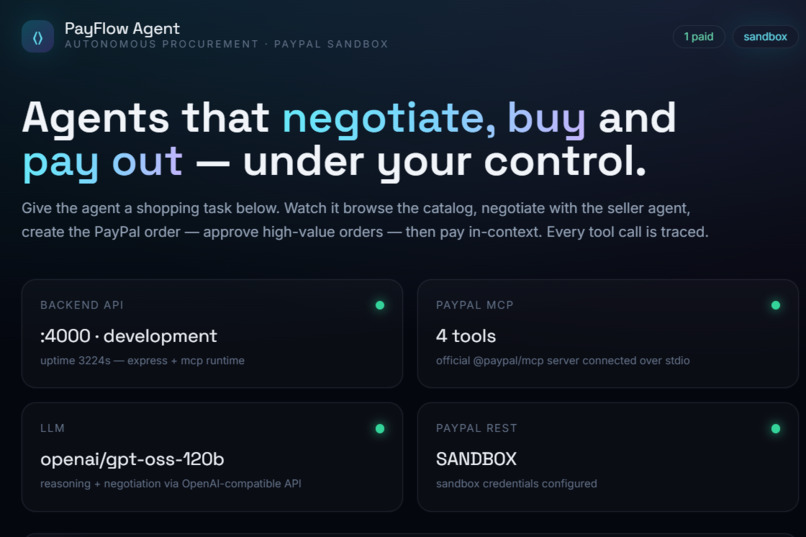
project overview
-
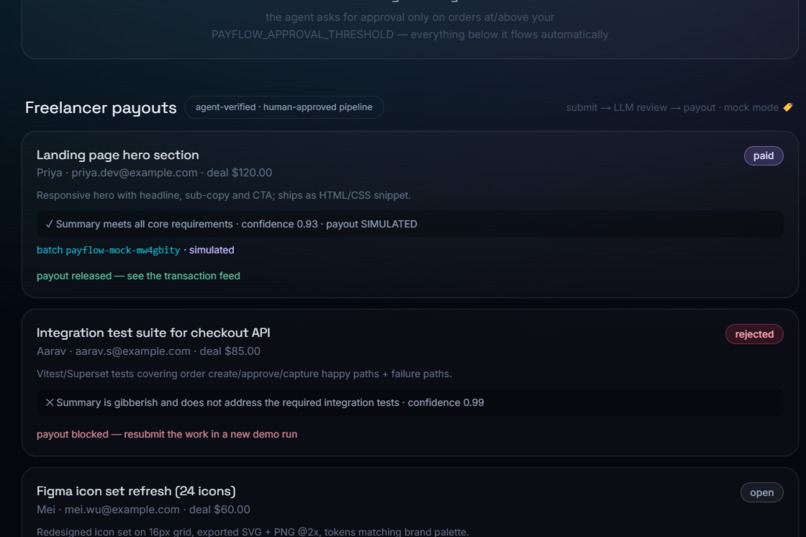
functionality
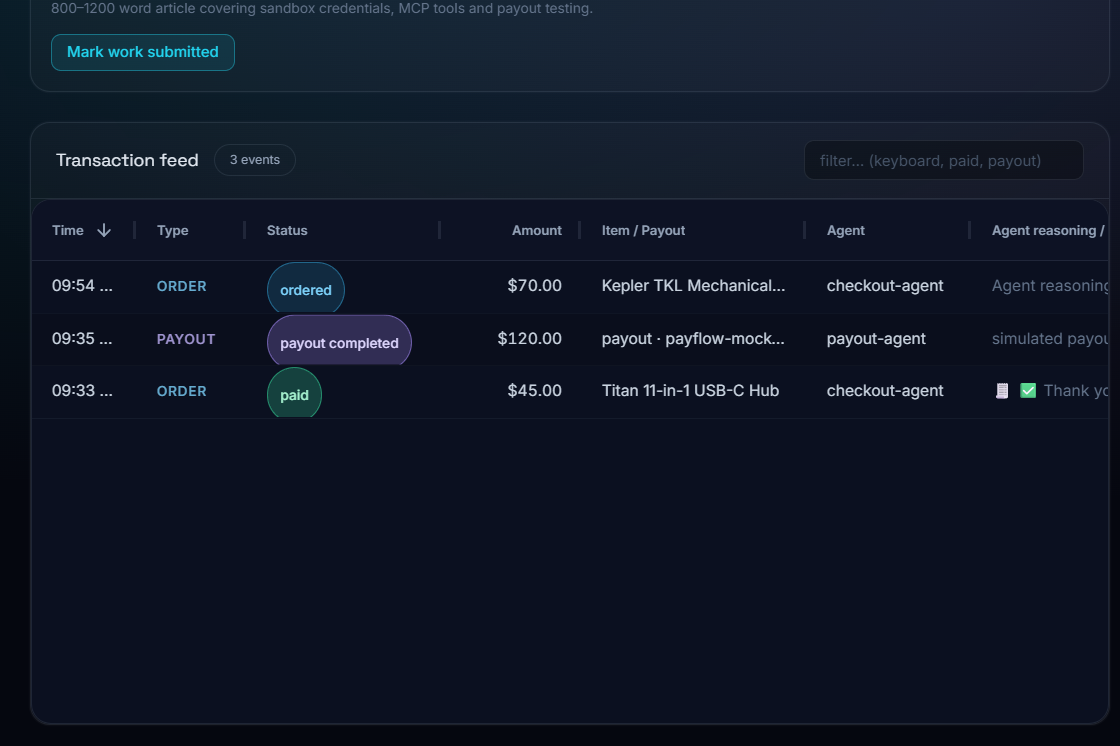
Inspiration
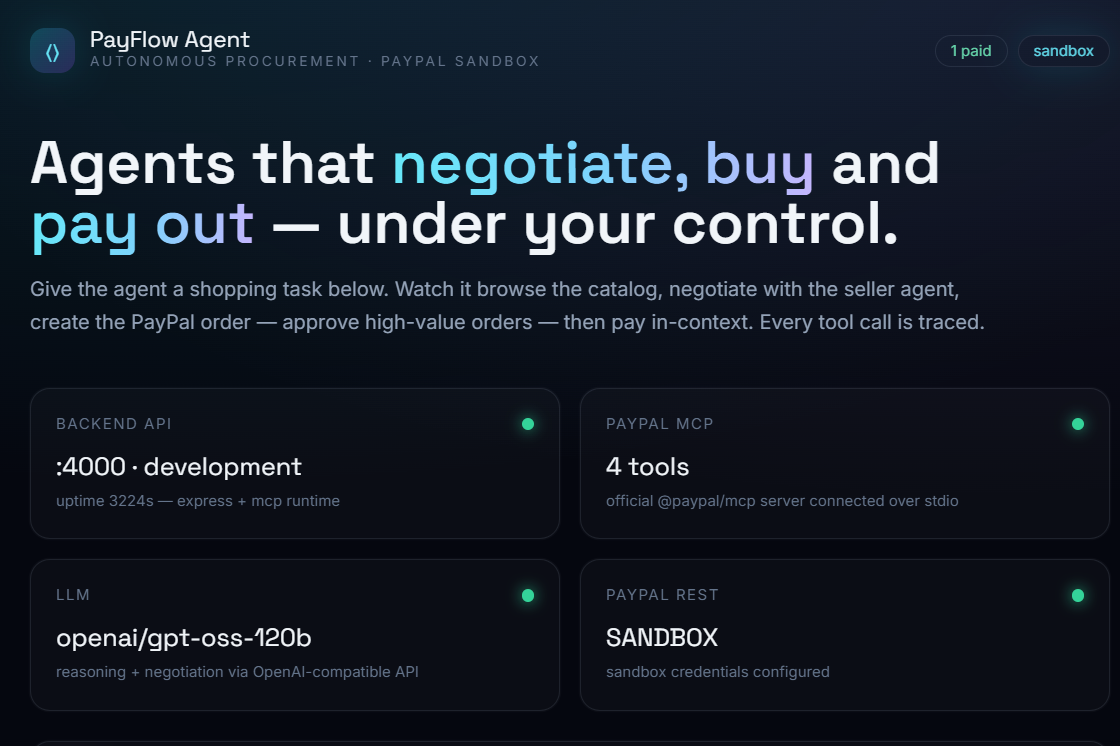
Autonomous agents are getting remarkably good at acting — browsing, negotiating, transacting. The missing half is governance: nobody can watch why an agent spent money, stop it before it does, or audit what happened afterwards. With payments in the loop, that risk multiplies. We asked: what if an AI agent had real PayPal superpowers, but was born inside a control room?
PayFlow Agent is our answer — the agent does the work; the platform provides the discipline.
What it does
- Autonomous checkout agent — a buyer agent browses a curated catalog through the official PayPal MCP server, haggles with an independent seller agent, and executes real sandbox PayPal orders. Live validation: the Titan USB-C hub negotiated from $59.99 → $45.
- Human-in-the-loop spending gate — any order ≥ $500 is held in
pending_approvaluntil an admin approves or rejects it from the dashboard. - A governance dashboard, not a chat toy — every tool call (args, results, duration) streams into an expandable trace timeline; an AG Grid audit feed tracks all money movement with receipts; smart PayPal buttons capture the order in-context.
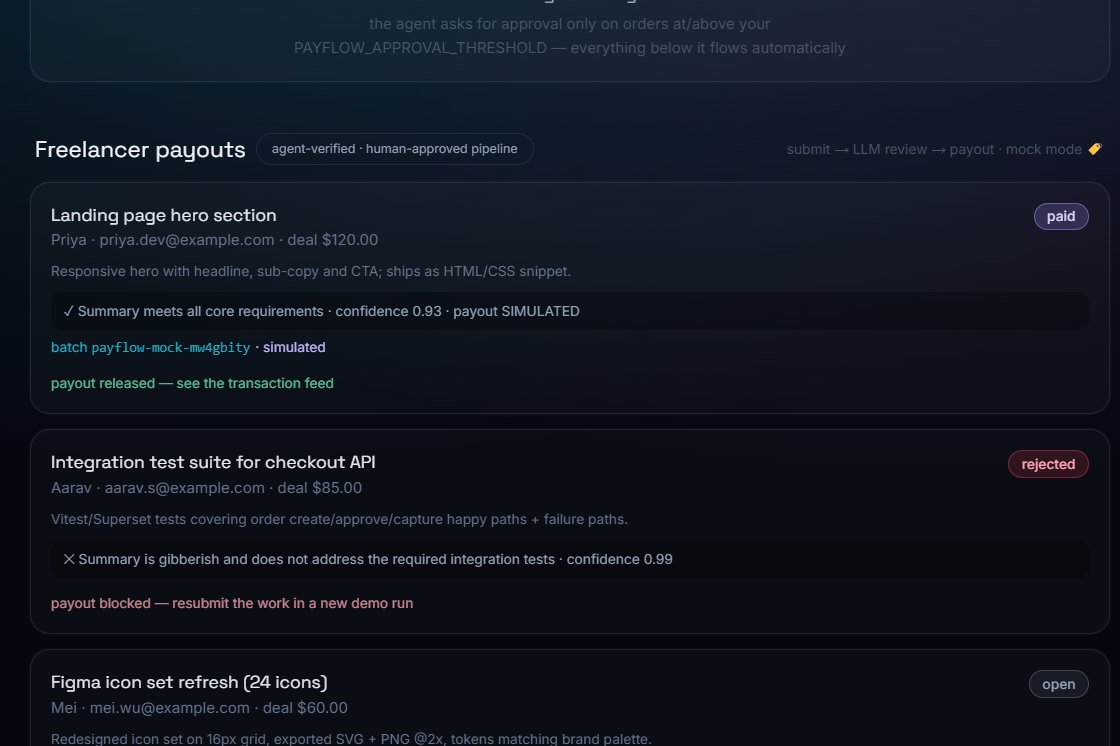
- Freelancer payout pipeline — manager submits the deliverable → an LLM quality gate scores it (live run: approved at 0.93 confidence) → admin releases a Payout batch. In regions where PayPal doesn't serve payout senders (like India), batches are clearly labeled simulated — the real REST path ships behind one env var.
- Webhooks → AI-written receipts — approval/capture events are matched against our own
transaction store, flip the status to
paid, and an LLM writes the receipt from verified facts only: "Thank you for purchasing the Titan 11-in-1 USB-C Hub for $45.00. Your PayPal order 42D08450M5493690L is now paid." Unknown event ids get an honest202 ignored— incoming envelopes are never trusted blindly.
How we built it
A TypeScript monorepo: Express + TS backend, Next.js dashboard. The backend spawns the
official @paypal/mcp npm package as a child process over stdio, auto-minting and refreshing
sandbox OAuth tokens. One tool-calling loop (max 10 rounds) merges four in-process domain tools —
get_product_catalog, negotiate_with_seller, create_paypal_order, execute_paypal_payout —
with filtered MCP tools, recording every step. Orders run on @paypal/paypal-server-sdk; payouts
use the documented /v1/payments/payouts endpoint; guarded amounts flow through a single shared
runPayout() service. The brain goes through an OpenAI-compatible gateway (Groq in this build —
one env var swaps providers). Zod-validated env, pino-style logs, a full Postman collection, and
a Render blueprint ship in-repo.
Challenges we ran into
- Token budgets: Groq's free 8k tokens/min cap choked on full MCP schemas → we added a
PAYPAL_MCP_TOOLSfilter, keeping the agent sharp on what matters. - Reasoning models misbehave:
openai/gpt-oss-120bhides its thinking in areasoningfield — replaying it broke tool loops, and tinymax_tokensstarved it before it wrote anything. We fixed both (strip on replay;max_completion_tokens: 500for receipts) and one nudge for empty replies. - India payout restriction: PayPal blocks Payouts from India-based senders. Rather than fake
success, we built explicit
PAYOUTS_MODE=mock— simulated batches are always labeled, with the real code path ready to switch on.
Accomplishments we're proud of
A fully validated end-to-end pipeline: chat → negotiation → sandbox order → webhook → AI receipt, plus a gig payout approved and paid out in the same session. And a strict honesty table in our docs separating what's real from what's simulated — we'd rather score points for transparency than lose them for pretending.
What we learned
- MCP is the fastest path to real platform superpowers for agents.
- Guardrails are design features, not afterthoughts: matching-first webhooks, bounded tools, approval gates, and labeled simulation are what make agent autonomy trustworthy.
- Reasoning models need different plumbing than chat models — and earn it.
What's next
Postgres-backed stores (our records are already swap-compatible), payout retry queues + a refund console, signature-verified webhooks on a public Render URL, and a real (sandbox) Payouts demo from a supported sender country.
Built With
- ag-grid
- ai-agents
- express.js
- groq
- human-in-the-loop
- llm
- model-context-protocol
- multi-agent-systems
- next.js
- node.js
- oauth
- paypal-mcp
- paypal-orders-api
- paypal-payouts-api
- paypal-sandbox
- react
- tailwindcss
- tool-calling
- typescript
- webhooks
