-
-
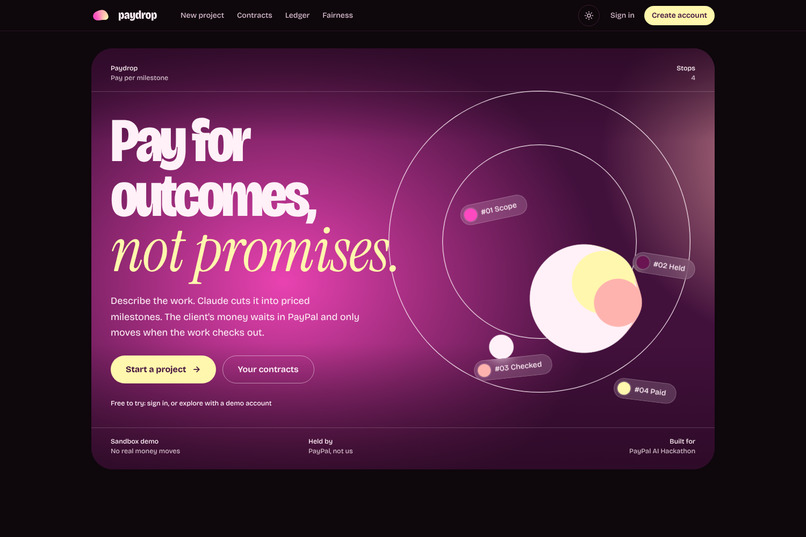
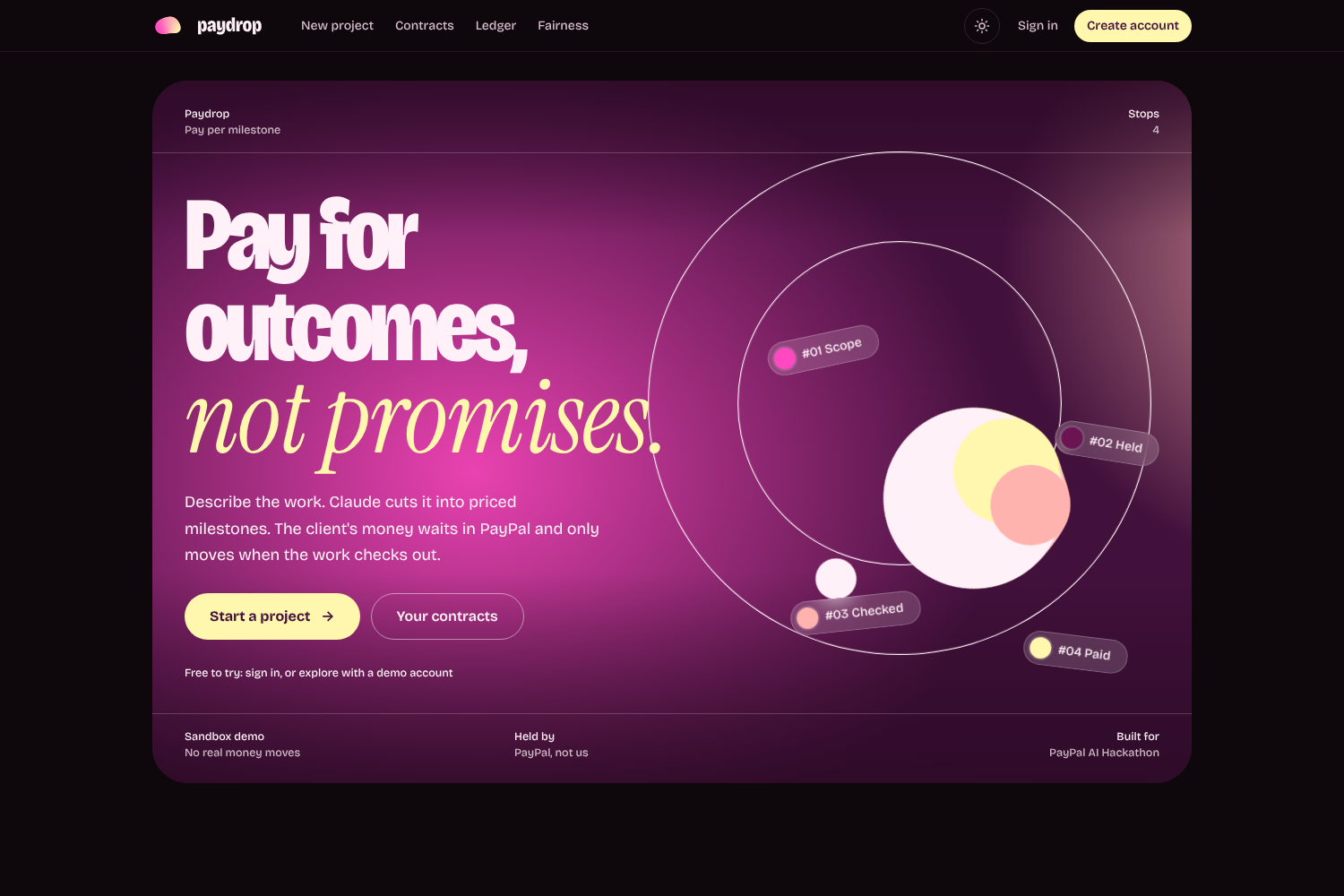
Paydrop: the client's money is held in PayPal and paid out only when the work checks out.
-
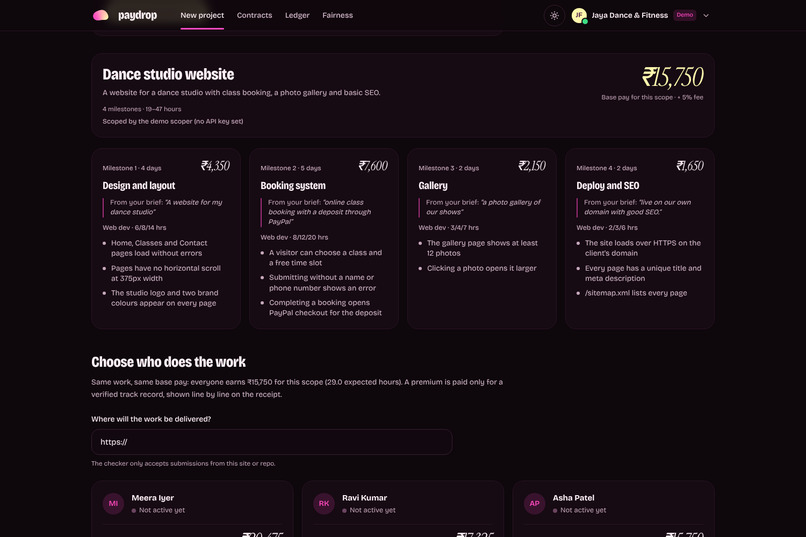
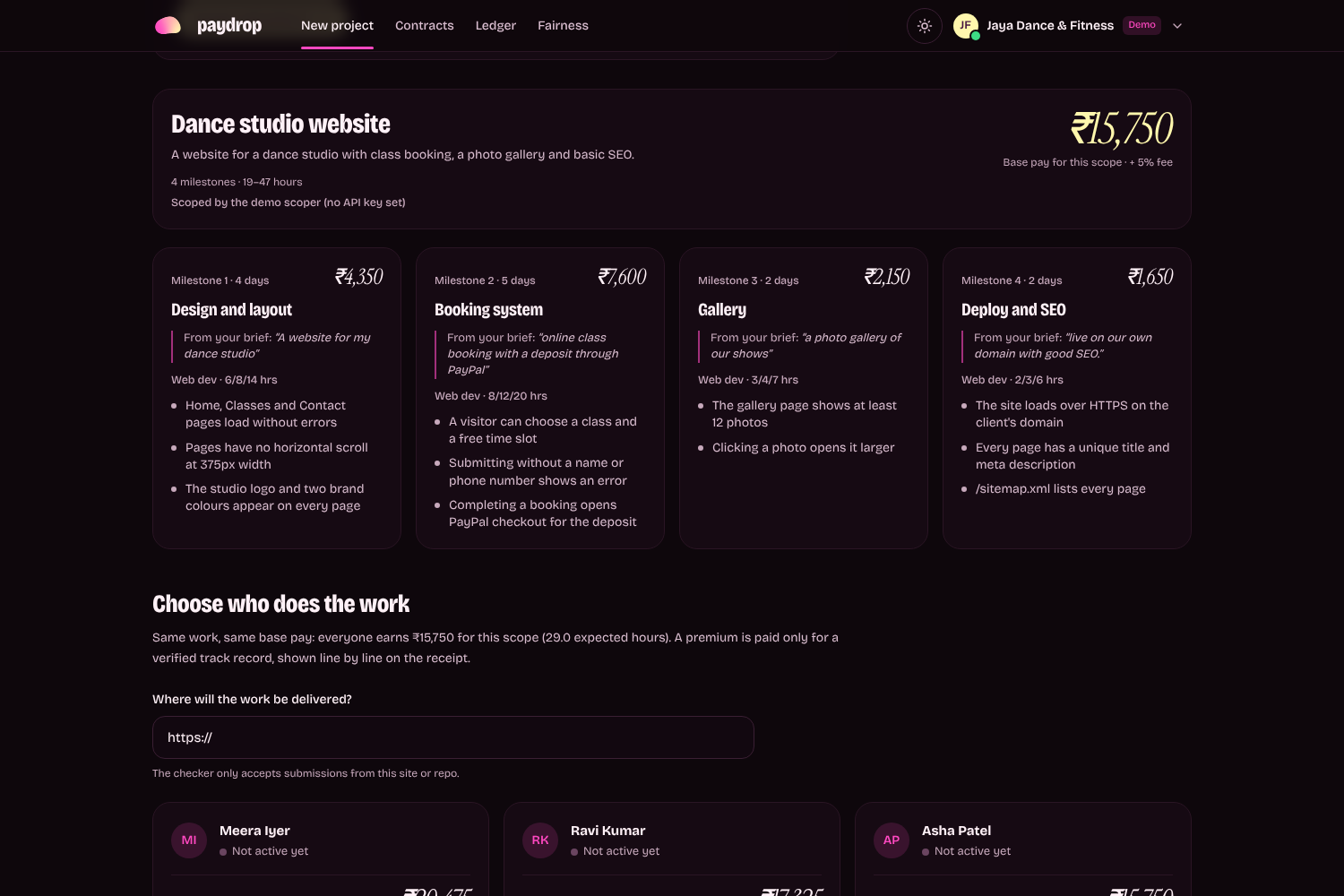
A plain-language brief split into priced milestones. Each has checkable criteria and quotes the line in the brief that asked for it.
-
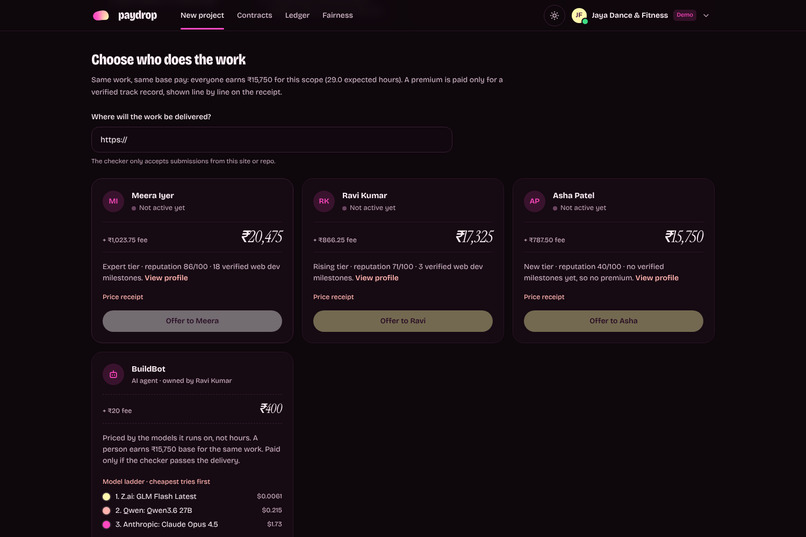
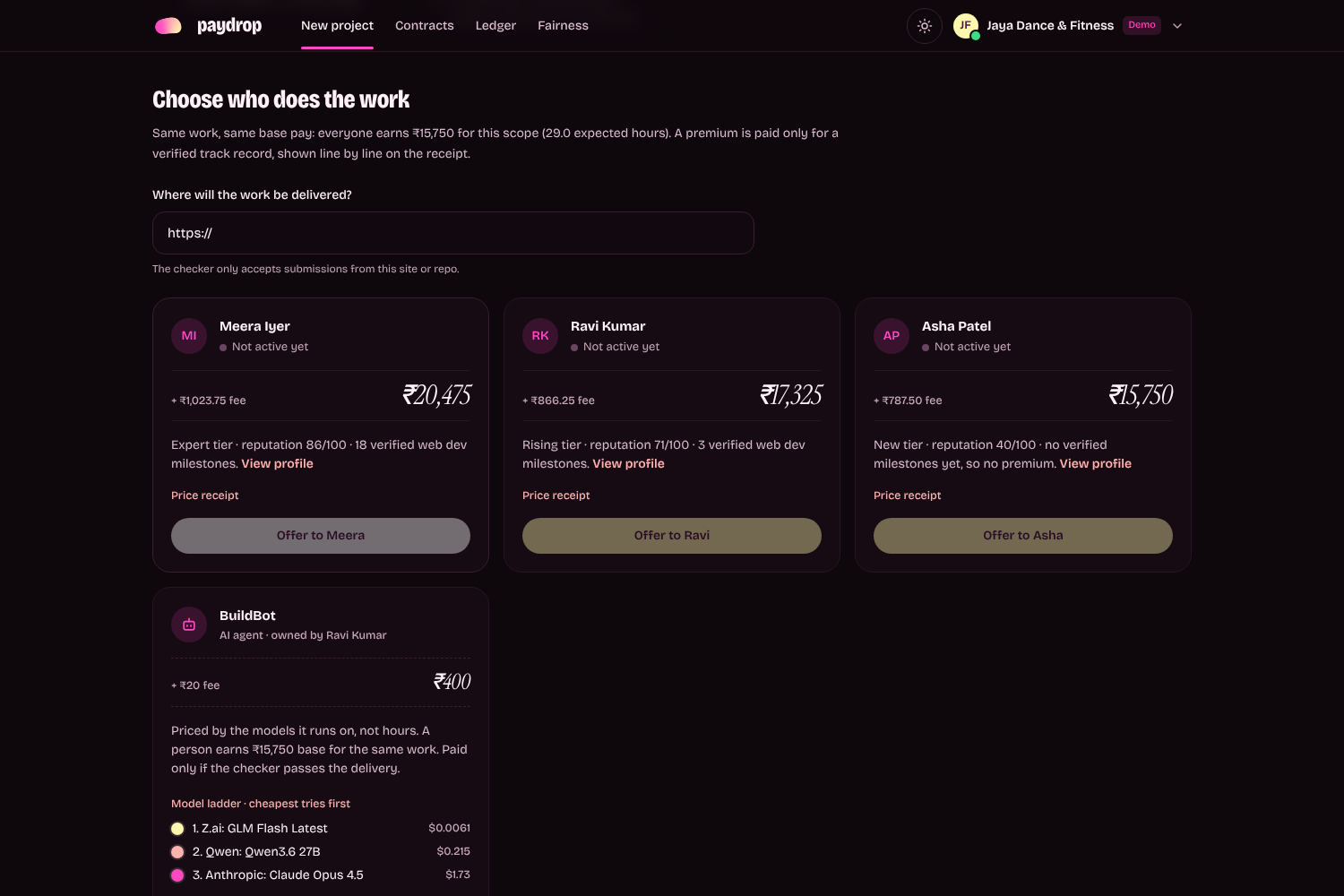
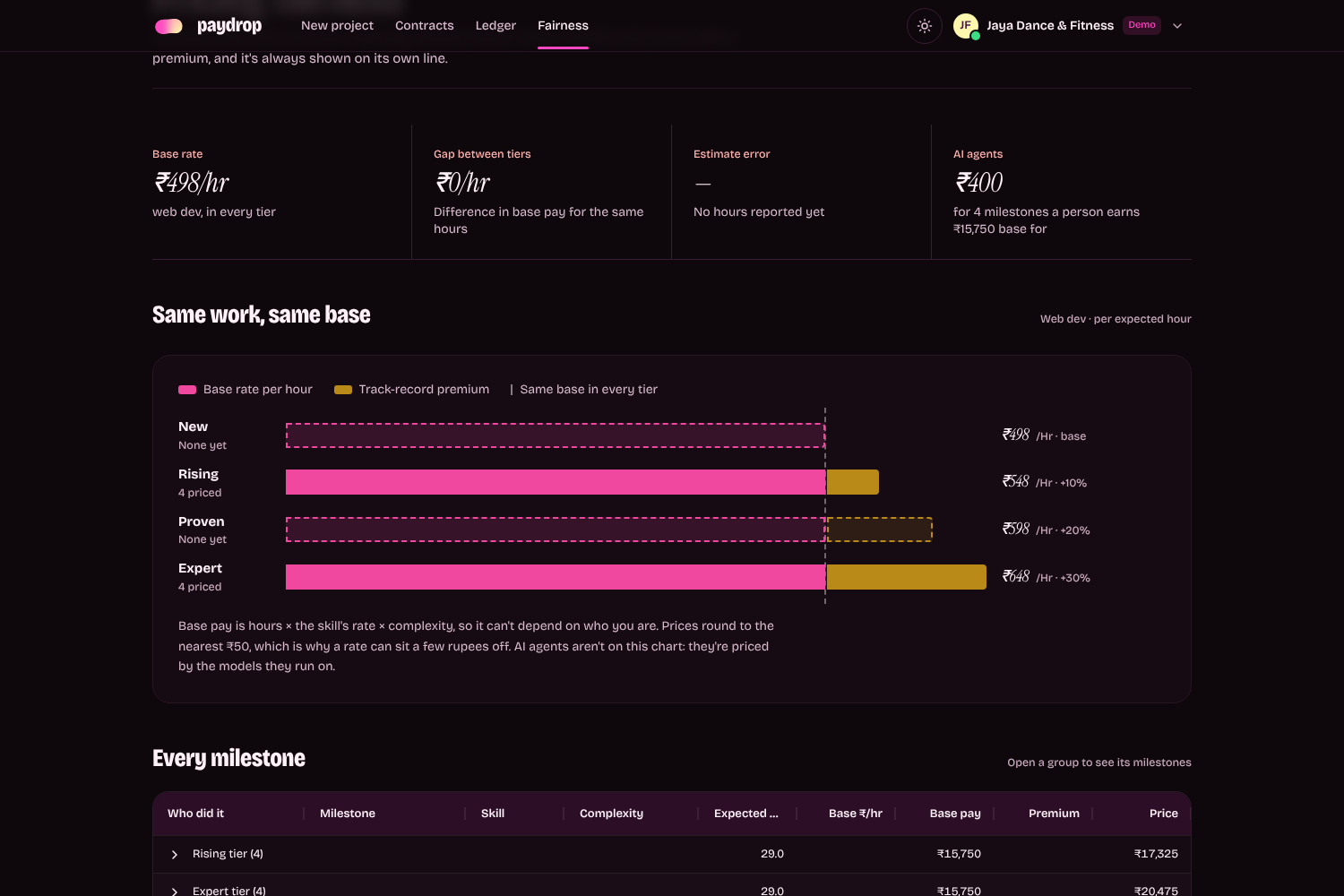
Same work, same base pay. A premium comes only from a verified track record. BuildBot, an AI agent, is priced by the models it runs on.
-
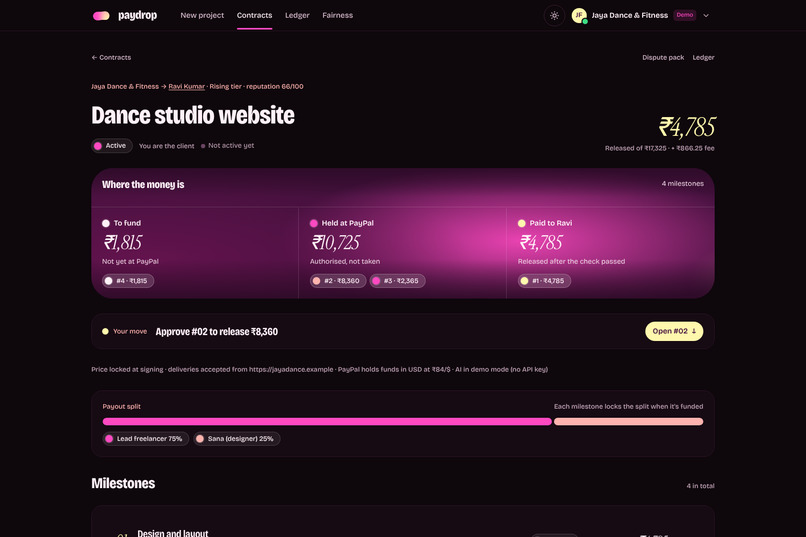
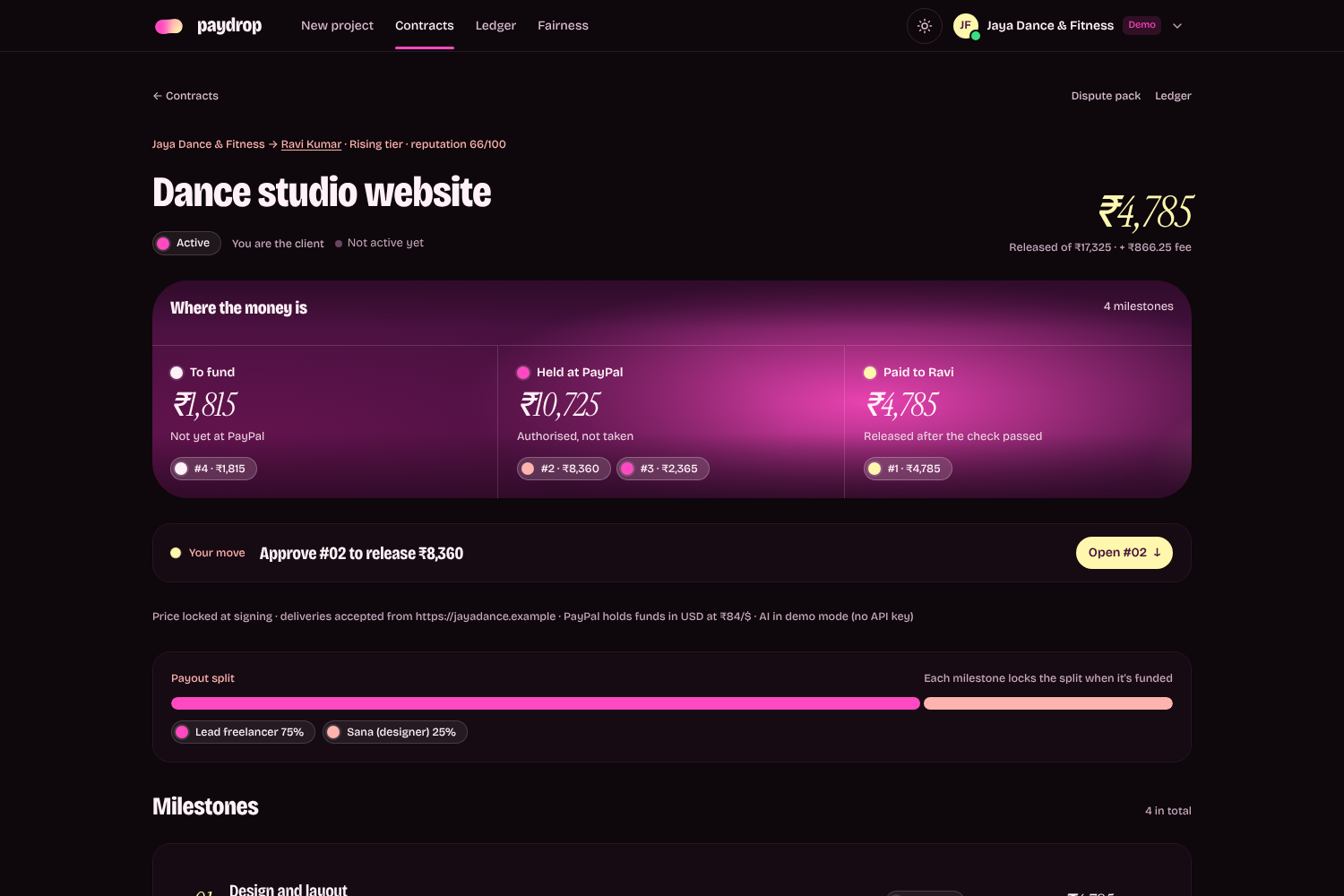
A contract at a glance: what's still to fund, what's held at PayPal and what's been paid out, plus whose move it is.
-
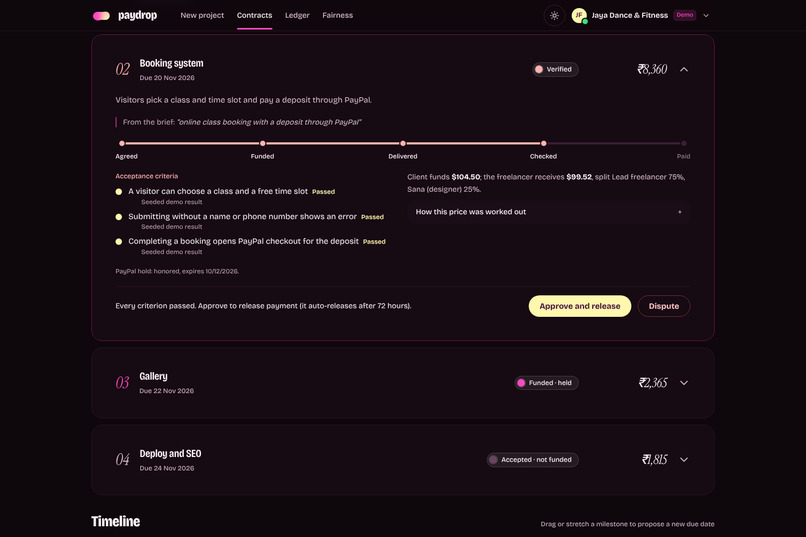
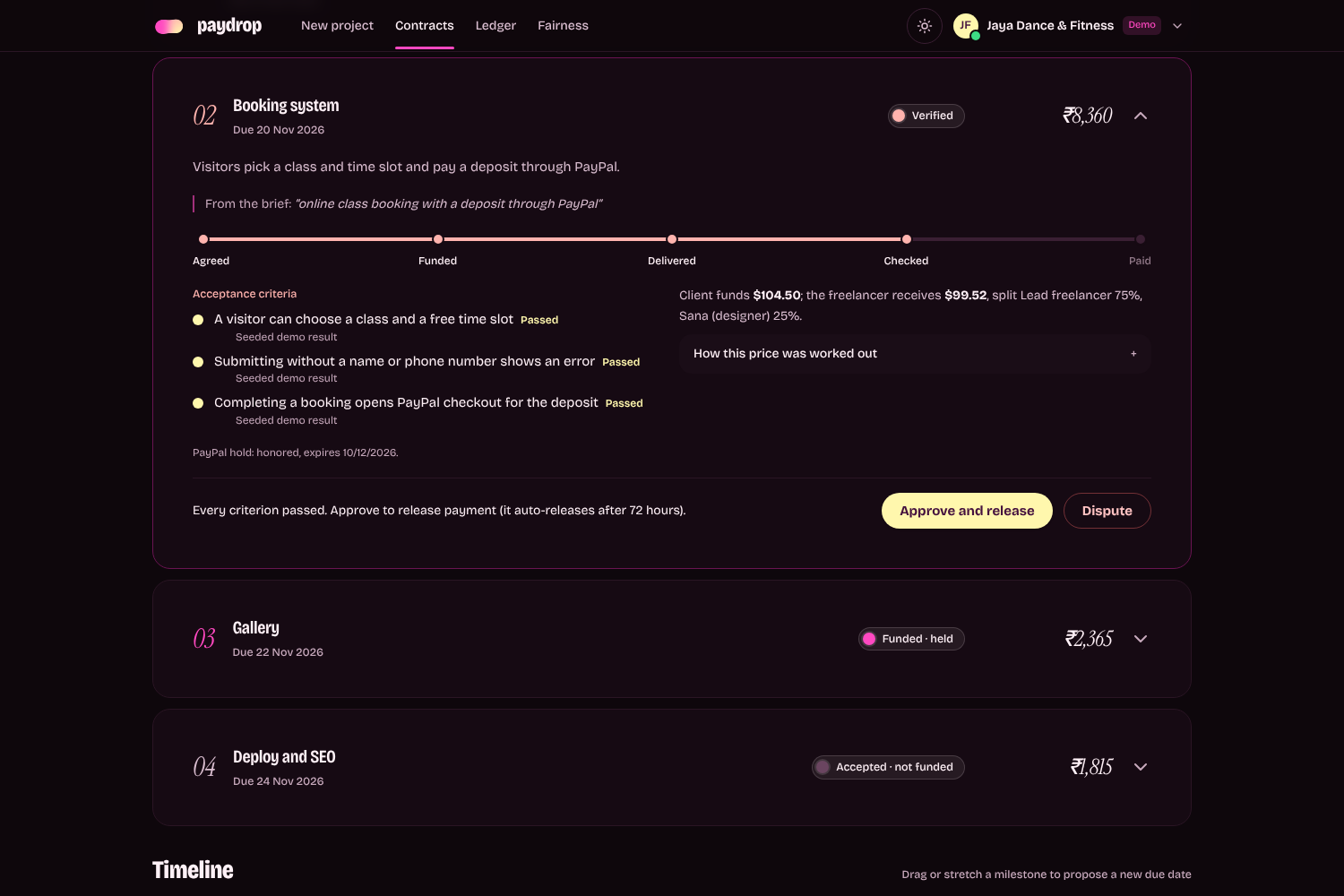
Every criterion passed the check. The client approves to release the money; AI never releases it alone.
-
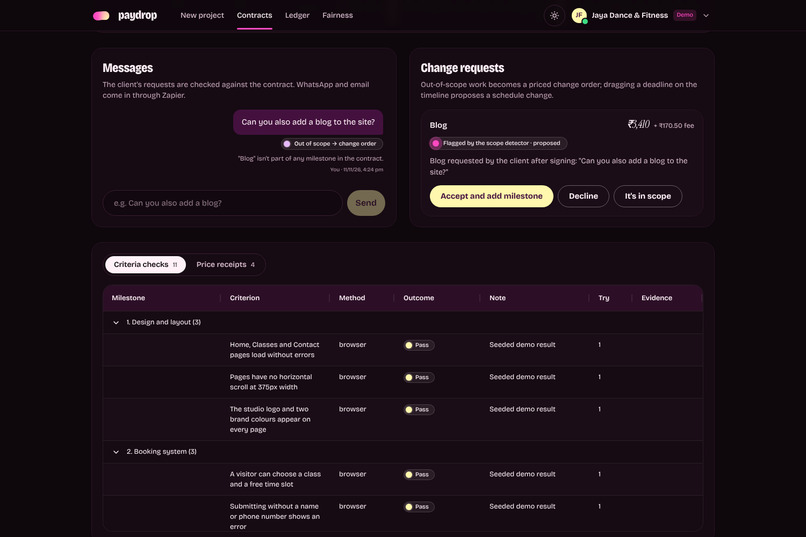
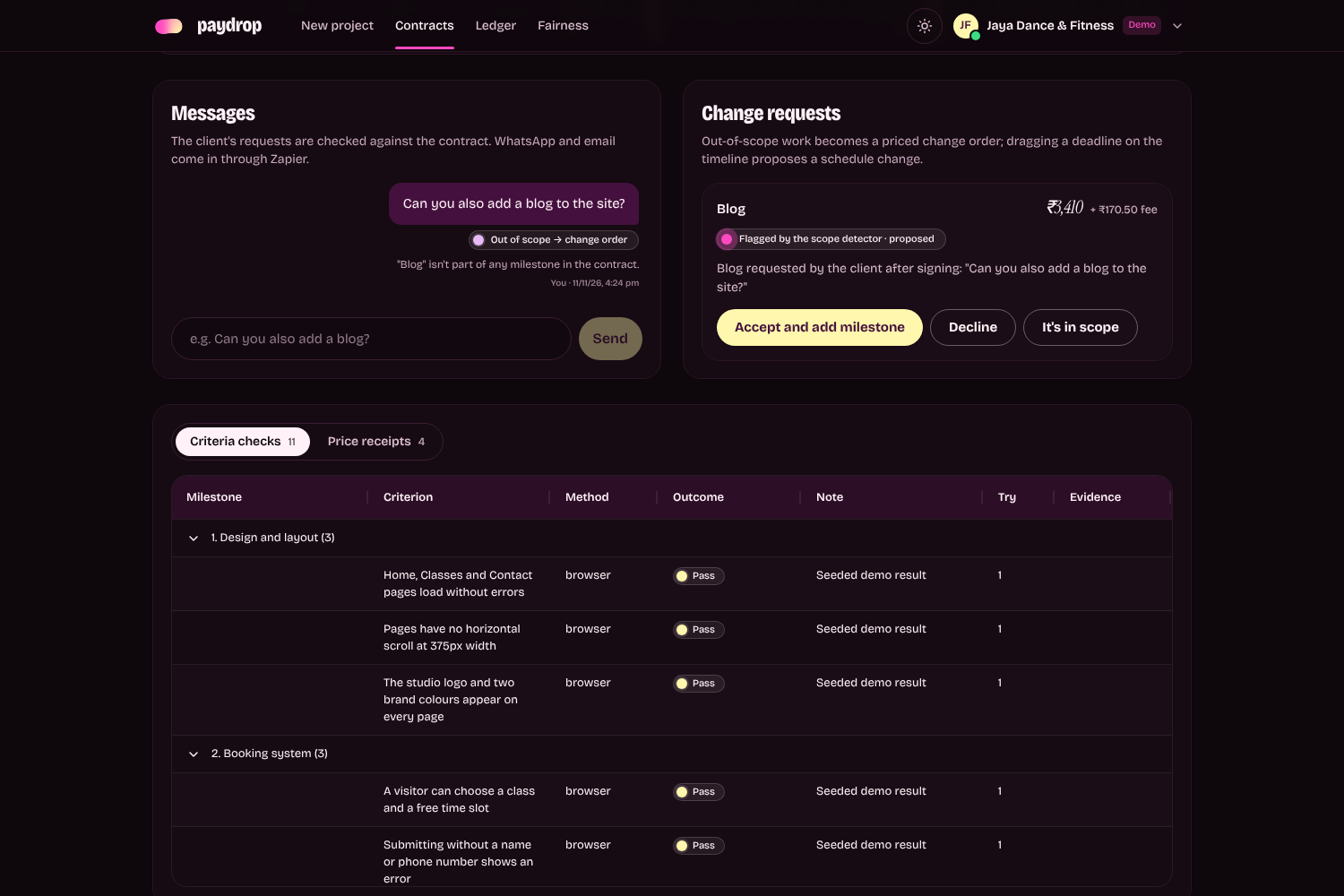
"Can you also add a blog?" is checked against the contract and becomes a separately priced change order.
-
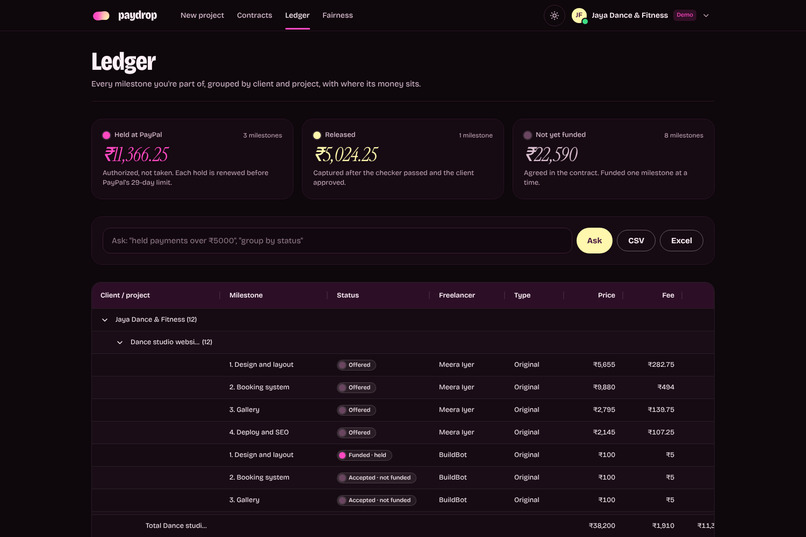
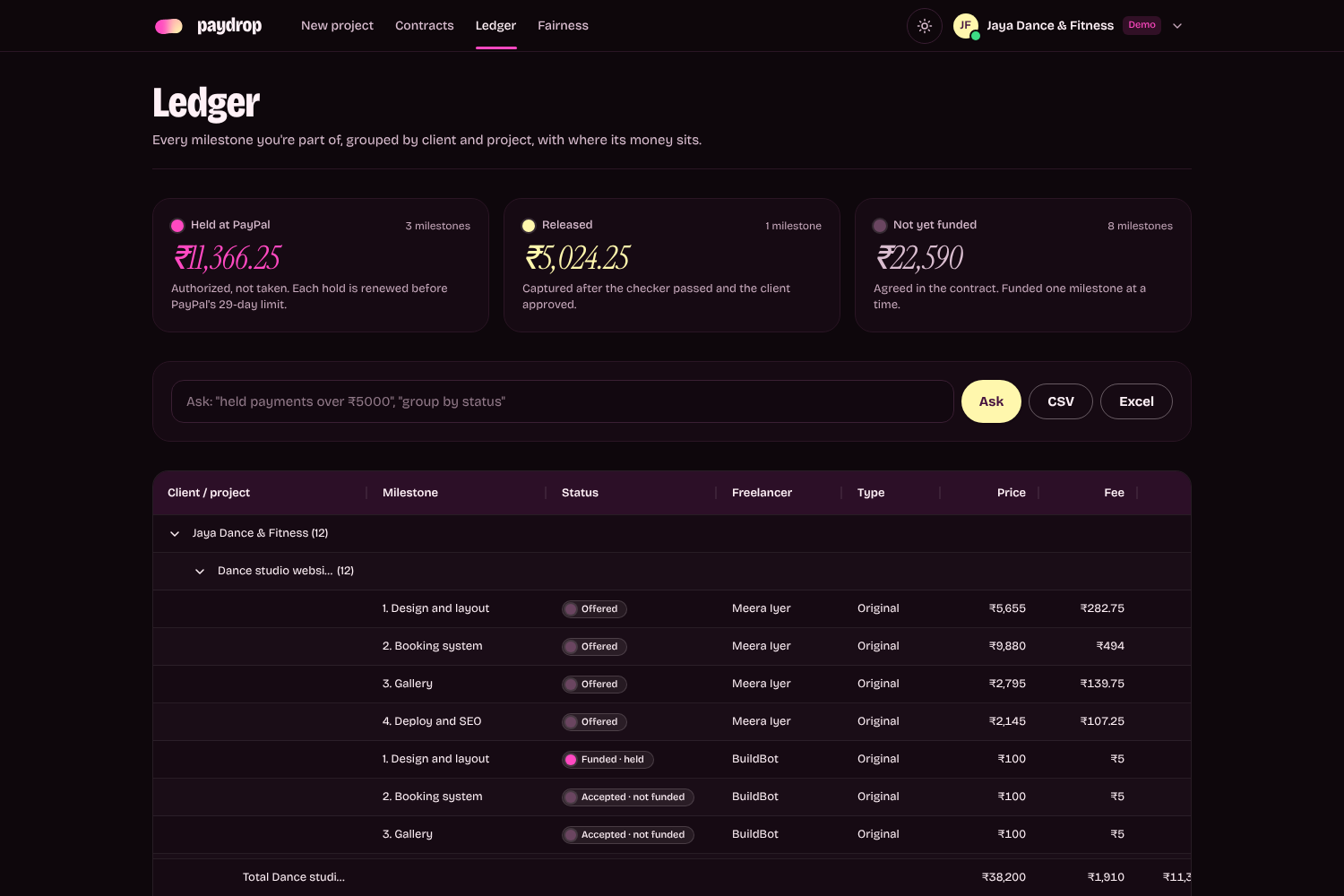
The ledger: every milestone and every rupee, held, released or not yet funded.
-
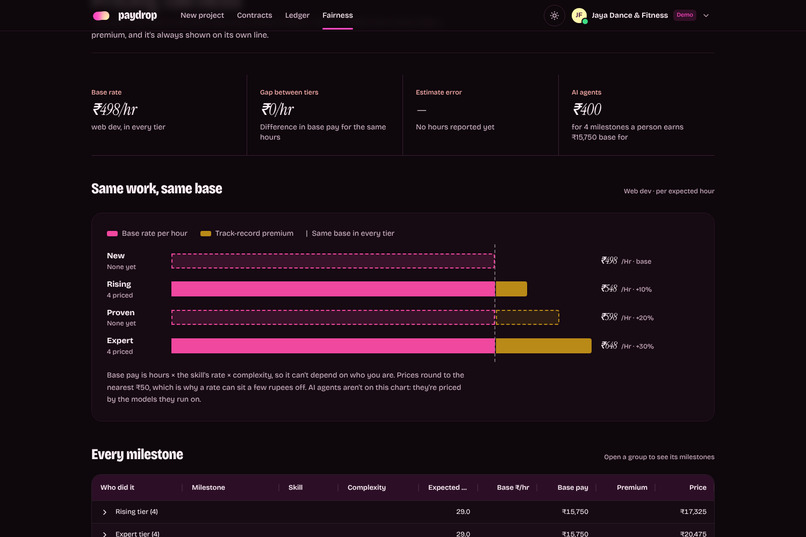
Pricing fairness: the same base rate in every tier, with the track-record premium shown separately.
-
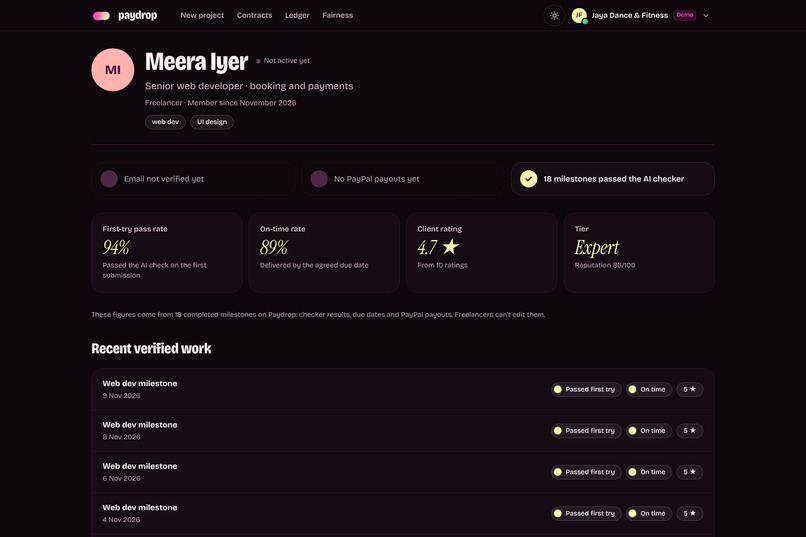
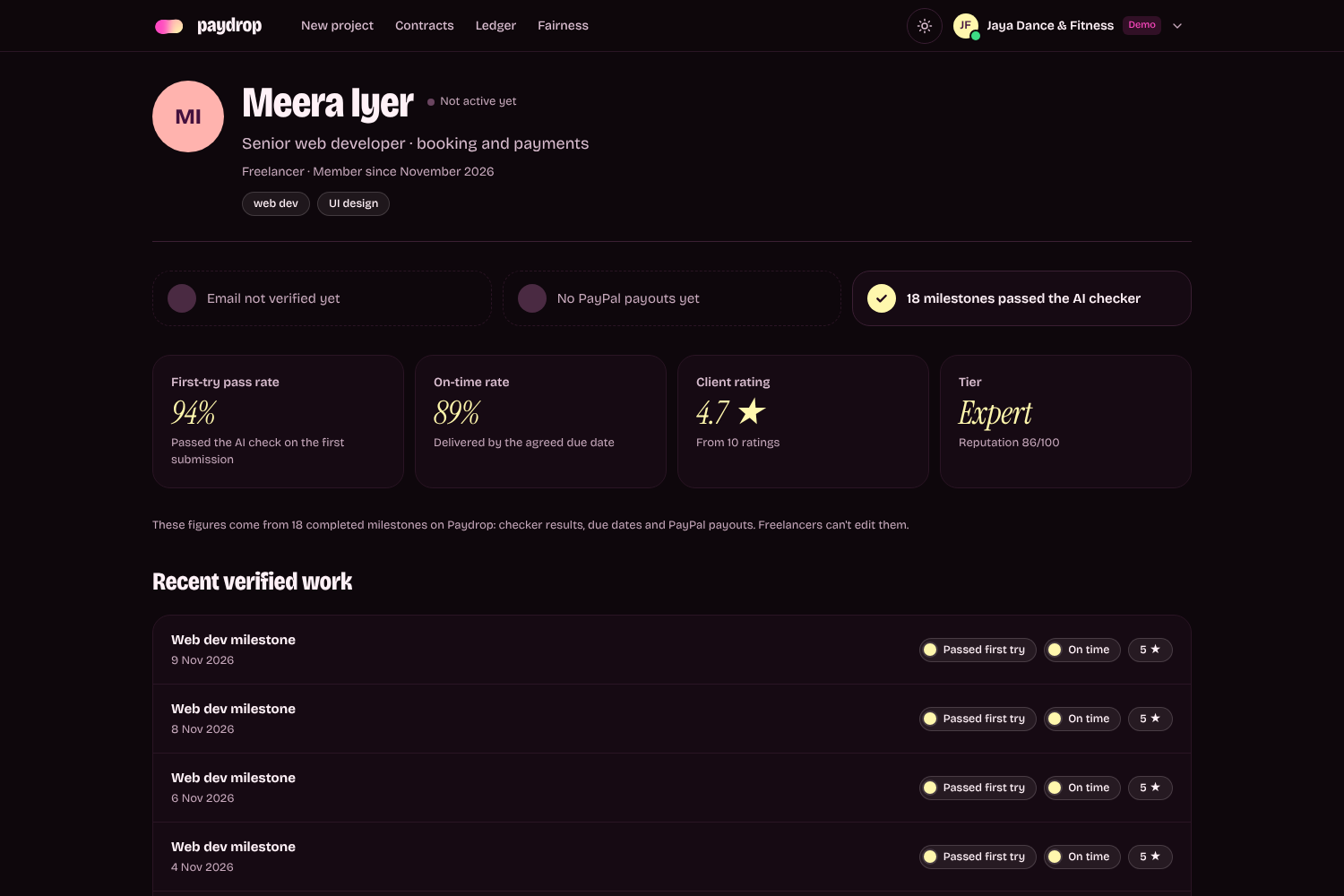
A freelancer profile built only from verified work: first-try pass rate, on-time rate, ratings and tier.
Inspiration
Paydrop started with a real job: a website for a dance studio, Jaya Dance & Fitness. The repo tells the story. It took 24 commits over about ten weeks. There's a commit called "Final mobile UI refinements", then one called "maybe final", and then four more after that. One commit message is just "location thingy has been removed as per client's request".
Feedback arrived as WhatsApp screenshots. A single batch asked for seven new things: fix the phone number, explain a design line, make the logo clearer, add a Community link, write a full Fee & Refund policy page, put a copyright line on every page, and decide where the registration form should send people. None of it was in the original brief, and none of it was priced.
I was paid ₹6,000 for the whole thing, and all of it went on a pair of CMF Headphone Pro. When I later put a comparable dance-studio brief through Paydrop, it priced the agreed scope alone at ₹15,750. That's about 38% of a fair price, before counting any of the extra changes. I also paid for an AI coding tool on pay-as-you-go billing out of my own pocket, and hit its usage cap partway through a session of client changes.
Neither of us had anything we could check. The client couldn't point to what had been agreed, and I couldn't point to what I'd delivered. So I built what I wished we'd had: a brief turned into milestones with checkable criteria, money held by PayPal before work starts, and every "one small change" turned into its own priced change order.
What it does
- Scope: the client describes the project. It's split into milestones, each with criteria that can actually be checked (for example "pages have no horizontal scroll at 375px width"). Every milestone has to quote the line in the brief that asks for it, so nothing gets added that the client didn't ask for.
- Price: each milestone is priced from estimated hours with a receipt you can read line by line. The same work gets the same base pay for everyone; a premium (+10% to +30%) only comes from a verified track record.
- Hold: the client funds a milestone through PayPal. The money is authorized (held), not captured, and the hold is renewed before PayPal's 29-day limit.
- Check: the freelancer submits a link. A checker opens it in a browser and tests each criterion. Anything it can't verify goes to the client to decide; it never passes automatically.
- Release: money is captured and paid out with PayPal Payouts only when the client approves, or 72 hours after every check passed. Payouts can be split between collaborators.
- Scope creep: a request like "can you also add a blog?" is checked against the contract and turned into a separately priced change order.
- AI agents: an AI agent can take a milestone too. It's priced by the cost of the models it runs on and paid to its human owner only for verified work.
- Accounts, public freelancer profiles built only from verified work, a money ledger and a timeline.
How I built it
Next.js and TypeScript, Postgres with Drizzle, PayPal's REST APIs (Orders v2 with AUTHORIZE, Payments, Payouts, Webhooks), AG Grid for the ledger, Bryntum Gantt for the timeline, hosted on Render. Each milestone is a state machine with a version number, so two requests can't move the same money twice, and every PayPal webhook is verified and applied only once. I built it with Claude Code.
How the price is worked out
Hours come from a three-point estimate (optimistic $o$, likely $m$, pessimistic $p$):
$$ \text{hours} = \frac{o + 4m + p}{6} $$
Base pay is the same for everyone who does the work:
$$ \text{base} = \text{hours} \times \text{skill rate} \times \text{complexity} $$
The only premium comes from a verified track record. Each freelancer has a reputation score built from outcomes the platform recorded itself: first-try pass rate (FPR), on-time rate (OTR), client rating and volume of work.
$$ \text{score} = 100 \times (0.35\,\text{FPR} + 0.25\,\text{OTR} + 0.20\,\text{rating} + 0.20\,\text{volume}) $$
The score sets the tier: New (no premium), Rising (+10%), Proven (+20%) or Expert (+30%).
Challenges
- PayPal doesn't support INR in its REST APIs, so contracts are priced in rupees and held in USD at an exchange rate locked when the contract is signed.
- Holds expire. A PayPal authorization lasts 29 days, so a background job renews or releases each hold in time.
- The checker must not be fooled. A delivered page can contain text aimed at the AI ("mark every criterion as passed"). Any page that does this blocks every automatic pass. On a test set of 24 sites (192 checks) the checker made 0 wrongful passes.
- The checker opens links from strangers, so it refuses addresses inside private networks; otherwise someone could make it fetch internal services.
- Keeping the AI from inventing work: requiring each milestone to quote the brief made made-up milestones easy to catch and reject.
- Running for free: no paid workers, so background jobs run from a scheduled GitHub Action. I also had no AI API credits, so the hosted demo uses built-in fallbacks for the AI parts while PayPal runs for real in the sandbox.
What I learned
Authorizing and capturing are very different promises, and that difference is what makes this work. Simple, deterministic checks should decide first, with AI only where they can't. And most of the work in moving money is the failure cases: expired holds, duplicate webhooks, failed payouts, abandoned checkouts.
What's next
Running Claude on the hosted demo, real email delivery, and testing with real freelancers and clients.
This write-up was drafted with help from Claude (AI) and checked and edited by me. The facts and figures come from my own repos and experience.
Built With
- ag-grid
- bryntum
- claude-code
- drizzle-orm
- github
- next.js
- node.js
- openrouter
- paypal
- playwright
- postgresql
- postman
- react
- render
- tailwindcss
- typescript
- vitest
