-
-
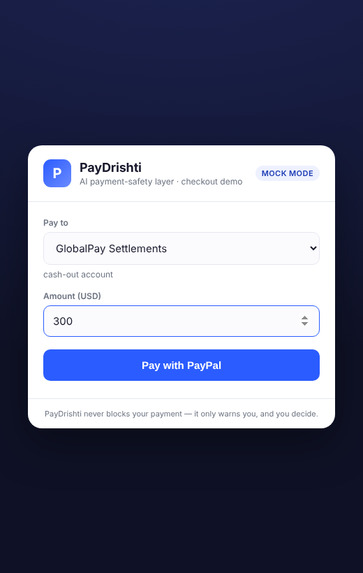
Live PayPal sandbox checkout — PayDrishti scores every payment in real time before it's captured.
-
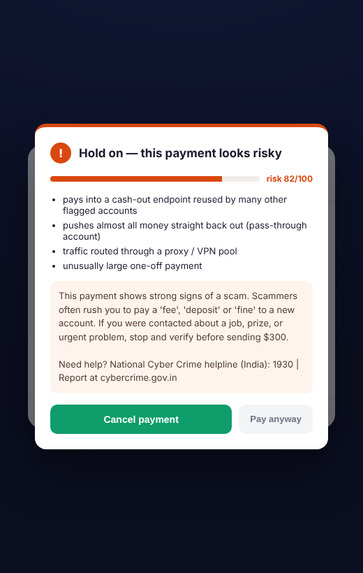
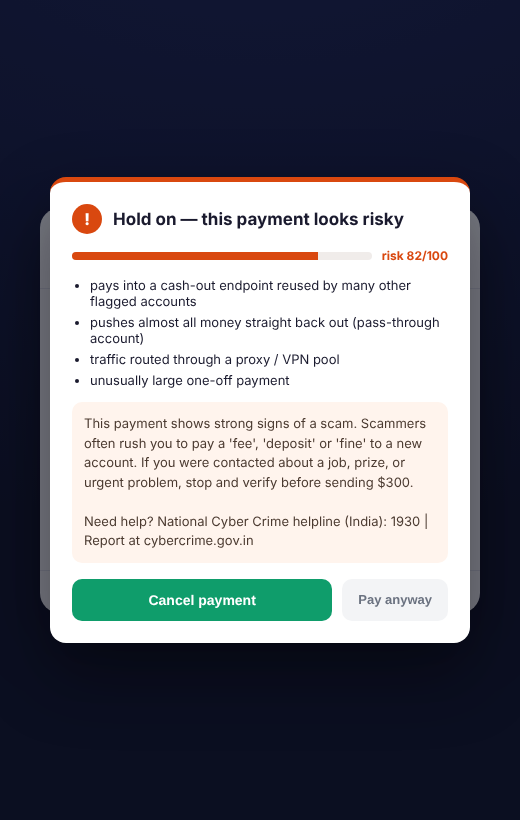
The AI warning that fires on a risky payee: risk score, reasons, and a plain-language alert, shown before the money is captured.
-
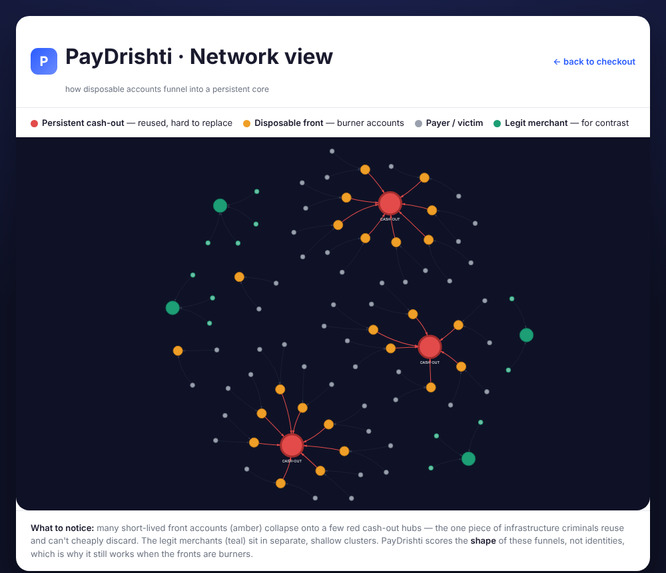
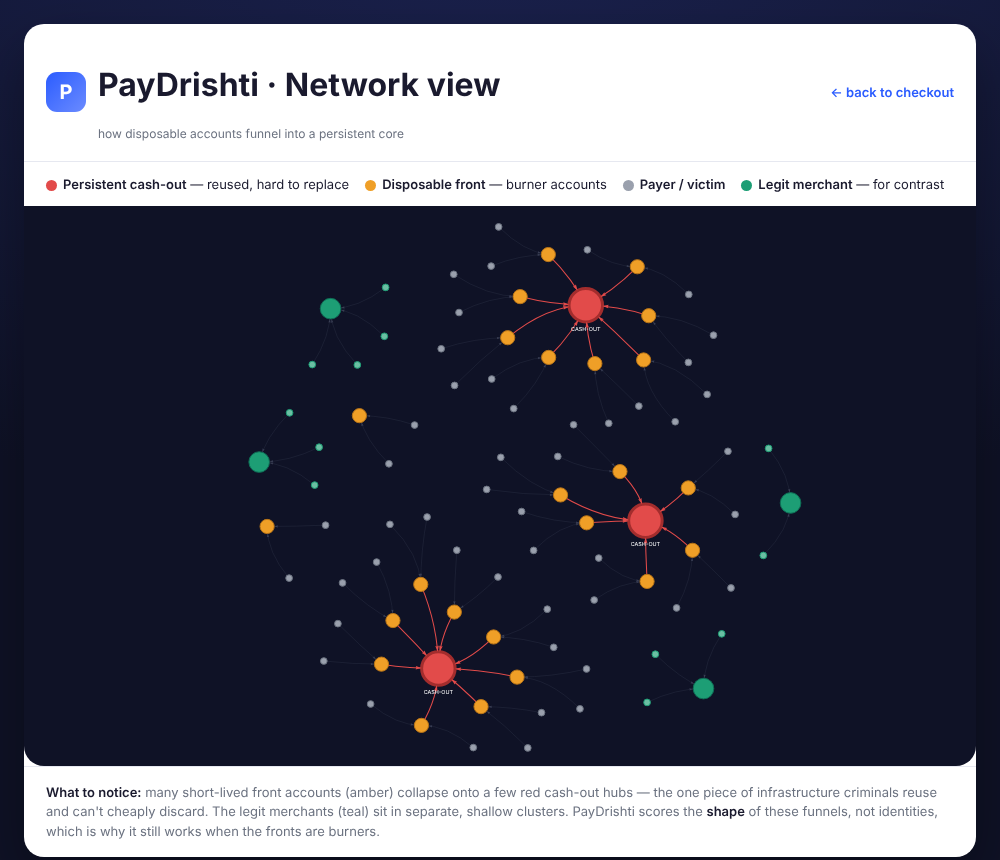
The fraud network PayDrishti detects: disposable front accounts (amber) funnel into the reused cash-out hubs (red) it flags.
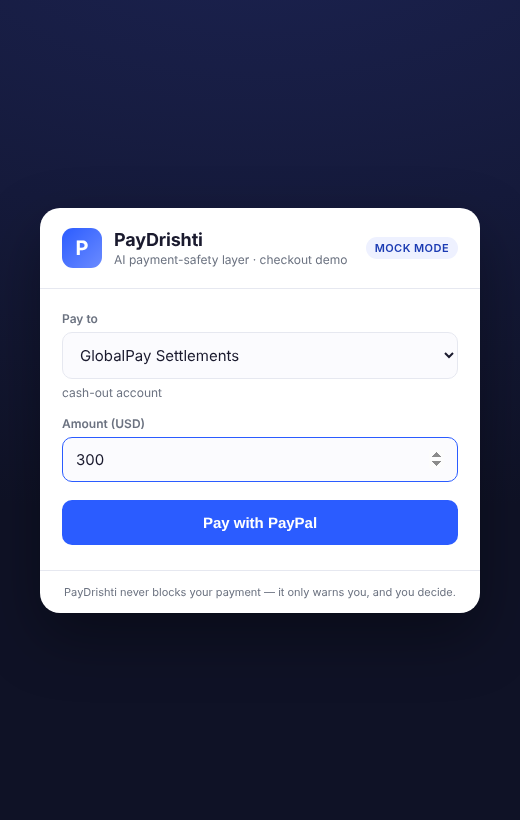
🔗 Live demo note: The demo is hosted on Render's free tier. If you see a "loading" screen, please wait ~2 minutes for the server to wake up — then the full PayPal sandbox checkout works.
🤖 About the AI warnings: The hosted demo uses pre-written warning text. The AI-generated warnings run locally via an on-device model (Ollama) — see the README and video.
📊 Evaluation: honest metrics, leakage checks and known limitations — EVALUATION.md
Inspiration
Most payment fraud and trafficking money doesn't move through dramatic hacks — it moves through ordinary payments made by people who were tricked. Victims are rushed into paying a "job fee", a "deposit" or a "fine" to an account they've never used, and by the time anyone notices, the money is gone.
The key insight: criminals can throw away the front of an operation cheaply — fake ads, burner accounts, spoofed numbers — but they cannot cheaply replace the thin layer of real cash-out accounts the money funnels into. That reused infrastructure is the one constant. PayDrishti targets exactly that, at the exact moment it matters: the instant someone clicks "pay".
What it does
PayDrishti sits inside a PayPal checkout. When you're about to send money, it scores the payment with AI in real time. If the recipient shows the fingerprints of a scam or money-laundering operation, PayDrishti pauses the payment with a clear, plain-language warning — before the money is captured — and lets you decide whether to continue. It never blocks you; it informs you.
- Safe payee → payment goes straight through, no friction.
- Risky payee → an interstitial explains why, shows a risk score, points to help, and you choose "Cancel" or "Pay anyway".
How I built it
A chokepoint inserted into PayPal's own payment flow:
create order → PayPal approval → PayDrishti risk check → (warn if risky) → capture
- Risk model — a gradient-boosted classifier (scikit-learn) scoring each payment from the payee's behavioural profile. Trained on a synthetic transaction world that models the real adversarial pattern: a churning shell of disposable front accounts hiding a thin, persistent core of reused cash-out accounts. The model reaches ~0.97 ROC-AUC, and its single strongest predictor is
reused_endpoint— confirming the thesis that the reused infrastructure, not the disposable identity, is what gives an operation away. - Explainer — a second AI surface turns the model's risk flags into a short, calm warning the payer actually reads. It runs on a local LLM (Llama 3 via Ollama), so it's free and no payment data leaves the machine; hosted models are also supported.
- PayPal integration — the backend (FastAPI) uses the PayPal Orders API v2 on the sandbox to create and capture orders, with the AI risk check gating the capture step. The frontend uses the PayPal JS SDK buttons and sandbox test accounts.
How it uses PayPal and AI
- PayPal: the payment is created and captured through PayPal's sandbox Orders API; PayPal is the chokepoint the whole product is built around. The risk check lives between order approval and capture — a natural control point PayPal's flow provides.
- AI (two surfaces): (1) the ML model that decides how risky a payment is, and (2) the LLM that decides what to say to the user. Neither is cosmetic — the product does not exist without both.
Challenges I ran into
- The data problem. Real fraud data is private and sensitive, and criminals deliberately churn identities. The fix was to stop chasing identity and build a synthetic world that models infrastructure reuse, then prove the model recovers the hidden core — rather than assuming clean, honest data.
- Not crying wolf. A fraud flag that freezes innocent people is worse than useless. PayDrishti weights signals by how hard they are to fake, treats "no history" as low risk (not high), and always leaves the decision to the human.
- Making AI output safe. The warning had to be firm without being alarmist or accusing, and must never invent helpline numbers — so those are appended from a verified list, never generated.
Accomplishments that I'm proud of
- A working end-to-end demo: PayPal sandbox payments gated by a live AI risk check.
- A model whose most important feature independently validates the design thesis.
- A privacy-first explainer that runs entirely on-device.
- A design that protects the payer (prevention) rather than only reporting fraud after the fact.
What I learned
That the leverage against payment-enabled crime isn't identity detection or offensive tooling — it's the money trail and the chokepoint, surfaced to a human who can act. And that a safety tool's hardest problems are ethical (false positives, victim safety, data privacy), not just technical.
What's next for PayDrishti
- A graph/fusion layer that links accounts, devices, and cash-out endpoints to surface whole rings, not single payments.
- A deployment path built with a payment provider, since the real cash-out and device signals live inside banks, exchanges, and PSPs.
- A recruitment-scam detector feeding the same risk graph (the fake-overseas-job pipeline).
Built With
- css
- fastapi
- html
- javascript
- llama3
- ollama
- pandas
- paypal
- python
- scikit-learn
- uvicorn

