-
-
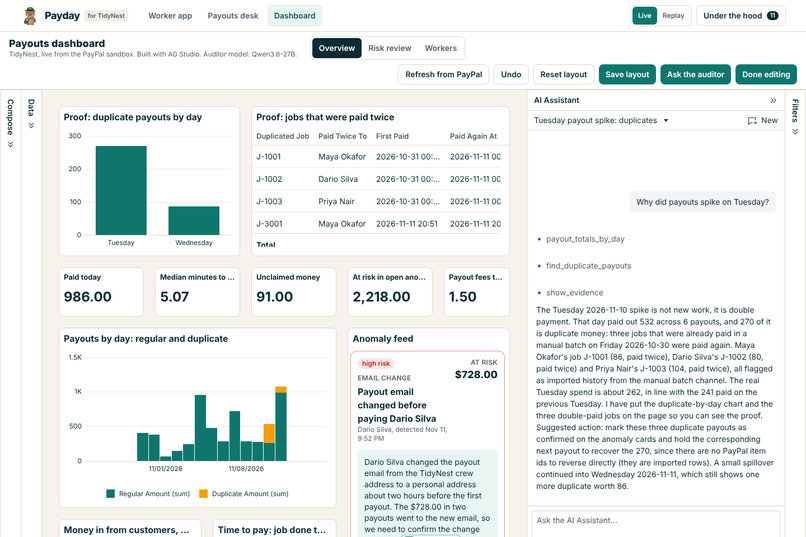
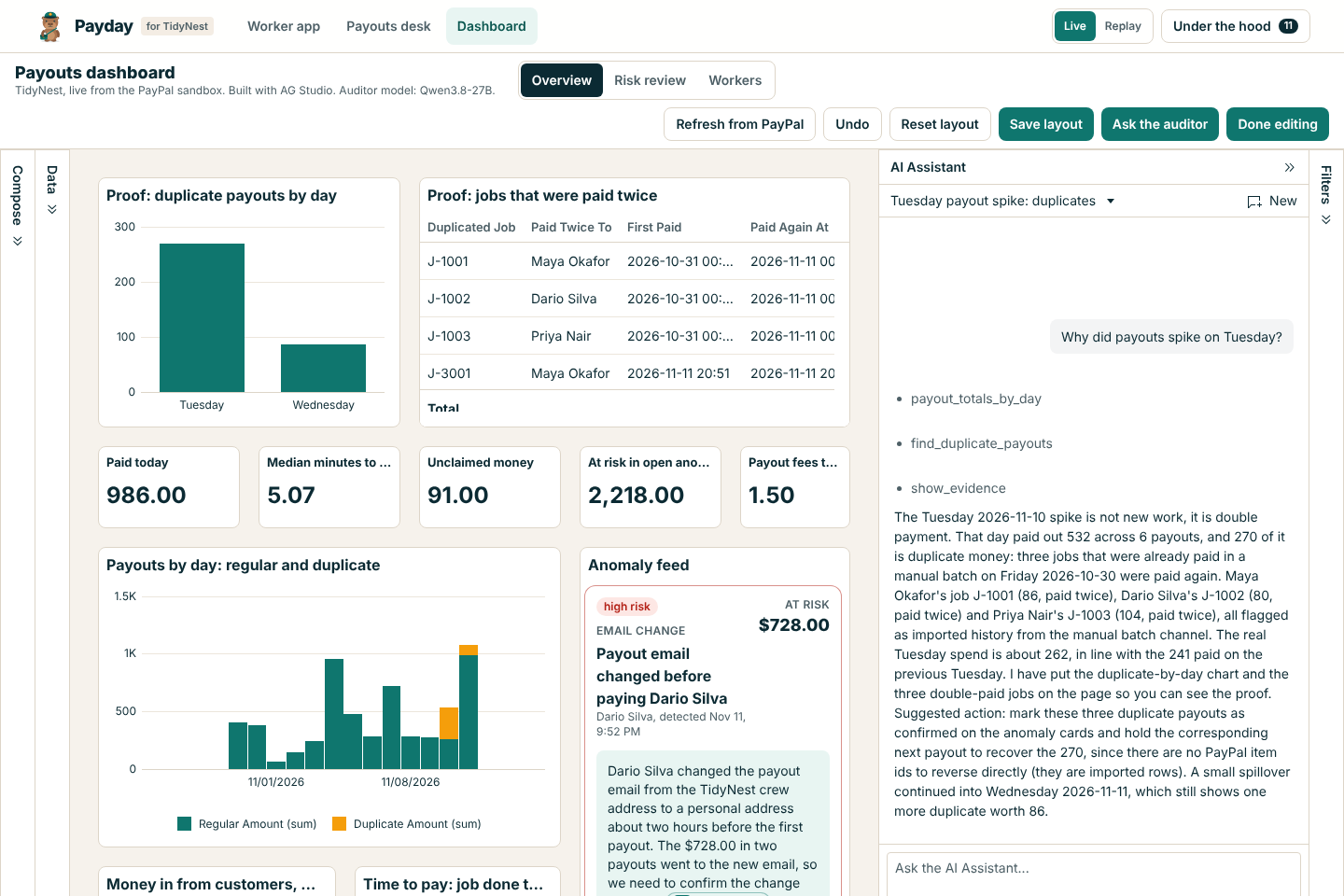
The Payout auditor in AG Studio explains Tuesday's spike: a batch sent twice, with the proof widgets pinned to the page.
-
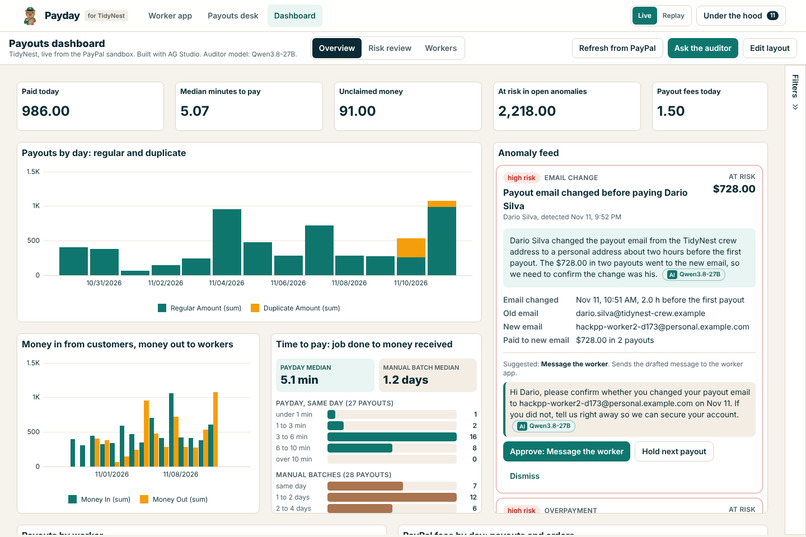
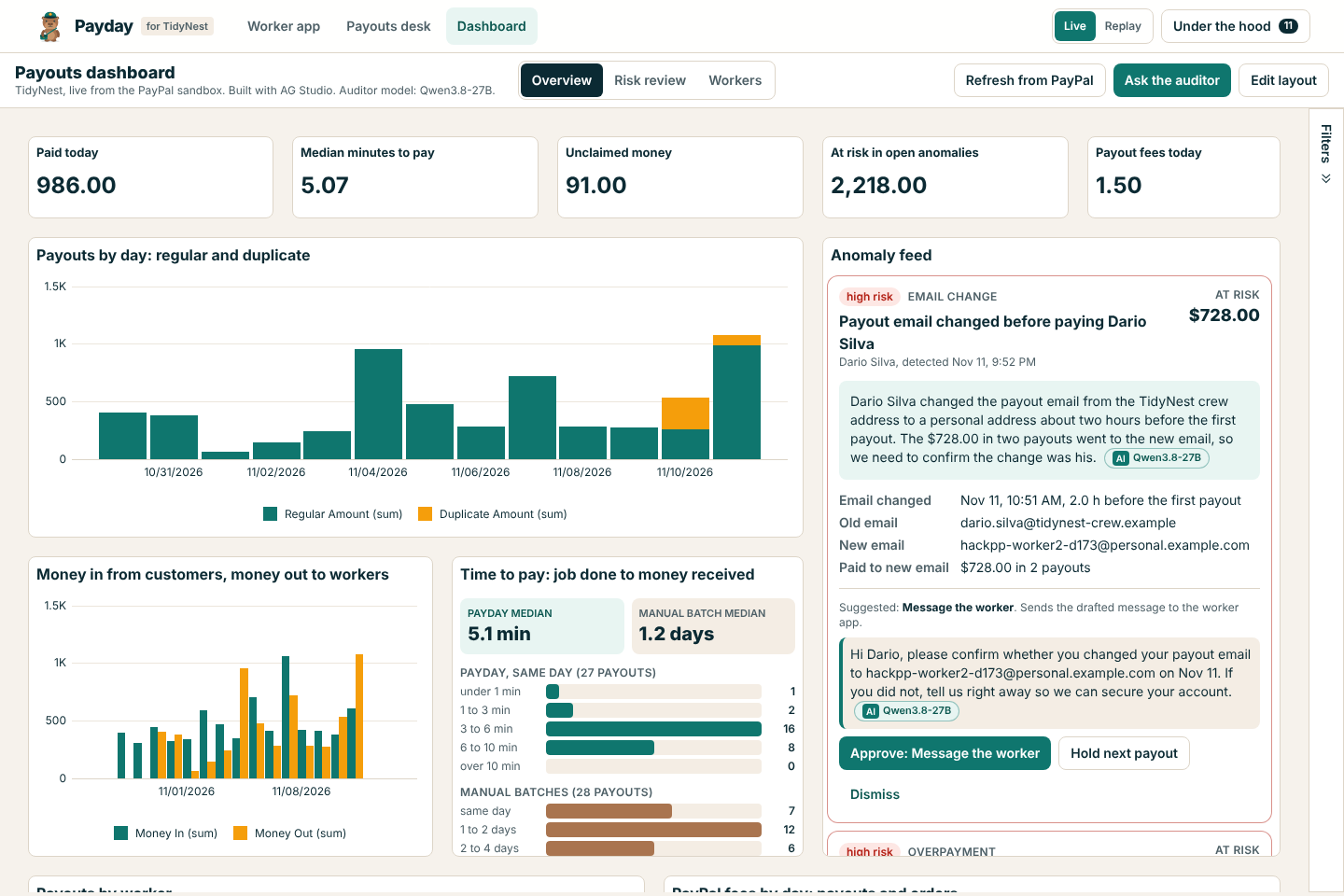
The operator's live payouts dashboard, built in AG Studio with custom widgets, the app's theme and layout presets.
-
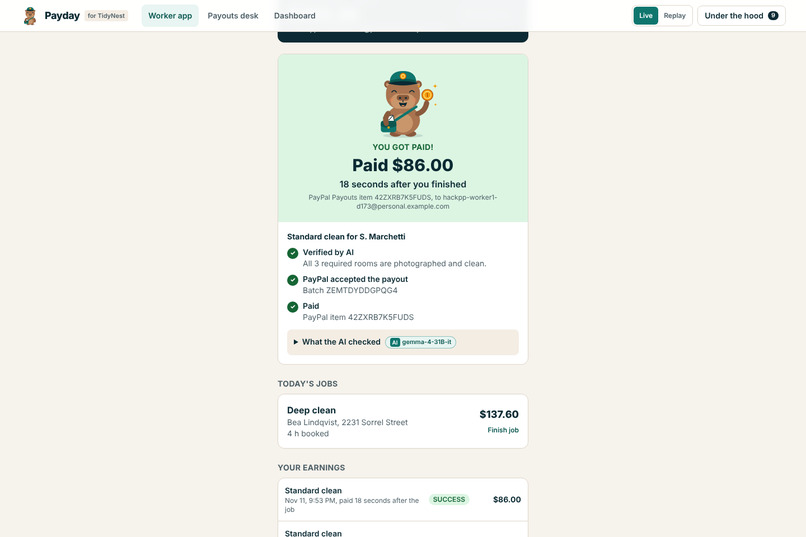
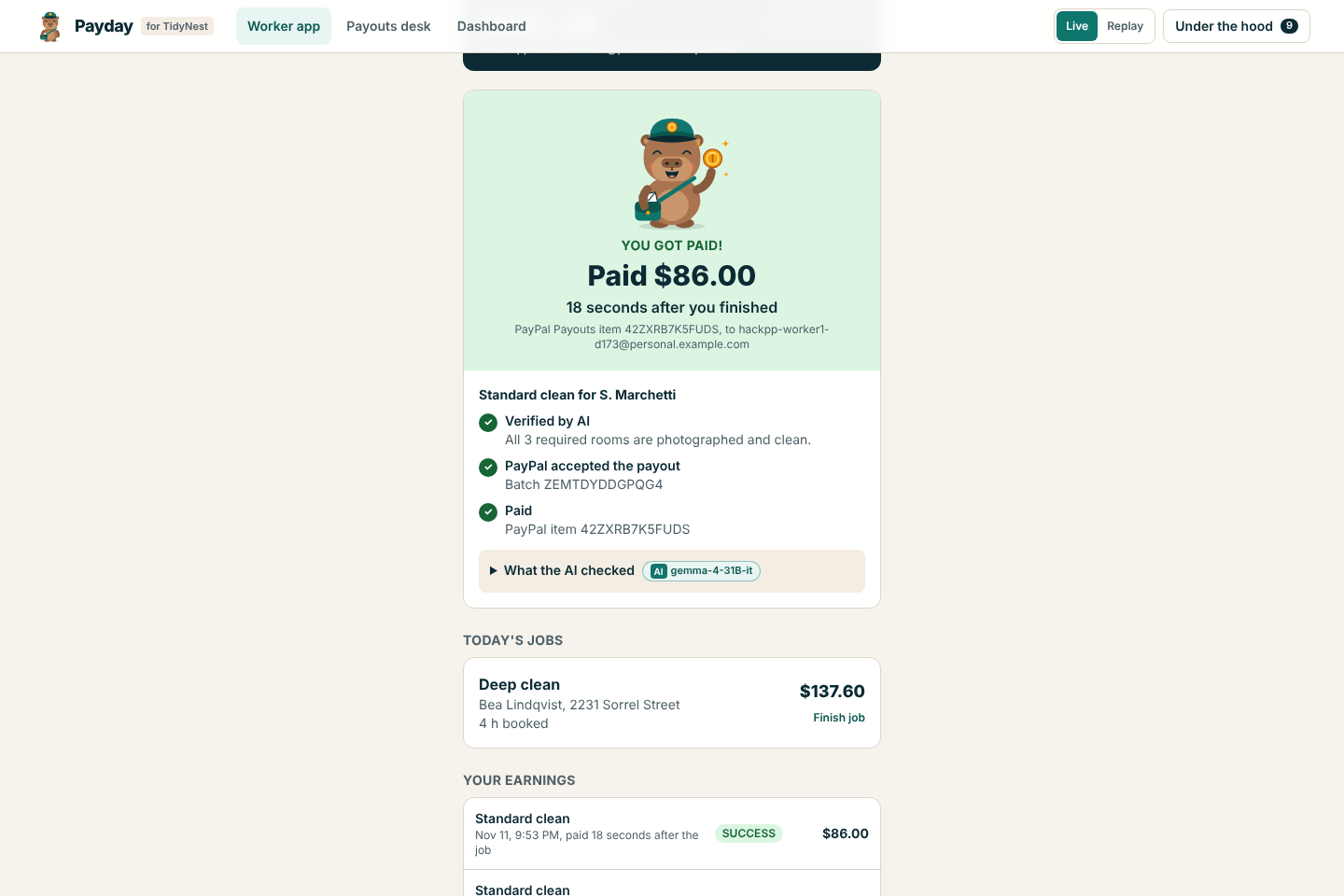
The worker app: photos verified by a vision model, then paid through PayPal Payouts seconds after the job is done.
-
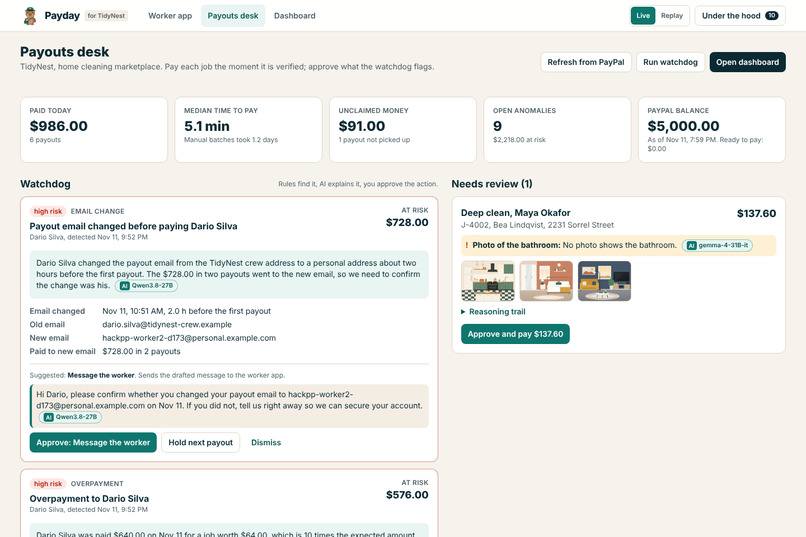
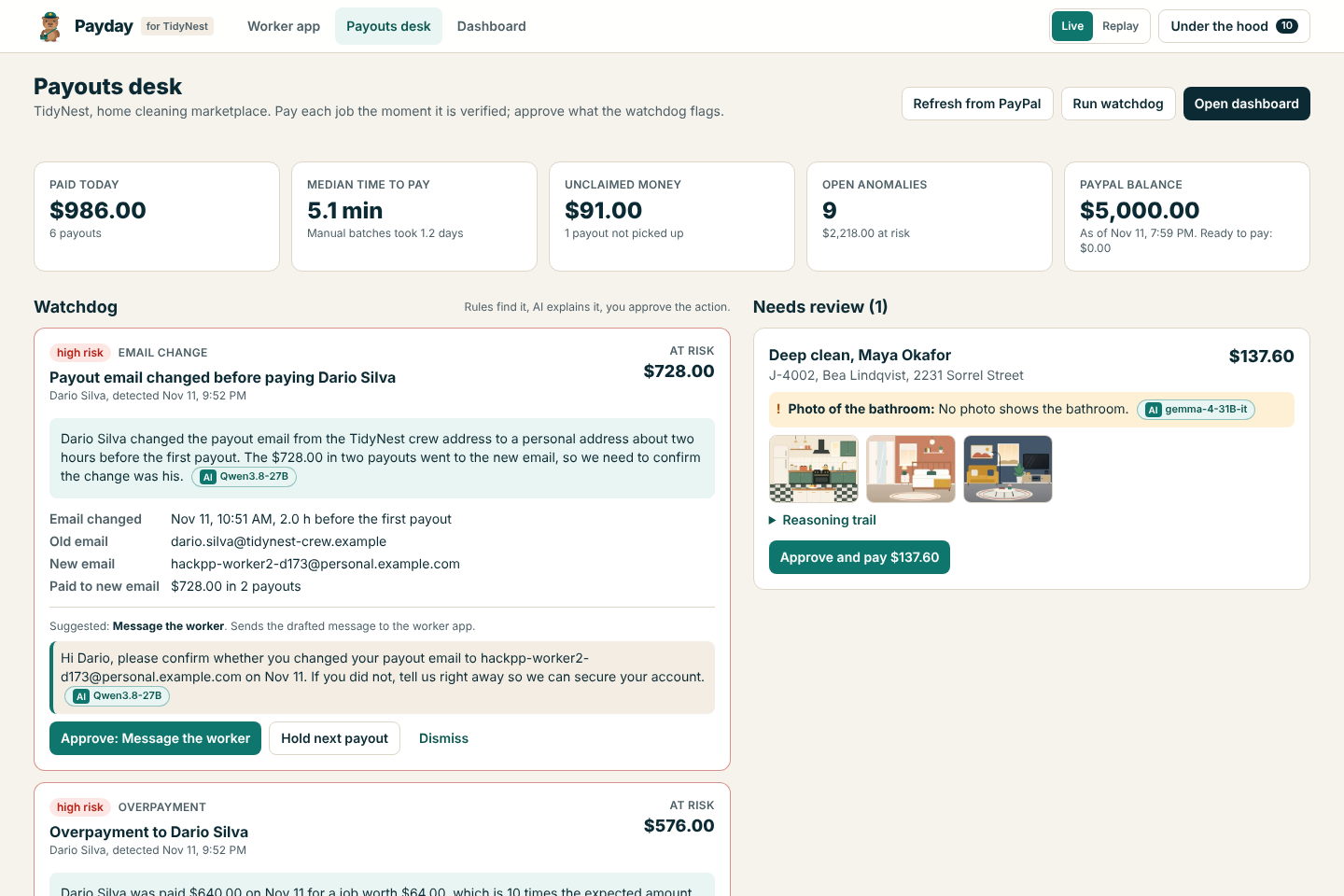
The payouts desk: watchdog findings with AI explanations, and actions the operator approves.
Live demo: https://hack-pp-payday.vercel.app (PayPal sandbox; no login needed) Code: https://github.com/chinesepowered/hack-pp-payday
Inspiration
Small service marketplaces (home cleaning, dog walking, tutoring, local delivery) usually pay their workers by hand: a spreadsheet, a batch upload, once a week if someone remembers. Workers wait days for money they earned today. And the manual process makes expensive mistakes that nobody notices until a worker complains or the balance looks wrong: a batch uploaded twice, a decimal slip, a mistyped email, money sitting unclaimed. We wanted to show that PayPal Payouts plus a careful AI can make "paid the day the job is done" the default for a 50-person marketplace, not only for the giants.
What it does
Payday is the payouts desk for a small marketplace. The demo runs TidyNest, a fictional home cleaning marketplace.
- Job complete. A worker submits the completion checklist and photos. A vision model reads every photo; code checks the photos against the checklist and the job record (check-in time, time on site, location). The job is marked Verified or Needs review, with reasons.
- Pay now. A verified job is paid at once through PayPal Payouts. The worker sees "Paid $86.00, 18 seconds after you finished", and Rio the capybara courier tells them out loud.
- Watchdog. Rules watch every payout and job for duplicates, overpayments, a payout email changed right before a payout, two jobs at once in different places, unclaimed payouts and hours spikes. AI explains each finding and drafts the message to the worker. The operator approves the action: hold the next payout, cancel the unclaimed item, or message the worker.
- Dashboard. The operator's live payouts dashboard is built in AG Studio, with custom widgets (anomaly feed with working approve buttons, time-to-pay distribution, worker earnings), the app's theme and three layout presets.
- Payout auditor. A custom agent in the AG Studio Agent Framework. Ask "why did payouts spike on Tuesday?" and it queries the data, finds the manual batch that was sent twice, and has Studio build the widgets that prove it.
- Under the hood. A drawer lists every PayPal call the session made, with its
PayPal-Debug-Id. - Replay mode runs the main flow from recorded real responses when the sandbox or the model is down.
How we built it
- Next.js 16 (App Router), TypeScript, Tailwind 4, pnpm, deployed on Vercel. State is a small JSON document store (files locally, Vercel Blob when deployed); PayPal stays the source of truth for money.
- PayPal. Payouts (create batch, get batch, get item, cancel item) over REST with a shared OAuth helper and a
PayPal-Request-Idon every POST; Orders through@paypal/paypal-server-sdk; Balances and Transaction Search for the balance check and reconciliation; webhooks with signature verification and idempotent handlers, plus polling so nothing depends on delivery;pnpm seedcreates the sandbox data through the API. - AI. W&B Inference:
google/gemma-4-31B-itreads the photos,Qwen/Qwen3.8-27Bexplains anomalies and runs the agents,zai-org/GLM-5.3-Flashis the fallback. Money decisions are deterministic code with 26 Vitest tests. - AG Studio. Started from PayPal's AG Grid boilerplate. Eight data sources, four custom widgets, a theme built on the app's design tokens, layout presets, and a custom harness with our Payout auditor as the primary agent next to Studio's five built-in agents.
- Video. Recorded from real runs with Playwright, composed with ffmpeg, narrated with ElevenLabs.
Challenges we ran into
- The sandbox would not cancel an unclaimed payout.
POST /v1/payments/payouts-item/{id}/cancelansweredBATCH_NOT_COMPLETEDwhile the batch was processing and500 INTERNAL_SERVICE_ERRORafterwards, every time. We decided not to hide it: the app shows PayPal's answer with the debug id, changes nothing, and offers a hold instead. The video shows the real outcome. - Sandbox timing. Payouts sit at
PENDINGfor 15 to 30 seconds; Balances and Transaction Search lag behind the ledger. The app polls, subtracts what it is about to send before comparing with the balance, and labels reconciliation rows as "waiting" for three hours instead of "missing". - Money in without a browser. Seeding customers' payments would have meant automating a PayPal approval window. Creating the order with a sandbox test card as the payment source captures it in one server call.
- AG Studio's AI panel lives in edit mode, and Studio reads
contextonce. We open the panel through report state and pass the widgets a small store they subscribe to. - Docs one version ahead. The Studio docs describe 3.1.0 while the boilerplate pins 3.0.0; the package's type definitions were the reliable reference for the Agent Framework.
- A model that sometimes returns nothing. The text model spends small token budgets on reasoning; larger budgets, retries, a fallback model and a time limit on explanations keep the desk responsive.
Accomplishments that we're proud of
- A worker is verified and paid in the PayPal sandbox in about 20 seconds, end to end, live.
- The auditor agent really investigates: it calls tools, cites the numbers, and builds the proof on the dashboard.
- Every money rule is in code and tested; the AI never moves money.
- The Under the hood drawer and Replay mode make the integration inspectable and demo-proof.
What we learned
- PayPal Payouts is simple to call and subtle to operate: idempotency keys, polling, unclaimed items and lagging reports matter more than the happy path.
- An agent is most useful when its tools are narrow and its output is evidence a person can check.
- Honest error handling is a feature. Showing PayPal's debug id beats pretending a cancel worked.
What's next for Payday
Payouts to Venmo and by phone number, recovering duplicates by offsetting against the next payout with the worker's consent, webhooks as the primary signal, photo checks against "before" photos, and multi-operator approval for large batches.
Tools: which AI models and services were used and how
- google/gemma-4-31B-it (W&B Inference): vision. Reads each completion photo and reports the room and whether it looks clean.
- Qwen/Qwen3.8-27B (W&B Inference): explains watchdog findings, drafts worker messages, and runs the Payout auditor and AG Studio's built-in agents through the Responses API with tool calling.
- zai-org/GLM-5.3-Flash (W&B Inference): fallback model.
- ElevenLabs (
eleven_multilingual_v2): the video narration and Rio's two pre-rendered voice lines. The hosted app never calls ElevenLabs. - Claude Code: AI coding agent used to build the project.
- APIMatic PayPal Context Plugin and the PayPal AI Toolkit skills: reference while writing the PayPal integration.
PayPal products used
- Payouts API: create batch, get batch, get item, cancel unclaimed item
- Orders API v2 (through the PayPal Server SDK)
- Reporting: Balances and Transaction Search
- Webhooks: registration, signature verification, payout batch and item events
- PayPal Agent Toolkit:
list_transactions,get_merchant_insights - PayPal sandbox
Sponsor tools used
- AG Grid: AG Studio and the Studio Agent Framework. The operator dashboard (custom widgets, theming, layout presets) and the custom Payout auditor agent that works alongside Studio's built-in agents.
- APIMatic. The APIMatic-generated PayPal Server SDK for Orders, and the PayPal Context Plugin skills installed in the repo and used while building the integration.
Built With
- ag-grid
- ag-studio
- apimatic
- elevenlabs
- ffmpeg
- next.js
- openai-sdk
- paypal
- paypal-agent-toolkit
- paypal-orders-api
- paypal-payouts
- paypal-server-sdk
- paypal-webhooks
- playwright
- react
- tailwindcss
- typescript
- vercel
- vercel-blob
- vitest
- weights-and-biases
