-
-
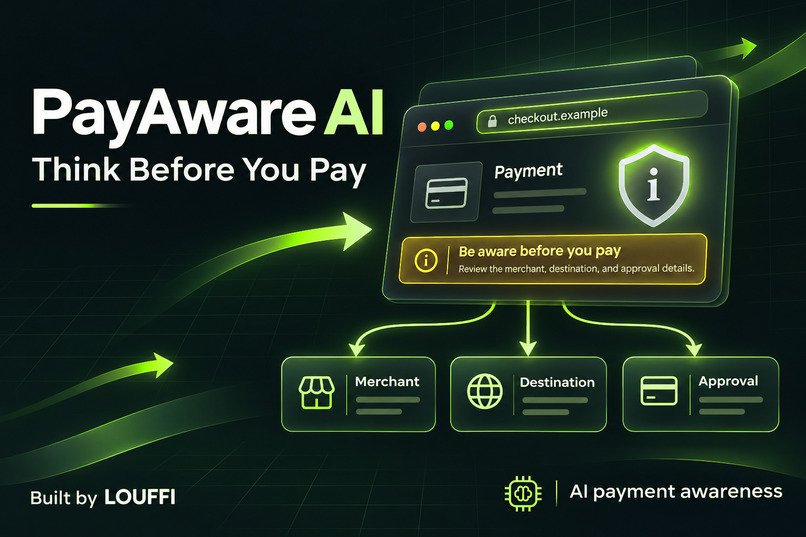
AI-powered guidance to help users recognize suspicious payment links and make more informed decisions before signing in or paying.
Inspiration
Payment security advice often arrives too early to be useful or adds friction at checkout. As a security practitioner, I wanted to turn the moment before a login or payment into a short, understandable learning opportunity. A familiar logo should never replace checking the destination and recipient.
What it does
PayAware AI is a payment-awareness companion with the motto "Think before you pay."
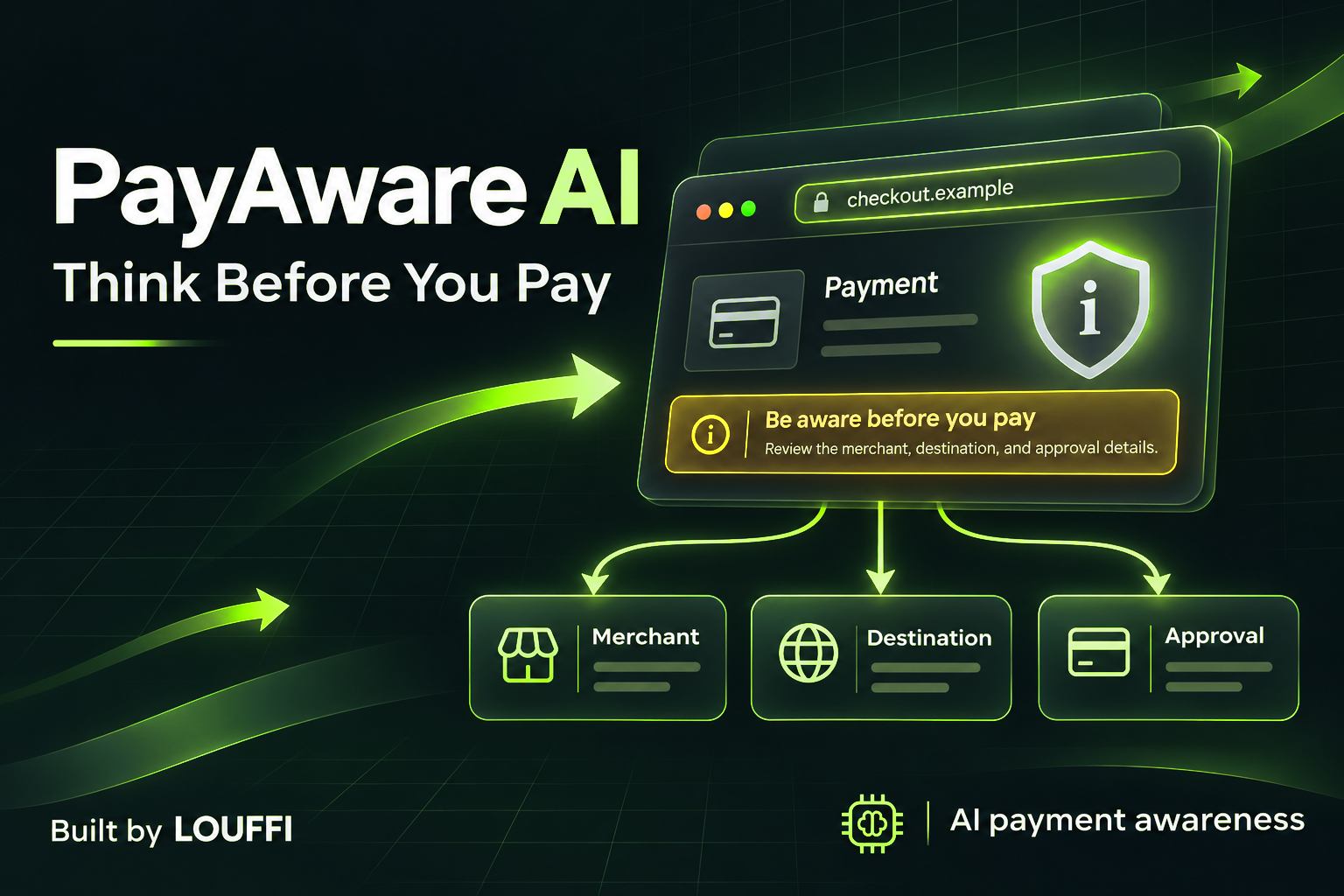
Users can inspect a payment or login URL and receive observable hostname signals, a focused awareness lesson, and a concise English explanation. Animated arrows illustrate the merchant-to-destination-to-approval journey. The interface also supports selecting a screenshot or taking a photograph of a computer screen for optional AI visual guidance.
The working PayPal integration creates a $1 USD Sandbox order and redirects to PayPal's hosted checkout. Users can cancel and return to the app. This MVP does not capture funds or perform real-money payments.
How we built it
The application uses HTML5, CSS animations and JavaScript, with a server-side Cloudflare Worker and a dependency-free Node.js development server.
Deterministic URL parsing checks hostname boundaries, embedded user information, HTTPS and encoded international hostnames. Jev selects a relevant awareness topic from the derived signals. DeepSeek produces the human-readable explanation and powers the image-analysis adapter. Missing or unavailable AI services fall back to clearly labeled local guidance.
PayPal's Sandbox OAuth and Orders APIs create the test order. API secrets stay server-side and are not committed to GitHub. The app does not collect PayPal credentials, intercept HTTPS traffic, or inject content into PayPal's login page.
Challenges we ran into
The main challenge was balancing useful security guidance with checkout simplicity. We chose an optional companion experience rather than blocking every purchase. We also had to distinguish a recognized hostname from proof that a seller is honest, and handle empty AI responses without incorrectly presenting local text as AI output.
Accomplishments that we're proud of
- A deployed interactive MVP with a responsive, animated awareness interface.
- Live DeepSeek and Jev integration verified with a simulated lookalike hostname and English coaching.
- PayPal Sandbox order creation, hosted-checkout redirection, cancellation and return verified in the browser.
- Three automated checks covering deceptive hostname boundaries, cross-origin rejection and missing integration credentials.
What we learned
Security explanations must be tied to specific evidence. AI can make that evidence easier to understand, but cannot guarantee a site's safety or prove a seller's honesty. The product must communicate those limits clearly.
What's next for PayAware AI
Finish buyer approval testing, validate screenshot/camera analysis end to end, improve visual evidence highlighting, evaluate advice accuracy with users, and add production-appropriate rate limits and privacy controls.
Judge setup and source
Source: https://github.com/salahlouffidi/payaware-ai . The repository contains the working application, a standard MIT LICENSE, environment-variable examples and setup instructions.
Install Node.js 20.6 or newer. Clone or download the complete repository, open a terminal in its root, run npm run dev, and open http://localhost:3000. No npm dependencies or API credentials are needed for local URL guidance. Try https://paypal.com.attacker.example/pay to inspect a deceptive hostname boundary. Run npm test for automated checks.
Optional AI and PayPal Sandbox testing requires the reviewer's own credentials in .env (see .env.example), started with node --env-file=.env server.mjs. Missing providers are explicitly labeled; local guidance is not presented as AI output. The hosted demo may require author sign-in. Repository public visibility is pending GitHub account verification and must be completed for judge download access.
Current demo limitations
Screenshot/camera input and the vision adapter are implemented but have not yet been verified end to end. Full buyer approval has not been tested; payment capture is outside this MVP. This is an independent educational prototype, not a production fraud detector or an official PayPal product.
