Inspiration
Traditional payment systems (such as UPI, Apple Pay, credit cards, or legacy checkout buttons) are passive rails: they move money only when a human manually discovers a vendor, extracts their payment handle, calculates taxes, and inputs an authorization credential (e.g., MPIN, SMS OTP, or biometric scan).
In the emerging era of autonomous AI agents and machine-to-machine (M2M) commerce, developers face the unsolved
**"Agent Wallet" Dilemma**:
* **How can an autonomous software agent spend money safely without having unfettered access to drain a bank
account or credit line?**
* Traditional mandates are too rigid (fixed calendar subscriptions), while raw credit card API keys create
catastrophic financial liability.

**PayAgent solves this problem** by pairing PayPal's global multi-currency sandbox rails with an intelligent,
policy-governed AI commerce orchestrator.
What it does
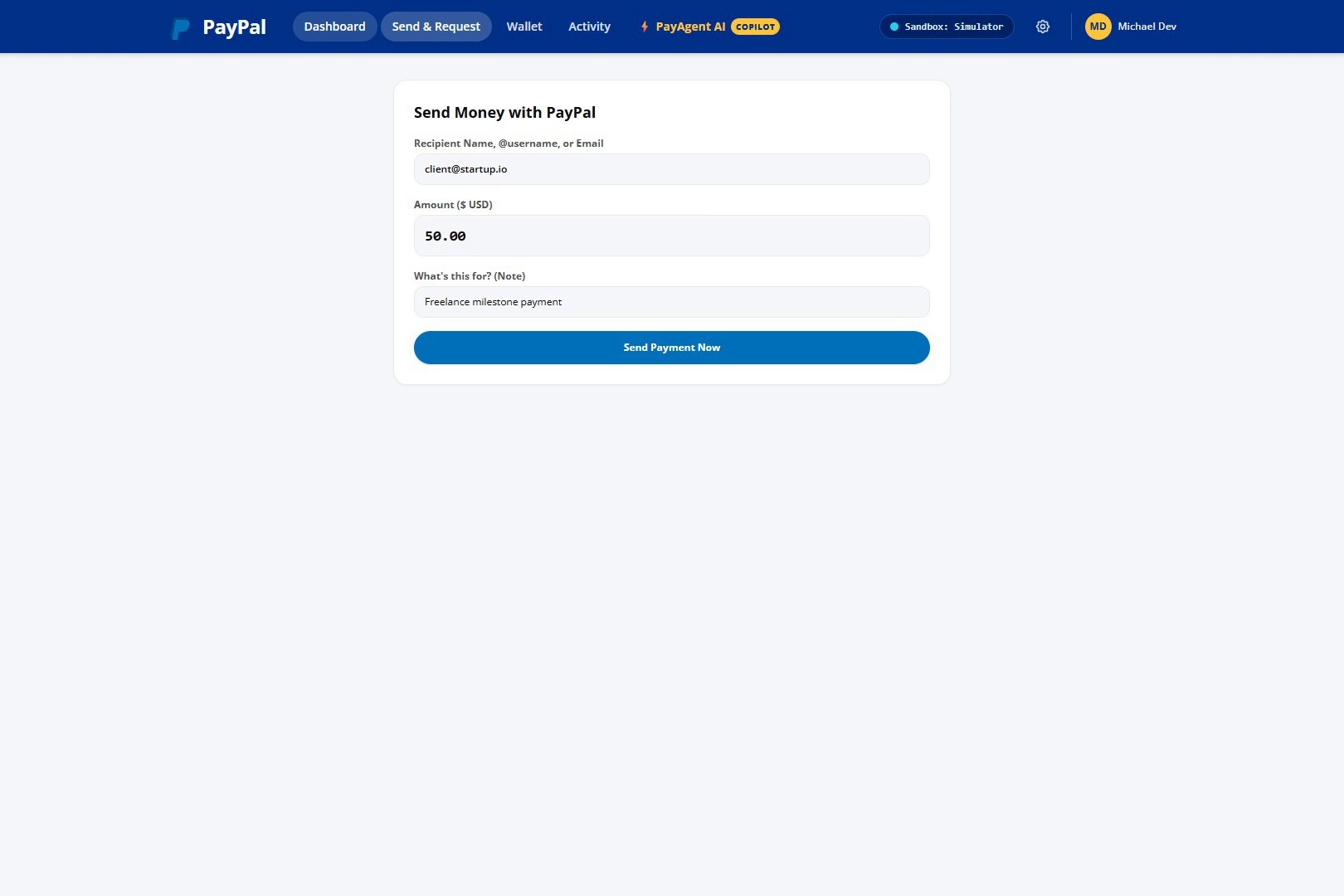
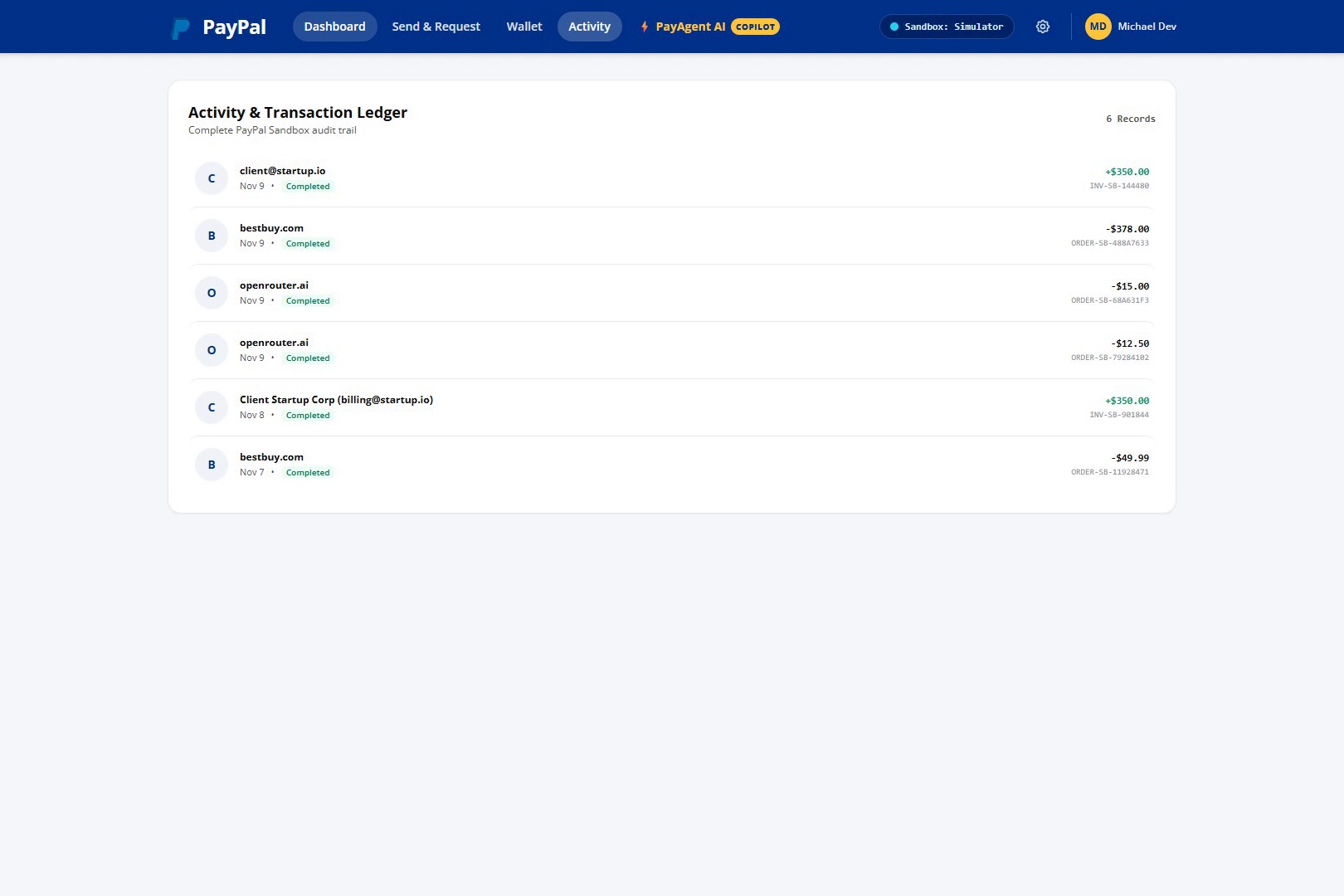
### 1. Authentic PayPal Portal Experience
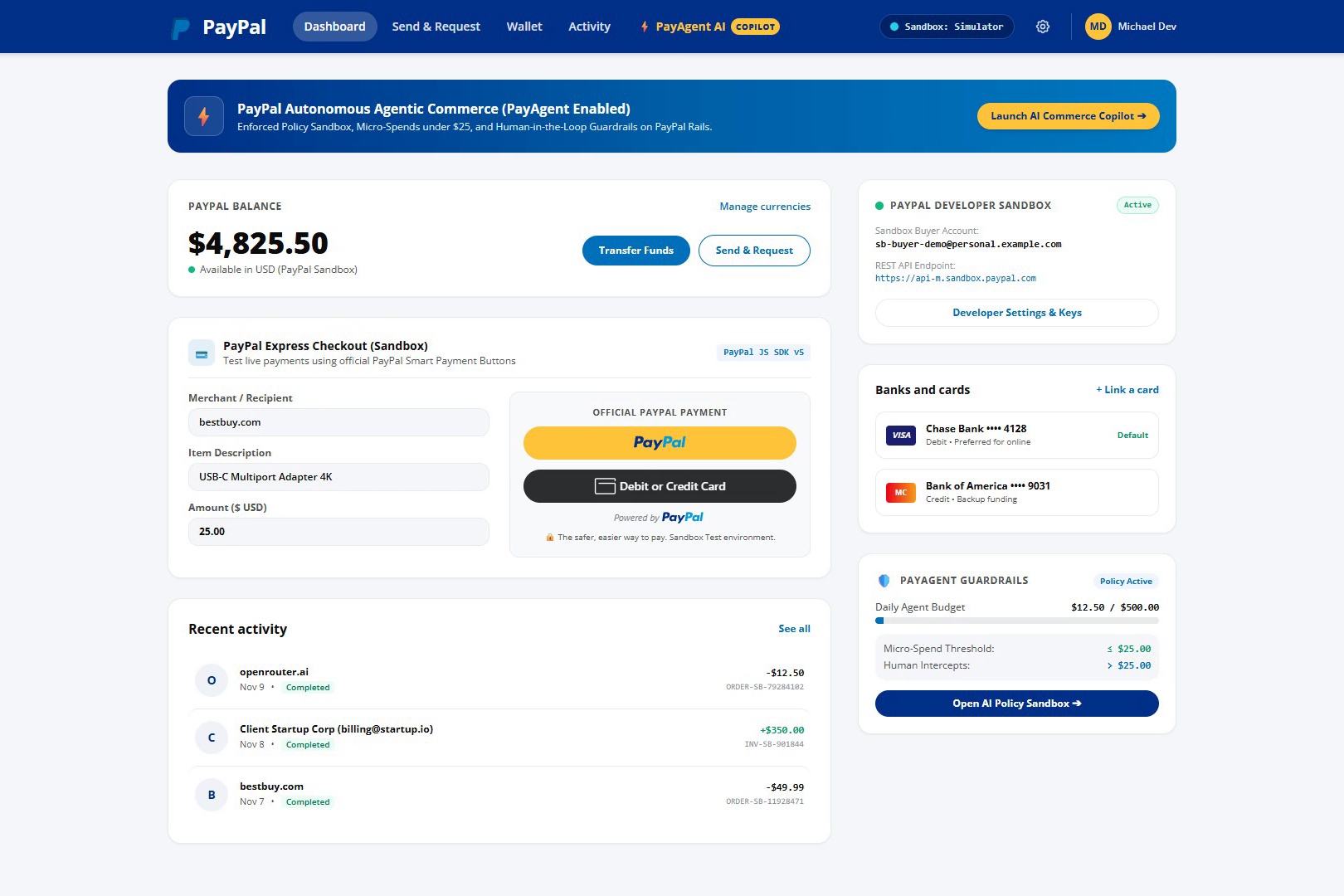
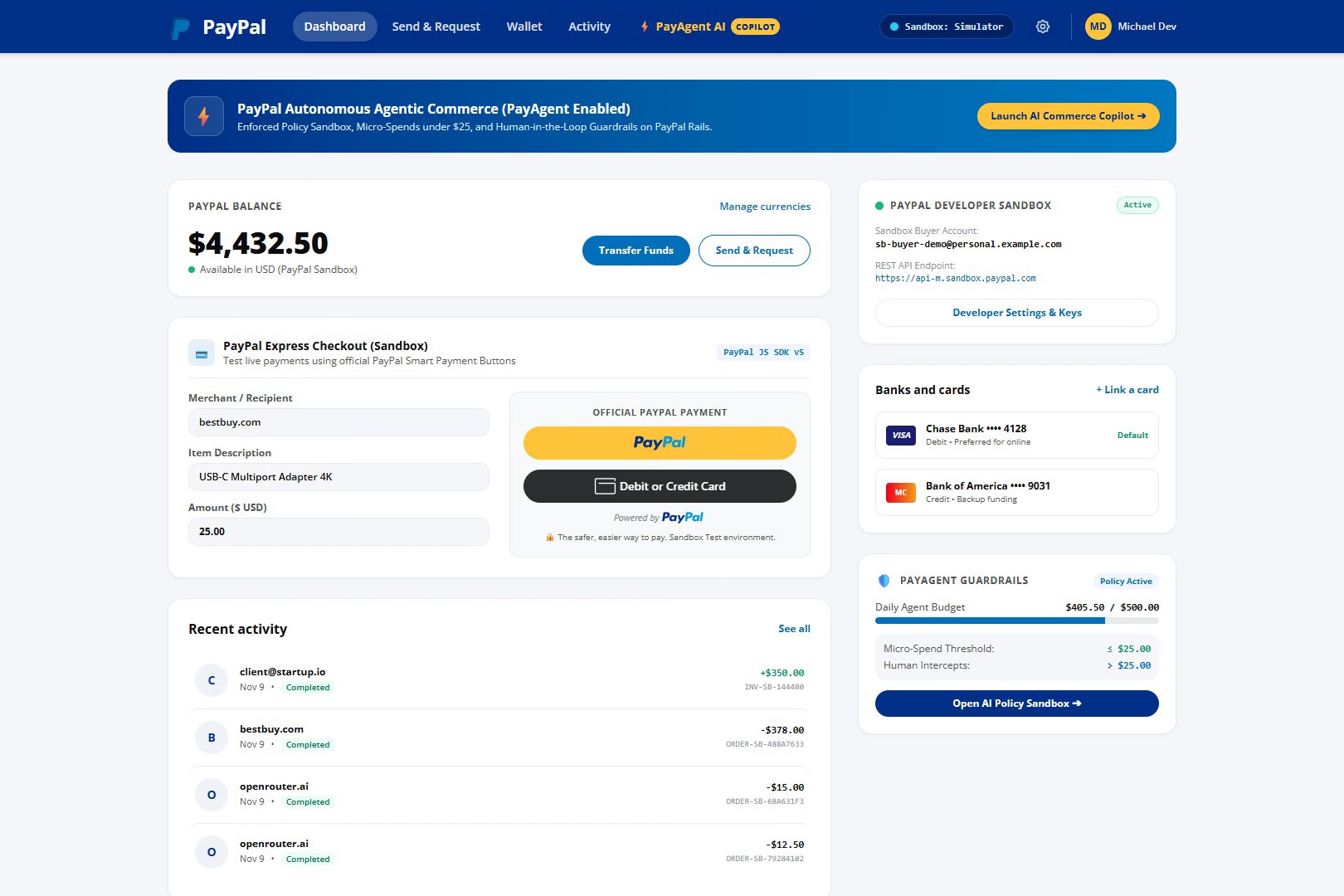
PayAgent isn't an abstract terminal tool—it is built directly into an authentic clone of the **official PayPal Web
Application**:
* **Official Visual Identity:** Deep Navy PayPal Header (`#003087`), overlapping dual-P logo, clean light gray
background (`#f5f7fa`), and official pill-shaped buttons (`#0070ba` and `#ffc439`).
* **Live Account Balances:** Displays an authentic **`$4,825.50 Available in USD`** balance that dynamically
deducts on checkout/micro-spends and credits on invoice settlements.
* **Official PayPal Smart Payment Buttons:** Integrates the official **PayPal JavaScript SDK v5**, rendering
genuine yellow **PayPal** and black **Debit or Credit Card** buttons with live sandbox checkout modals.
* **Five Authentic Tabs:** *Dashboard*, *Send & Request*, *Wallet*, *Activity*, and the *⚡ PayAgent AI* Copilot.

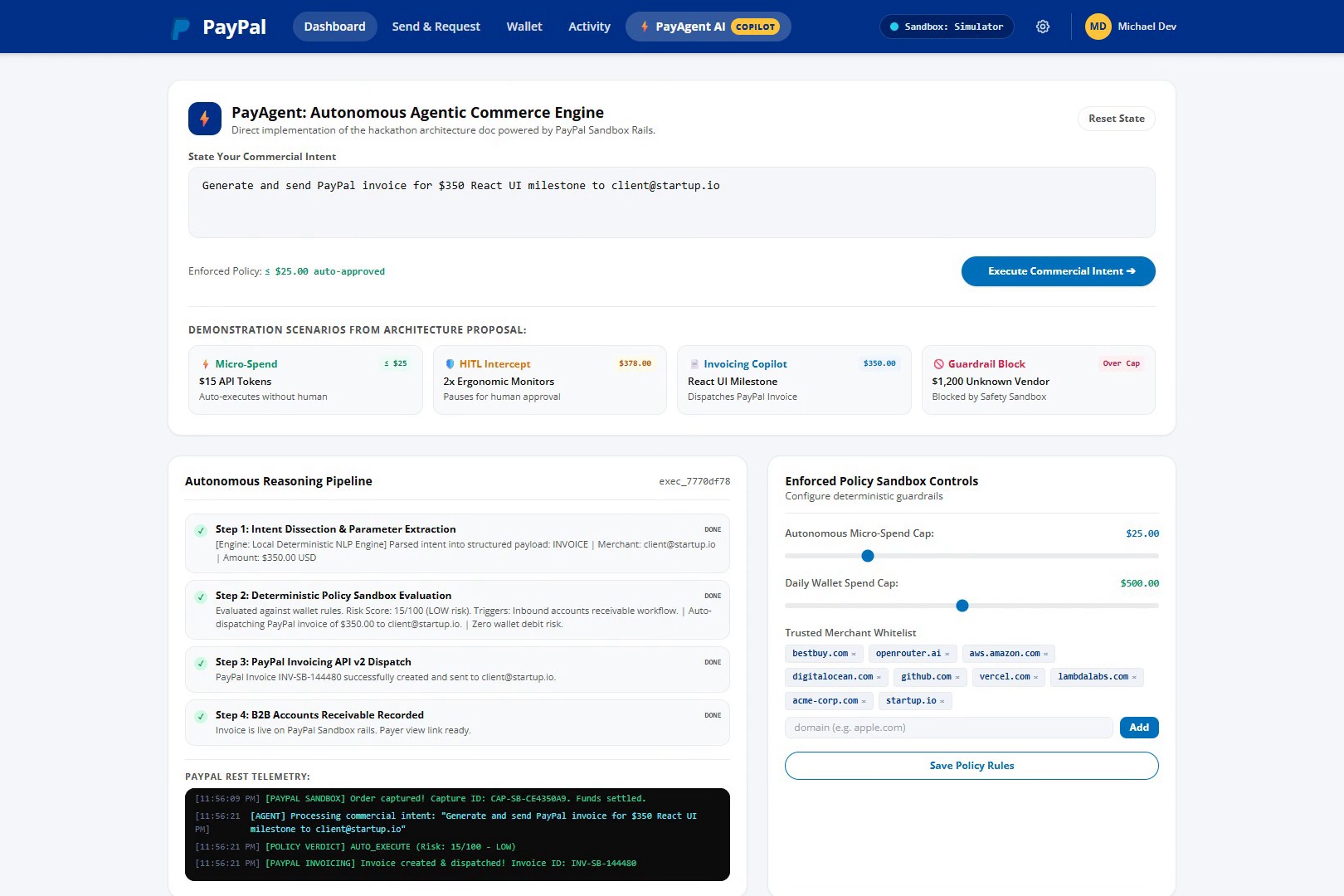
### 2. Commercial Intent Console ("Set Goal & Delegate")
Instead of manually navigating checkout funnels, users state their commercial objective in natural language:
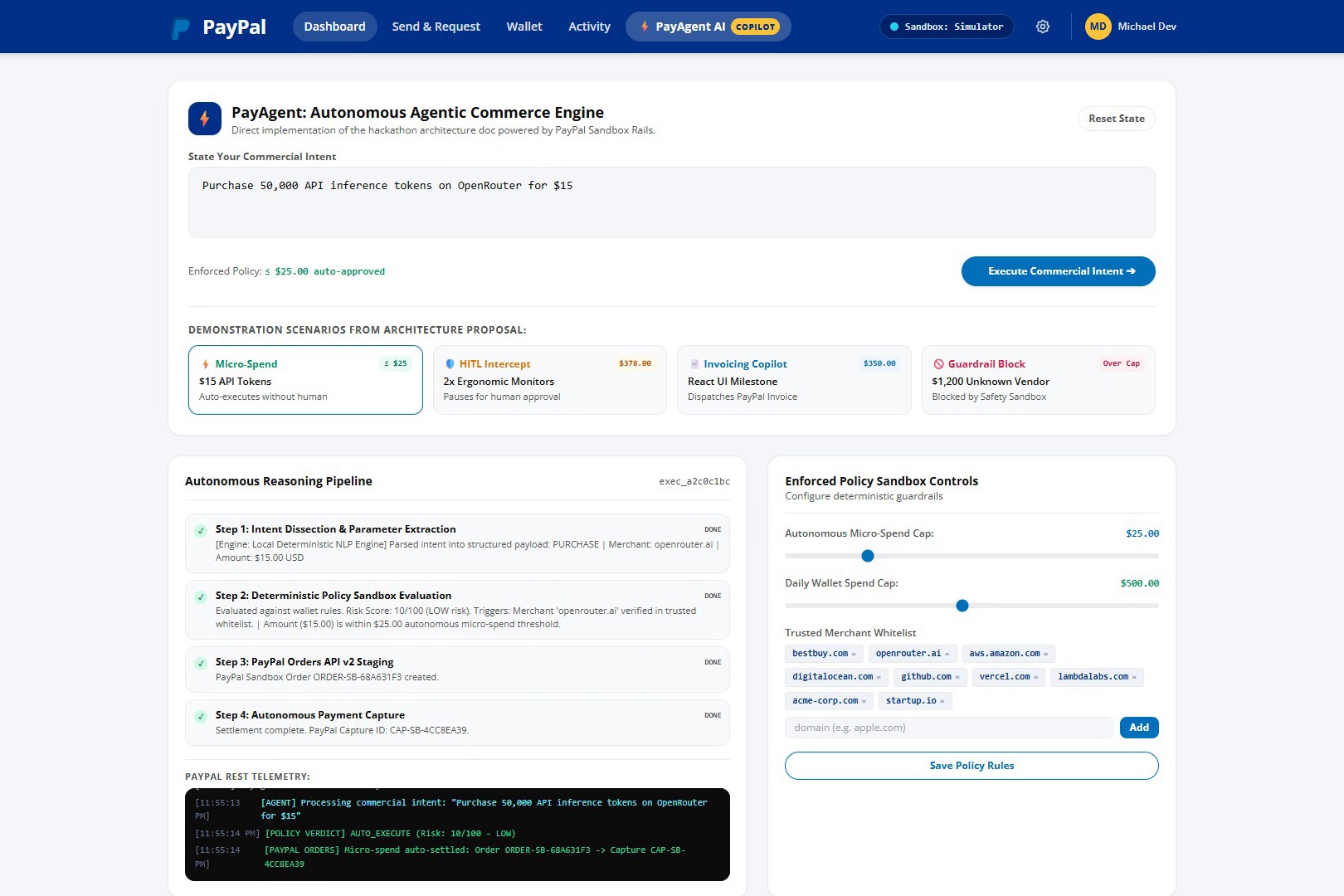
* *"Purchase 50,000 API inference tokens on OpenRouter for $15"*
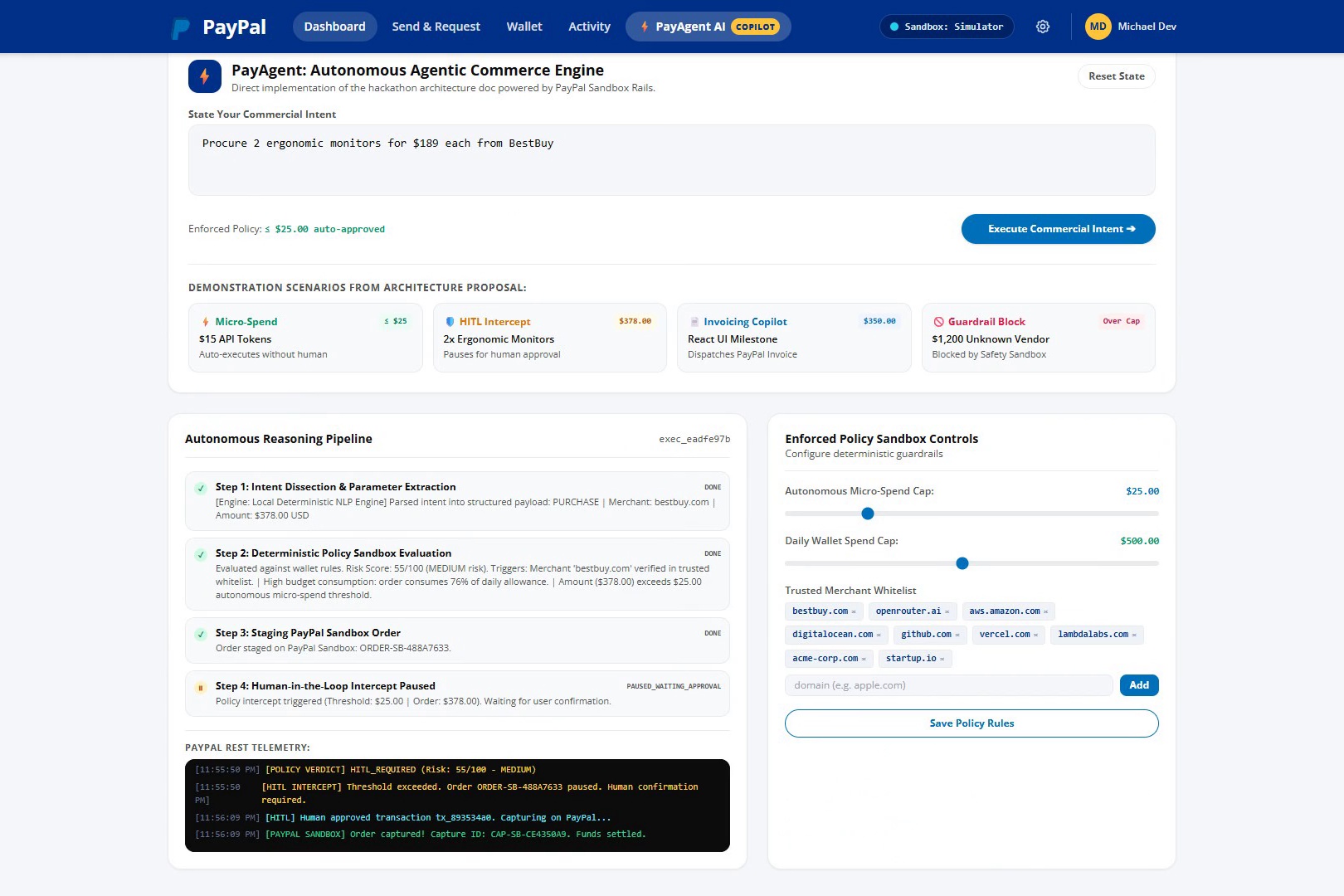
* *"Procure 2 ergonomic monitors for $189 each from BestBuy"*
* *"Generate and send PayPal invoice for $350 React milestone to [email protected]"*
The AI engine decomposes the request, identifies the merchant, verifies domain trust, itemizes line items, and
stages the transaction.

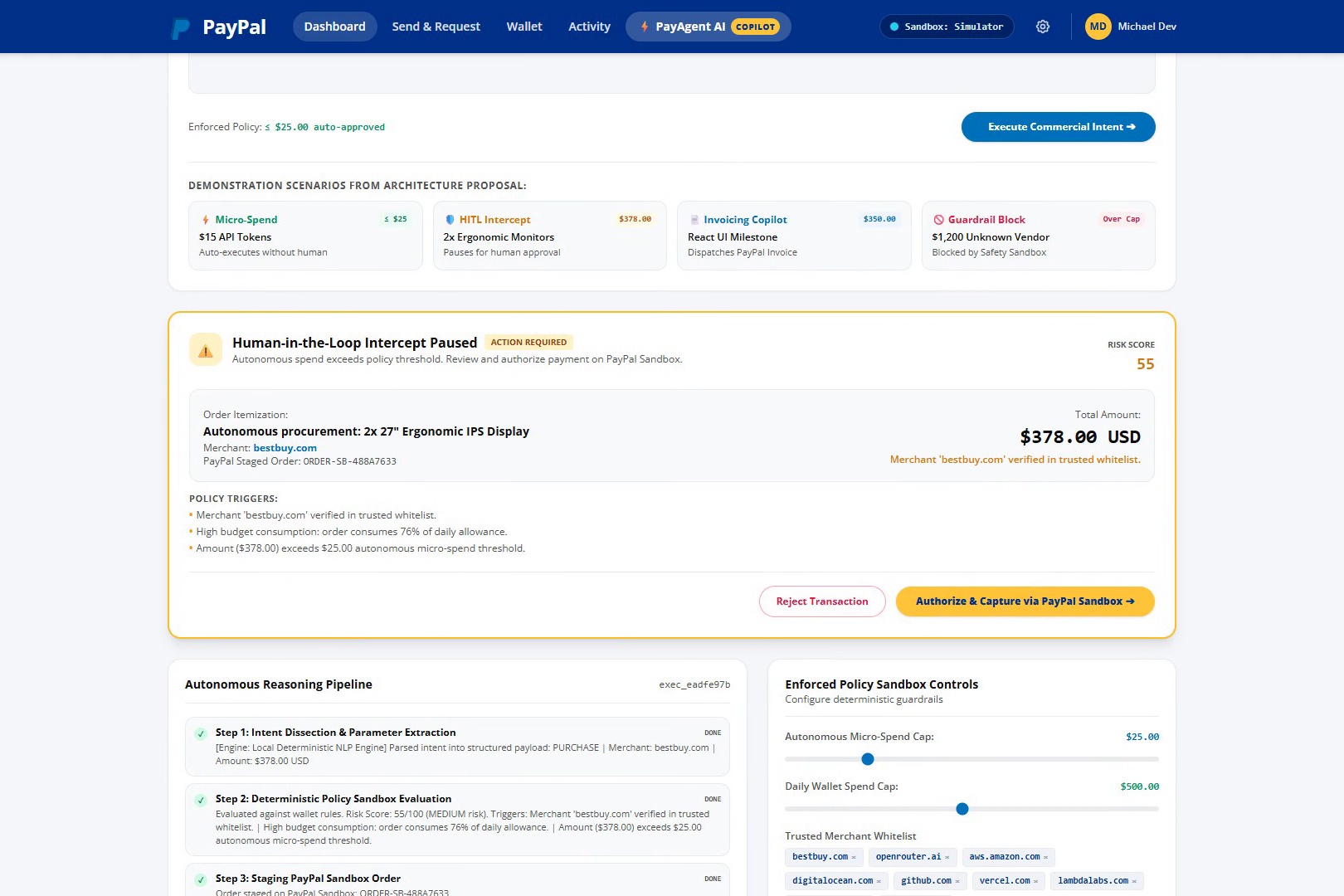
### 3. Solving the "Agent Wallet" Dilemma: The Enforced Policy Sandbox
Before any PayPal API is called, transactions are deterministically evaluated server-side:
* **Autonomous Micro-Spend (≤ $25.00):** Routine low-value purchases with whitelisted vendors auto-execute and
capture immediately on PayPal Sandbox without human intervention.
* **Context-Aware Dynamic Risk Scoring (0–100):** Evaluates transaction magnitude relative to daily budget, vendor
whitelist status, and historical price deltas.
* **Human-in-the-Loop (HITL) Intercepts (> $25.00 or Unverified Vendors):** The agent halts spending, stages the
order on PayPal Sandbox (`ORDER-SB-xxxx`), and displays an interactive approval card with risk metrics and 1-click
authorization.
* **Deterministic Ceilings:** Strict daily budget limits (`$500.00`) and single transaction caps (`$1,000.00`)
prevent unauthorized spending.

### 4. Automated B2B Invoicing Copilot
* Ingests contract agreements, conversation logs, or deliverable descriptions.
* Programmatically calculates line items and dispatches an authentic PayPal invoice via the **PayPal Invoicing API
v2** (`/v2/invoicing/invoices` & `/send`).

### 5. Live Agent Reasoning Pipeline & REST Telemetry
Users and judges can watch the agent's internal chain-of-thought in real time:
1. Intent Dissection & Entity Extraction
2. Deterministic Policy Sandbox Evaluation
3. PayPal Orders v2 / Invoicing Staging
4. HITL Pause or Autonomous Dispatch
5. PayPal Capture & Balance Settlement
How we built it
- PayPal Developer Platform:
- Orders API v2:
/v2/checkout/orders(Order creation and staging) - Capture API:
/v2/checkout/orders/{id}/capture(Payment capture and settlement) - Invoicing API v2:
/v2/invoicing/invoices(B2B draft creation and email dispatch) - OAuth 2.0:
/v1/oauth2/token(Bearer token generation) - PayPal JavaScript SDK v5: Official Smart Payment Buttons client-side integration
- AI & NLP Pipeline:
- Multi-tier LLM engine supporting Google Gemini 1.5 Flash and OpenAI GPT-4o-mini for semantic intent decomposition.
- Zero-latency deterministic NLP parser fallback ensuring offline reliability.
- Contextual Risk Scoring Algorithm evaluating spend-to-budget ratios, vendor reputation, and anomaly deltas.
- Backend: Node.js, Express 5, CORS, Dotenv, Crypto.
- Frontend: Modern responsive JavaScript, Tailwind CSS, Open Sans typography, SVG brand assets, and custom glassmorphism components.
- Dual-Engine Architecture: Toggle between live PayPal Sandbox credentials or the pre-configured Sandbox Simulator for zero-setup evaluation.
- Orders API v2:
Challenges we ran into
- Mitigating Autonomous Financial Leakage: Creating a policy engine that provides software agents autonomy
for micro-transactions while guaranteeing zero financial overreach required strict deterministic state machines
before any external API is touched.
- Synchronizing State Across Asynchronous Approvals: Designing the Human-in-the-Loop flow where an agent stages an order on PayPal Sandbox, pauses execution, surfaces risk metrics to a human, and seamlessly resumes capture upon one-click approval.
- Cross-Platform Zero-Config Setup: Ensuring judges on Windows, macOS, and Linux could clone and run the application with one click without getting stuck on environment variables or API keys.
Accomplishments that we're proud of
- End-to-End Working Prototype: A fully responsive web platform mirroring PayPal's exact design system,
complete with live balance updates, transaction ledgers, and official PayPal Smart Payment Buttons.
- Solving the Agent Wallet Problem: Successfully implementing dynamic risk scoring with autonomous micro-spend execution and HITL pauses.
- One-Click Launch & Automated Test Suite: Building
start.batand an automated test suite (npm test) that verifies all 5 core payment scenarios automatically.
What we learned
- Why domestic payment systems (like UPI or local debit rails) cannot support the next wave of autonomous
machine-to-machine (M2M) agents due to strict interactive human PIN requirements.
- How PayPal's global multi-currency REST APIs, OAuth 2.0 flows, and buyer/seller dispute protections make it the ideal financial operating system for autonomous AI agents.
- Best practices for designing contextual risk engines that balance agent autonomy with human oversight.
What's next for Pay2Pal
- Multi-Agent Negotiation Protocols: Buyer agents negotiating pricing with seller agents using PayPal Escrow
and Payouts APIs.
- Real-Time Stream Micro-Tipping (StreamBounty AI): Multimodal vision AI continuously validating livestream game states and executing conditional micropayments via PayPal Payouts.
- SubscriGuard AI: Autonomous subscription auditor that parses PayPal Subscriptions API to detect price hikes and automatically cancel redundant SaaS tools.
Built With
- agentic-commerce
- express.js
- gemini-api
- gpt-4o
- invoicing-api-v2
- javascript
- node.js
- orders-api-v2
- paypal
- paypal-sdk
- rest-api
- smart-payment-buttons
- tailwind-css
