-
-
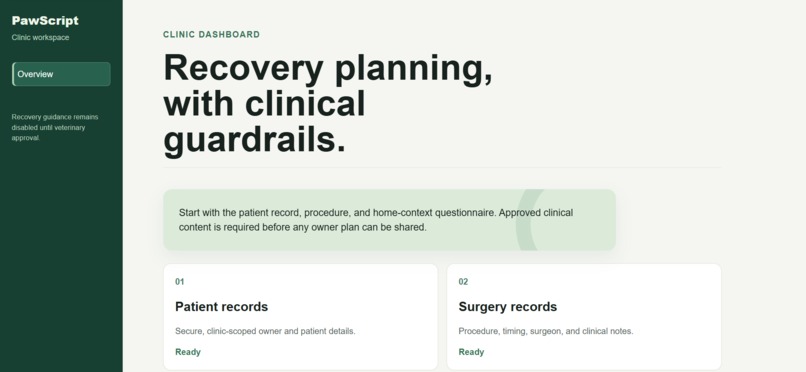
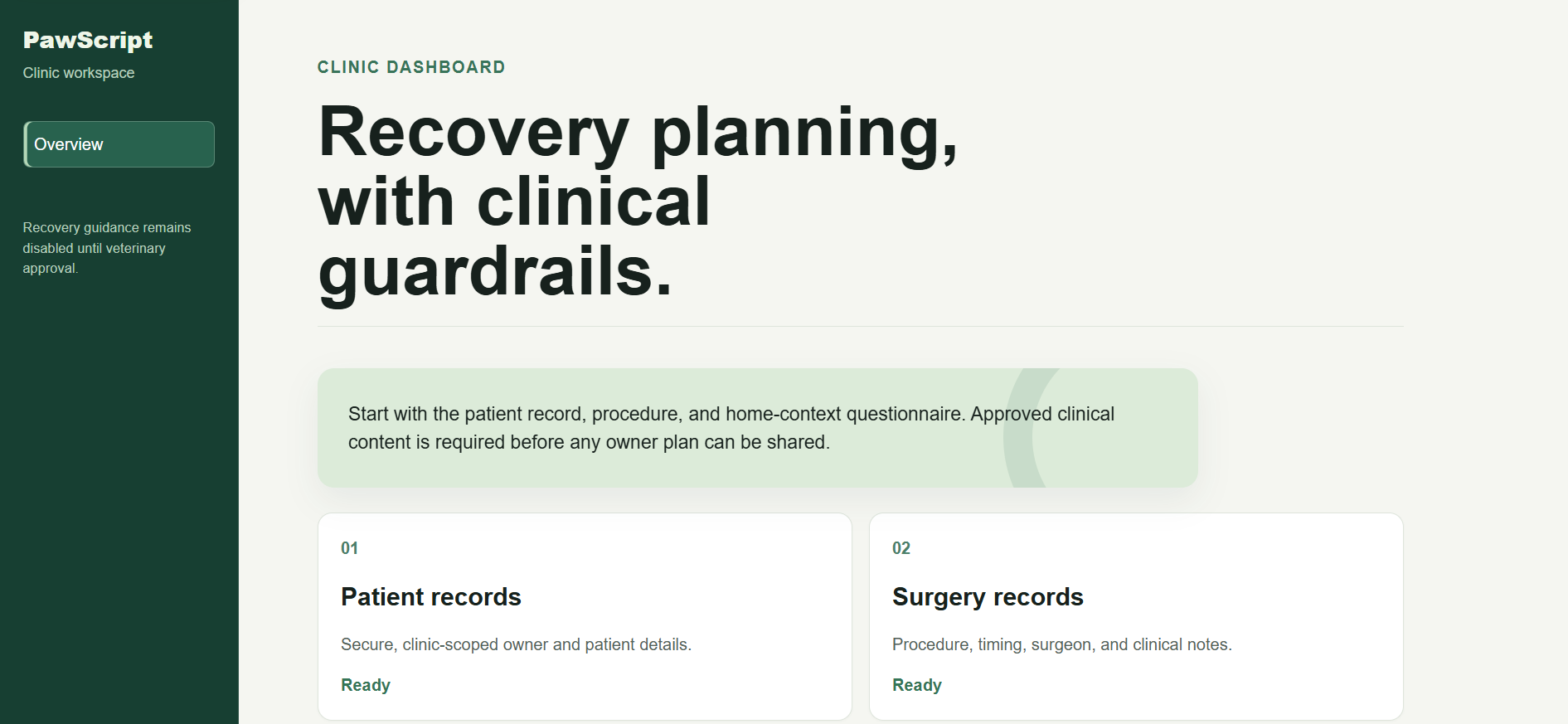
The Dashboard of my pawScript AI.
Inspiration
Veterinary post-operative care often breaks down after a pet leaves the clinic. Generic discharge sheets cannot reflect the patient’s behavior, home environment, stairs, other pets, or the caregiver’s practical limits. PawScript AI was inspired by the need to bridge the clinic and the home without replacing veterinary judgment. We wanted to give clinics one secure workflow for organizing patient context, procedures, follow-ups, intake information, and non-urgent owner updates.
What it does
PawScript AI is a clinic workspace for post-operative recovery workflow management. It allows clinic staff to create owner and patient records, record surgeries, schedule follow-ups, capture structured home-context questionnaires, create veterinary review cases, and view a consolidated patient case summary. It also provides restricted owner access through expiring, revocable links. Owners can view clinic-shared follow-up appointments and send a short non-urgent check-in. The current prototype does not diagnose, prescribe, generate recovery plans, assess wounds, or provide emergency guidance.
How we built it
We built PawScript as a separate frontend and backend system: Next.js 15 and TypeScript for the clinic dashboard and owner portal NestJS and TypeScript for authentication, authorization, validation, business rules, and API endpoints Neon PostgreSQL with Prisma for tenant-scoped data and migrations Render for separate frontend and backend deployment GitHub Actions for linting, type checking, testing, and production builds We used GPT-5.6 and Codex as development copilots to accelerate planning, coding, testing, debugging, UI refinement, documentation, CI/CD setup, and deployment configuration. All AI-assisted work was reviewed and verified with automated checks and manual browser testing.
Challenges we ran into
The biggest challenge was building a useful veterinary workflow without crossing clinical-safety boundaries. We had to make deliberate decisions around tenant isolation, session security, owner access, sensitive data, and what information should never be exposed through a public owner link. We also encountered deployment and authentication challenges when connecting separately hosted frontend and backend services. We solved this with a same-origin Next.js API proxy so browser sessions remain secure while the frontend and backend can still deploy independently.
Accomplishments that we're proud of
We are proud that PawScript is more than a simple dashboard prototype. It includes: Clinic-scoped roles and authorization Owner, patient, surgery, appointment, and questionnaire workflows A review queue that intentionally prevents unapproved recovery guidance Expiring and revocable owner-access links with hashed tokens Owner check-ins protected with idempotency controls Activity and authentication audit records Responsive clinic and owner interfaces Automated linting, type checks, tests, database integration coverage, production builds, Docker support, CI, and Render deployment configuration Most importantly, we designed the product to keep veterinary professionals in control.
What we learned
We learned that healthcare-adjacent software needs clear safety boundaries, not just good features. A responsible AI-enabled workflow must minimize data sharing, preserve auditability, enforce permissions, and clearly define what the system cannot do. We also learned that starting with a focused administrative workflow creates a stronger foundation than immediately adding AI advice, notifications, medical-image analysis, or complex integrations.
What's next for PawScript AI
Next, we plan to work with licensed veterinary reviewers to create versioned, procedure-specific recovery content and approval workflows. Only after clinical, privacy, and safety gates are complete, PawScript can support clinician-approved recovery-plan previews and controlled owner delivery. Future milestones include verified email flows, shared rate limiting, backup and restore testing, accessibility testing, pilot-clinic feedback, notifications, practice-management integrations, and carefully governed clinician-only AI assistance.
Built With
- ai
- authentication
- codex
- docker
- full-stack
- github-actions
- gpt-5.6
- healthcare
- jest
- neon
- nestjs
- next.js
- node.js
- openai
- postgresql
- prisma
- react
- render
- rest-api
- saas
- security
- tailwind-css
- typescript
- veterinary-tech

Log in or sign up for Devpost to join the conversation.