-
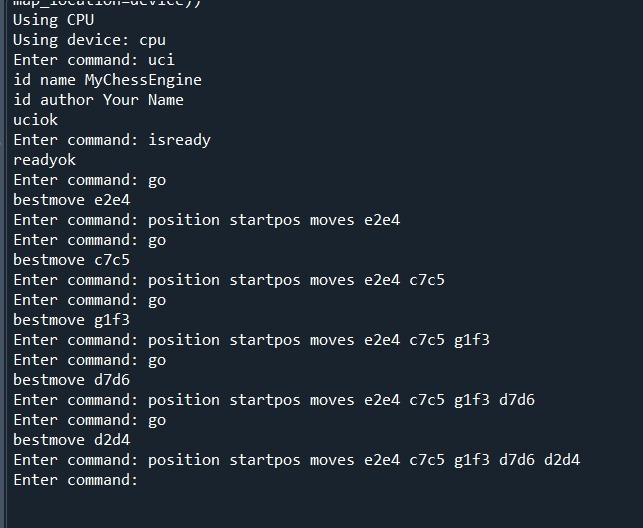
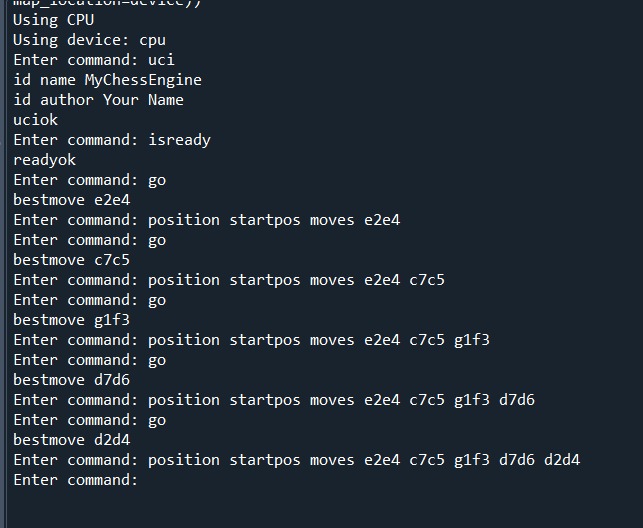
Output in terminal for UCI Protocol implementation
Inspiration
The Pawn Storm Chess Engine was born from a passion for chess and a drive to push the boundaries of artificial intelligence in the game. Our inspiration came from the challenge of creating a chess engine that not only understands the basic rules but also incorporates advanced strategic planning and tactics. We aimed to develop an engine that could rival human expertise and offer unique insights into chess strategy.
What It Does
Pawn Storm is a sophisticated chess engine designed to analyze chess positions, predict optimal moves, and provide strategic recommendations. It uses advanced machine learning algorithms to evaluate various game scenarios and suggest moves that align with high-level strategic principles. The engine is capable of playing at a competitive level and can be integrated into various chess platforms for enhanced gameplay experiences.
How We Built It
Data Collection and Cleaning: We began by collecting a large dataset of historical chess games from various sources. Data cleaning involved removing inconsistencies and irrelevant data to prepare a high-quality dataset for training.
Model Training: We implemented and trained several machine learning models to predict chess moves. This process included experimenting with different model architectures, such as neural networks, and optimizing hyperparameters to improve performance.
Validation and Testing: The models were rigorously validated using cross-validation techniques and performance metrics. We tested the engine against established benchmarks and refined the models based on their performance.
Integration: The trained models were integrated into a user-friendly interface, allowing users to interact with the engine and receive strategic recommendations during gameplay.
Challenges We Ran Into
Data Cleaning: Handling and preprocessing a large dataset of chess games was challenging. Ensuring data accuracy and consistency required significant effort.
Model Training and Validation: Training machine learning models for chess involved dealing with complex data and achieving a balance between model complexity and performance. Validating the models and ensuring their effectiveness in different scenarios was also challenging.
Accomplishments That We're Proud Of
High-Level Performance: Our engine demonstrates strong performance in analyzing and predicting chess moves, showing the effectiveness of our machine learning approach.
User Integration: Successfully integrating the engine into a user-friendly interface has made it accessible for chess enthusiasts and players of all levels.
Innovative Approach: The use of advanced machine learning techniques to enhance chess strategy and gameplay represents a significant advancement in chess engine technology.
What We Learned
Data Management: We gained insights into efficiently handling and preprocessing large datasets, which is crucial for developing effective machine learning models.
Machine Learning Techniques: We explored various machine learning algorithms and techniques, deepening our understanding of model training, validation, and performance optimization.
Integration Challenges: Integrating complex models into user interfaces taught us valuable lessons in balancing technical complexity with user experience.
What's Next for Pawn Storm
Enhanced Algorithms: We plan to refine and expand our machine learning algorithms to improve the engine's strategic capabilities and overall performance.
Broader Integration: We aim to integrate Pawn Storm into additional chess platforms and applications to reach a wider audience and enhance the gaming experience for users.
Continuous Learning: Future updates will focus on incorporating feedback from users and learning from new chess games to continually improve the engine's accuracy and strategic insight.
Built With
- machine-learning
- python
- pytorch
- tensorflow


Log in or sign up for Devpost to join the conversation.