-
-
System Architecture
-
Rescue Flow
Inspiration
The inspiration for PawConnect is deeply personal and rooted in experiences that many of us share but often feel powerless about. In cities and towns all over the world, stray and injured animals are part of the urban landscape. They are seen crossing busy roads, scavenging near trash bins, or limping silently in alleyways. For many people, encountering a suffering animal is an emotional moment — you want to help, but the options available are unclear. Do you call the municipality? Do you try searching for an animal NGO online? Do you attempt to rescue the animal yourself without proper training or facilities?
We reflected on how many times we have witnessed such situations. A limping street dog that clearly had been hit by a vehicle. A kitten crying from under a parked car. A bird entangled in wires. These are not rare incidents, and each time, the immediate reaction is a mix of compassion and helplessness. People want to help, but they are limited by time, knowledge, and access to professional rescue organizations.
On the other side, animal NGOs and shelters exist specifically to handle such cases. They often have trained staff, access to veterinary care, and the infrastructure to house rescued animals. However, these organizations operate with limited resources, receive fragmented requests across multiple communication channels (phone calls, WhatsApp messages, social media DMs), and often cannot prioritize effectively. A single NGO might be managing hundreds of rescue requests without any structured system. The result is slower response times and fewer animals helped.
That gap — between compassionate citizens who want to help and organizations that can actually provide the help — is where PawConnect was born. Our inspiration was the simple but powerful belief that technology can transform compassion into coordinated action. Just as apps exist to order food in seconds or hail a ride instantly, why shouldn’t there be an equally simple way to report an injured animal and connect directly with those who can respond?
We imagined a tool that makes it effortless for someone on the street to say: “Here is an animal in need. Here’s where it is. Please help.” And for an NGO to immediately see that request, assign it, and update the status transparently. This vision of turning everyday empathy into structured rescue operations became the heart of PawConnect.
What it does
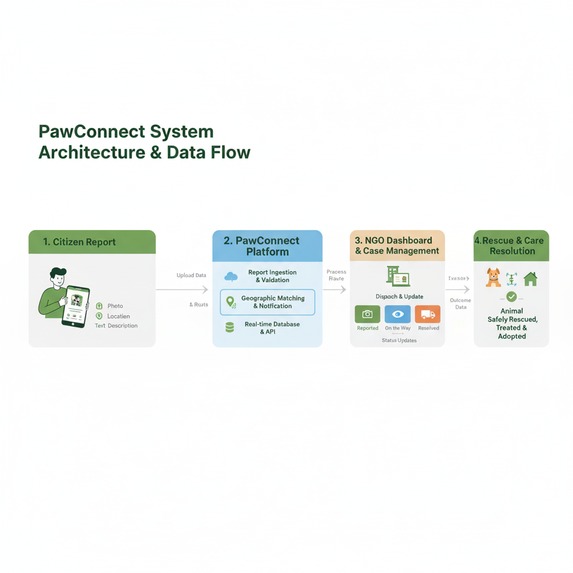
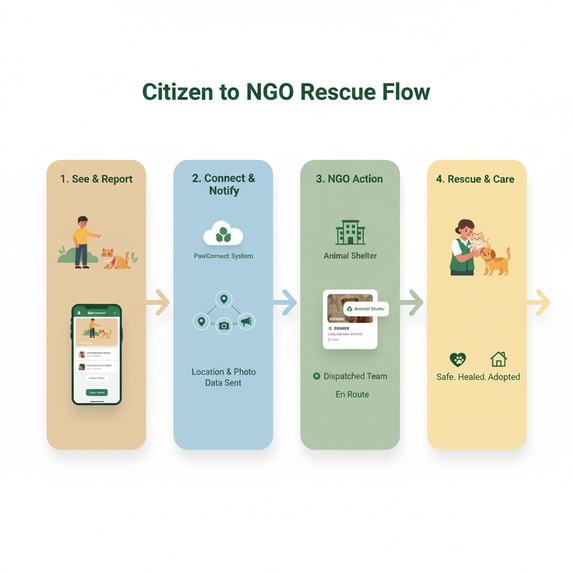
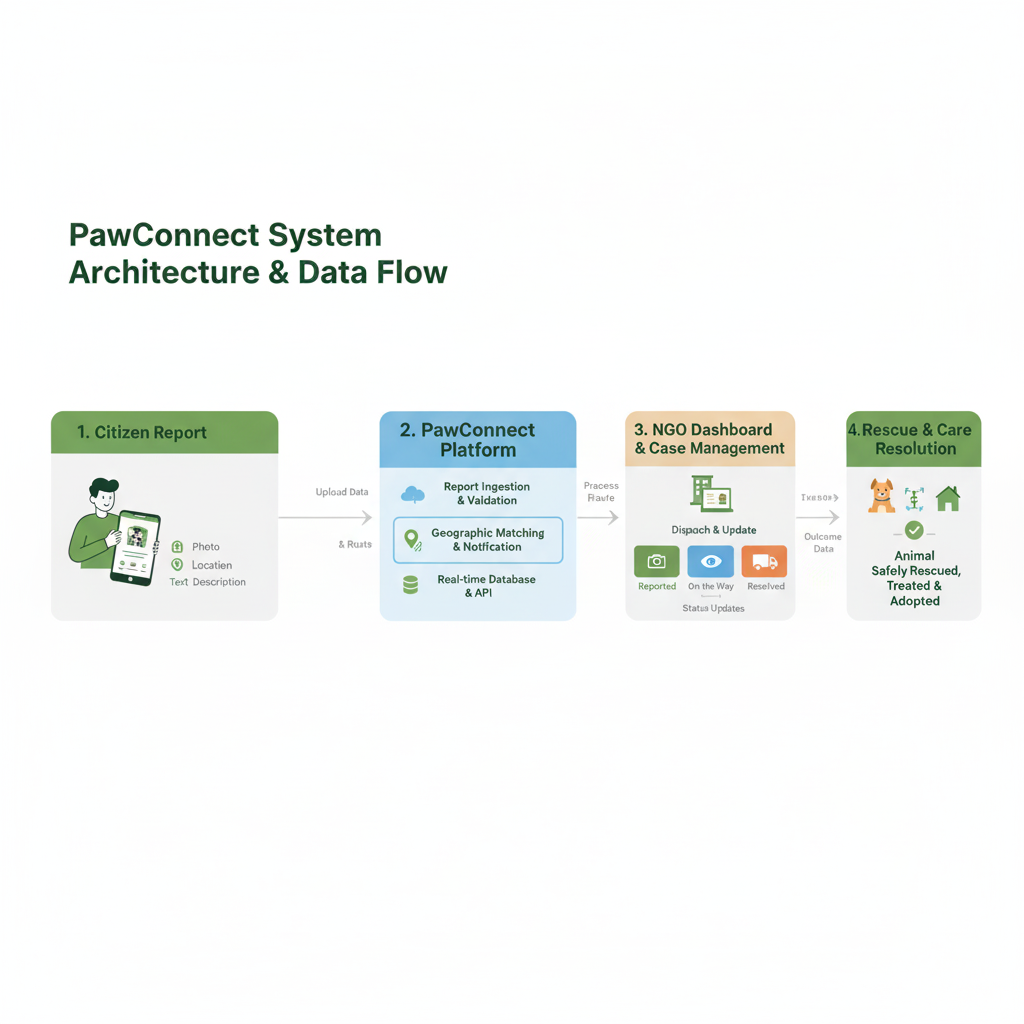
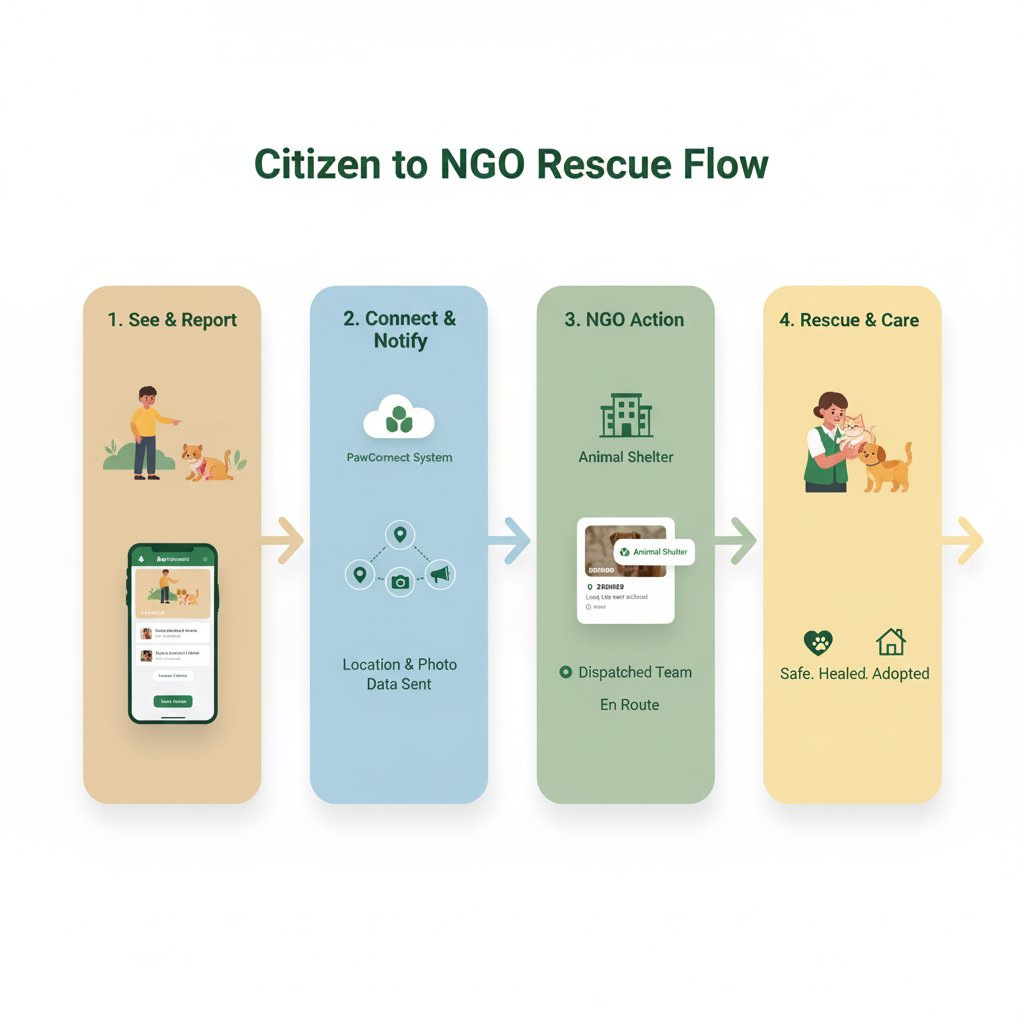
At its core, PawConnect is a platform that creates a real-time bridge between citizens and animal welfare organizations. It has two major sides:
For Citizens (Reporters)
- Seamless Animal Reporting: Anyone who sees a stray or injured animal can quickly fill out a form. They upload a photo (to help identify urgency), describe the situation, add the location, and leave their contact information for follow-up.
- Guided Experience: The platform is designed to feel warm and supportive. After submitting, users receive a clear “thank-you” message with next steps, reassurance that the report has been logged, and even a unique tracking ID. This gives them confidence that their action is meaningful.
- Ease of Access: Whether on a phone or laptop, the site is responsive and simple. No one has to download an app or deal with complex menus. The goal is speed — in emergencies, every second matters.
For NGOs, Shelters, and Vets
- Secure Login: Organizations access a dedicated dashboard with secure login credentials.
- Centralized Dashboard: Instead of juggling calls, texts, and DMs, they now have all reports in one place. Each report contains the photo, description, location, and contact info of the reporter.
- Status Management: They can move a report through clear stages — from “Reported” → “Received” → “On the Way” → “Resolved.” This ensures no case slips through the cracks.
- Filtering & Prioritization: NGOs can filter cases by urgency, location, or status, enabling them to allocate their limited resources more effectively.
- Direct Contact: Clicking on a report provides direct access to the reporter’s contact info, making communication fast and transparent.
Impact of This Flow
PawConnect removes the chaos from animal rescue requests. It replaces fragmented, unstructured communication with a streamlined pipeline. It empowers ordinary citizens to contribute meaningfully and gives NGOs the tools to respond efficiently.
It transforms animal rescue into something organized, data-driven, and humane.
How we built it
PawConnect was designed with both hackathon constraints and real-world scalability in mind. Our goal was to deliver something that looks polished, works smoothly, and can grow into a production-ready platform.
Frontend
- We used React 18 with TypeScript to build a robust and modern frontend application. React gave us flexibility in creating dynamic components, while TypeScript added type safety to reduce bugs and enforce clean contracts in our data models.
- Styling was powered by Tailwind CSS combined with shadcn/ui components. This allowed us to rapidly prototype interfaces while maintaining a consistent design system. The color palette — warm greens, sky blues, and beiges — was chosen carefully to evoke compassion and trust.
- Animations were handled with smooth CSS transitions, giving the app a sense of care rather than abruptness.
Routing & Pages
- Landing Page: Introduces the app with a clear hero section, statistics, and “How it Works” steps.
- Report Page: A user-friendly form for citizens. We added validation (e.g., requiring a description or photo) to ensure data quality.
- Thank You Page: Provides reassurance and explains what happens next.
- NGO Dashboard: A structured admin panel with tables, filters, and report detail views.
Data Management
- For the hackathon demo, we intentionally kept things lightweight by using localStorage. This allowed us to simulate persistence without requiring a backend.
- The app comes preloaded with sample reports and demo NGO credentials. This makes live demos seamless — no need to populate data on the spot.
Scalability Considerations
Even though we used localStorage for now, the architecture is built so that all localStorage calls could easily be replaced with API calls to a real backend. This makes migration to a scalable stack (Node.js + PostgreSQL, for example) straightforward.
Demo Friendliness
One of our design principles was demo-readiness. Judges should be able to see the complete flow (citizen → NGO → rescue) in under 2 minutes without hiccups. That’s why we added sample data, demo credentials, and a clear demo script.
Challenges we ran into
Every hackathon project faces obstacles, and PawConnect was no exception.
Dual-Sided Platform Complexity:
We weren’t just building one app — we were essentially building two. The citizen side needed to be welcoming, simple, and intuitive, while the NGO side required more structured tools like filtering, status updates, and login systems. Balancing development time across both sides was one of the biggest challenges.Time Pressure vs. Design Quality:
Hackathons are notorious for time pressure. We had to resist the temptation to cut corners in design. It was important for us that PawConnect felt compassionate and human-centered, not just functional. This meant spending hours refining typography, spacing, and color choices while still racing against the clock.Deciding What to Leave Out:
Our initial vision included features like GPS auto-detection, real-time WebSocket updates, and push notifications. With limited time, we had to accept that some ideas would remain in the “future work” section. The challenge was prioritizing without losing the core essence of the app.Data Modeling Simplicity:
Since we used localStorage, we had to carefully model our data to mimic a real backend. This required creating clear TypeScript interfaces and thinking about how those would map to a future database schema.Accessibility:
Building a warm and visually engaging app while still maintaining WCAG accessibility standards required effort. We had to ensure proper ARIA labels, keyboard navigation, and contrast ratios.
Accomplishments that we're proud of
Despite the challenges, PawConnect became one of those projects we are truly proud of. Some highlights:
- We created a working, end-to-end demo in a very limited timeframe. This isn’t just a static prototype — it’s an actual functional app.
- The NGO dashboard turned out better than expected, with intuitive status tracking and filtering that NGOs could actually use in real life.
- Our design system received positive reactions. The colors and UI gave people a sense of calm and care — exactly the emotion we wanted to evoke.
- We developed a demo flow that tells a compelling story: a user reports an injured dog, an NGO logs in, updates the case, and the system shows progress in real time. Judges can visualize the impact instantly.
- The most important accomplishment is that PawConnect has real-world potential. Unlike many hackathon projects that remain concepts, this feels deployable with only a few more engineering steps.
What we learned
PawConnect was as much a learning journey as it was a building journey.
- Empathy-Driven Design: We learned how to design for users in stressful situations. For example, when someone is reporting an injured animal, they may be panicked. The interface had to minimize friction: fewer fields, bigger buttons, clearer labels.
- Human Feedback Loops Matter: A simple thank-you page isn’t just UX polish — it builds trust and motivates future engagement. Without it, users might feel like their effort vanished into the void.
- Hackathon Project Structuring: We learned to scope tightly while still leaving room to dream big. By designing localStorage as a placeholder for a database, we ensured our architecture could scale.
- Team Collaboration: Dividing tasks effectively (frontend design, NGO dashboard, demo prep) was essential. Communication within the team made sure we didn’t duplicate work or drift off-track.
- Tech + Compassion Can Coexist: This project reinforced that technology isn’t just about automation or efficiency — it can embody empathy, bridge human-animal gaps, and create genuine impact.
What's next for PawConnect
PawConnect is just scratching the surface. We see this as a foundation for something much bigger:
- Real Backend & APIs: Transition from localStorage to a scalable backend (Node.js/Express + PostgreSQL). Add APIs for authentication, reporting, and status updates.
- GPS Auto-detection: Automatically fetch the reporter’s coordinates using browser geolocation. Display reports on an interactive map for NGOs.
- Push Notifications: NGOs receive instant alerts on their phones when a new case is reported nearby.
- Mobile-first PWA: Make PawConnect installable on phones, usable offline, and accessible in low-connectivity areas.
- Volunteer Integration: Allow ordinary citizens to sign up as community volunteers, helping NGOs with rescues when they are overstretched.
- Analytics Dashboards: Provide NGOs with data like number of rescues completed, average response time, and hotspots for stray animal activity.
- Photo/Video Uploads: Allow multiple images and short videos with automatic compression and cloud storage.
- Multi-language Support: Translate PawConnect into local languages so it can be deployed globally.
- Government & Vet Partnerships: Collaborate with local municipalities and vet clinics to make rescues faster and more coordinated.
- AI-powered Prioritization: Use machine learning to analyze uploaded photos and flag urgent cases automatically (e.g., visible bleeding, fractures).
Our dream is bold: a global network for animal rescue. Imagine PawConnect scaling city by city, creating a live map of rescues, volunteers, and shelters working together. A compassionate digital safety net for animals everywhere.
PawConnect is more than just code. It’s a vision of a world where no injured or stray animal is left behind.
By bridging compassion with technology, we’re taking one small but significant step toward that future.
Built With
- react
- tailwind
- typescript

Log in or sign up for Devpost to join the conversation.