-
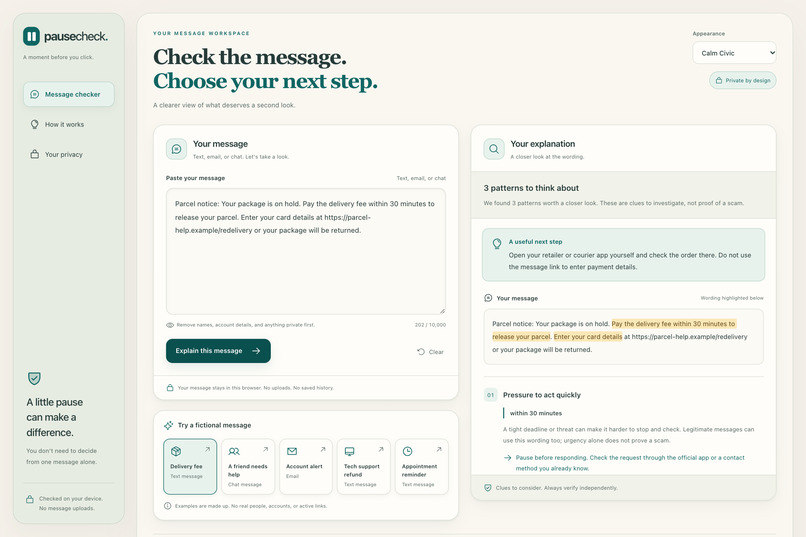
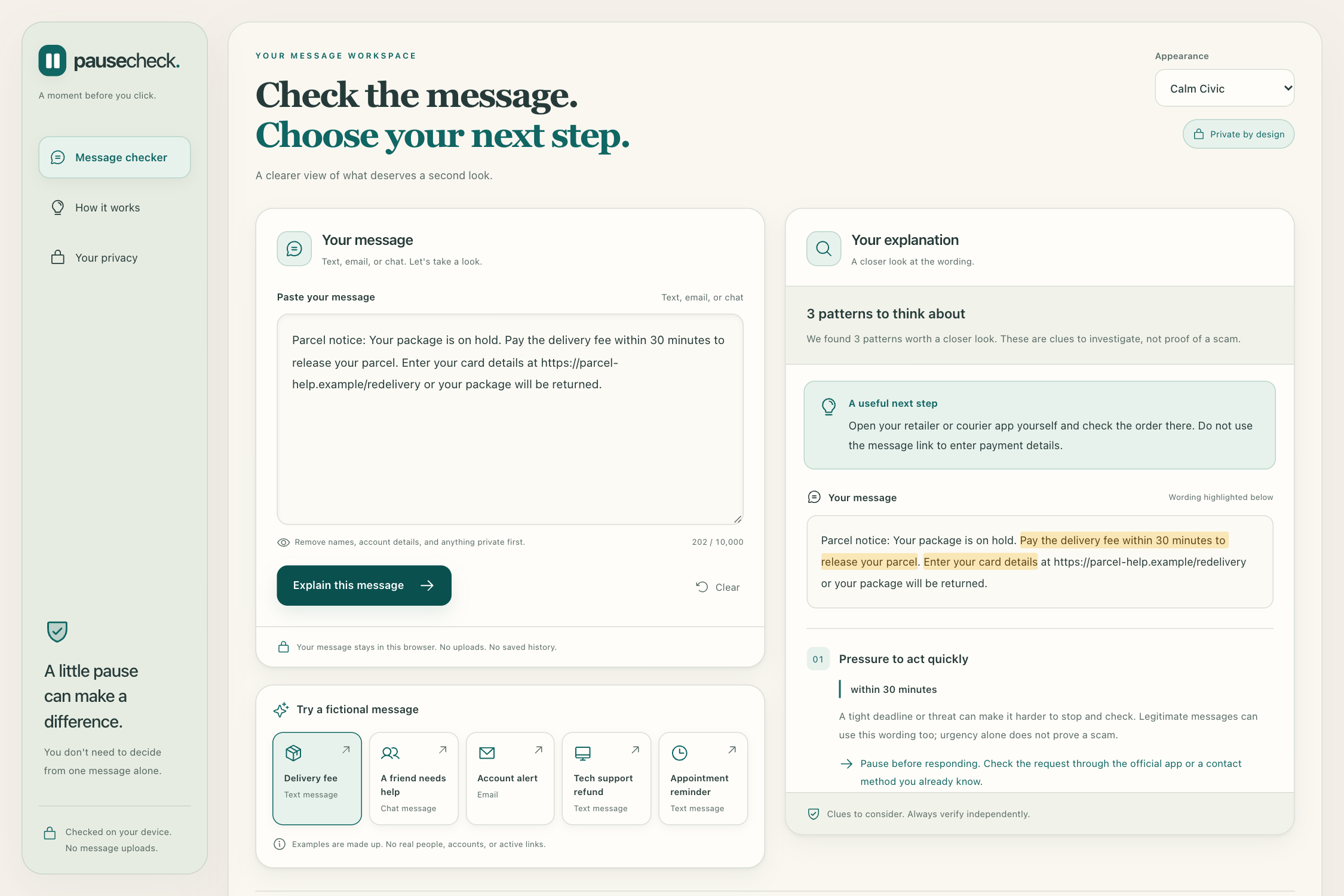
Delivery-fee example: deadline, card request and fee highlighted, with an independent next step
-
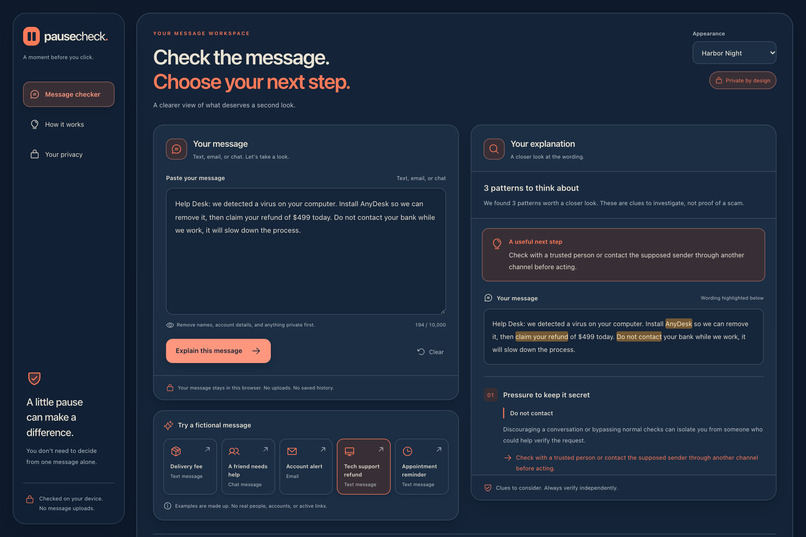
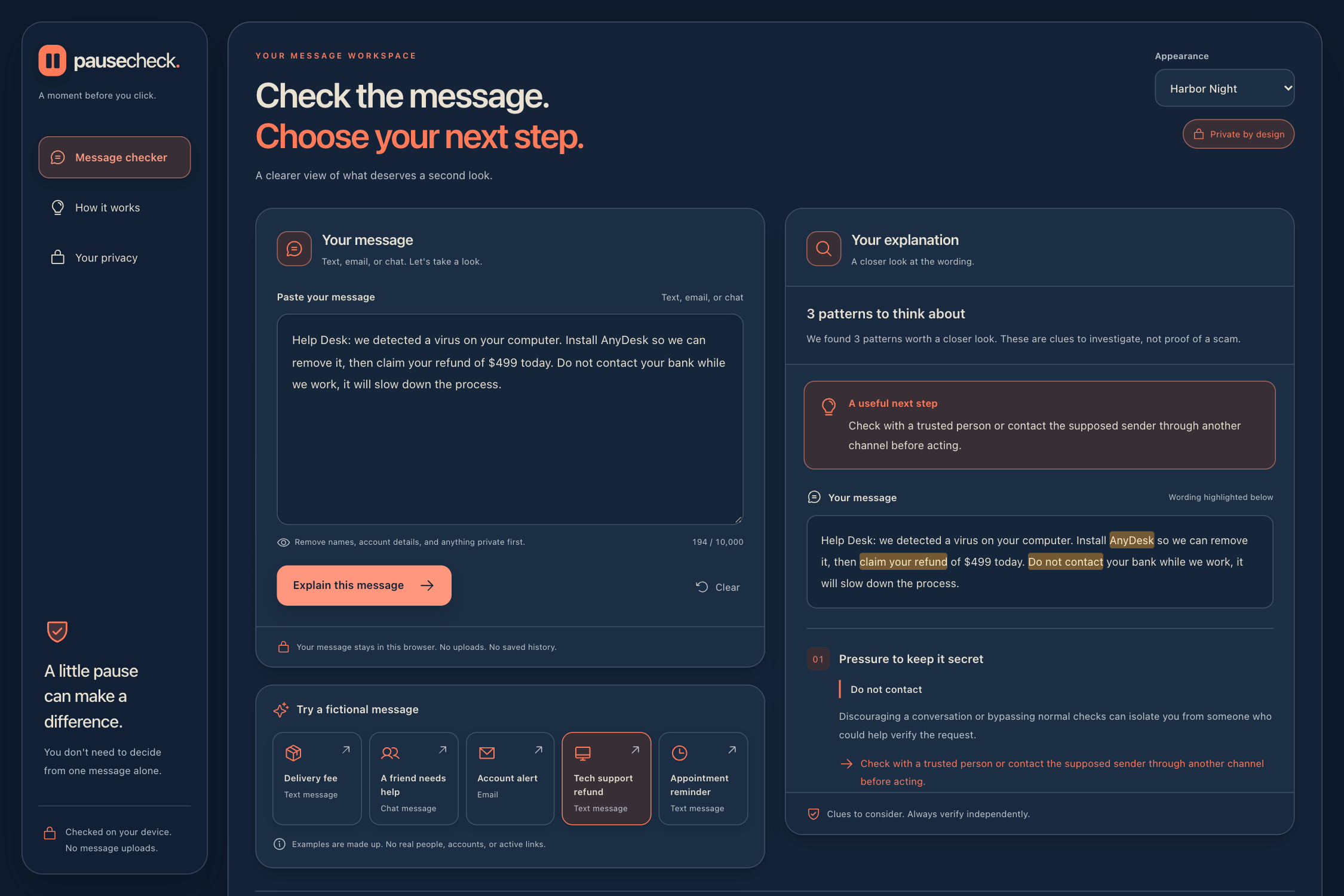
Tech-support scam: remote access (AnyDesk), refund lure and secrecy, in the Harbor Night theme
-
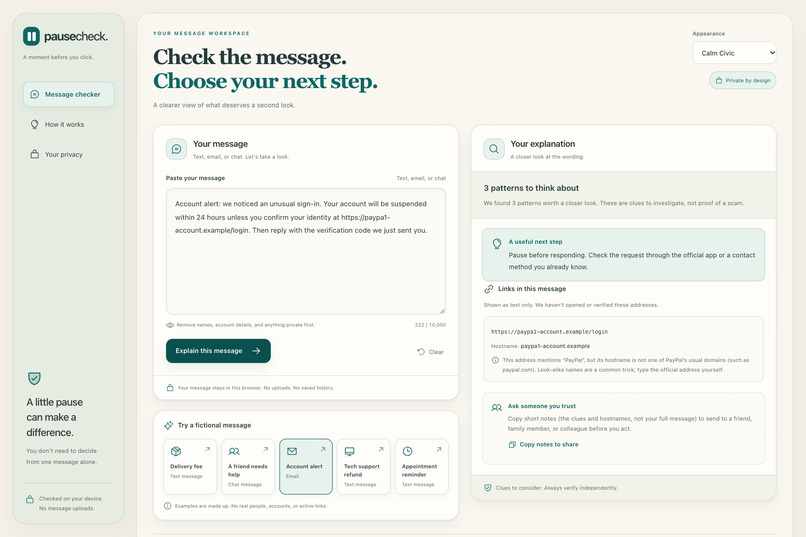
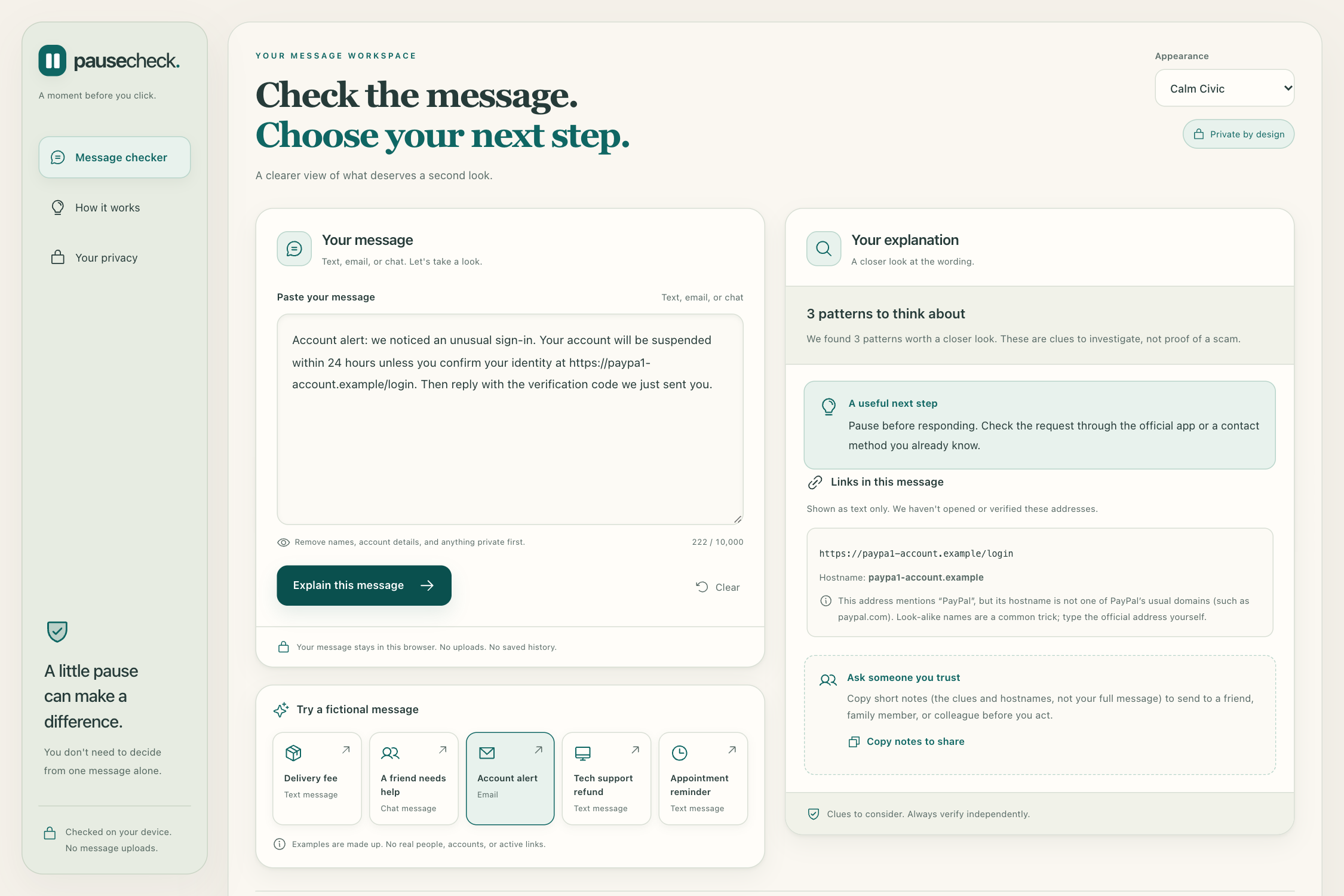
Look-alike link (paypa1) explained without opening it, plus "Ask someone you trust" share notes
-
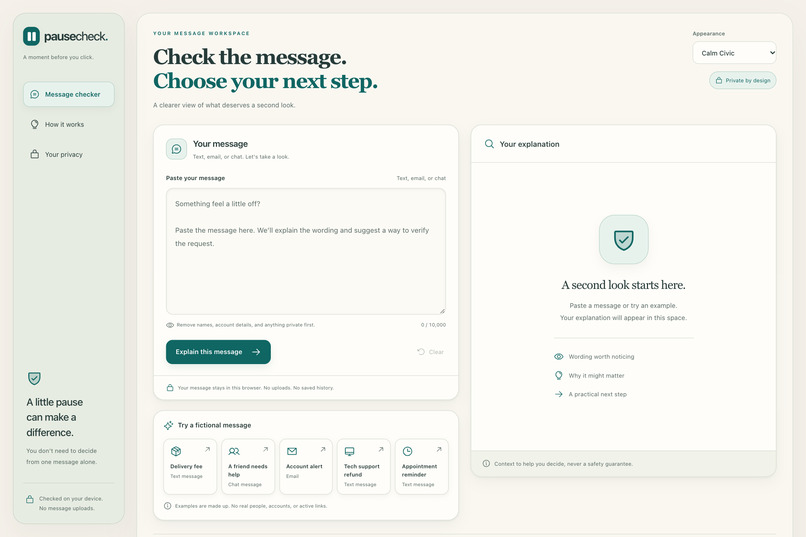
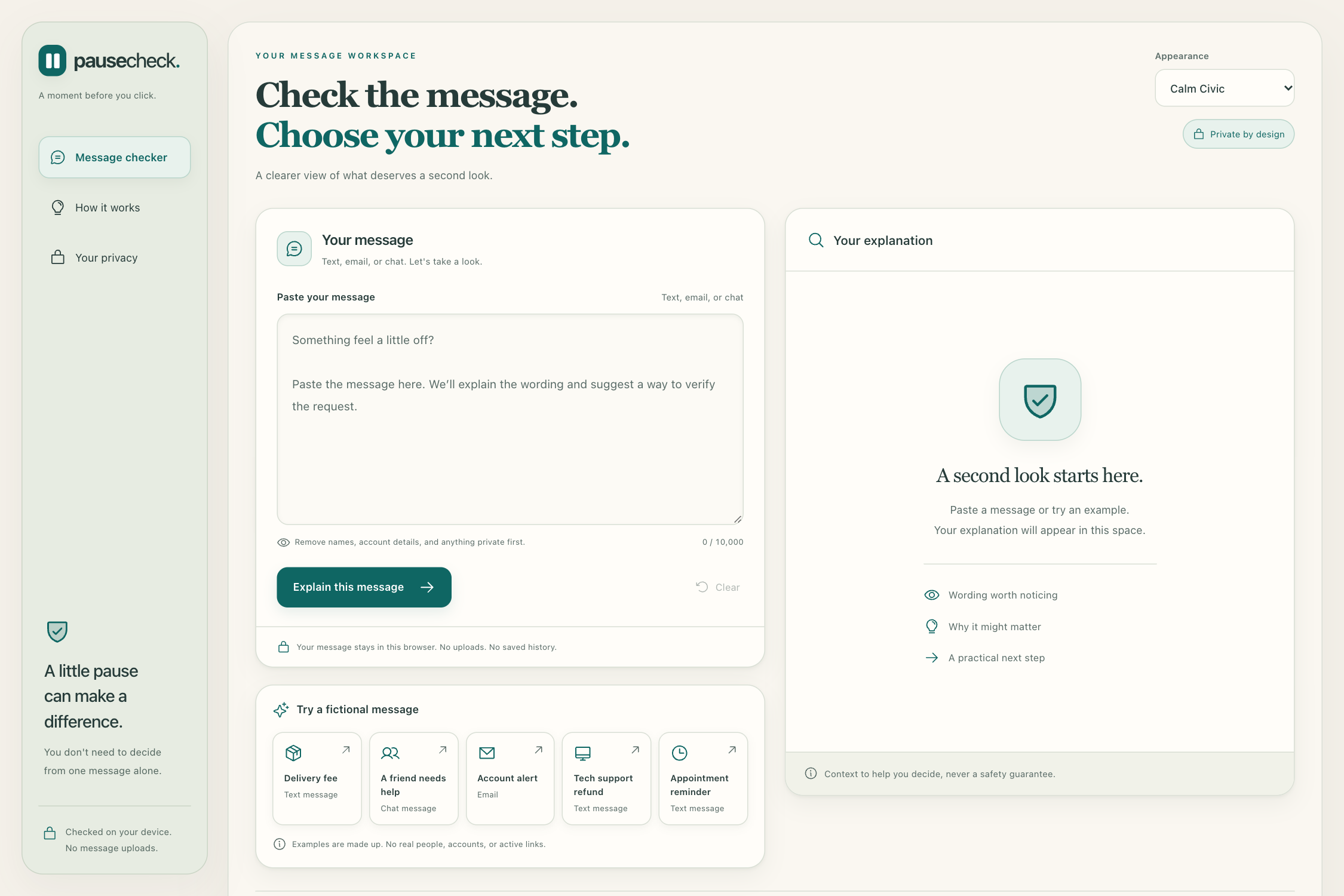
Home: paste a message or try one of five fictional examples. Analysis stays in the browser
-
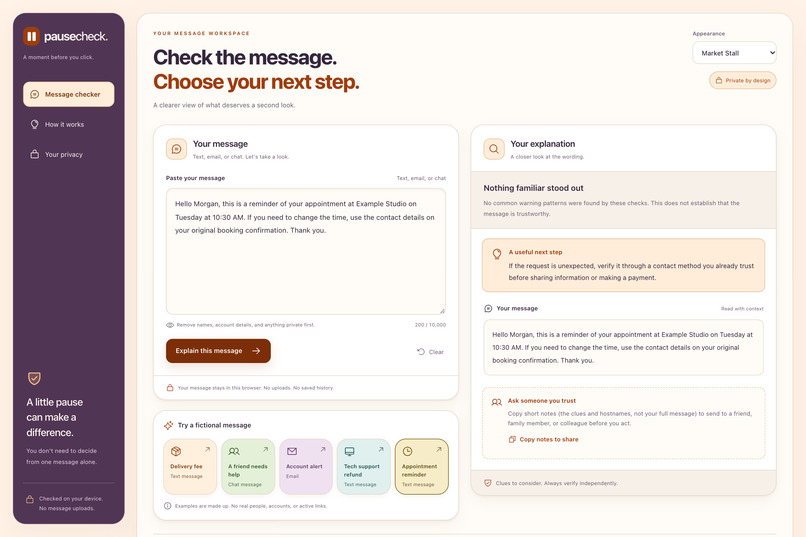
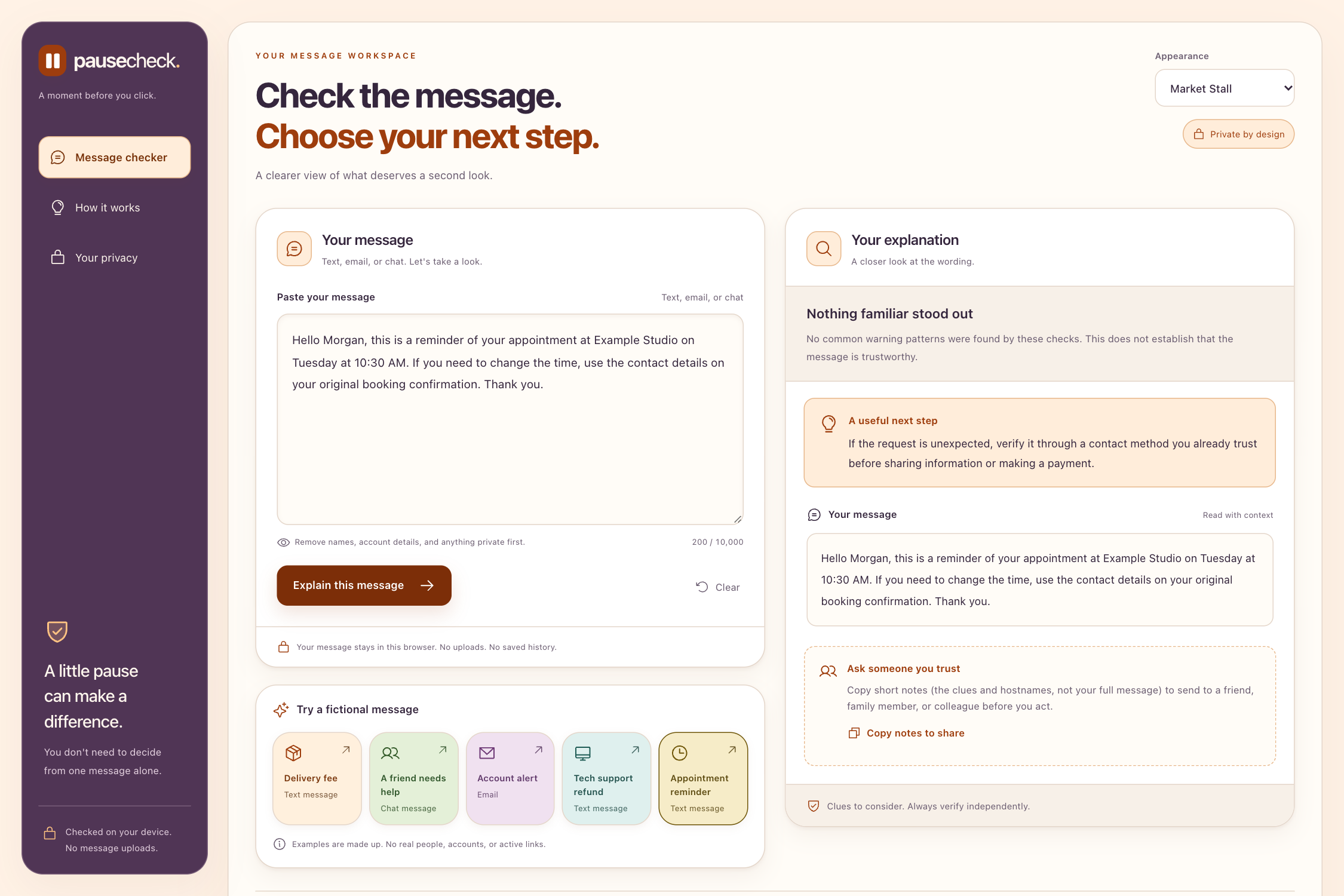
No findings is never a "safe" verdict: cautious result for an ordinary reminder (Market Stall theme)
Inspiration
A parcel "on hold" with a 30-minute deadline. A friend texting from a "new number" who needs gift cards. An "account alert" with a link that looks almost right. These messages ask people to make a trust decision before they have enough context, and the people most often targeted (older relatives, busy parents, students, people new to a language) are the least likely to want to paste a private message into an online AI service.
Intended user: anyone who receives an unexpected text, email or chat message and hesitates before acting. Situation: the few seconds between reading a message and clicking, paying or replying. Practical improvement: a clear explanation of what in the message deserves a second look, plus a concrete, independent way to verify it.
What it does
- Paste a message, or try one of five fictional examples: delivery fee, a friend with a new number, an account alert, a tech-support refund, and an ordinary appointment reminder.
- See the exact wording highlighted. Deterministic rules flag eight kinds of pattern: pressure to act quickly, requests for passwords or one-time codes, unusual payments (gift cards, crypto, wire transfers), secrecy, unexpected delivery fees, sudden contact changes ("my phone broke, new number"), remote-access requests (AnyDesk, screen sharing), and too-good-to-be-true offers.
- Read why it matters, then what to do. Every finding has a plain-language explanation and an independent verification step, such as "open the courier app yourself" or "call them on the number you already have".
- Inspect links without opening them. Links are shown as non-clickable text with their parsed hostname. PauseCheck explains link shorteners, raw IP addresses, misleading
user@hosttricks, encoded international domains, and look-alike brand domains (e.g.paypa1-account.examplementions PayPal but is not paypal.com). - Ask someone you trust. One click copies short notes (the clues and hostnames, not the full message) so the user can send them to a friend or family member before acting.
- Never a "safe" verdict. When nothing is found, PauseCheck says so and explains that this does not make the message trustworthy. There is no score and no green tick.
There is also an "Already clicked or shared something?" section with immediate recovery steps, four accessible visual themes, and full keyboard and screen-reader support.
How we built it
- React 19 + TypeScript + Vite, styled with Tailwind CSS 4 and CSS custom-property themes; icons from Phosphor.
- A separate, pure analysis module (
src/analysis.ts) runs regular-expression rules and URL parsing, and returns every finding with exact character ranges in the original message. Those ranges drive the highlights, so evidence is never paraphrased or invented. - Link inspection uses the browser's built-in
URLparser only. Nothing is fetched, resolved or rendered as a link. Look-alike detection normalises common character swaps (0→o, 1→l, rn→m) and compares against each brand's real domains, including subdomains. - A strict Content-Security-Policy, no analytics, no backend, no storage, and no AI calls at runtime.
- 31 automated tests (Node's built-in test runner) cover each rule, evidence positions, length limits, negation ("never share your password" is not a request), URL edge cases (IPv6, punctuation,
@tricks), look-alike false positives, the share summary, and a guard that fails if analysis ever callsfetch. GitHub Actions runs the tests and production build on every push. - Deployed as a static site on Vercel.
Challenges we ran into
- Explaining uncertainty without false comfort. The hardest design problem was the no-findings case. We removed every "safe" signal and use the same cautious framing whether or not anything is found.
- Trustworthy evidence. Overlapping and repeated matches had to be merged into readable highlights without altering or duplicating any of the original text.
- False positives. "Never share your password" should not be flagged as a request for a password, and
purchase.exampleshould not be flagged as a Chase look-alike. Narrow negation handling and whole-label matching for short brand names fixed these, and both are covered by tests. - Sharing without leaking. The "ask someone you trust" feature had to be useful without copying private message content, so it shares only excerpts and hostnames.
What we learned
Separating observable details from claims about intent makes a safety tool more honest and more useful. We can say "this hostname is not PayPal's" without claiming the sender is a criminal. Keeping the analysis pure and separate from the UI also made it easy to test the behaviour that matters most.
A safer outcome (example)
In the fictional Delivery fee message, PauseCheck highlights "Pay the delivery fee within 30 minutes to release your parcel" and "Enter your card details", then advises: open your retailer or courier app yourself and check the order there; do not use the message link to enter payment details. The user verifies through a channel they already trust instead of typing card details into a link. This is a demonstrated prototype flow, not a measured real-world prevention rate.
Limitations
- It is a pattern-based prototype, not a fraud detector. It covers common English wording and can miss novel, misspelled, obfuscated or non-English scams, and can flag legitimate messages.
- It does not read images or attachments, follow redirects, check domain reputation, or authenticate senders. Look-alike detection covers a short list of commonly imitated brands.
- No findings ≠ safe. The app cannot recover money or respond to incidents.
What's next
Rules for more languages, a browser-extension "explain this selection" mode, an offline-installable PWA for low-connectivity users, and testing the wording with older adults and community digital-safety volunteers.
Work period, credits and AI assistance
- All application source, examples, tests and documents were created during the event window (October 17 – November 22, 2026): initial build on October 18, layout revision on October 19, release work on October 20, and new rules, look-alike detection, sharing, CI and documentation on November 18. No pre-existing application code was imported.
- Open-source dependencies (pre-existing): React and React DOM (MIT), TypeScript (Apache-2.0), Vite and @vitejs/plugin-react (MIT), Tailwind CSS (MIT), Phosphor Icons (MIT).
- All example messages are synthetic and use reserved
.exampledomains. Brand names appear only to demonstrate look-alike detection. - AI assistance: OpenAI Codex helped with the initial concept, design, implementation, tests and documentation; Anthropic's Claude Code helped with the November 18 improvements. The running app calls no AI model.
Built With
- css3
- github-actions
- html5
- node.js
- phosphor-icons
- react
- tailwindcss
- typescript
- vercel
- vite
