-
-
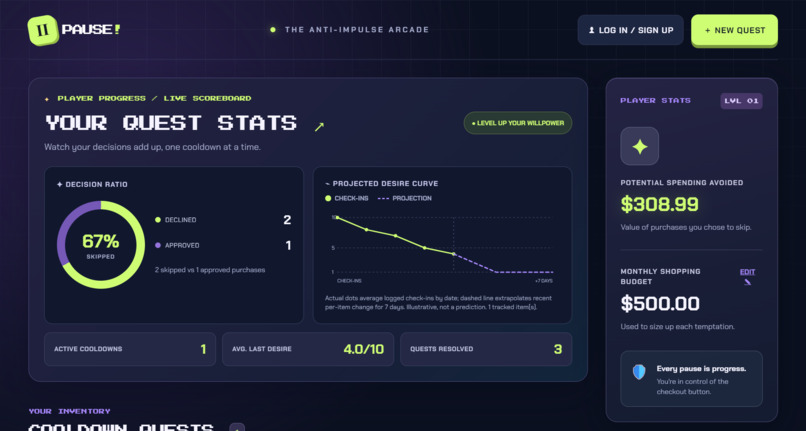
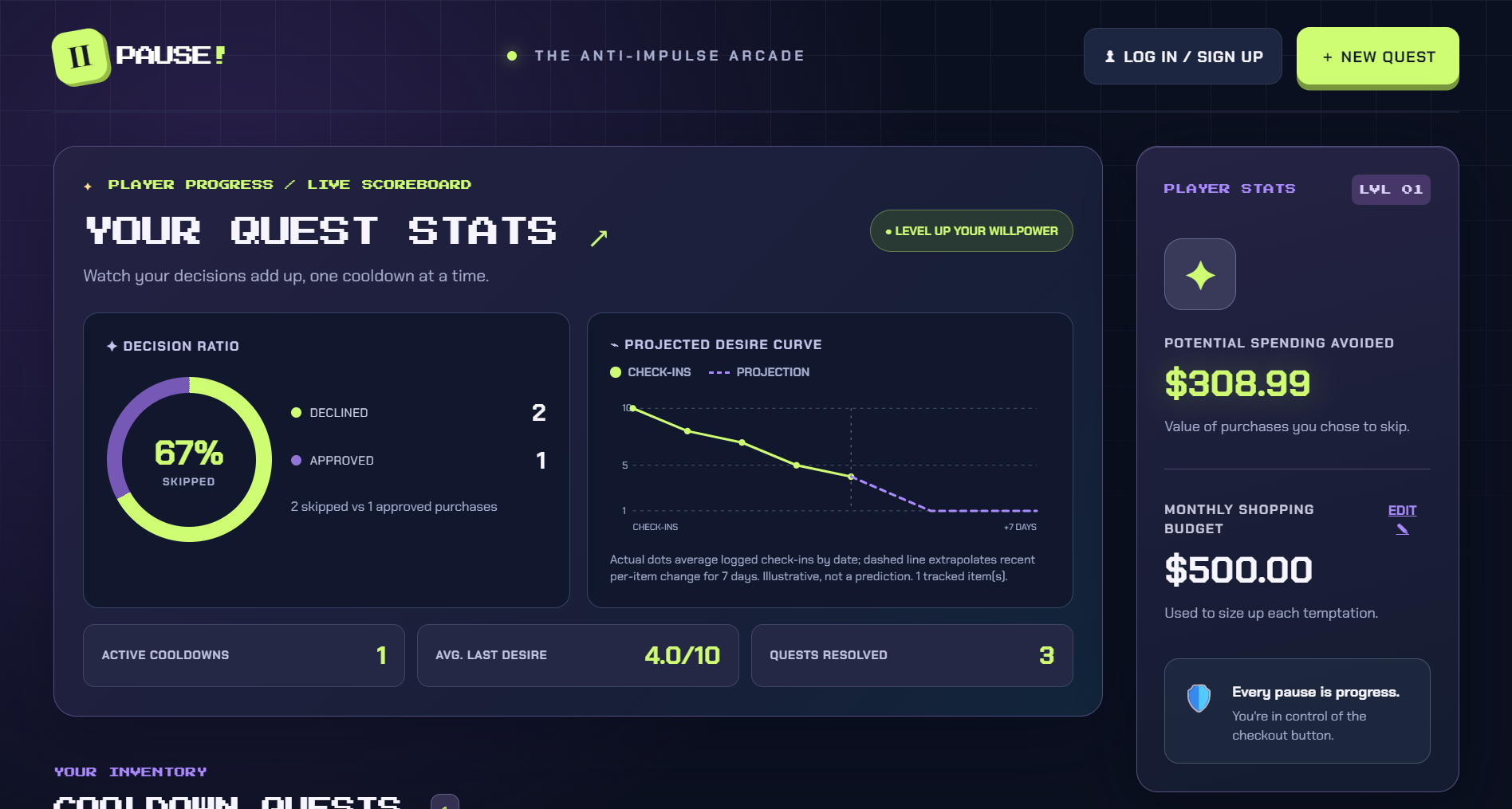
Main dashboard
-
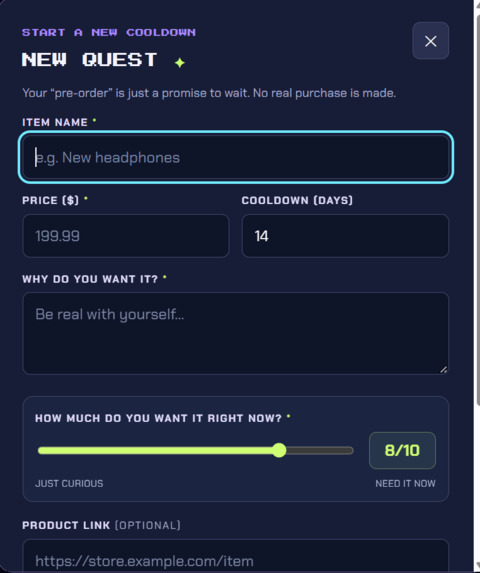
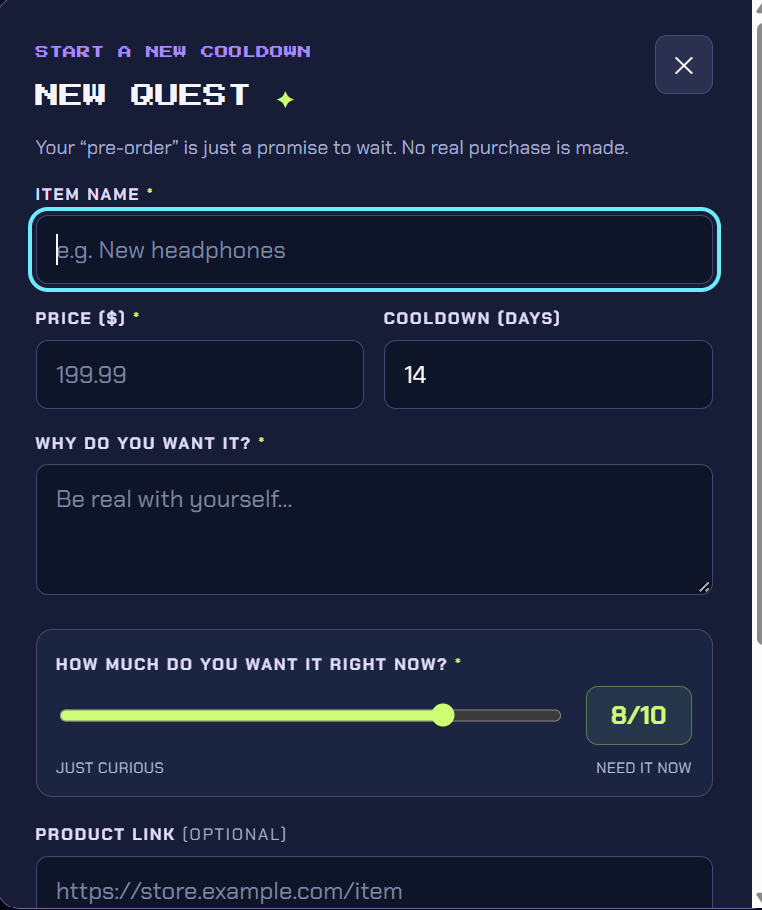
New quest
-
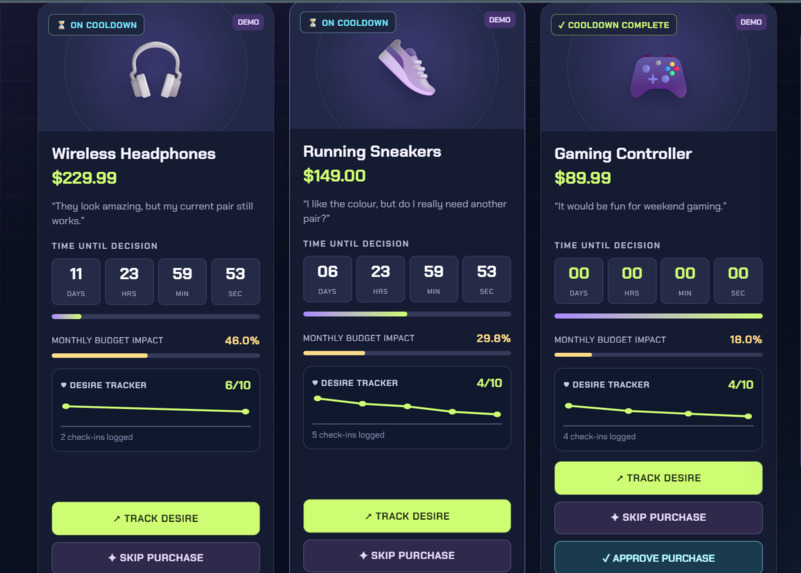
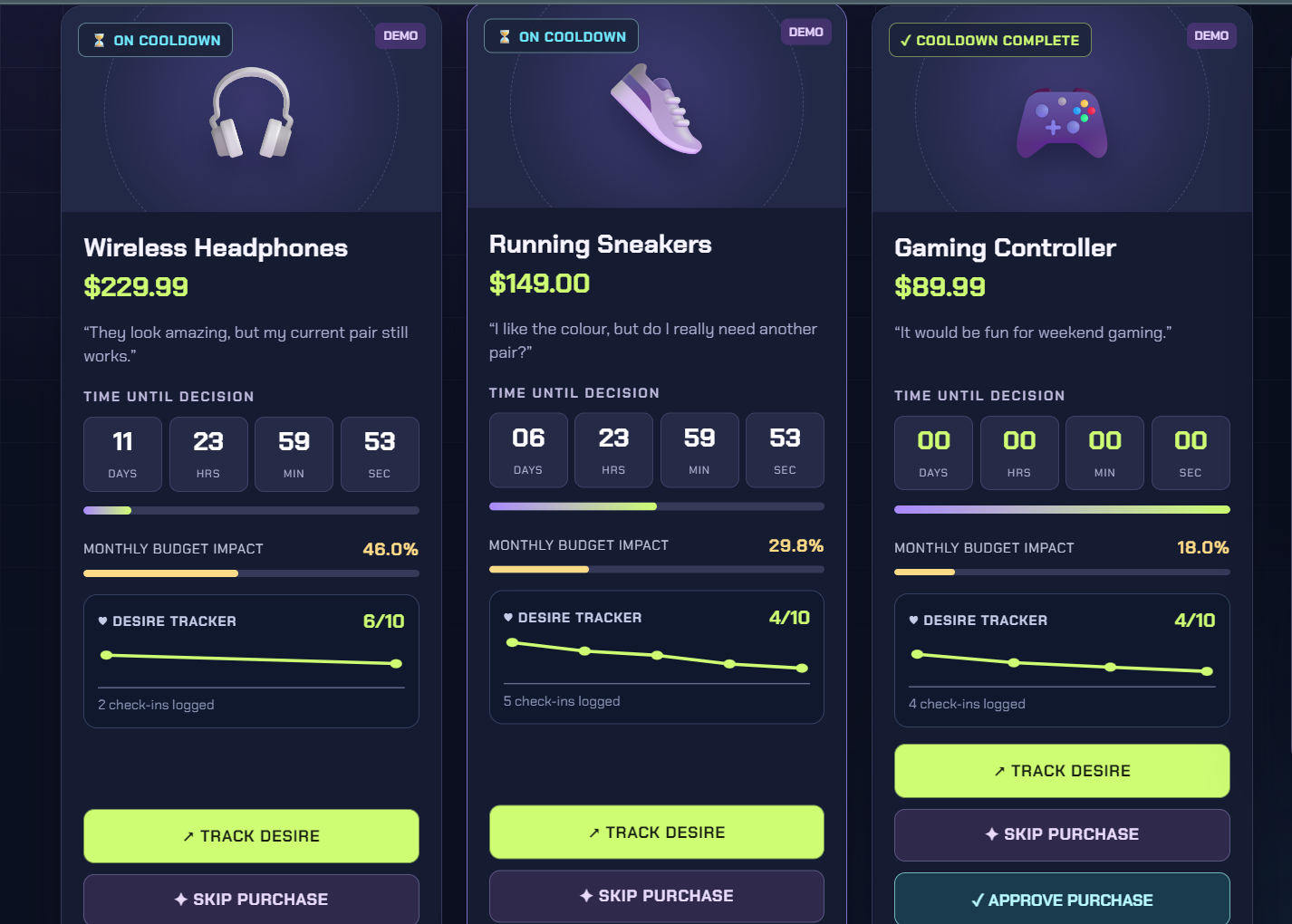
Items on "cooldown"
-
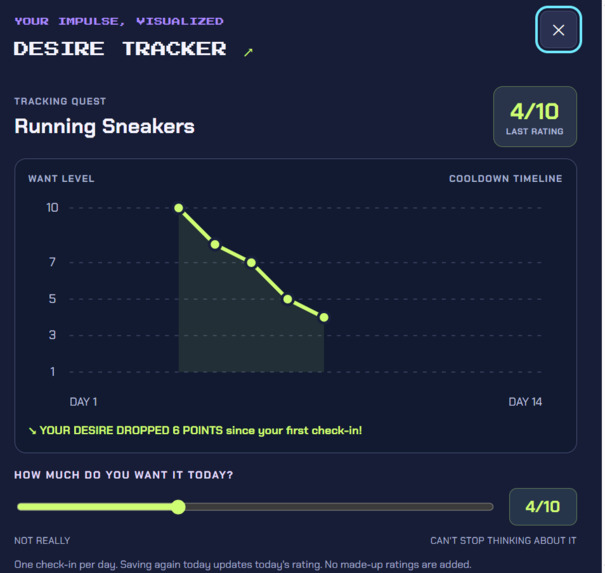
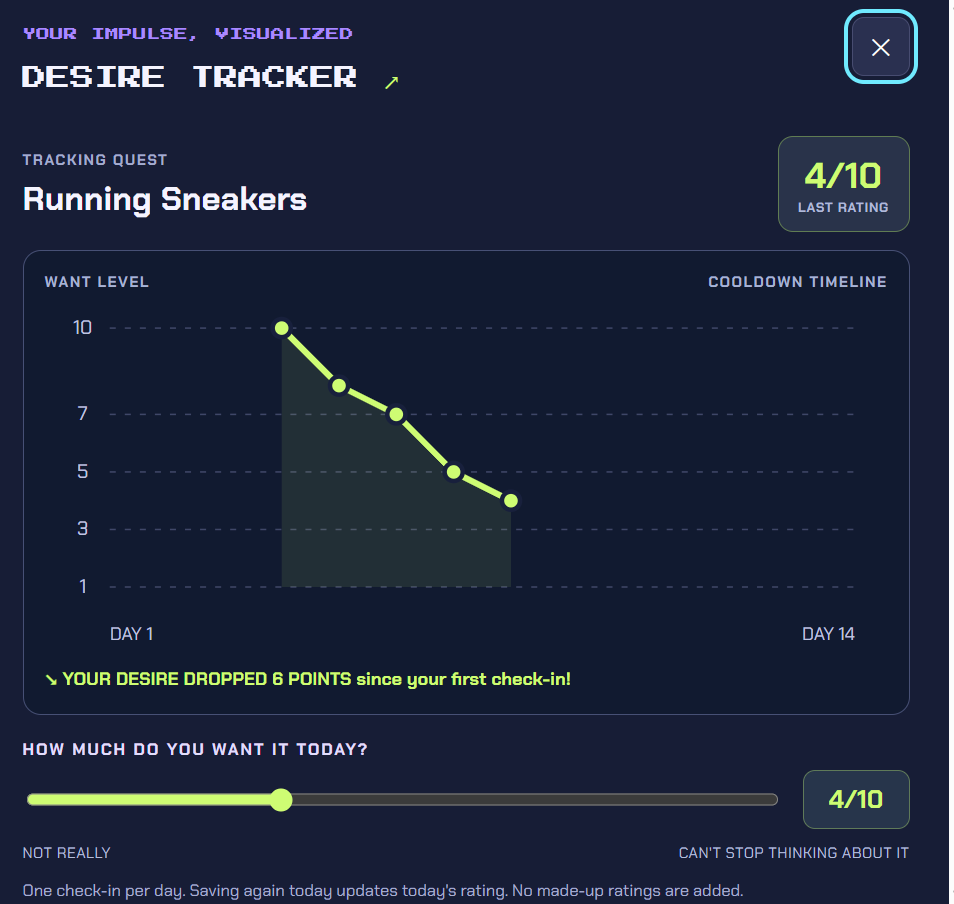
Desire Tracker
Inspiration
- Frictionless E-Commerce: Over 70% of online shopping decisions are impulsive, driven by one-click checkouts that exploit our brain's craving for an instant dopamine rush.
- The Willpower Trap: Traditional budgeting tools rely on restrictive blockers and guilt, which consistently fail against human neuroscience.
- The Financial Placebo: We created Pause. to satisfy the psychological urge of completing a checkout while keeping user bank accounts completely untouched.
What it does
- Simulated Pre-Order: Users submit items they want to buy, rate their impulse on a 1–10 desire scale, and receive an authentic order confirmation receipt for an instant dopamine rush.
- Custom Cooling Vault (14-Day Minimum): Holds purchases in a front-and-center 3-column grid with custom hold periods—enforcing at least 14 days—with live timers ticking down days, hours, minutes, and seconds.
- Real-Time Analytics: Visualizes spending discipline via an interactive SVG donut chart tracking the percentage of purchases resisted versus completed.
- Savings Tracking: Rejecting an expired item permanently logs the avoided purchase and immediately updates the lifetime savings counter in the sticky header HUD.
How we built it
- AI-Assisted Architecture: Leveraged generative AI as our primary pair programmer to write and architect the majority of the client-side application in vanilla HTML5, CSS3, and JavaScript.
- Spring Boot & Cloud Infrastructure: Built a Java Spring Boot backend service deployed on Railway, connecting directly to a cloud PostgreSQL database and user authentication service powered by Supabase.
Collaborative Workflow: Maintained a multi-branch Git and GitHub workflow to coordinate frontend and backend development.
Key Implementation Details:
- REST API Architecture: Built HTTP endpoints such as
GET /items,POST /items,GET /budget, andGET /statsto connect the JavaScript frontend with the Java backend. - Database Integration: Used Spring Boot's data access layer to communicate with PostgreSQL, allowing purchase records and budget information to persist across sessions.
- Account Management: Integrated Supabase Authentication with backend authentication checks and user-specific data handling.
- Dynamic Frontend: Implemented live countdown timers, interactive spending visualizations, and simulated purchase receipts using JavaScript.
- AI-Assisted Development: Leveraged generative AI as our primary pair programmer to help architect, implement, and debug the application.
- REST API Architecture: Built HTTP endpoints such as
Challenges we ran into
- Backend and Database Integration: Connecting Java Spring Boot to Supabase PostgreSQL required configuring database connections, environment variables, and persistent data models.
- Authentication Integration: Connecting Supabase Authentication to our deployed application introduced challenges involving incorrect API URLs, HTTP 401 and 404 responses, and email confirmation redirects.
- Frontend Synchronization and Performance: We worked through browser caching issues that caused teammates to load outdated frontend files, while implementing live, per-second countdown timers without interrupting active form inputs.
- Git Learning Curve: Navigating our first collaborative GitHub workflow—learning how to branch, stash uncommitted work, and resolve merge conflicts across teammates without losing progress.
Accomplishments that we're proud of
- End-to-End Production Pipeline: Successfully architecting and deploying a complete full-stack pipeline (Frontend Client → Spring Boot on Railway → Supabase PostgreSQL and Authentication) within 24 hours.
- Zero to Shipped: Transformed an abstract behavioral psychology concept into a live, fully functional web application within hackathon time limits.
- Mindful Habit Loop: Successfully replaced impulsive shopping urges with the tangible satisfaction of watching lifetime savings metrics and discipline ratios rise.
- Overcoming Technical Hurdles: Resolved complex deployment and configuration errors under tight deadlines to deliver a unified, deployed project.
What we learned
- REST API Development: Learned how JavaScript communicates with a Java Spring Boot backend through HTTP requests and JSON responses, separating frontend presentation from backend business logic.
- Relational Database Integration: Gained practical experience connecting Spring Boot to PostgreSQL, managing persistent records, and designing database structures for user-specific application data.
- Authentication and Security: Explored Supabase Authentication, user sessions, protected API endpoints, and the importance of separating authenticated user data.
- Cloud Deployment and Debugging: Learned how to deploy a full-stack application using Railway, configure environment variables, troubleshoot Maven build failures, and diagnose HTTP errors using browser developer tools and server logs.
- Collaborative Software Engineering: Developed confidence using Git and GitHub for branching, committing, rebasing, and resolving conflicts while coordinating development across multiple contributors.
What's next for Pause.
- Browser Extension: Build a Chrome extension that auto-detects checkouts on Amazon and Shopify to intercept impulse purchases directly at the point of sale.
- Computer Vision / OCR: Expand the Spring Boot backend with OCR so users can add items simply by uploading screenshots of storefronts.
- Automated Savings: Partner with banking APIs (e.g., Plaid) to automatically transfer money saved from resisted purchases directly into a real high-yield savings account.
- Milestone Check-Ins: Implement automated check-in emails at day 7 and the 14-day mark to prompt mindful reflection on cooling-off items.
Built With
- css
- html
- javascript
- postgresql
- railway
- springboot
- supabase

Log in or sign up for Devpost to join the conversation.