Inspiration
In healthcare, delayed detection of abnormal vital signs can be life-threatening. Furthermore, patient data transmitted across networks faces severe cybersecurity risks. We built PatientGuard AI to bridge the gap between strong data privacy and real-time early warning systems for critical medical conditions.
What it does
PatientGuard AI is an end-to-end medical monitoring system that:
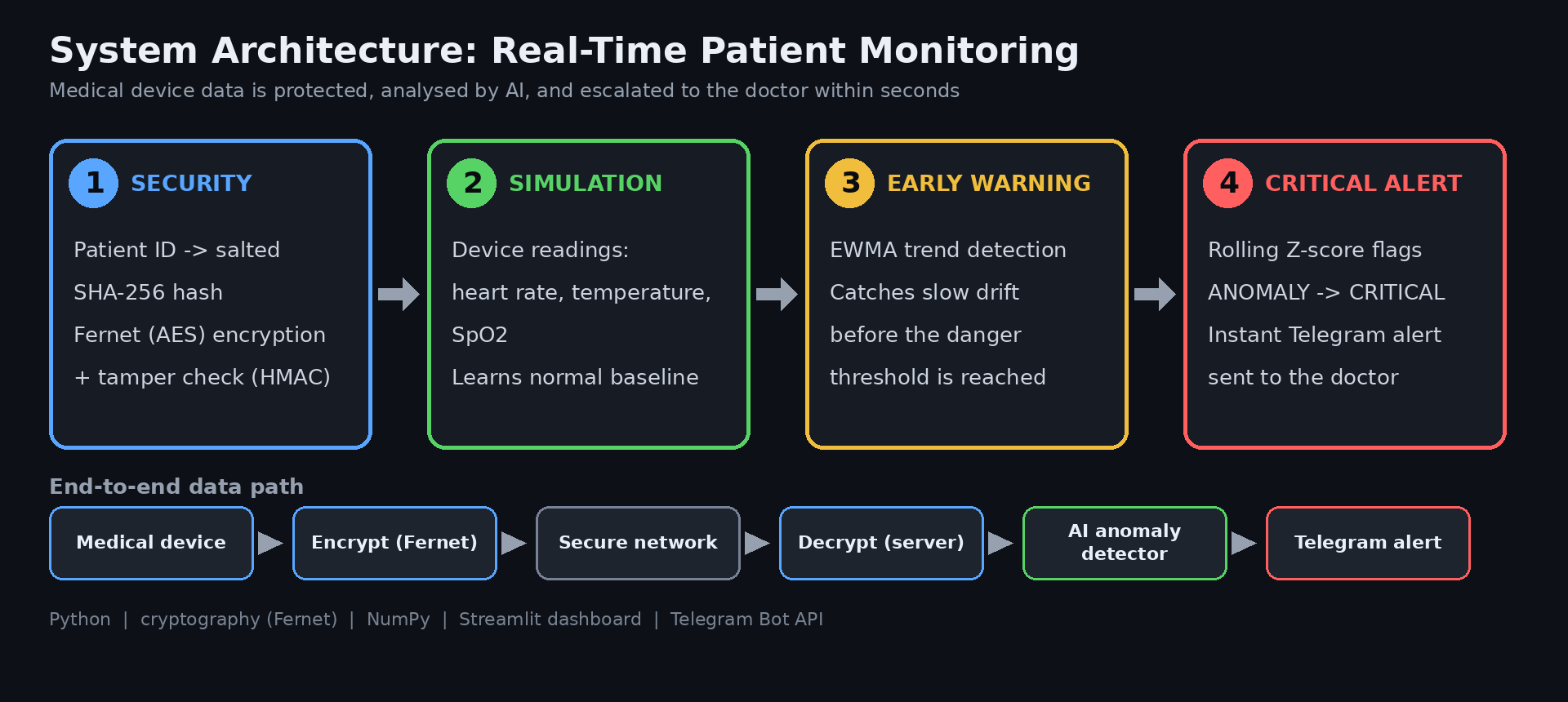
- Protects Privacy: Anonymizes patient IDs with salted SHA-256 hashes and encrypts vital data packets in transit using Fernet (AES-128) with HMAC authentication.
- Detects Early Trends: Uses Exponentially Weighted Moving Average (EWMA) to flag subtle, deteriorating vitals before they cross critical limits.
- Triggers Critical Alerts: Calculates a rolling Z-score on vitals (heart rate, temperature, SpO2) to isolate severe anomalies.
- Alerts Doctors Instantly: Integrates a Streamlit live dashboard and dispatches automated alerts directly to physicians via Telegram.
How we built it
- Python: Core engine for data simulation and streaming.
- Cryptography: Fernet (AES) symmetric encryption and SHA-256 hashing.
- NumPy & Pandas: Signal filtering, rolling baseline metrics, EWMA, and Z-score calculations.
- Streamlit: Interactive real-time monitoring web dashboard.
- Telegram Bot API: Automated notification pipeline.
Challenges we faced
- Preventing "model poisoning" during anomaly detection, solved by excluding anomalous readings from the normal baseline calculation buffer.
- Mitigating alert fatigue by implementing cooldown timers and multi-stage warnings (Early Warning vs. Critical Alert).
Accomplishments that we're proud of
- Successfully combining high-grade encryption with real-time ML anomaly detection.
- Zero third-party dependency overhead for the alerting pipeline using standard library HTTP modules.
What we learned
- Deep hands-on experience in time-series anomaly detection (Z-score & EWMA).
- Best practices for HIPAA-compliant, zero-trust cryptographic pipeline design in IoT healthcare devices.
What's next for PatientGuard AI
- Integrating physical IoT sensors (e.g., MAX30102 on ESP32/Raspberry Pi).
- Deploying advanced LSTM predictive models for long-term physiological trend forecasting.
