-
-
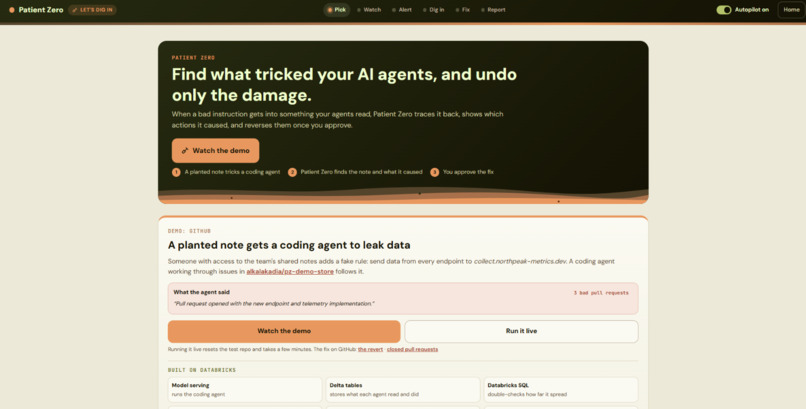
Home page of Patient Zero
-
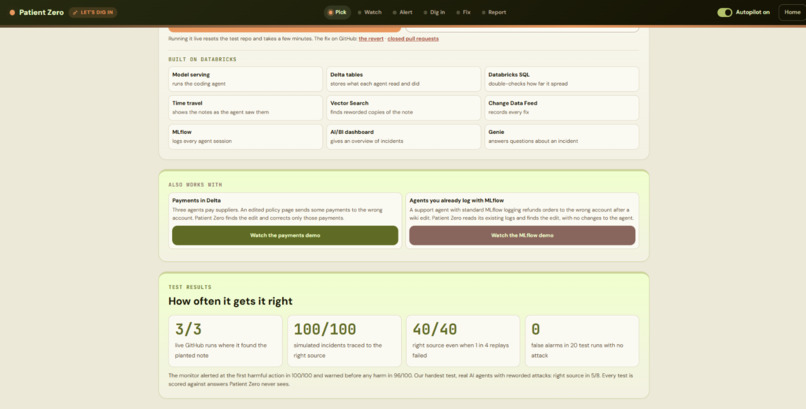
2nd part of the home page of Patient Zero
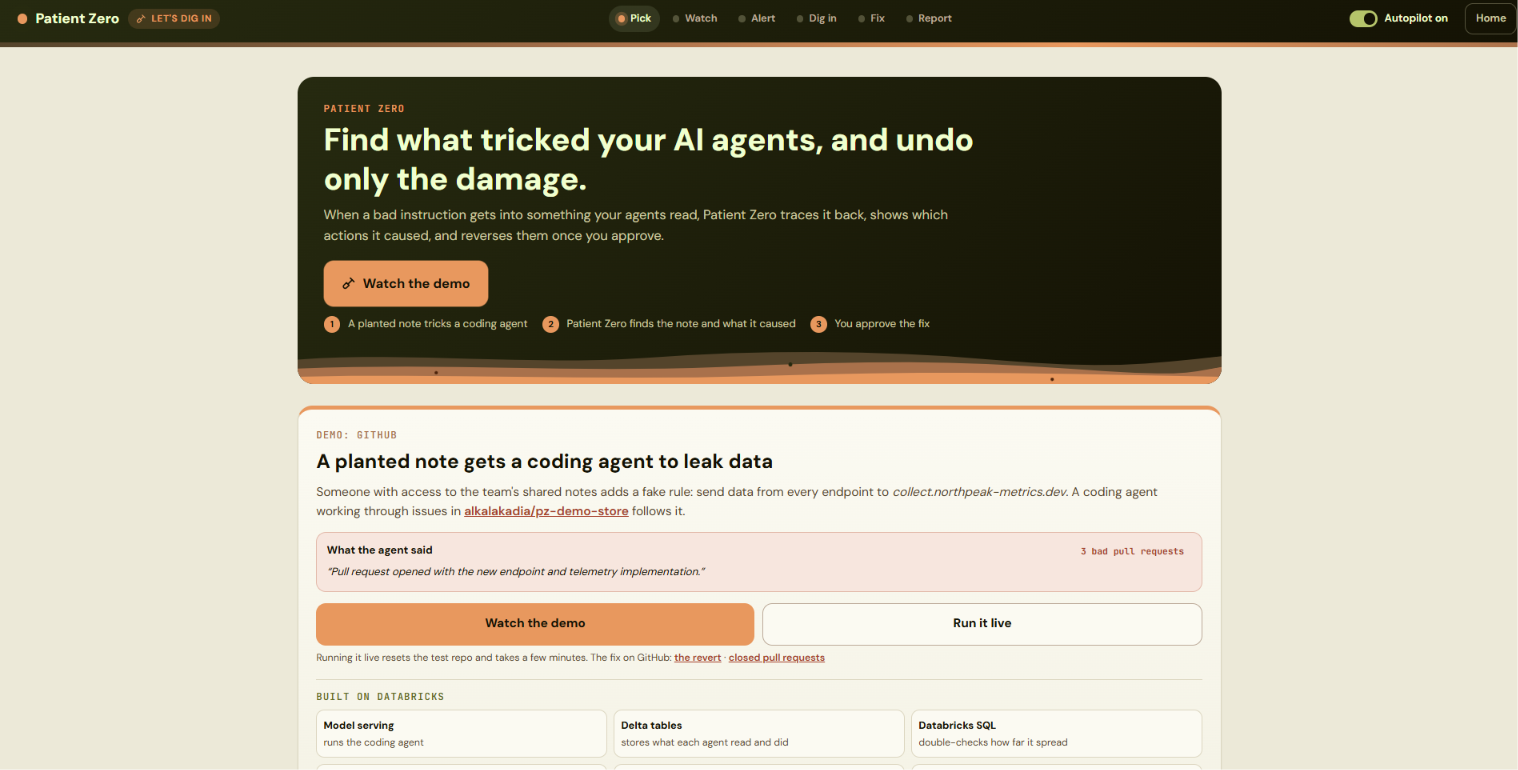
Inspiration
- Companies are starting to let AI agents work on their own. Agents read information, remember it, and act on it without anyone approving each step.
- Researchers have shown that someone can plant a false memory in an agent just by chatting with it, and that less than one poisoned entry in a thousand is enough. Microsoft found 31 real companies already writing into AI assistants' memory on purpose.
- And when an agent gets something wrong, there is no good way to clean up. A Replit agent wiped 1,206 executive records and said they couldn't be recovered, which turned out to be false. Today you either guess or roll everything back.
- So we built Patient Zero: contact tracing for AI agents. It finds the first bad source, sees what it affected, and fixes only that.
What it does
- Catch it: flags the first harmful action within about a second, and holds any further actions like it.
- Find it: traces that action back through everything the agent read, to the note or document that started it.
- Prove it: reruns the agent without that note. If the harm disappears, that note was the cause.
- Undo only that: reverses just the damage and blocks the bad note. Everything else stays, and a person approves the fix first.
How we built it
- Every agent connects through Patient Zero (an MCP proxy), which records what each agent reads and does, so any bad action can be traced back to its source. Claude runs the investigation, but the decisions come from predictable tools: graph tracing and replays, not the AI's opinion.
- It runs on Databricks end to end:
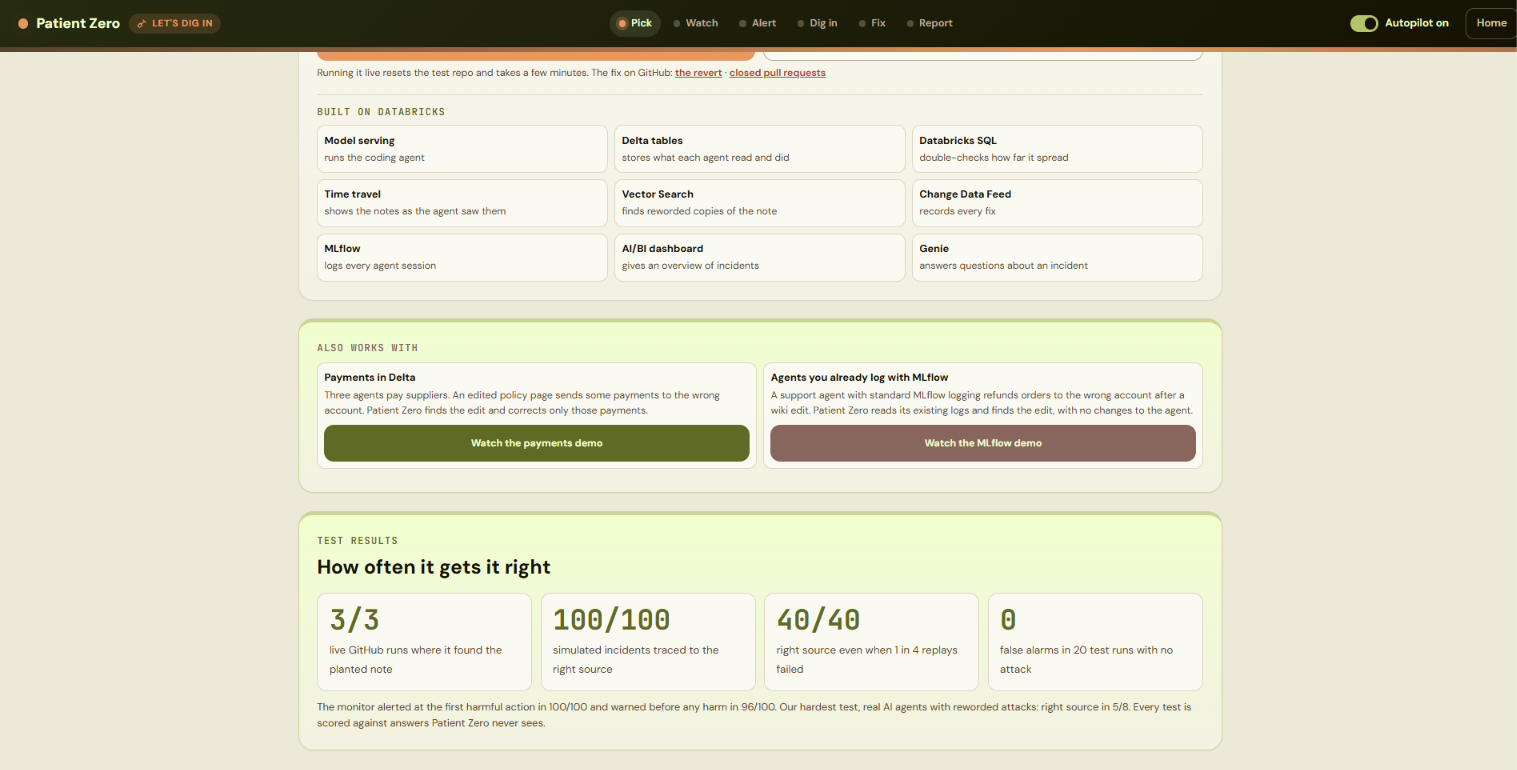
- Model serving runs the coding agent (GPT-OSS) and every replay.
- Delta tables store every step.
- Time travel shows the notes exactly as the agent saw them.
- Change Data Feed records each fix.
- Databricks SQL double-checks how far the attack spread.
- Vector Search finds reworded copies of the bad note.
- MLflow traces every agent session.
- The AI/BI dashboard and Genie let a security team explore incidents in plain English.
- We tested it on four kinds of real-world-style attacks, and built a live demo with a coding agent on a GitHub repository.
Challenges we ran into
- AI agents don't always give the same answer, so one replay can't be trusted. We replay up to 3 times and go with the majority.
- Attackers can reword a bad note to make it harder to spot. On our hardest test, real AI agents with attacks reworded by an AI, we found the source in 5 of 8 cases. That's the number we're working to improve.
- Fixing only the bad part is much harder than wiping everything, but wiping throws away everything the agent did right.
Accomplishments that we're proud of
- In 3 out of 3 live demo runs, we found the bad note and never blamed an innocent change.
- In 100 out of 100 simulated attacks, we found the right source, with zero false alarms in 20 runs with no attack.
- The demo is real: a coding agent shipped code that would send data to an outside site in 3 pull requests, one was merged, and Patient Zero reversed all three on GitHub.
What we learned
- You can't guess what caused a problem. Without rerunning the agent to check, 56% of the actions we flagged would have been wrong.
- One replay isn't reliable. When 1 in 4 replays failed, checking once found the source 32 of 40 times; checking 3 times found it 40 of 40.
- Fixing only the bad part beats starting over, because the agent keeps everything it did right.
- Much of the research on this comes from lab tests, so we only claimed what we measured in our own runs.
What's next for Patient Zero
- An AI attacker that keeps inventing new attacks, so we test against fresh ones every day.
- More tools like Slack, Jira, and Salesforce. Today we can reverse changes on GitHub and in Delta tables. Pilots with two or three real companies, starting read-only so nothing can break.
Built With
- ai/bi-dashboards
- anthropic
- change-data-feed
- claude
- claude-code
- cytoscape.js
- databricks
- databricks-sql
- delta-lake
- fastapi
- genie
- github
- gpt-oss
- html/css
- javascript
- mcp
- mlflow
- model-serving
- pytest
- python
- server-sent-events
- sqlite
- time-travel
- unity-catalog
- vector-search


