Inspiration
Comfort started with a hospital visit with my mum.
While accompanying her, I found myself thinking about how much responsibility patients and their caregivers carry beyond the illness itself. Navigating unfamiliar hospital buildings, locating departments on different floors, keeping track of consultations, and trying to remember medical information from previous visits can be overwhelming.
What stood out to me was how fragmented the patient experience can become.
Medical histories are scattered across hospitals, prescriptions, laboratory results, referral letters, and personal recollections. During consultations, patients are often expected to reconstruct that history from memory, sometimes while unwell, anxious, or exhausted.
For people managing chronic illnesses, recovering from accidents, or attending repeated hospital appointments, this isn't a one-time inconvenience. It becomes part of their everyday healthcare experience.
I wanted to explore a different approach: What if patients had a continuous, understandable account of their healthcare journey that travelled with them?
Not another hospital management system, but something built around the patient.
That idea became Comfort.
What it does
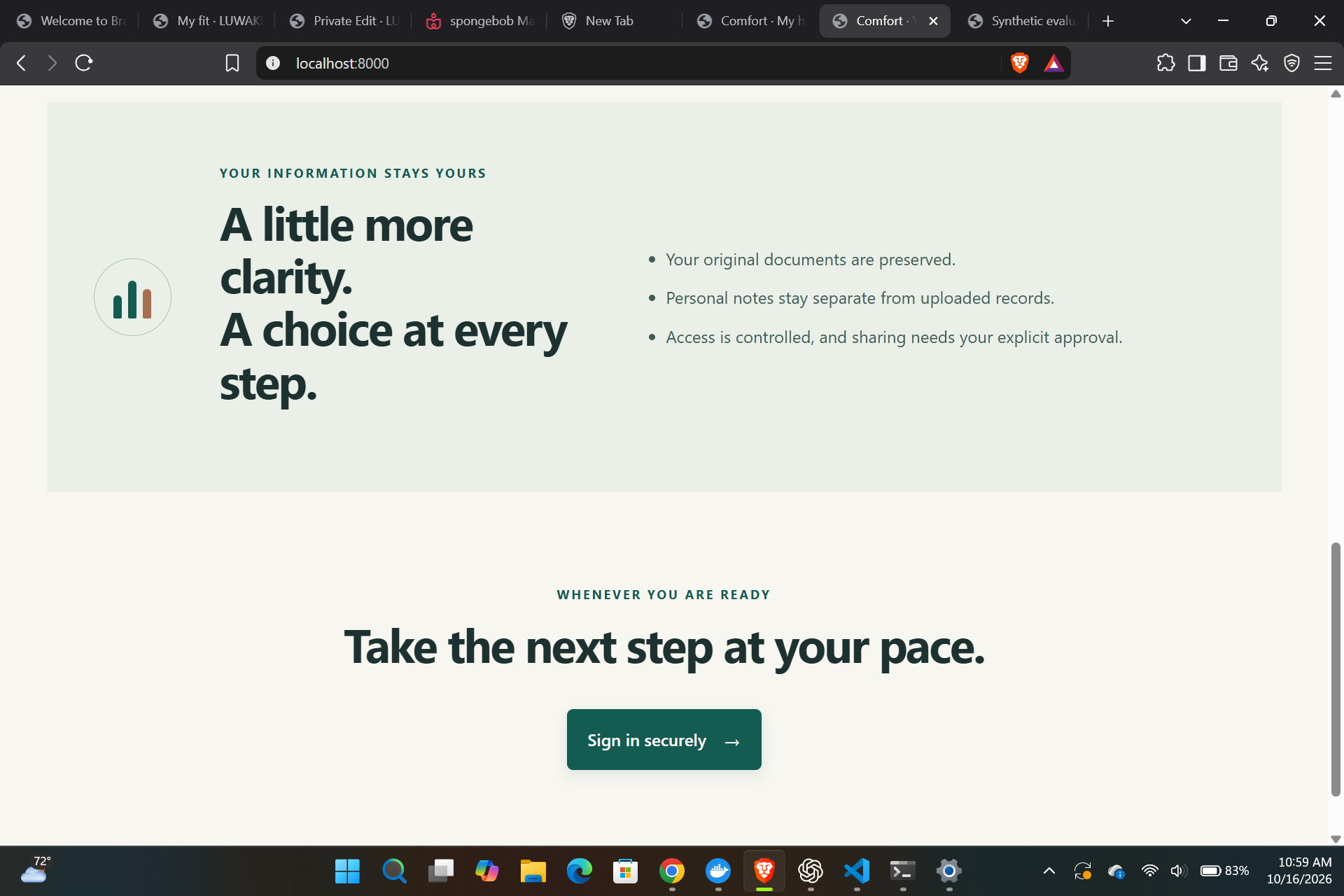
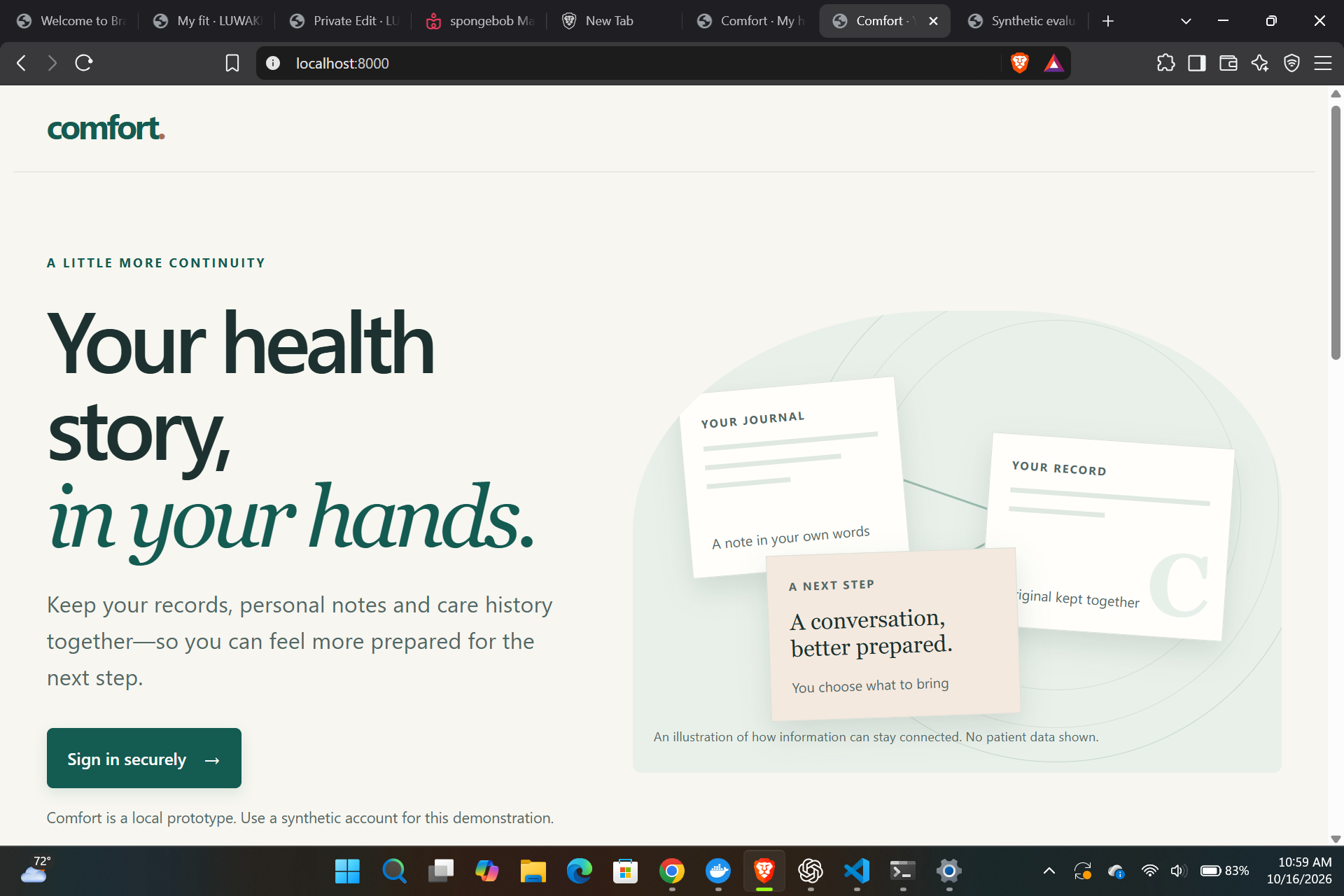
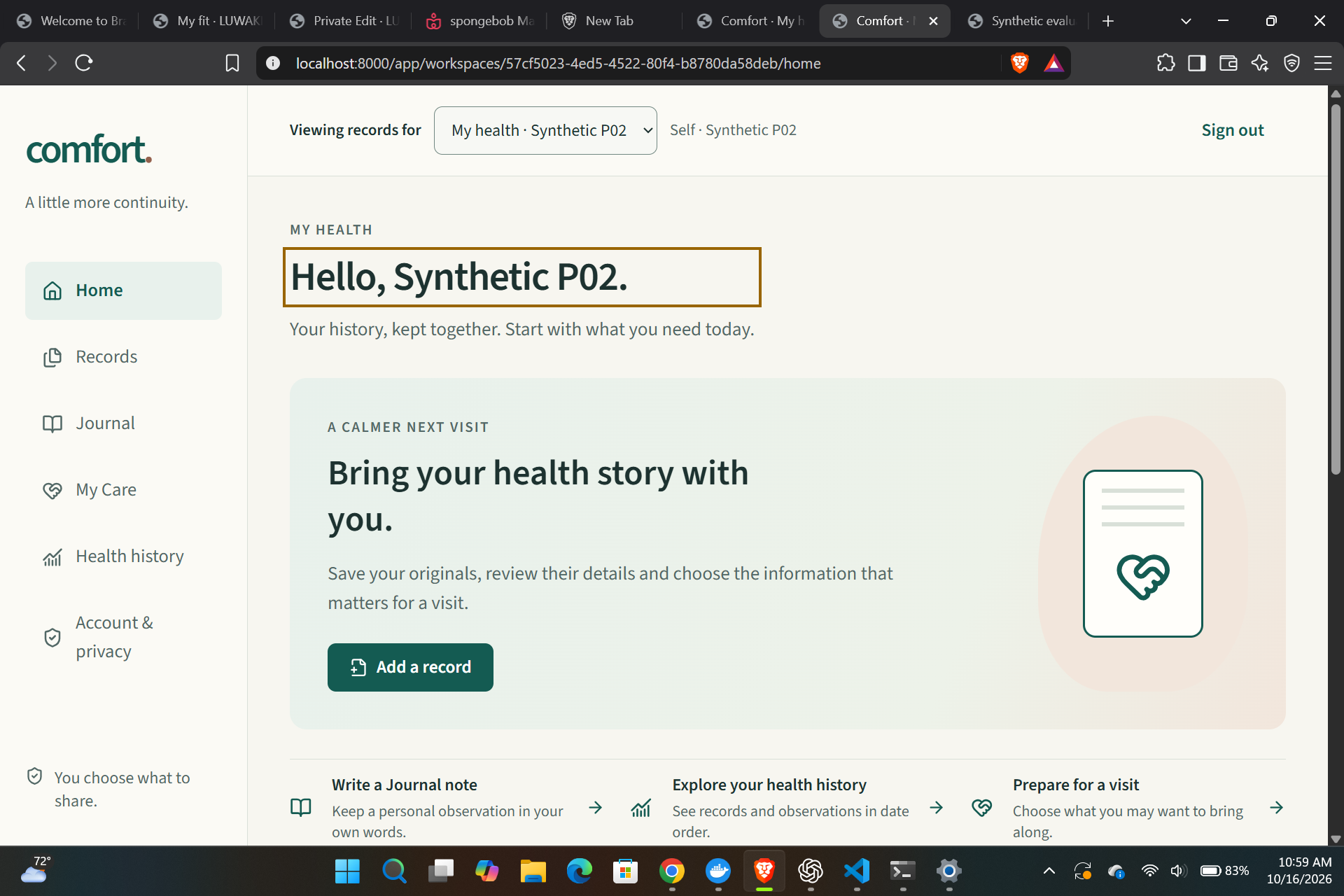
Comfort is a patient-centred health records platform designed to bring fragmented medical information into one private, connected space.
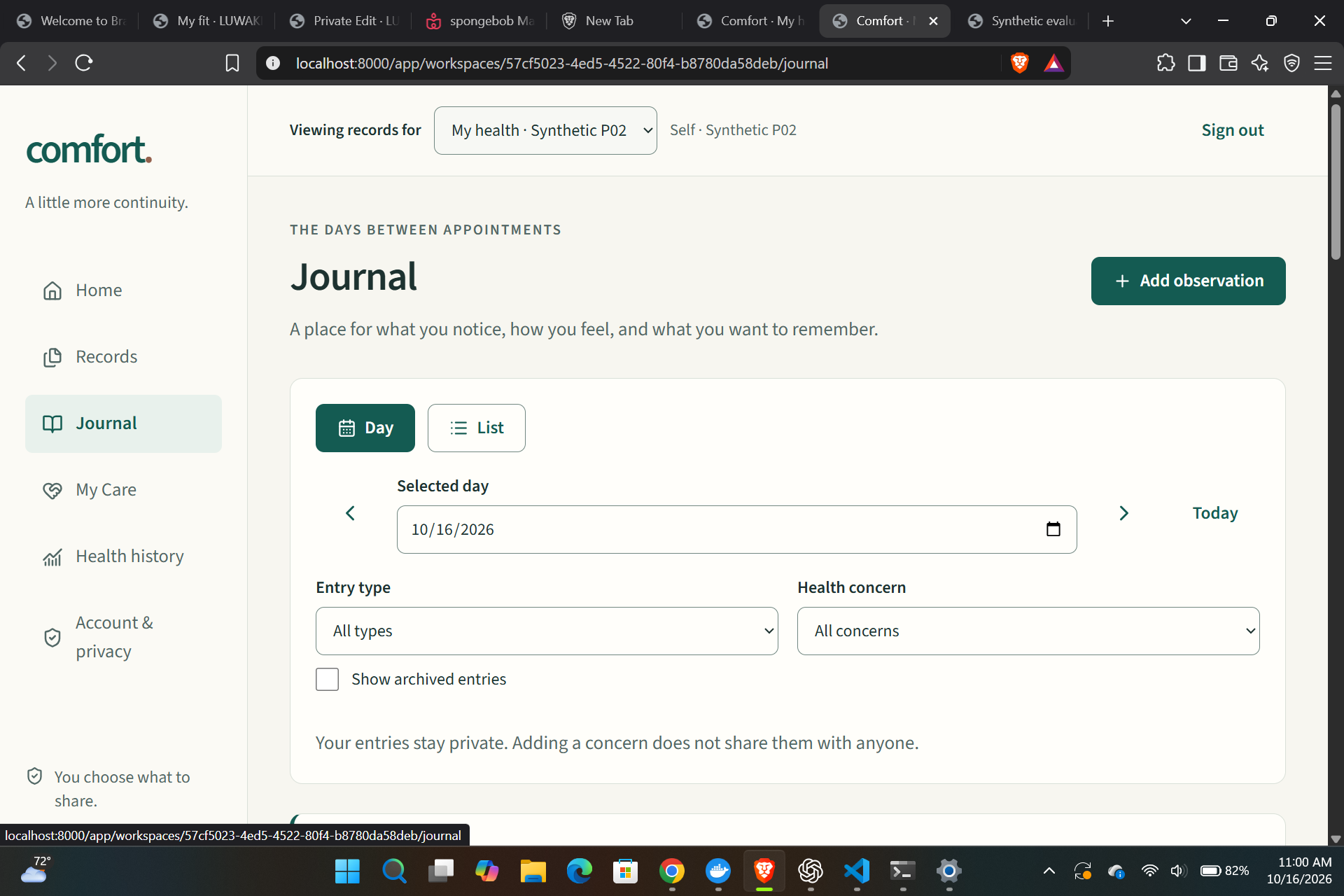
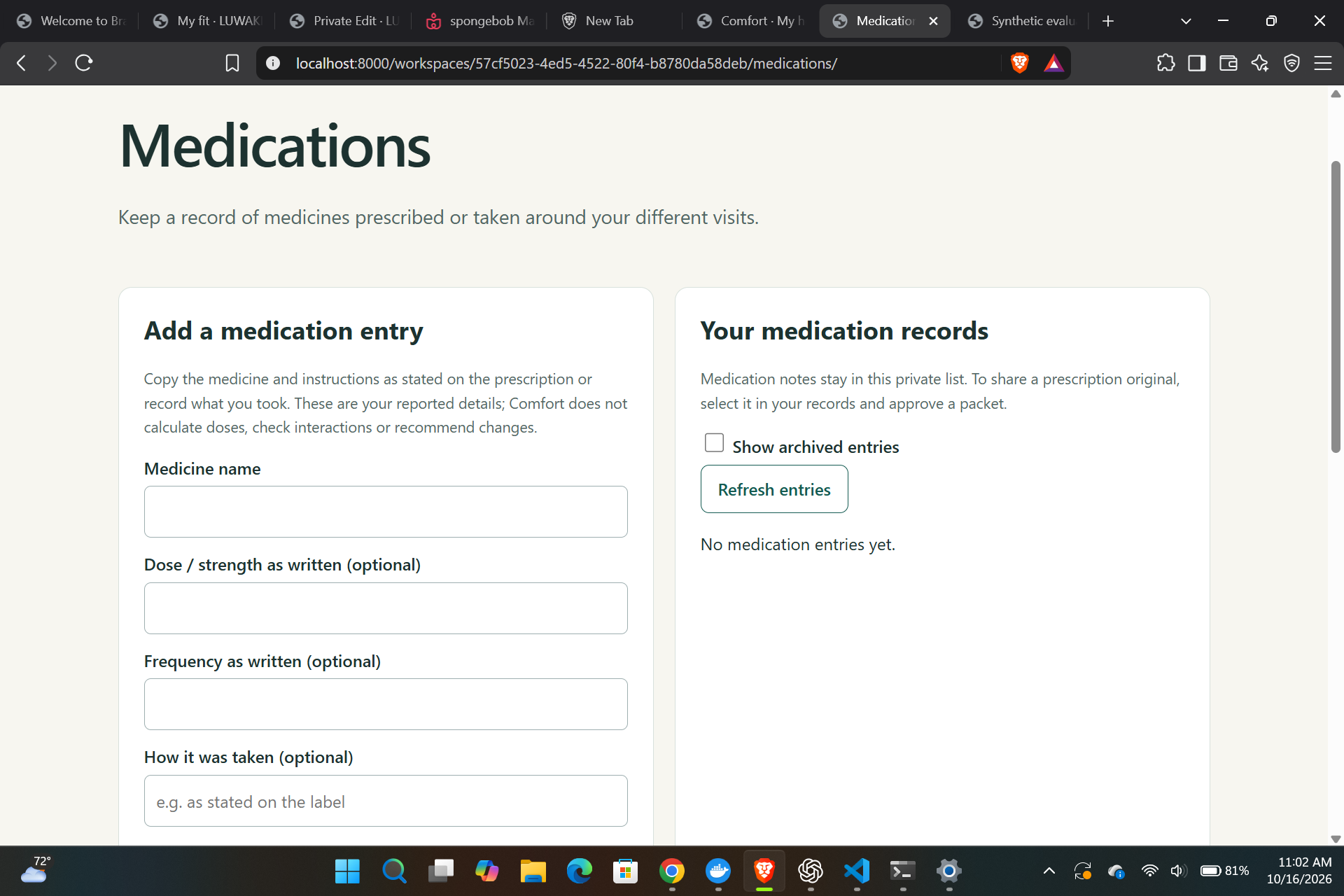
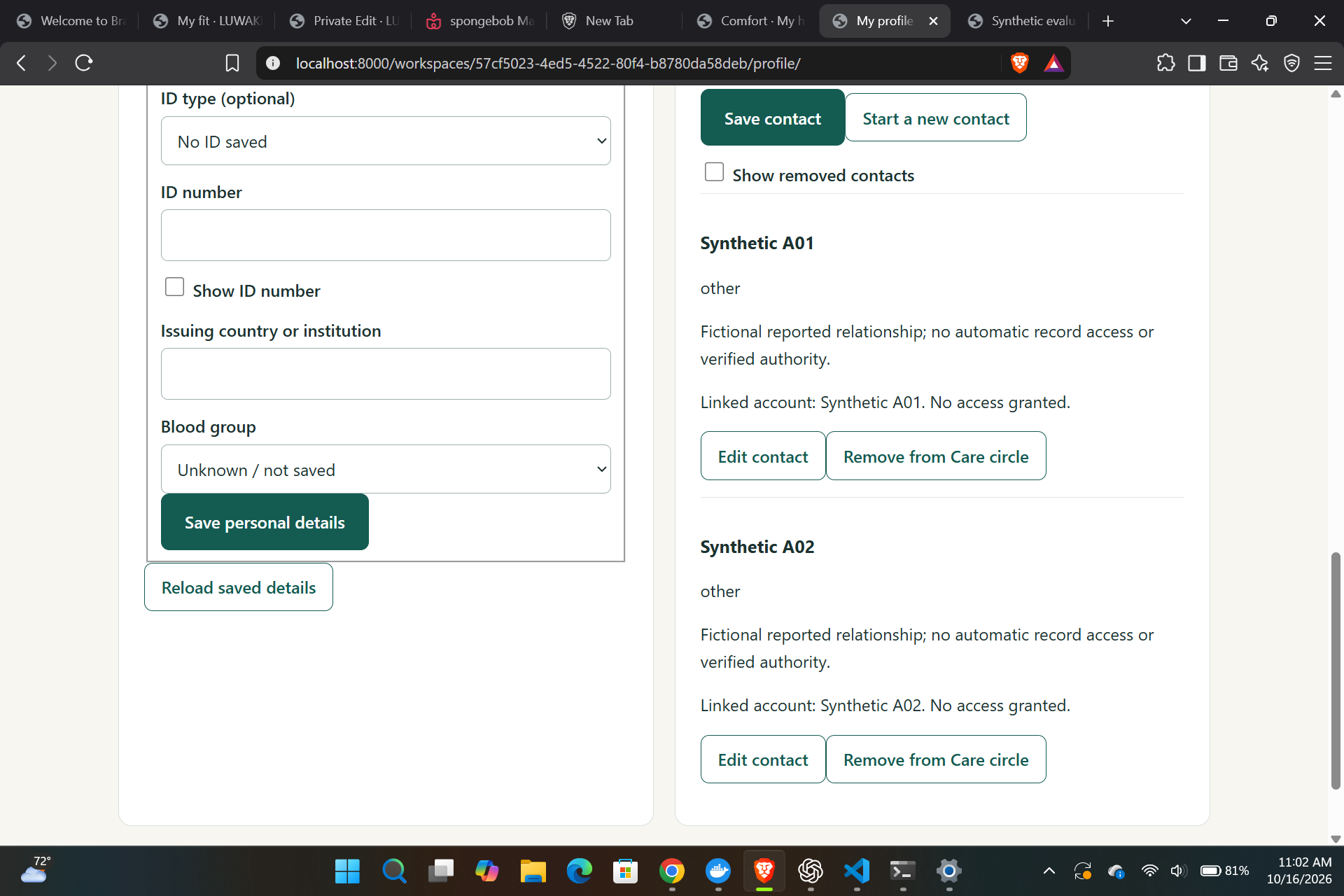
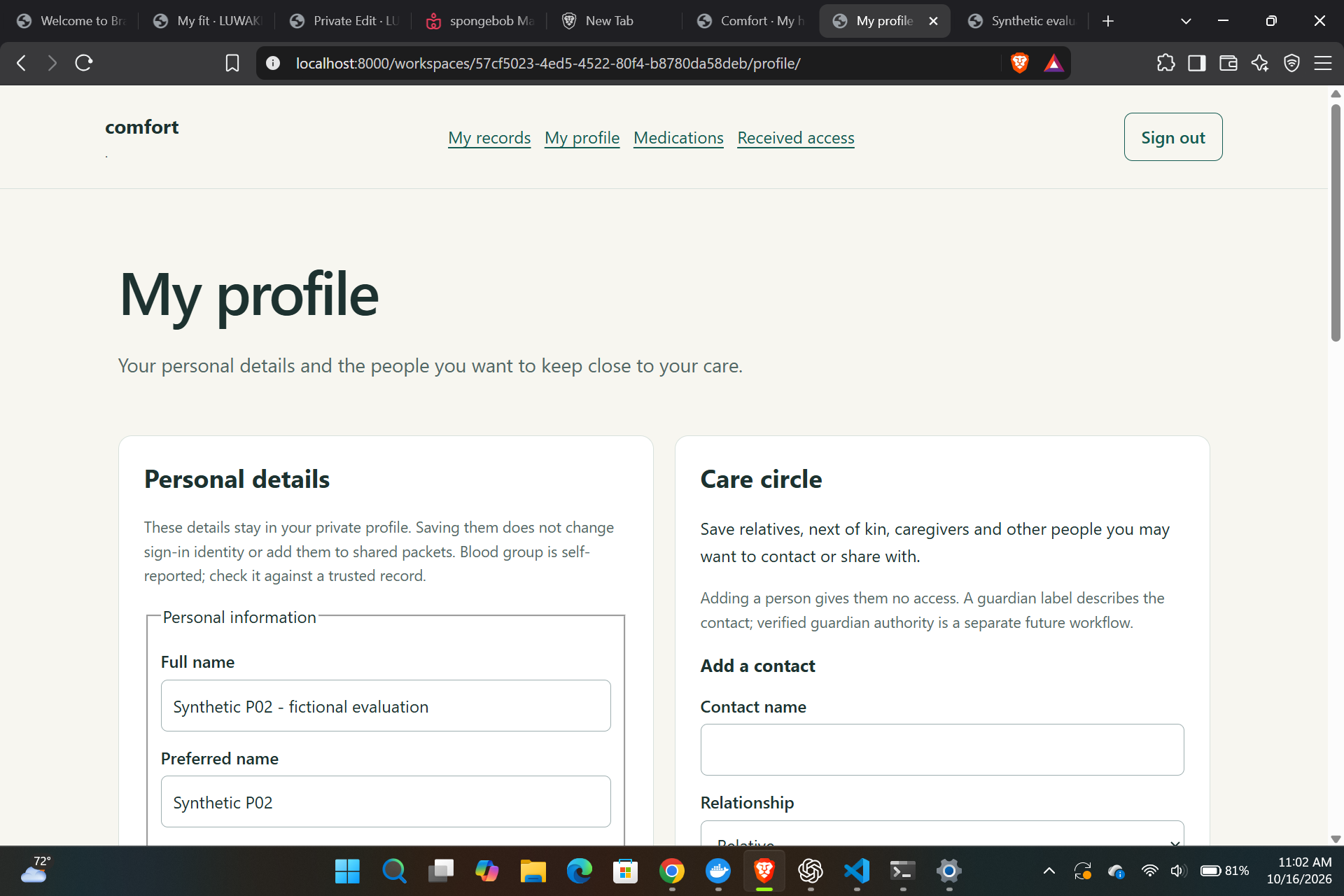
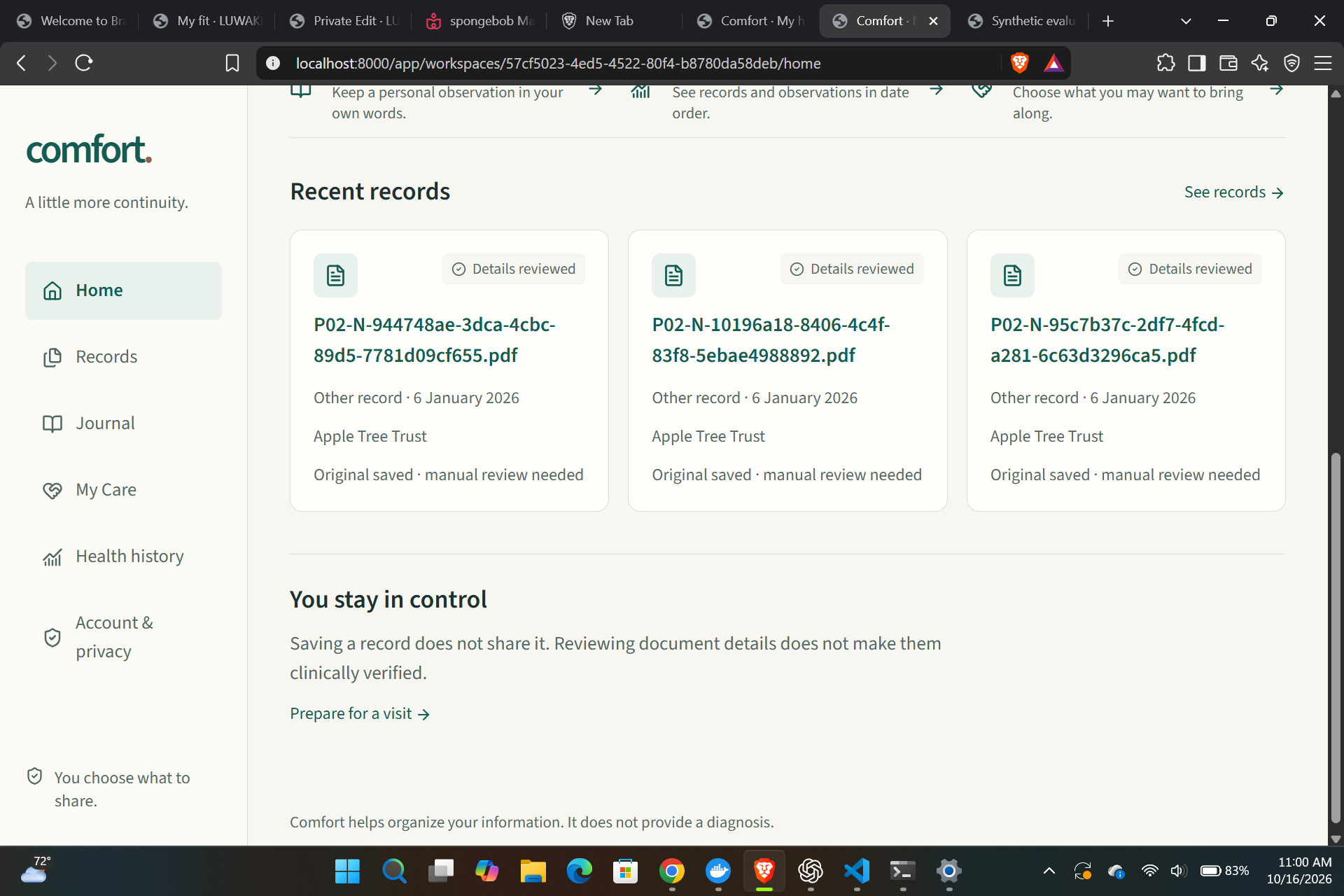
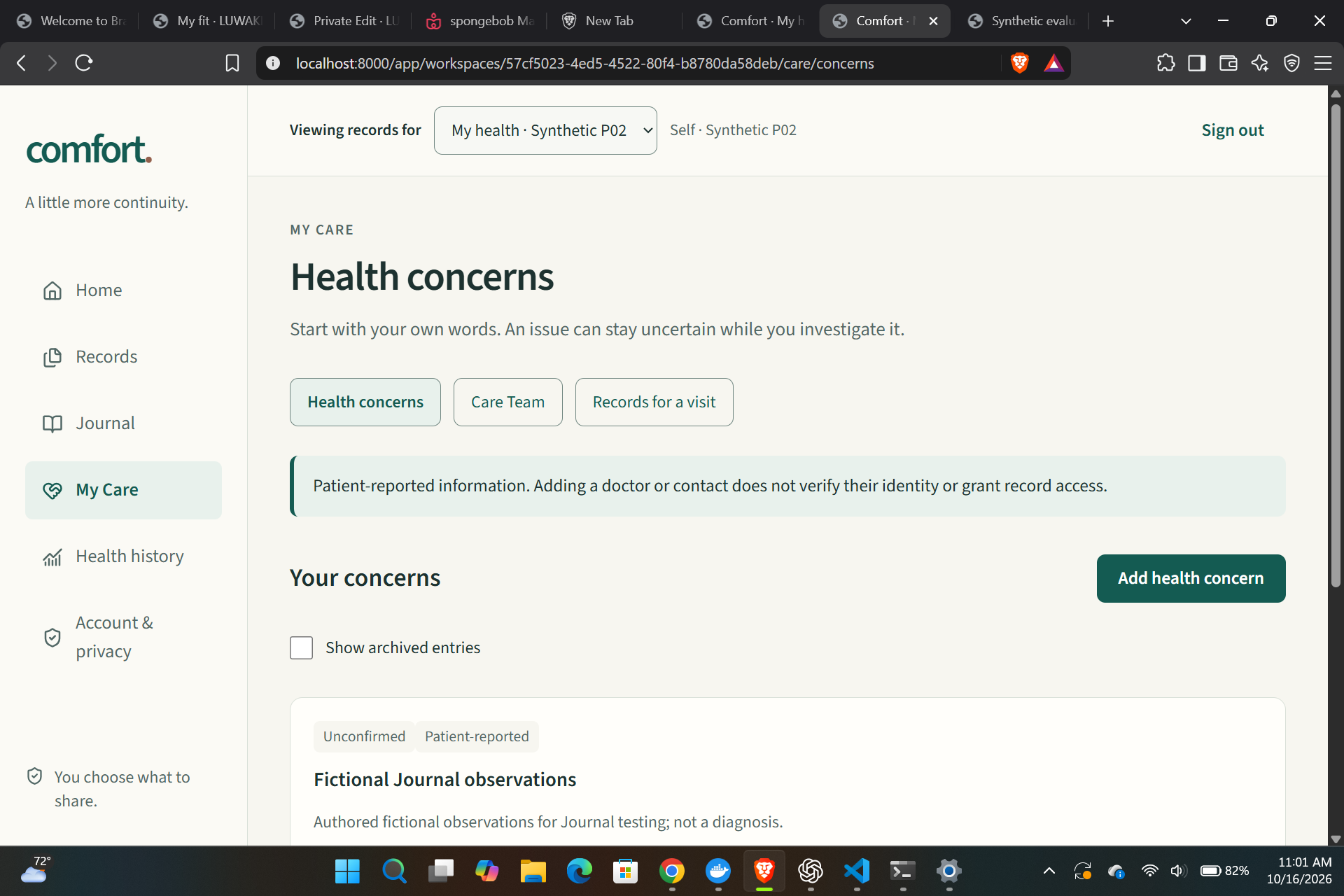
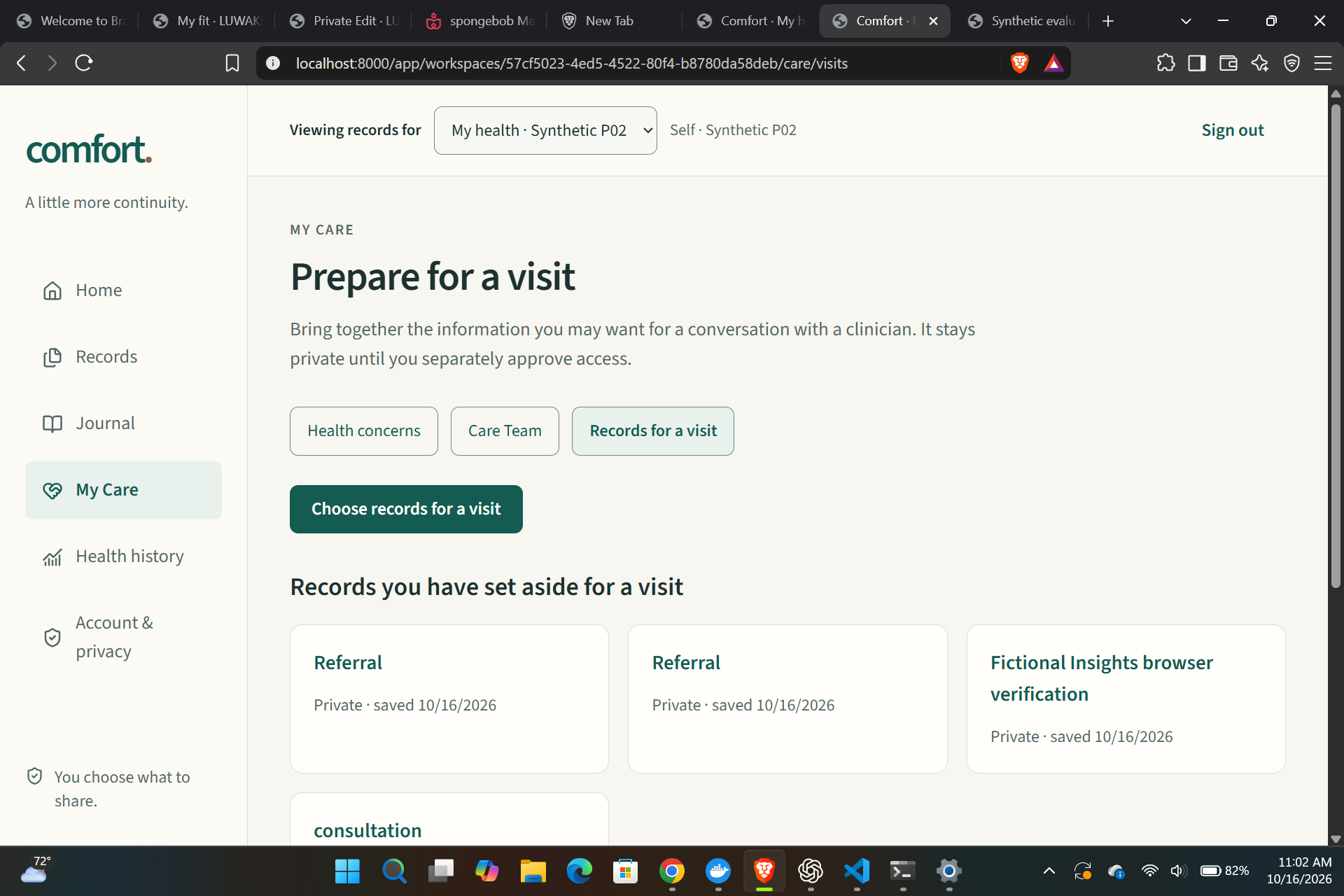
Patients can upload and preserve original medical documents, maintain a personal health Journal, organize health concerns, record medication information, keep track of their care contacts, and explore their healthcare history chronologically.
The goal is to make health information easier to understand, revisit, and use during future appointments.
Apertus brings intelligence to that experience.
Running locally, Apertus helps identify relevant information within patient-selected medical documents and organize source evidence for consultation preparation.
Instead of generating unsupported medical conclusions, Comfort connects AI-assisted findings to the original records so patients can review the evidence themselves.
We implemented source-grounded related-record search and visit overviews, with completed real-model requests demonstrated using fictional patient data.
We've also developed experimental capabilities for organizing Journal observations, exploring longitudinal health information, extracting documented follow-up actions, and preparing more structured consultation briefs.
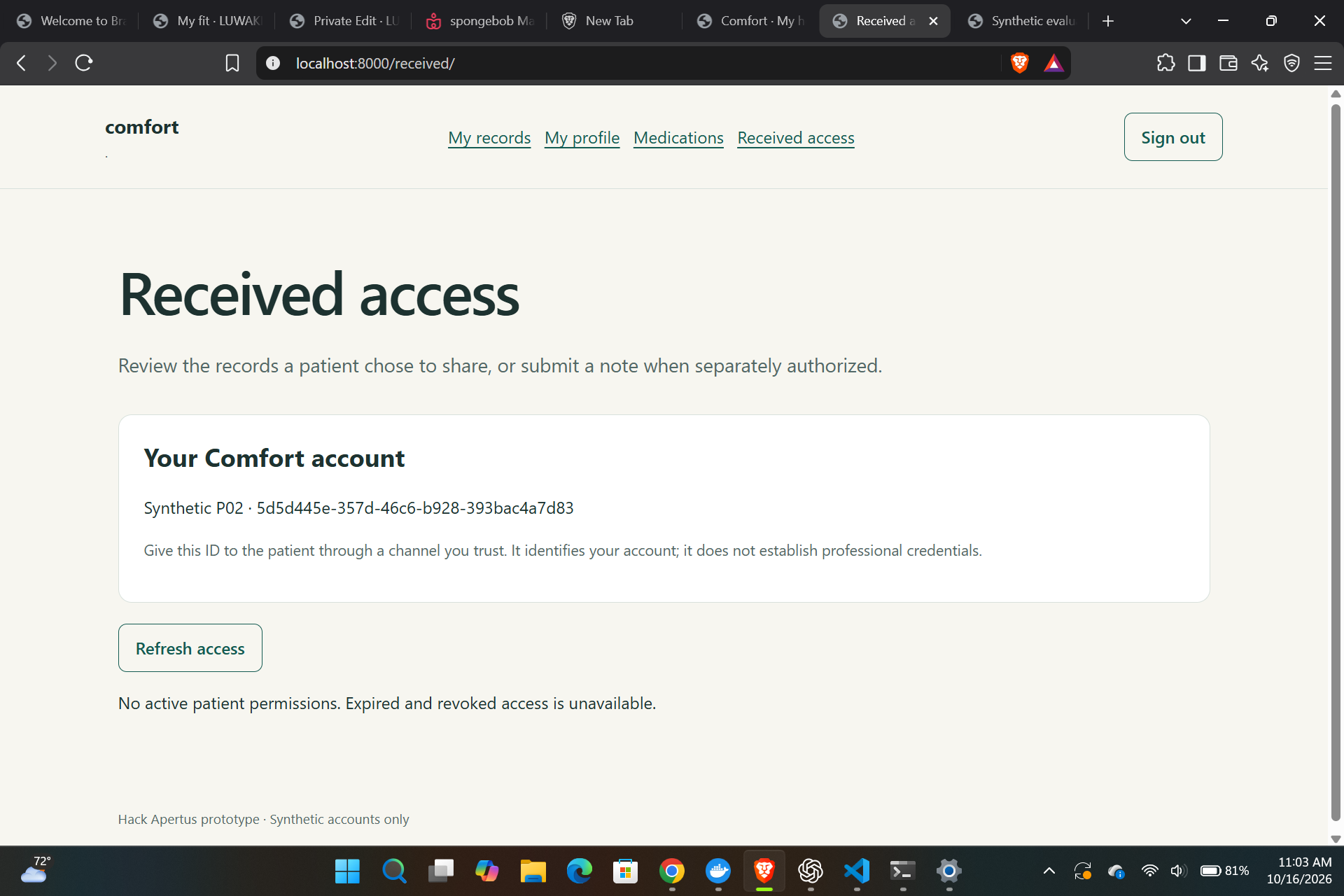
Patient control remains fundamental. AI-generated suggestions do not automatically become clinical facts, and sharing information requires separate authorization.
Comfort is not a diagnostic tool. It helps patients prepare to have better-informed conversations with healthcare professionals.
How we built it
Comfort combines a modern web application with locally deployed, open-weight AI.
The frontend uses React and TypeScript, with a custom patient-focused design system emphasizing accessible layouts, clear information hierarchy, and calm visual interactions.
The backend runs on Django, supported by PostgreSQL for structured healthcare information and Keycloak for identity and authentication.
The application is containerized using Docker Compose.
For AI, we integrated Apertus v1.5 8B, using a quantized GGUF text-model conversion served through llama.cpp. Model inference runs locally rather than through an external hosted API.
An asynchronous worker processes AI requests separately from normal application interactions.
One of our main architectural decisions was to separate AI interpretation from evidence verification.
Comfort uses bounded retrieval to identify relevant passages from authorized source documents. Apertus helps select and organize that evidence, while deterministic validation checks source references and preserves links to the original material.
We also designed the system around immutable document versions, explicitly selected context, permission checks, and separate patient review and sharing workflows.
This architecture allows us to explore the usefulness of AI in healthcare while remaining transparent about uncertainty and the limitations of generated output.
Challenges we ran into
Our biggest challenge was making a relatively small, locally running language model produce reliably structured, source-grounded information.
During Journal testing, Apertus successfully generated responses that were nevertheless rejected by Comfort's validation system.
The problems included unsupported dates and times, missing evidence quotations, and severity values that could not be verified against the original narrative.
Initially, one unsupported optional field could invalidate an entire response.
Rather than weakening the safety checks, we redesigned the extraction contract to support deterministic source normalization, explicit uncertainty, and field-level abstention.
We also discovered that finding relevant information is not the same as preparing a useful clinical overview.
Early live visit overviews sometimes selected repeated medication excerpts while overlooking other important context, including investigations and documented follow-up plans.
This led us to improve our evidence-retrieval strategy and develop more comprehensive, category-aware visit preparation.
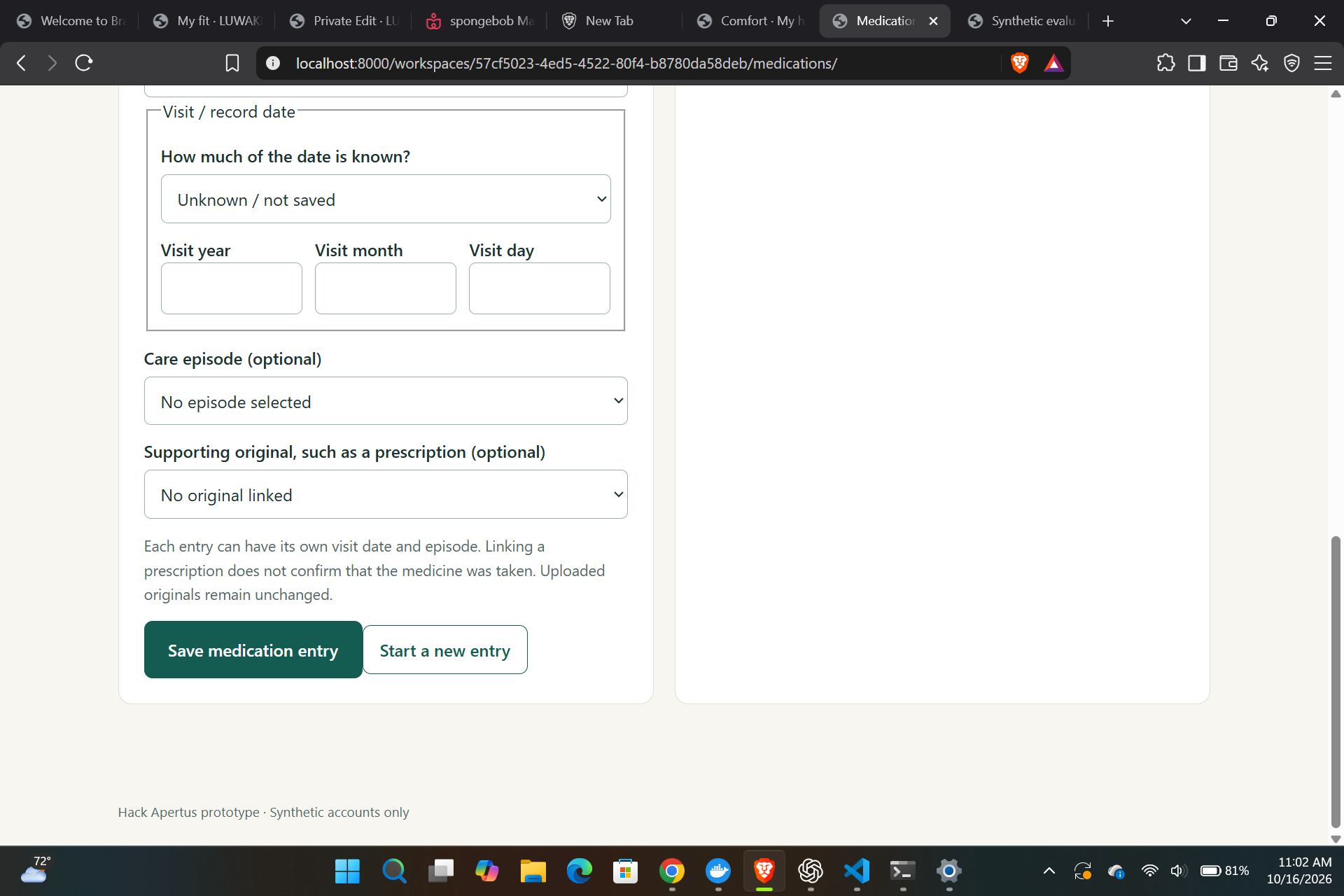
Other challenges included managing local CPU inference latency, balancing privacy with useful AI context, maintaining historical accuracy, and distinguishing prescribed treatments from confirmed patient actions.
Building the entire project independently also meant making difficult decisions about scope, implementation priorities, and validation.
Accomplishments that we're proud of
I'm particularly proud that Comfort evolved beyond a simple document-storage concept into a working prototype with connected patient journeys.
We built:
- A patient-focused application for medical records, Journal entries, healthcare history, care relationships, and consultation preparation.
- A locally deployed Apertus integration with completed real-model, source-linked record searches and visit overviews.
- Source verification and patient-review safeguards that separate AI suggestions from preserved clinical information.
- A structured data model supporting partial dates, historical corrections, immutable records, and permission-controlled access.
- A reproducible Docker-based development environment with automated backend and frontend tests.
One of the most meaningful milestones was seeing Apertus process selected fictional medical records and return evidence that could be traced back to the original documents.
That demonstrated an important part of our vision: AI can help patients navigate information they already own without taking control of their decisions.
I'm also proud of the attention given to the patient experience. Comfort's interface was designed to feel approachable and reassuring rather than like a conventional hospital administration dashboard.
What we learned
This project reinforced something important: AI in healthcare is as much an information-design and trust problem as it is a model-integration problem.
A model returning valid JSON doesn't necessarily mean it has understood the patient's history correctly.
A correct quotation doesn't establish that the entire medical context has been captured.
And missing information must remain missing rather than becoming an assumption.
We learned to build AI workflows around verifiable evidence, clearly represented uncertainty, and human review instead of treating language-model outputs as authoritative.
We also learned how much patient experience matters.
People don't naturally think about their healthcare in terms of databases, document versions, or individual software modules. They think about symptoms, appointments, medicines, people who care for them, and what happens next.
Technology should help connect those experiences.
Working with Apertus also gave us practical insight into running sovereign AI locally, including quantization, inference constraints, output validation, and performance trade-offs.
What's next for Comfort
The hackathon is a starting point, not the intended finish line.
Our next priority is improving the reliability and usefulness of Apertus-assisted consultation preparation.
We want to develop more comprehensive, evidence-linked visit briefs that combine selected clinical documents with patient-reported observations, medications, relevant history, and unanswered questions.
We also plan to expand Comfort in several directions:
- Caregiver support: Better workflows for relatives, guardians, and people assisting patients, with appropriate verification and permissions.
- Accessible hospital navigation: Guidance that considers unfamiliar hospital layouts, mobility limitations, accessibility requirements, and the difficulties patients experience while seeking care.
- Longitudinal health intelligence: Helping patients understand how their recorded experiences and care plans have changed over time.
- Better document accessibility: Improving support for scanned records, document processing, and human-readable organization.
- Clinical collaboration: Exploring responsible ways for healthcare professionals to contribute information, with patient-controlled access and clear provenance.
- Validation and interoperability: Broader evaluation, usability testing, stronger clinical safeguards, and compatibility with established healthcare information standards.
These are future directions, not capabilities we claim to have completed.
Ultimately, I want Comfort to become something that genuinely reduces the effort of being a patient.
Because your medical history shouldn't have to start over every time you walk into a different hospital.
Comfort — A little more continuity.
Built With
- apertus
- django
- docker
- health-records
- healthcare
- keycloak
- llama.cpp
- medical-record-organization
- on-premise-ai
- open-source-ai
- patient
- patient-privacy
- postgresql
- react
- typescript

Log in or sign up for Devpost to join the conversation.