-
-
-
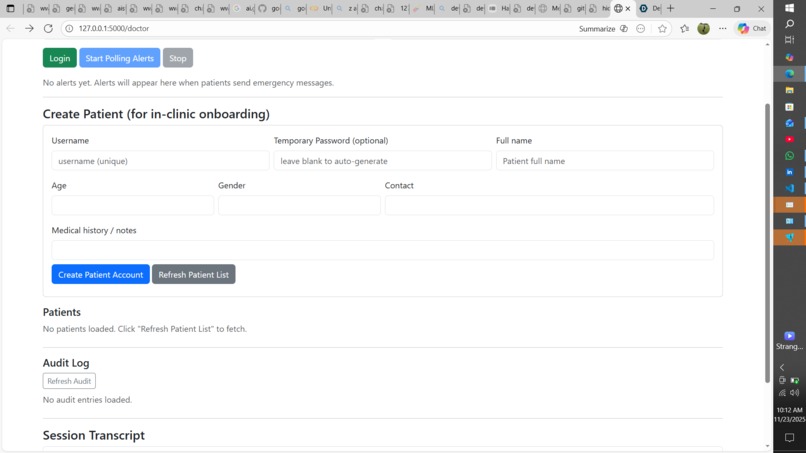
A doctor can onboard a patient who just the hospital.


Inspiration
Improve access to basic medical guidance for patients who struggle with navigation or remembering follow-ups. Goal: Make a lightweight, clinic-friendly assistant that supports doctors reviewing conversations and enables simple in-clinic onboarding.
What it does
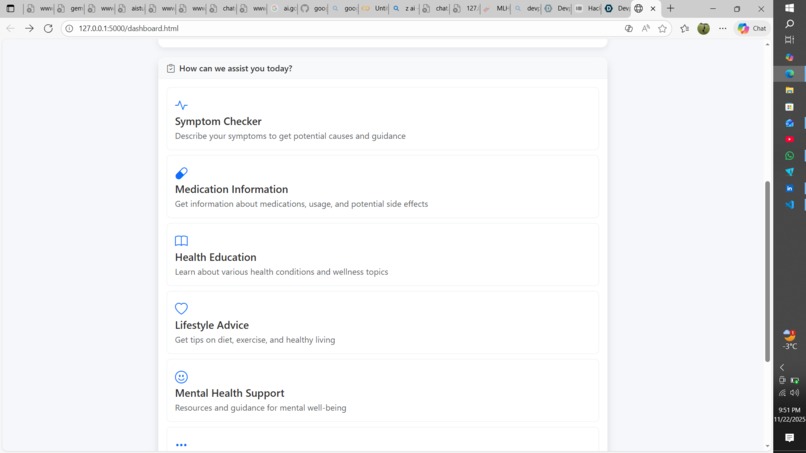
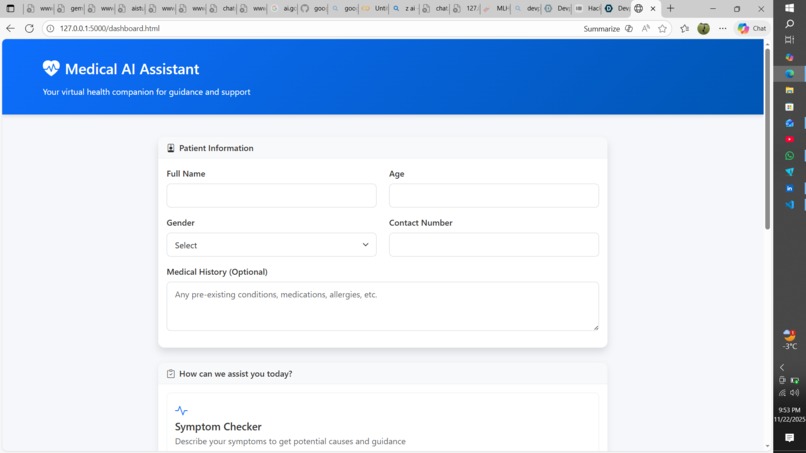
Core: A patient-facing chat assistant that gives general health guidance, detects potential emergencies, and preserves transcripts for clinician review. Clinic features: Doctors can create patient accounts in-clinic and generate a printable one-time login (QR) so patients can quickly access their session without typing credentials.
How I built it
Stack: Lightweight Flask backend, browser UI, and local persistence for sessions and messages. AI: Integrates an off-the-shelf generative model (configured via environment) for conversational responses. Auth & onboarding: JWT-based auth for normal use and time-limited one-time tokens for printable cards. Security note: Prototype-level protections only no production PHI safeguards. No secrets or private keys are included in this summary.
Challenges I ran into
Edge cases: Handling emergency detection reliably while avoiding false alarms. Onboarding: Making in-clinic onboarding simple for non-technical patients without exposing credentials. Platform constraints: Dealing with environment-specific dependencies during development (resolved by choosing portable libraries).
Accomplishments that I'm proud of
Complete flow: End-to-end patient -> AI -> persistent transcript ->clinician review workflow implemented. Practical onboarding: Printable QR-based one-time login that works on clinic devices. Auditability: Lightweight audit trail so clinician actions (like creating a patient) are recorded.
What I learned
Usability matters: Simple onboarding (QR/one-time links) dramatically reduces friction for real patients. Prototype trade-offs: Rapid iteration is possible with local storage and simple auth, but production requires stronger PHI protections. Testing: Manual end-to-end testing uncovered subtle issues in templating and token handling.
What's next for patient assistant AI
Short term: Harden security (HTTPS, encrypted storage, proper migrations), add unit/integration tests, and improve emergency detection with clinician feedback. Medium term: Add role-based access controls, audit export, and optional clinician annotations on transcripts. Long term: Evaluate clinical utility in supervised pilots and integrate with secure EHR systems (with all required compliance).
