-
-
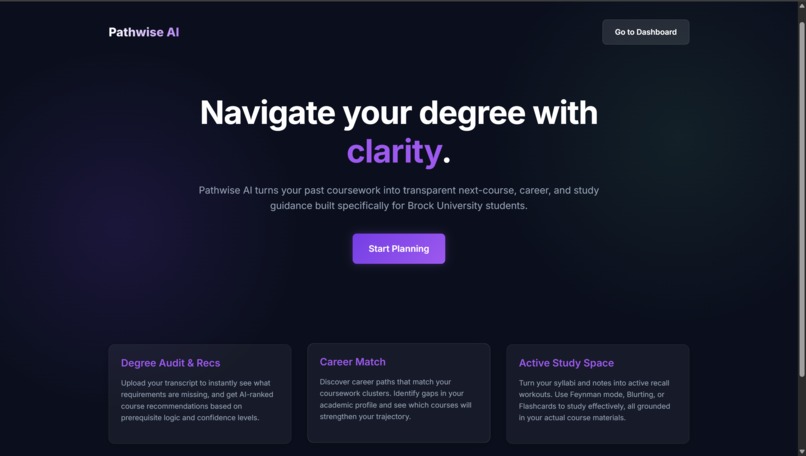
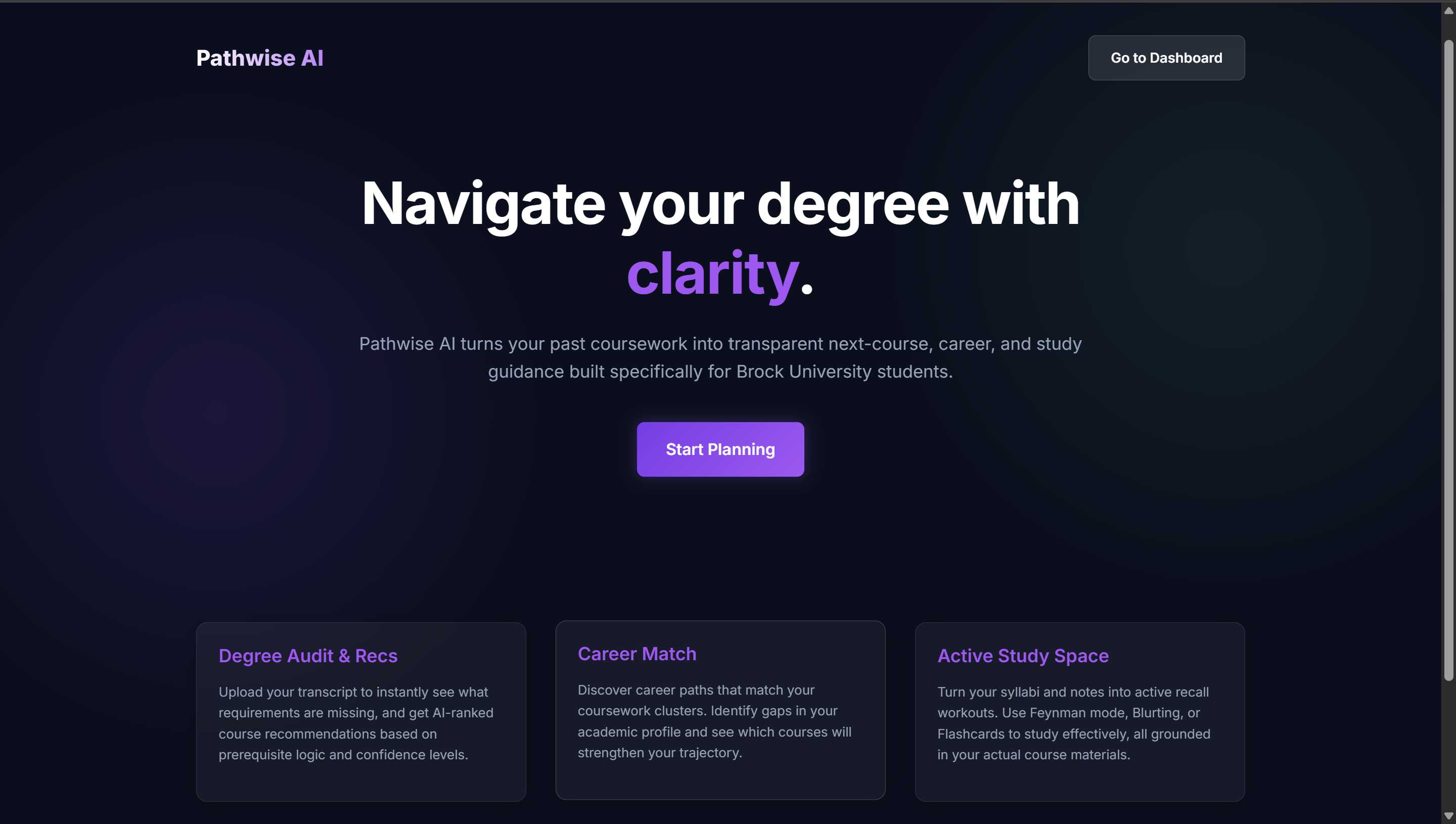
Home Page
-
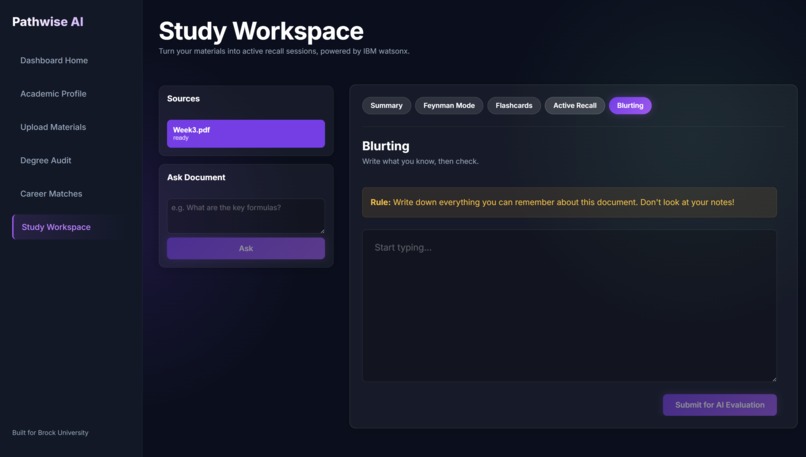
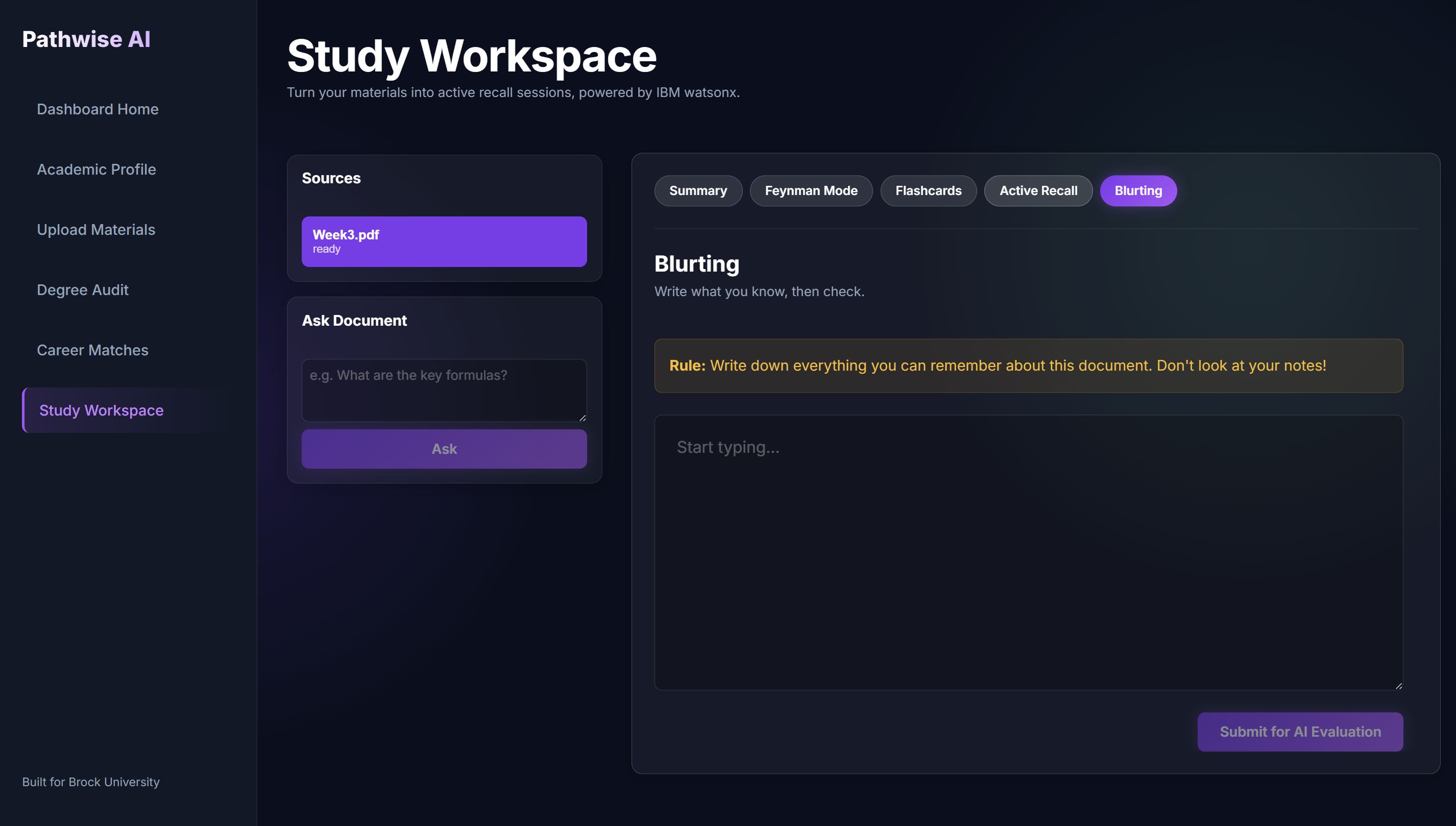
Study page
-
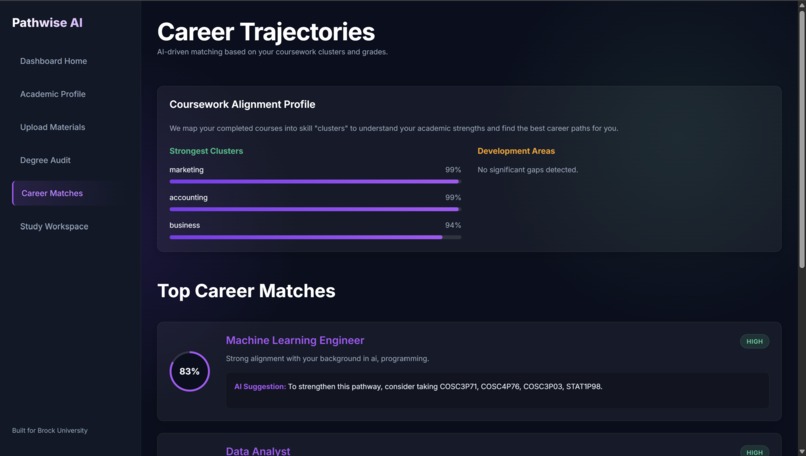
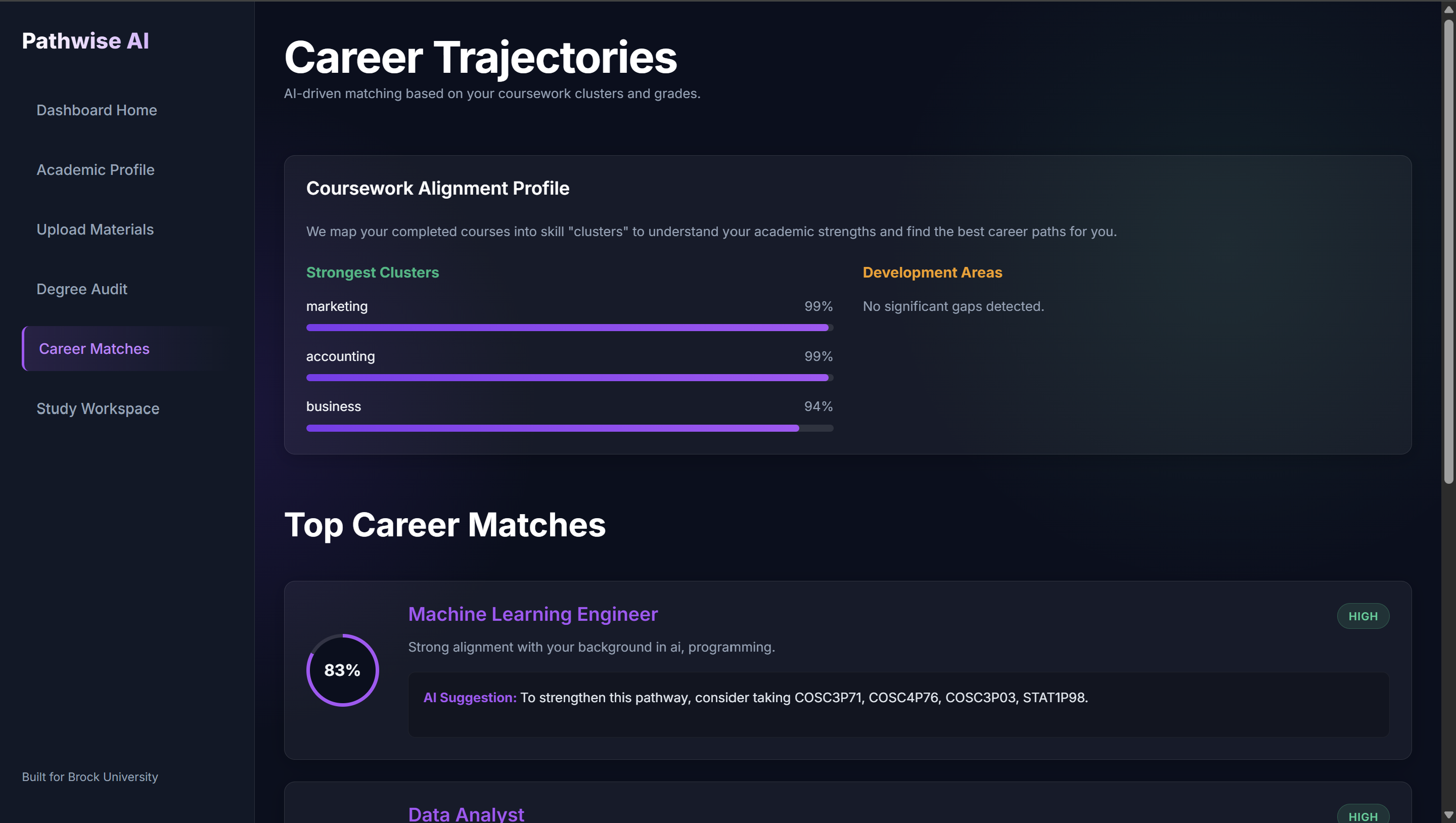
Career Trajectory page
-
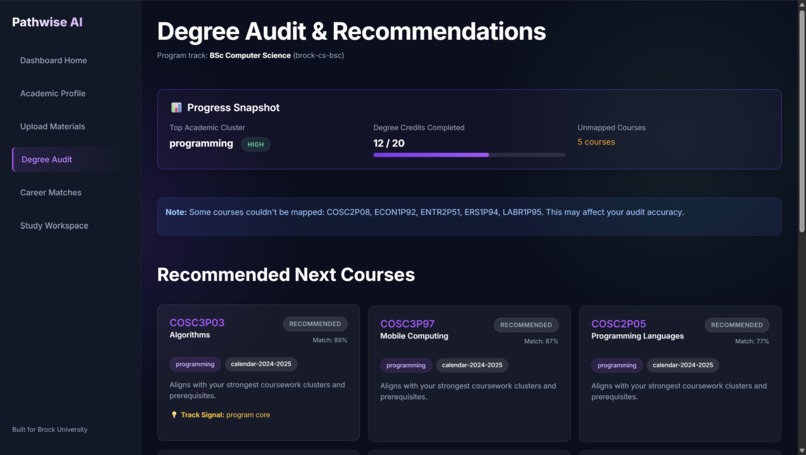
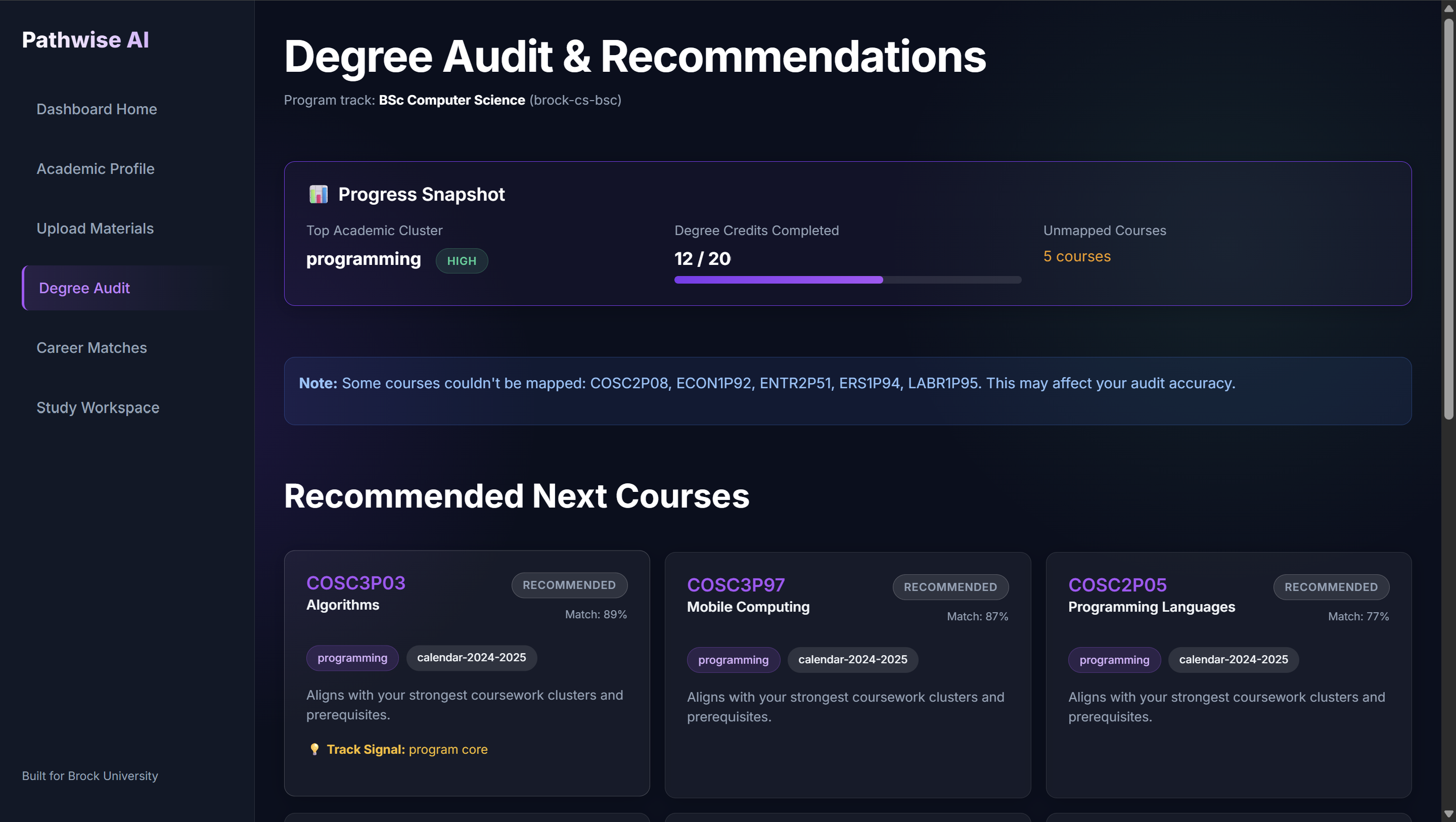
Degree Audit
-
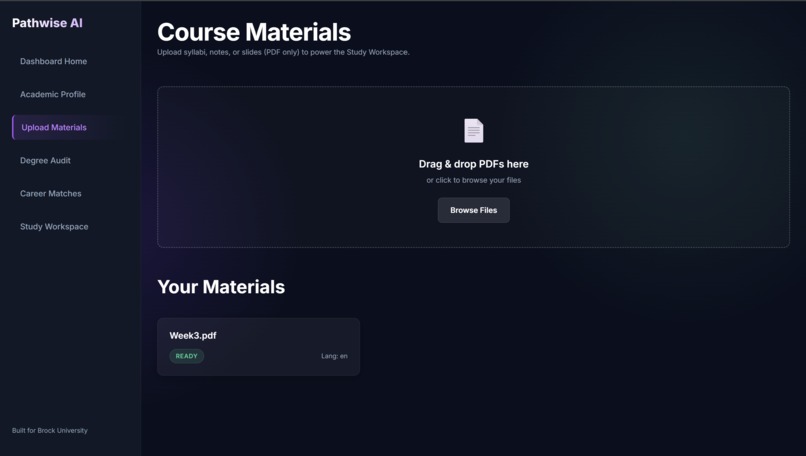
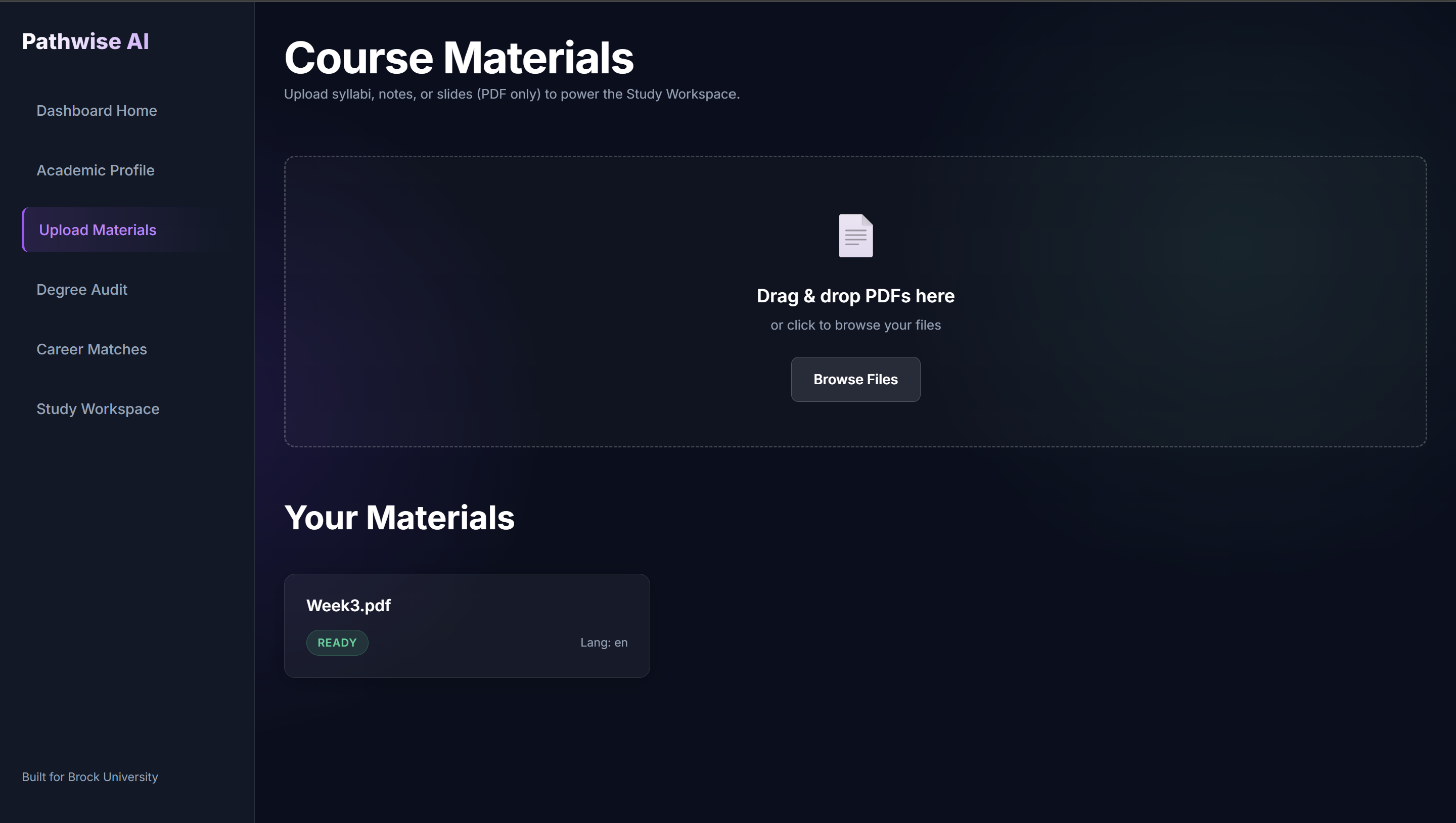
Course Upload
Pathwise AI — Devpost Submission
Tagline: From transcript to roadmap in seconds. Pathwise AI uses IBM watsonx to recommend next courses, match career paths, and power a citation-grounded study workspace — built for students.
Inspiration
Navigating a university degree is harder than it looks. Students — especially first-generation students with no family network to lean on — routinely pick courses without knowing whether they have the prerequisites, how the course fits their career goals, or how it stacks up against their existing strengths. Academic advisors are overloaded and appointment slots are scarce. The result: delayed graduations, wasted credits, and missed opportunities.
We wanted to build something that puts that advising intelligence directly in the student's hands — transparent, evidence-based, and available at 2am before course registration opens.
What it does
Pathwise AI is a student pathway engine with three core features:
Course Recommendations — Upload your transcript or enter your completed courses. Pathwise checks every eligible next course against a full prerequisite graph (required courses, one-of groups, corequisites, grade minimums, program restrictions) and scores each one using your academic cluster strengths. Every recommendation is labeled safe, stretch, or risky with a confidence badge so you know exactly where you stand.
Career Path Matching — Your coursework history is mapped onto skill clusters (systems, data science, security, software engineering) and weighted against career profiles to surface your top 5 matches — Software Engineer, Data Analyst, ML Engineer, Security Analyst — with the specific courses that would close your gaps.
Grounded Study Workspace — Upload any PDF (syllabus, lecture notes, textbook chapter) and generate five artifacts grounded in your own material: summary, concept breakdown, glossary, self-test questions, and a study guide. Ask follow-up questions and get answers with citations back to the exact page. No hallucinated content — every output links to evidence from your upload.
How we built it
Frontend: Next.js (App Router) + TypeScript dashboard with five routes: Profile, Recommendations, Careers, Upload Workspace, and Study Workspace.
Backend: FastAPI (Python) with clean module separation — engine.py handles all deterministic prerequisite logic and scoring, watsonx_client.py manages IBM watsonx IAM tokens and text/vision generation, study_service.py runs BM25 retrieval with spread sampling across long PDFs, and doc_understanding.py abstracts local pypdf from IBM Document Understanding.
IBM watsonx: Two model roles — a text-generation model (Llama 3.3 70B Instruct) polishes recommendation rationale and generates grounded study artifacts, and a vision model (Llama 3.2 11B Vision Instruct) reads uploaded transcript screenshots via the watsonx Chat API for OCR. Watson TTS optionally synthesizes study content to audio.
Data: Three hand-curated JSON datasets from the Brock 2024–25 academic calendar — courses with full prerequisite graphs and cluster tags, program tracks, and career-path cluster-weight matrices.
The system degrades gracefully — all deterministic features run without any IBM credentials, so judges can test the full flow locally without API keys.
Challenges we ran into
Prerequisite graph complexity: Brock's calendar uses nested logic — requires_all, requires_one_of groups, corequisites, minimum grade thresholds, and program-restriction blocks all interact. Encoding this correctly as a testable data model, without a live calendar API, required careful schema design and 21+ edge-case tests.
LLM grounding without hallucination: Getting watsonx to generate artifacts citing only retrieved content — and not echoing internal chunk IDs back into the output — required explicit anti-hallucination prompt guards and a post-processing normalization layer.
Vision OCR routing: Text-only instruct models cannot read images. We had to route transcript screenshot uploads to a separate vision-capable model via a different API path, while reusing the same IAM token and watsonx base URL.
Long-document retrieval balance: Naive BM25 top-k over long PDFs over-represented the first few pages. Spread sampling — picking chunks proportionally across page ranges — distributes evidence evenly through the document.
Accomplishments that we're proud of
- A prerequisite engine that handles the real complexity of a university course catalog, not a toy example, backed by a full test suite
- A study workspace that behaves like NotebookLM — upload any PDF, get grounded citation-linked artifacts in seconds
- Full graceful degradation: every deterministic feature works without API keys
- Clean architectural separation between deterministic logic and LLM enhancement — the AI polishes the output but never invents prerequisites or facts
What we learned
- Structuring an LLM as an enhancer on top of deterministic logic — rather than a source of ground truth — is the right pattern for high-stakes domains like academic advising
- BM25 is underrated for constrained, single-session retrieval. No embedding infrastructure, no vector database, still highly effective
- IBM watsonx's IAM token refresh and model discovery APIs require careful handling; silent auth failures are the hardest bugs to diagnose under hackathon pressure
- Graceful degradation isn't just a nice-to-have — designing fallback paths from the start forced us to keep the core logic clean and independently testable
What's next for Pathwise AI
- Live calendar integration — replace frozen JSON with a real-time feed from Brock's academic calendar so prerequisites stay current
- Full degree audit — show remaining credits toward graduation, not just next-course picks
- Multi-university support — generalize the course catalog schema so any institution can plug in their own data
- Voice-first study mode — combine Watson TTS with the study workspace for hands-free active recall sessions
- Mobile app — a React Native wrapper of the same API to reach students where they actually are
Prize Tracks
- Best Use of IBM Tech — watsonx text generation + vision OCR + optional Document Understanding + optional Watson TTS
- Best UN Hack — SDG 4 (Quality Education), SDG 10 (Reduced Inequalities)
- Best Startup Potential — prerequisite engine + study workspace is a defensible product; schema generalizes beyond Brock
Tech Stack
| Layer | Technology |
|---|---|
| Frontend | Next.js 15 (App Router), TypeScript |
| Backend | FastAPI, Python 3.13 |
| AI / LLM | IBM watsonx (Llama 3.3 70B Instruct + Llama 3.2 11B Vision Instruct) |
| Retrieval | BM25 (rank-bm25) |
| PDF parsing | pypdf (local), IBM Document Understanding (optional) |
| Data | Frozen JSON — Brock 2024–25 course catalog |
| Tests | pytest (21+ tests) |
Built With
- fastapi
- featherless
- ibm
- ibm-watson
- json
- nextjs
- pypdf
- pytest
- python
- typescript


Log in or sign up for Devpost to join the conversation.