Inspiration
In today's world, we say "you can learn anything online" — but that's only true if you already know how to navigate the internet. For underprivileged communities, recent immigrants, seniors, and anyone without strong digital literacy, the abundance of resources isn't empowering. It's paralyzing. Too many tabs. Too many options. Too much information. People don't lack access to knowledge; they lack a starting point. And when everything feels overwhelming, most people don't push through. They just stop.
The hackathon track on economic empowerment and education spoke to us deeply. Coming from a background in both software engineering and international development, I've seen firsthand that the problem is rarely a lack of resources: it's a lack of access to them in a form that feels manageable and trustworthy. Nanjiba, my teammate and a data science student, brought the same frustration from a different angle. She sees people constantly overestimating what AI can and should do, assuming it can automate everything and make every decision. Her perspective grounded the project: AI is a tool, not a replacement for human judgment. That belief shaped every decision we made.
What it does
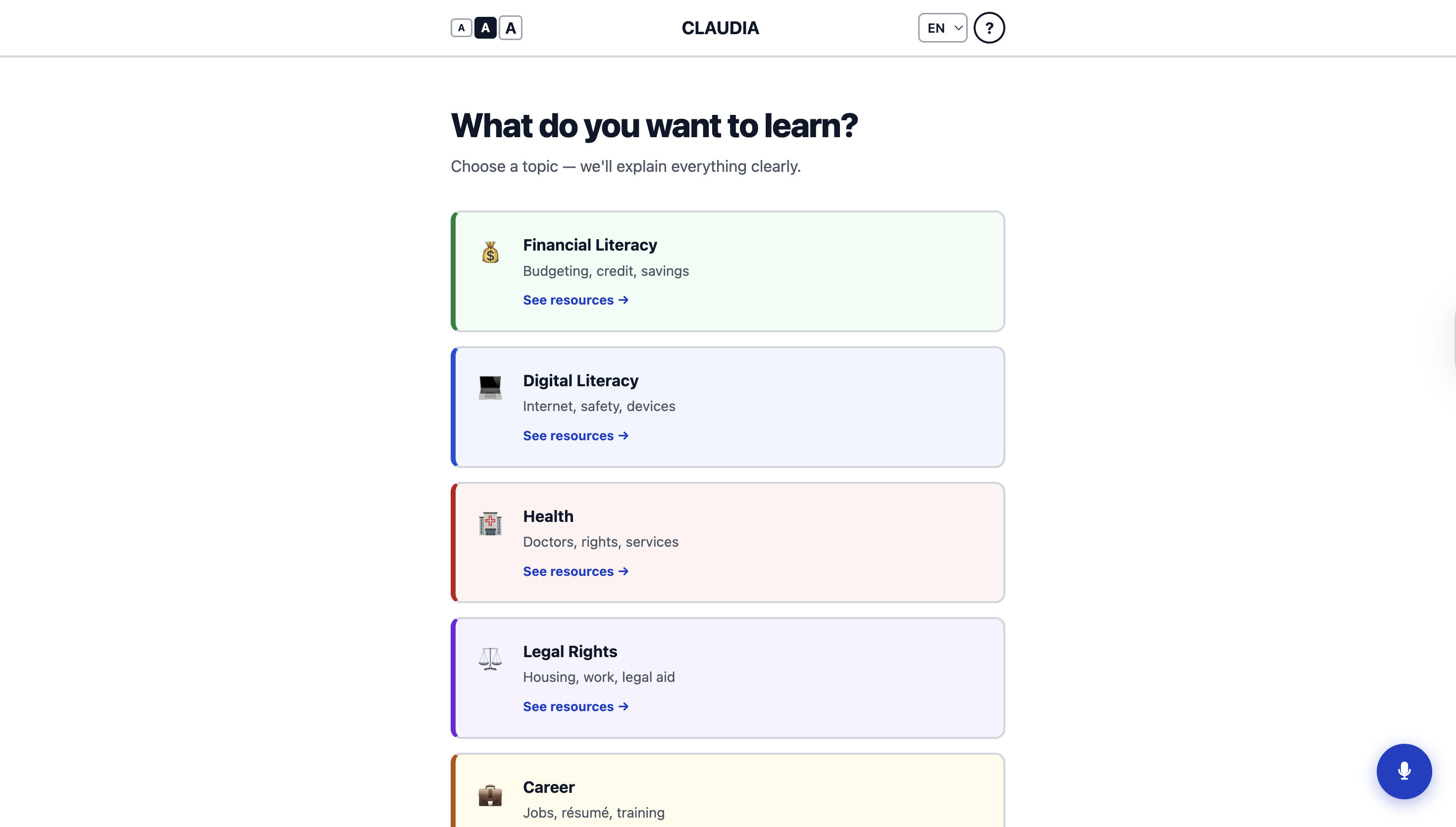
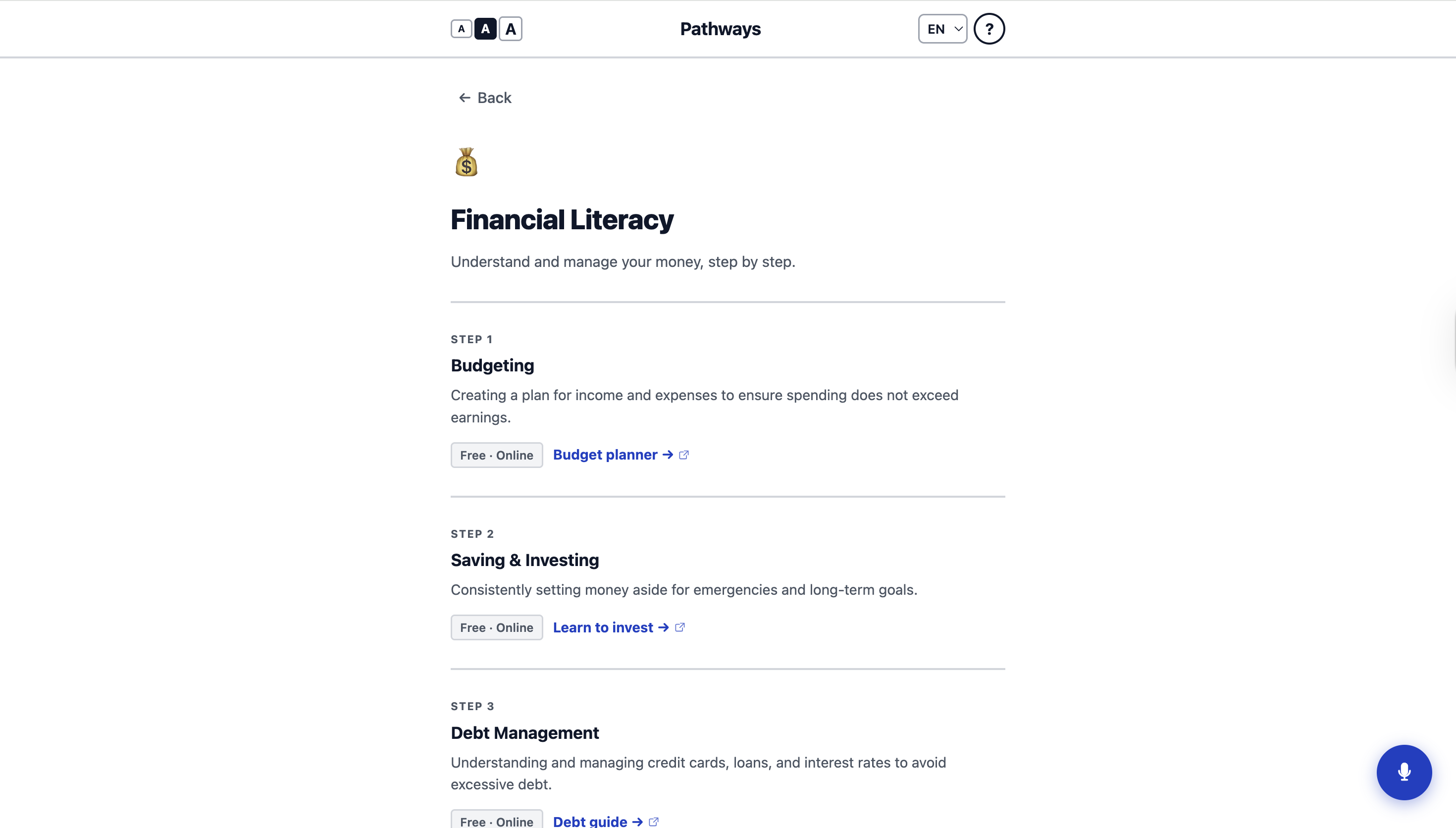
Claudia is a simple multilingual website that curates free, trusted resources on six topics: financial literacy, digital literacy, health, legal rights, career, and education. You land on the page, pick a topic, and get a short human-verified list of resources with plain-language descriptions. No algorithm, no account, no app to download.
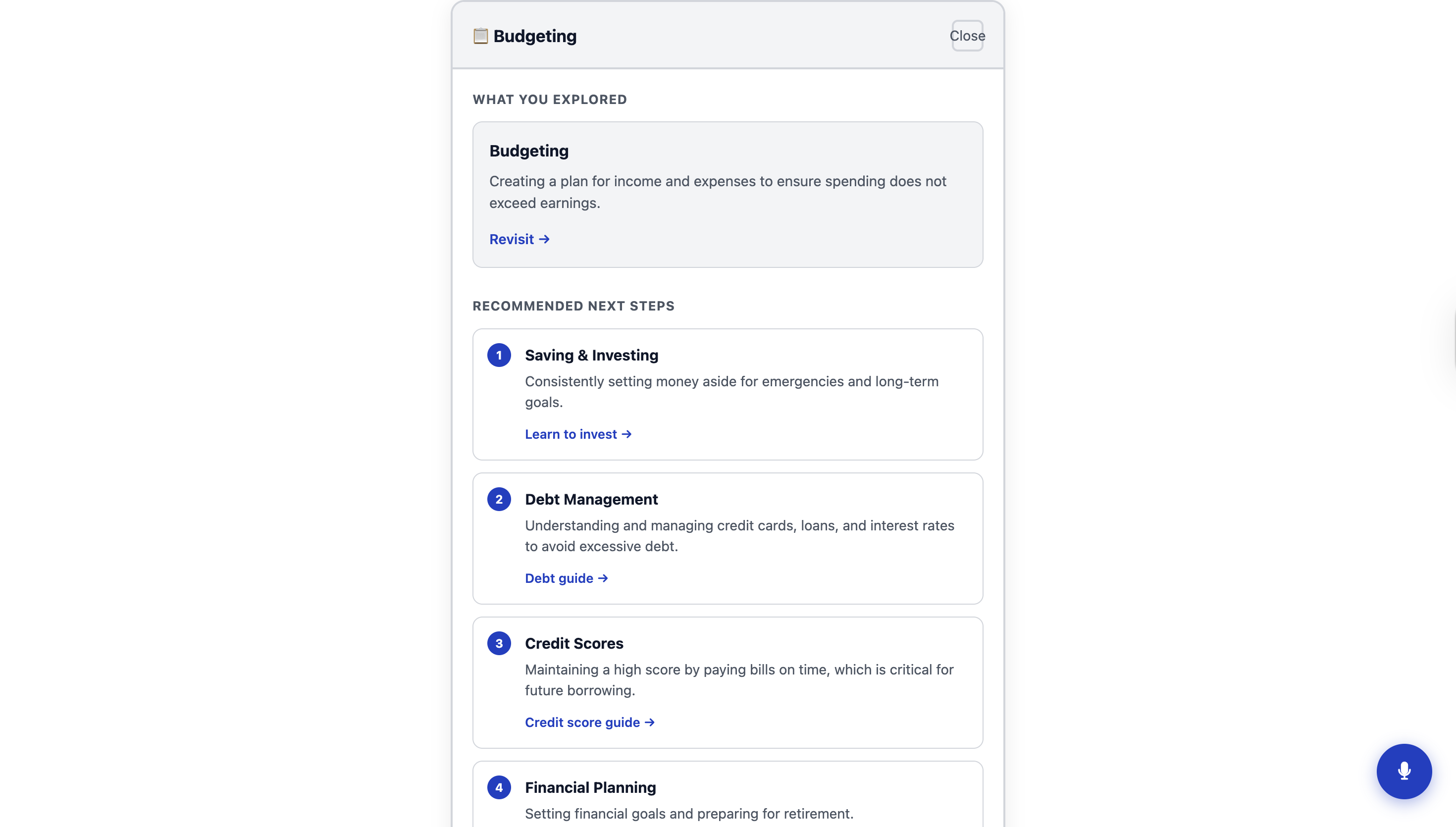
When a user clicks on a resource, the link is stored in localStorage. When they return to Claudia, it gets detected via the browser's visibility change event; they're prompted with an AI-generated summary of the page they just visited, powered by a RAG-enabled summarizer built with Claude. The summary is written in plain language and includes suggested "next steps" so the user knows what to do with what they just read.
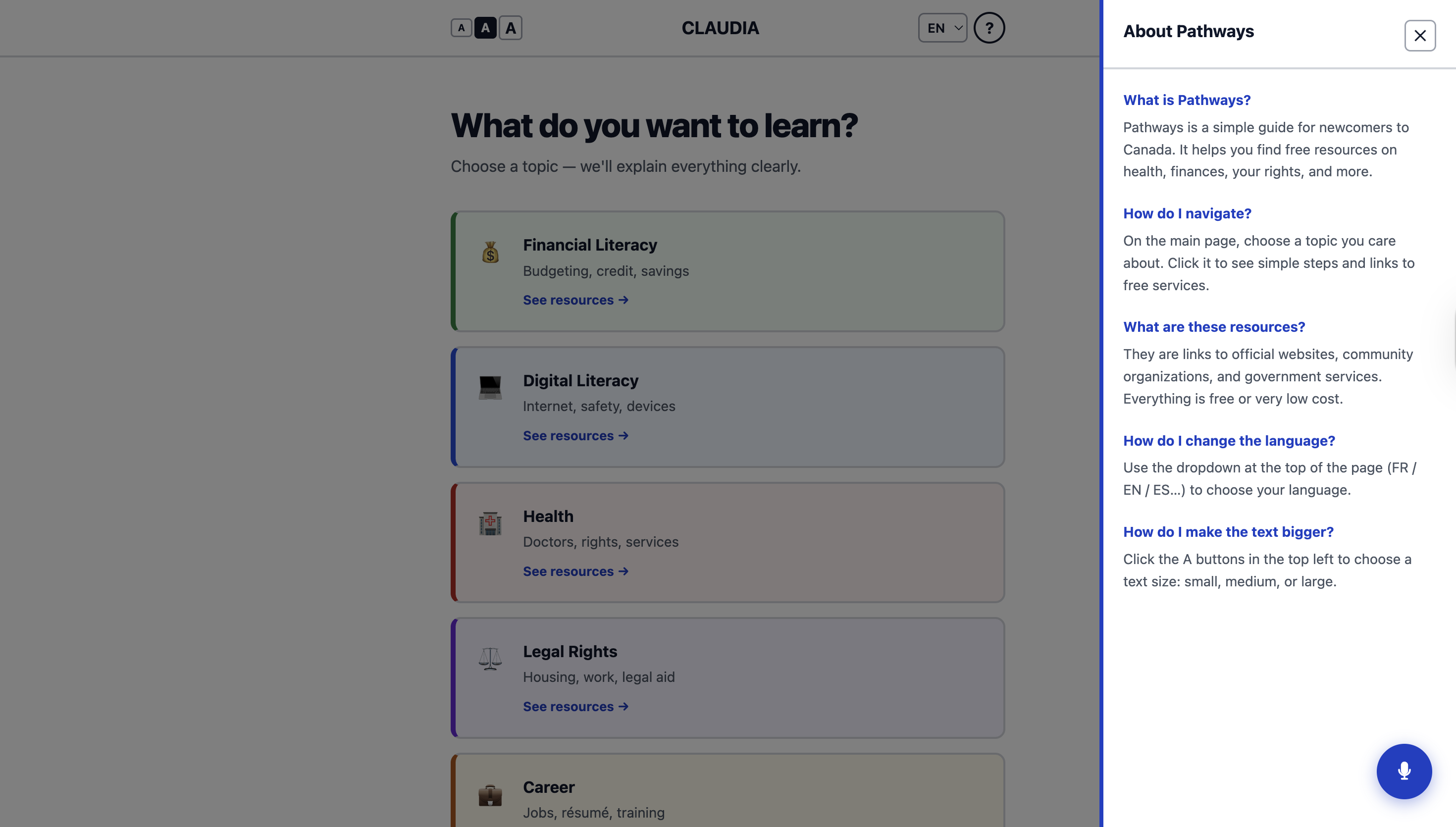
It works on any device, in 6 languages, and follows web accessibility standards so it's usable by people with low digital literacy, seniors, recent immigrants, and anyone who feels overwhelmed by the internet.
How we built it
We used HTML and CSS for the frontend and JavaScript for the website functionalities. We leveraged the memory optimization of Retrieval Augmented Generation to build the 'ai-summarizer' model. Finally, for the speech, we used the in-built web API.
Challenges we ran into
Saying no was the hardest part. We started with roadmaps, login systems, AI chatbots, community features, and daily emails. Every idea felt useful. But every addition made the site less useful for the person it was actually built for. We kept asking: would a person understand this in 10 seconds? If the answer was no, we cut it. The final product is much simpler than what we originally planned, and that simplicity was the hardest thing to build.
Accomplishments that we're proud of
We're proud that we kept it simple and then added intelligence exactly where it was needed. The RAG-enabled summarizer was a deliberate choice: instead of putting AI at the front of the experience where it could intimidate or confuse, we placed it at the moment the user comes back, having just read something complex. That's when a plain-language summary and a set of next steps is actually useful. We're proud of the RAG indexing approach that makes this feel seamless without any backend or login. We're also proud of the 6-language support including right-to-left Arabic, the WCAG accessibility compliance, and the fact that every resource was found and verified by a human. We used Claude as a quiet support tool in two ways: rewriting resource descriptions into plain language and generating summaries with next steps. That felt like the right relationship between AI and a project like this.
What we learned
Two things we kept coming back to. First, from international development: to solve a problem for a community you're not part of, you need a searcher approach, not a planner approach. It has to be about what people actually need, not what you think they need. Second, from Nanjiba's work in data science: people consistently overestimate what AI should do. We can't automate decision-making, but AI agents can make a resource description easier to read, or summarize a complex page into three actionable next steps. That's the role we gave it.
What's next for Claudia
The immediate next step is expanding the resource list beyond Montréal and Québec so the site can serve communities across Canada and eventually internationally. We want to partner with community organizations like Centraide to have local workers verify and update resources on an ongoing basis, keeping the content alive and trustworthy. We also want to grow the depth of each topic, adding more verified resources so users always have a meaningful next thing to explore. On the accessibility side, we want to add audio descriptions for users who struggle with reading. We'd also like to introduce a short knowledge quiz at the end of each topic; a simple, low-stakes way for users to check their understanding and reinforce what they just learned, without it feeling like a test. In long term, we'd like to open a simple contribution model where community workers and educators can submit resources for review, so Claudia grows from a curated list into a living, community-maintained guide. The model is simple enough to scale - that was always the point.


Log in or sign up for Devpost to join the conversation.